



Divyank Mahajan, PhD
@divyankm.bsky.social
Rationalist. Scientist. PhD. Proteomics & Phosphoproteomics. Tumor hypoxia.
Intrstd in
•Evolution of & acquired chemoresistance
•Gene Regulation & its evolution
•AI led DD
Skilled:
Proteomics, genomics, sc-&spatial-transc, mol-cell bio, drug screening
Intrstd in
•Evolution of & acquired chemoresistance
•Gene Regulation & its evolution
•AI led DD
Skilled:
Proteomics, genomics, sc-&spatial-transc, mol-cell bio, drug screening
What could be possible cellular/biological reason(s) for change in transcripts/transcriptome not being consistent with changes in respective proteins/proteome?
What advantage would it give a biosystem to make RNA if not to be translated?
What advantage would it give a biosystem to make RNA if not to be translated?
December 5, 2024 at 10:59 AM
What could be possible cellular/biological reason(s) for change in transcripts/transcriptome not being consistent with changes in respective proteins/proteome?
What advantage would it give a biosystem to make RNA if not to be translated?
What advantage would it give a biosystem to make RNA if not to be translated?
Reposted by Divyank Mahajan, PhD
If you think research is expensive, try disease.
-- Mary Lasker
-- Mary Lasker
November 30, 2024 at 12:23 PM
If you think research is expensive, try disease.
-- Mary Lasker
-- Mary Lasker
Penning down after a while

December 1, 2024 at 6:14 AM
Penning down after a while
Reposted by Divyank Mahajan, PhD

A great support system really forces you to become the best version of yourself.🫶🏽
November 30, 2024 at 2:03 PM
A great support system really forces you to become the best version of yourself.🫶🏽
Reposted by Divyank Mahajan, PhD

'I much prefer the British spelling of “diarrhea” which is “diarrhoea” because it looks like you’ve lost control of your vowels.' -- Sal Robins
November 21, 2024 at 10:31 PM
'I much prefer the British spelling of “diarrhea” which is “diarrhoea” because it looks like you’ve lost control of your vowels.' -- Sal Robins
Reposted by Divyank Mahajan, PhD
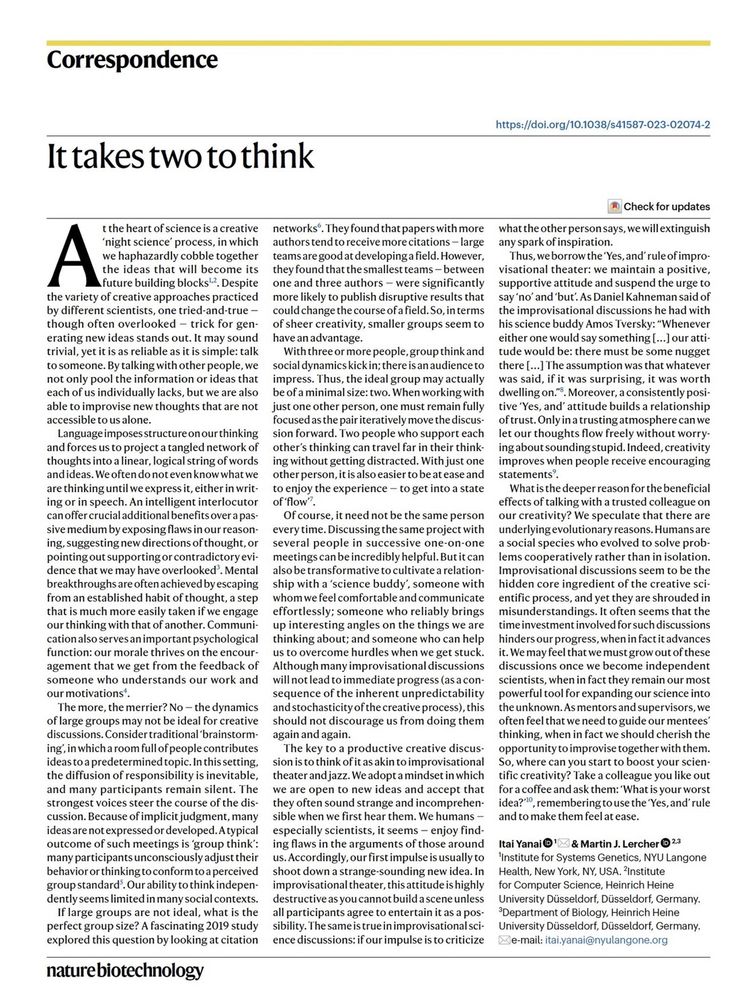
Doing good science is 90% finding a science buddy to constantly talk to about the project.
November 9, 2024 at 10:53 PM
Doing good science is 90% finding a science buddy to constantly talk to about the project.
Reposted by Divyank Mahajan, PhD

#NatureReviewsCancer🚨
The #CancerDepMap is an invaluable, publicly available resource for systemically identifying cancer vulnerabilities. In this #Perspective, Bill Hahn & team (@broadinstitute.org) review its impact, uses, limitations & efforts to improve + expand its use.
go.nature.com/4fiZ6sw
The #CancerDepMap is an invaluable, publicly available resource for systemically identifying cancer vulnerabilities. In this #Perspective, Bill Hahn & team (@broadinstitute.org) review its impact, uses, limitations & efforts to improve + expand its use.
go.nature.com/4fiZ6sw

The present and future of the Cancer Dependency Map - Nature Reviews Cancer
The Cancer Dependency Map (DepMap) is a data repository and research platform that can be utilized to systematically identify cancer vulnerabilities. Here Arafeh, Shibue et al. outline the current lim...
go.nature.com
November 27, 2024 at 10:44 AM
#NatureReviewsCancer🚨
The #CancerDepMap is an invaluable, publicly available resource for systemically identifying cancer vulnerabilities. In this #Perspective, Bill Hahn & team (@broadinstitute.org) review its impact, uses, limitations & efforts to improve + expand its use.
go.nature.com/4fiZ6sw
The #CancerDepMap is an invaluable, publicly available resource for systemically identifying cancer vulnerabilities. In this #Perspective, Bill Hahn & team (@broadinstitute.org) review its impact, uses, limitations & efforts to improve + expand its use.
go.nature.com/4fiZ6sw
Stephen Jay Gould talks in his book Bully for Brontosaurus about non-adaptive mechanism of evolution in NZ kiwis and their eggs.
How far have come..? in knowing of phenotypes which have come off just as by-the-way or as compensatory needs?.
How far have come..? in knowing of phenotypes which have come off just as by-the-way or as compensatory needs?.


November 30, 2024 at 2:19 AM
Stephen Jay Gould talks in his book Bully for Brontosaurus about non-adaptive mechanism of evolution in NZ kiwis and their eggs.
How far have come..? in knowing of phenotypes which have come off just as by-the-way or as compensatory needs?.
How far have come..? in knowing of phenotypes which have come off just as by-the-way or as compensatory needs?.
Reposted by Divyank Mahajan, PhD

Biomolecular condensates are frequently discussed in the context of different cellular processes.
This Review is dedicated to their function in the regulation of transcription. @bsabari.bsky.social et al. discuss condensate organisation and their impact on gene activation in development & disease.
This Review is dedicated to their function in the regulation of transcription. @bsabari.bsky.social et al. discuss condensate organisation and their impact on gene activation in development & disease.
I am excited to share our review published online with Nature Reviews MCB. Pilong Li, Gaofeng Pei, Heankel Lyons, and I review the current literature on the regulation of transcription by condensates, large length scale assemblies of complexes (Figure 1).
www.nature.com/articles/s41...
www.nature.com/articles/s41...

Transcription regulation by biomolecular condensates - Nature Reviews Molecular Cell Biology
Transcriptional condensates, which are formed through dynamic multivalent interactions between proteins, RNA and chromatin, regulate transcription by compartmentalizing its machinery in the crowded nu...
www.nature.com
November 28, 2024 at 11:05 AM
Biomolecular condensates are frequently discussed in the context of different cellular processes.
This Review is dedicated to their function in the regulation of transcription. @bsabari.bsky.social et al. discuss condensate organisation and their impact on gene activation in development & disease.
This Review is dedicated to their function in the regulation of transcription. @bsabari.bsky.social et al. discuss condensate organisation and their impact on gene activation in development & disease.
Reposted by Divyank Mahajan, PhD

Naïve question: When RNA Polymerase finishes transcription and detaches from DNA, does it do so as an intact complex, or does it have to split apart to release the DNA strand it's been encircling?
November 27, 2024 at 12:50 PM
Naïve question: When RNA Polymerase finishes transcription and detaches from DNA, does it do so as an intact complex, or does it have to split apart to release the DNA strand it's been encircling?