



ZhaoLab
@zhaolabski.bsky.social
We study chromosomal replication & recombinational repair mechanisms, Smc5/6, SUMO-based controls using multidisciplinary approaches. Tweets are a group effort.
Reposted by ZhaoLab
Happy to share our perspective on the DNA translocation mechanism by the CMG helicase.
DNA translocation by the CMG helicase: the helical inchworm model url: portlandpress.com/biochemsoctr...
DNA translocation by the CMG helicase: the helical inchworm model url: portlandpress.com/biochemsoctr...
DNA translocation by the CMG helicase: the helical inchworm model
Abstract. In all cells, hexameric helicases drive the unwinding of parental chromosomal DNA at replication forks to provide the single-stranded DNA templates required by replicative DNA polymerases. D...
portlandpress.com
February 6, 2026 at 10:32 PM
Happy to share our perspective on the DNA translocation mechanism by the CMG helicase.
DNA translocation by the CMG helicase: the helical inchworm model url: portlandpress.com/biochemsoctr...
DNA translocation by the CMG helicase: the helical inchworm model url: portlandpress.com/biochemsoctr...
Reposted by ZhaoLab
Nice to see some yeast genetics in a Cell paper, where the authors test models based on single-molecule in vitro analysis. The combination of genetics and biochemistry often addresses questions most effectively.
www.cell.com/cell/fulltex...
www.cell.com/cell/fulltex...

A non-catalytic role for RFC in PCNA-mediated processive DNA synthesis
The RFC clamp loader remains associated with PCNA beyond the loading step, supporting
processive DNA replication by stabilizing the inherently unstable PCNA-polymerase
ẟ complex.
www.cell.com
February 6, 2026 at 6:07 PM
Nice to see some yeast genetics in a Cell paper, where the authors test models based on single-molecule in vitro analysis. The combination of genetics and biochemistry often addresses questions most effectively.
www.cell.com/cell/fulltex...
www.cell.com/cell/fulltex...
Reposted by ZhaoLab

Join SGD at #Yeast26 for cutting-edge #yeast research, networking opportunities, engaging talks, poster sessions, and workshops, for everyone from early career scientists to experienced researchers! Abstract submission by Mar5, early registration ends Apr16. See you there! @genetics-gsa.bsky.social

January 29, 2026 at 4:51 PM
Join SGD at #Yeast26 for cutting-edge #yeast research, networking opportunities, engaging talks, poster sessions, and workshops, for everyone from early career scientists to experienced researchers! Abstract submission by Mar5, early registration ends Apr16. See you there! @genetics-gsa.bsky.social
Reposted by ZhaoLab
Hi all!
We developed CAD-C to map chromatin organization at high res in yeast. It revealed an unexpected tight alignment: nucleosomes covering the same sequence tend to be associated across sister chromatids.
www.biorxiv.org/content/10.6...
#3DGenome #chromatin #Cohesin #centromere
We developed CAD-C to map chromatin organization at high res in yeast. It revealed an unexpected tight alignment: nucleosomes covering the same sequence tend to be associated across sister chromatids.
www.biorxiv.org/content/10.6...
#3DGenome #chromatin #Cohesin #centromere

CAD-C reveals centromere pairing and near-perfect alignment of sister chromatids
Three-dimensional (3D) genome organization plays a central role in gene regulation, chromatin folding, and genome stability. Although chromosome-conformation capture (3C)-derived methods have revoluti...
www.biorxiv.org
December 20, 2025 at 4:43 PM
Hi all!
We developed CAD-C to map chromatin organization at high res in yeast. It revealed an unexpected tight alignment: nucleosomes covering the same sequence tend to be associated across sister chromatids.
www.biorxiv.org/content/10.6...
#3DGenome #chromatin #Cohesin #centromere
We developed CAD-C to map chromatin organization at high res in yeast. It revealed an unexpected tight alignment: nucleosomes covering the same sequence tend to be associated across sister chromatids.
www.biorxiv.org/content/10.6...
#3DGenome #chromatin #Cohesin #centromere
Reposted by ZhaoLab

Want to know how homologous recombination defects are caused upon loss of BRCA2? Check out our recent efforts in uncovering this phenomenon just out in Science!
www.science.org/doi/10.1126/...
www.science.org/doi/10.1126/...

FIGNL1 inhibits homologous recombination in BRCA2 deficient cells by dissociating RAD51 filaments
Homologous recombination (HR) deficiency upon Breast Cancer Gene 2 (BRCA2) loss arises from defects in the formation of RAD51 nucleoprotein filaments. We demonstrate that loss of the anti-recombinase ...
www.science.org
October 30, 2025 at 9:52 PM
Want to know how homologous recombination defects are caused upon loss of BRCA2? Check out our recent efforts in uncovering this phenomenon just out in Science!
www.science.org/doi/10.1126/...
www.science.org/doi/10.1126/...
Reposted by ZhaoLab

Our paper in Science is out! @souravagrawal.bsky.social, @rlynn.bsky.social, @susvirkar.bsky.social, and the rest of the team show human RPA is a telomerase processivity factor essential for telomere maintenance. This reshapes our thinking about telomerase regulation. www.science.org/doi/10.1126/...

Human RPA is an essential telomerase processivity factor for maintaining telomeres
Telomerase counteracts telomere shortening by repeatedly adding DNA repeats to chromosome ends. We identified the replication protein A (RPA) heterotrimer as a telomerase processivity factor critical ...
www.science.org
October 30, 2025 at 10:07 PM
Our paper in Science is out! @souravagrawal.bsky.social, @rlynn.bsky.social, @susvirkar.bsky.social, and the rest of the team show human RPA is a telomerase processivity factor essential for telomere maintenance. This reshapes our thinking about telomerase regulation. www.science.org/doi/10.1126/...
Reposted by ZhaoLab
Beautiful, layered argument for the use of model organisms, especially small ones, in research. A must read!


October 10, 2025 at 10:15 PM
Beautiful, layered argument for the use of model organisms, especially small ones, in research. A must read!
Reposted by ZhaoLab

Cryo-EM captures the elusive moment when E1 hands off SUMO to E2- a molecular relay that’s been mostly guesswork until now. The structures reveal E1 doing dramatic shape-shifting to line up perfectly for the transfer, like enzyme origami in action.

New online: Cryo-EM structures reveal the molecular mechanism of SUMO E1–E2 thioester transfer
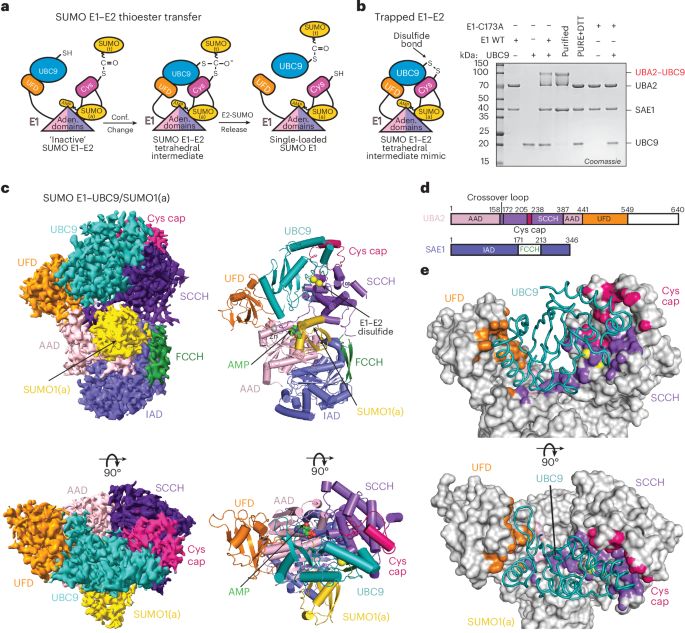
Cryo-EM structures reveal the molecular mechanism of SUMO E1–E2 thioester transfer
Nature Structural & Molecular Biology, Published online: 25 September 2025; doi:10.1038/s41594-025-01681-8This study reveals how human small ubiquitin-like modifier (SUMO) E1 recruits its E2 partner UBC9 and transfers SUMO1 through large structural changes, uncovering key mechanisms that ensure specificity and fidelity in SUMOylation, an essential protein modification pathway.
go.nature.com
September 28, 2025 at 6:43 PM
Cryo-EM captures the elusive moment when E1 hands off SUMO to E2- a molecular relay that’s been mostly guesswork until now. The structures reveal E1 doing dramatic shape-shifting to line up perfectly for the transfer, like enzyme origami in action.
Reposted by ZhaoLab
Our paper is now out in Molecular Cell!
Check the thread in this former post:
www.cell.com/molecular-ce...
Check the thread in this former post:
www.cell.com/molecular-ce...
July 17, 2025 at 5:41 PM
Our paper is now out in Molecular Cell!
Check the thread in this former post:
www.cell.com/molecular-ce...
Check the thread in this former post:
www.cell.com/molecular-ce...
Reposted by ZhaoLab
Interested in chromatin architecture?
Checkout our new method - PCP - that can map genome organization as multi-way interactions as well as nucleosome footprint and nucleosome spacing at very high resolution.
www.biorxiv.org/content/10.1...
Checkout our new method - PCP - that can map genome organization as multi-way interactions as well as nucleosome footprint and nucleosome spacing at very high resolution.
www.biorxiv.org/content/10.1...
Chromatin architecture mapping by multiplex proximity tagging
Chromatin plays a pivotal role in genome expression, maintenance, and replication. To better understand chromatin organization, we developed a novel proximity-tagging method which assigns unique DNA b...
www.biorxiv.org
November 13, 2024 at 1:09 PM
Interested in chromatin architecture?
Checkout our new method - PCP - that can map genome organization as multi-way interactions as well as nucleosome footprint and nucleosome spacing at very high resolution.
www.biorxiv.org/content/10.1...
Checkout our new method - PCP - that can map genome organization as multi-way interactions as well as nucleosome footprint and nucleosome spacing at very high resolution.
www.biorxiv.org/content/10.1...
Reposted by ZhaoLab
How do replisomes walk on DNA? And what happens when they run into a G-quadruplex? @sahilbatra.bsky.social and @benallwein.bsky.social provide unexpected insight in our latest paper with Richard Hite @mskcancercenter.bsky.social @science.org www.science.org/doi/10.1126/.... Congrats to all authors!
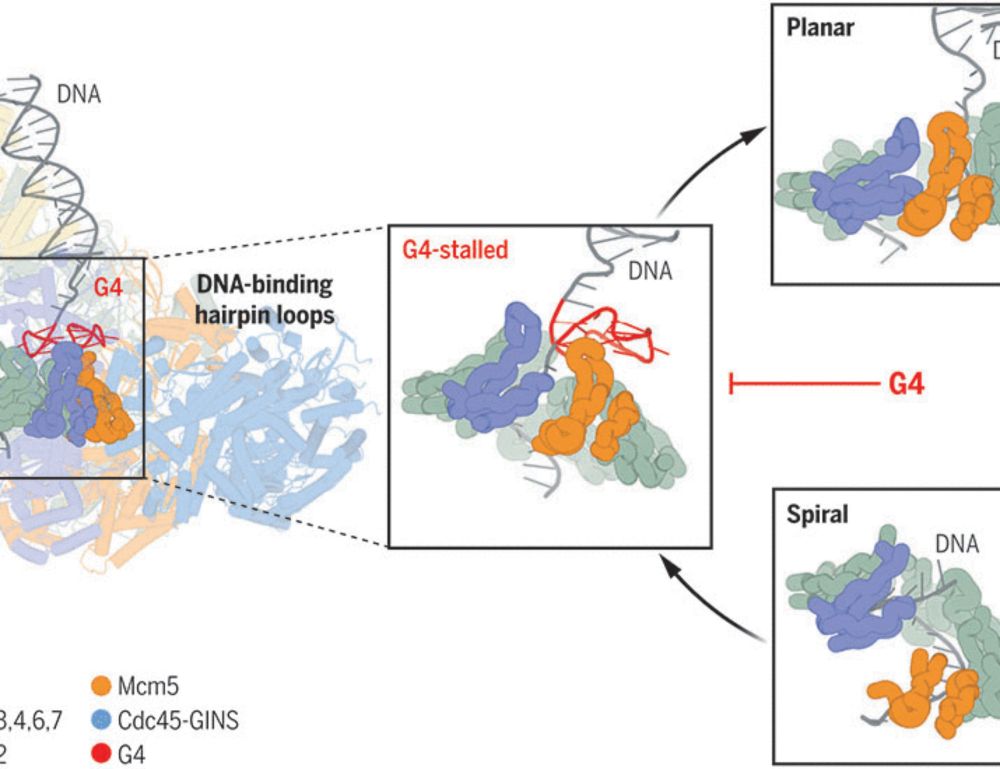
G-quadruplex–stalled eukaryotic replisome structure reveals helical inchworm DNA translocation
DNA G-quadruplexes (G4s) are non–B-form DNA secondary structures that threaten genome stability by impeding DNA replication. To elucidate how G4s induce replication fork arrest, we characterized fork ...
www.science.org
March 6, 2025 at 9:30 PM
How do replisomes walk on DNA? And what happens when they run into a G-quadruplex? @sahilbatra.bsky.social and @benallwein.bsky.social provide unexpected insight in our latest paper with Richard Hite @mskcancercenter.bsky.social @science.org www.science.org/doi/10.1126/.... Congrats to all authors!
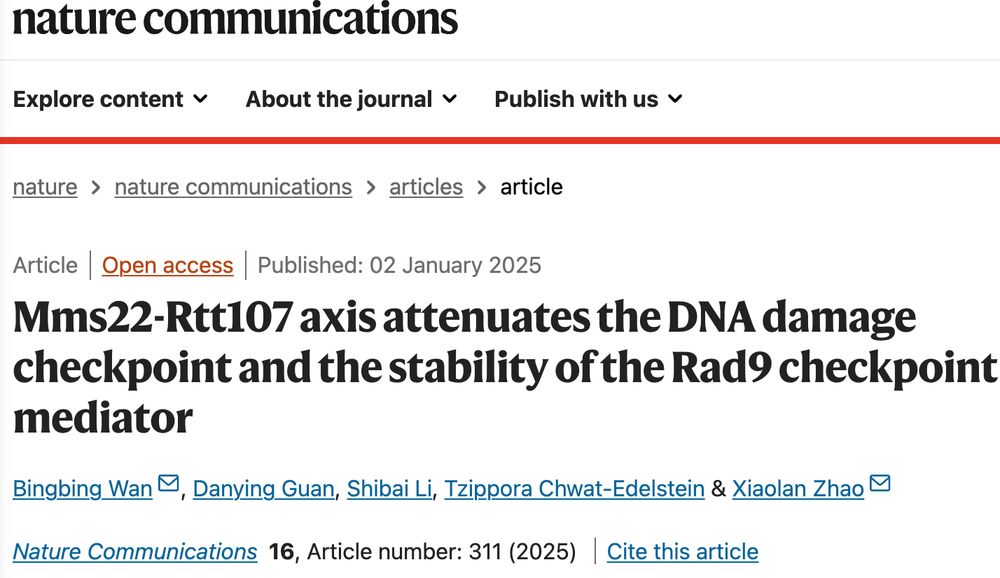
Happy to share a new work from the lab on how DNA damage checkpoint can be down-regulated. rdcu.be/d5o3E. Congrats to all authors at @mskcancercenter.bsky.social and our Weill BCMB student @tzippora.bsky.social. gradschool.weill.cornell.edu/bcmb-allied-...
January 4, 2025 at 5:03 PM
Happy to share a new work from the lab on how DNA damage checkpoint can be down-regulated. rdcu.be/d5o3E. Congrats to all authors at @mskcancercenter.bsky.social and our Weill BCMB student @tzippora.bsky.social. gradschool.weill.cornell.edu/bcmb-allied-...
Reposted by ZhaoLab
Our latest paper showing that DNA nicks drive expansions of both normal and disease-size alleles. All credit goes to a fantastic graduate student Liangzi Li as well as to a terrific team of current and former undergraduate and graduate students in the lab.
www.pnas.org/doi/10.1073/pnas.2413298121
www.pnas.org/doi/10.1073/pnas.2413298121

Recurrent DNA nicks drive massive expansions of (GAA)n repeats | PNAS
Over 50 hereditary degenerative disorders are caused by expansions of short tandem
DNA repeats (STRs). (GAA)n repeat expansions are responsible for...
www.pnas.org
November 25, 2024 at 9:08 PM
Our latest paper showing that DNA nicks drive expansions of both normal and disease-size alleles. All credit goes to a fantastic graduate student Liangzi Li as well as to a terrific team of current and former undergraduate and graduate students in the lab.
www.pnas.org/doi/10.1073/pnas.2413298121
www.pnas.org/doi/10.1073/pnas.2413298121
Reposted by ZhaoLab
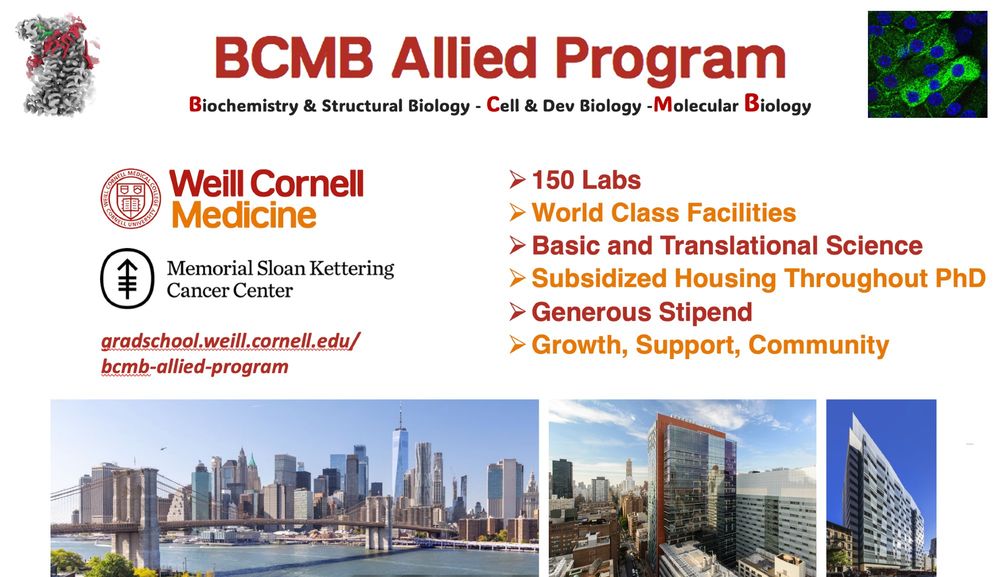
If you are interested in pursuing a PhD in biomedical sciences in New York City, it is still time to apply to the BCMB program run jointly by Weill Cornell Medicine and Memorial Sloan Kettering Cancer Center ! Deadline: Dec 1, 2024.
November 22, 2024 at 4:37 PM
If you are interested in pursuing a PhD in biomedical sciences in New York City, it is still time to apply to the BCMB program run jointly by Weill Cornell Medicine and Memorial Sloan Kettering Cancer Center ! Deadline: Dec 1, 2024.
Reposted by ZhaoLab
Check out this list of ubiquitin and Ubl profiles to follow. Repost if you want me to add you to it. Let’s create a good community here ☁️ go.bsky.app/3VPQofn
November 15, 2024 at 7:38 PM
Check out this list of ubiquitin and Ubl profiles to follow. Repost if you want me to add you to it. Let’s create a good community here ☁️ go.bsky.app/3VPQofn