



valeo.ai
@valeoai.bsky.social
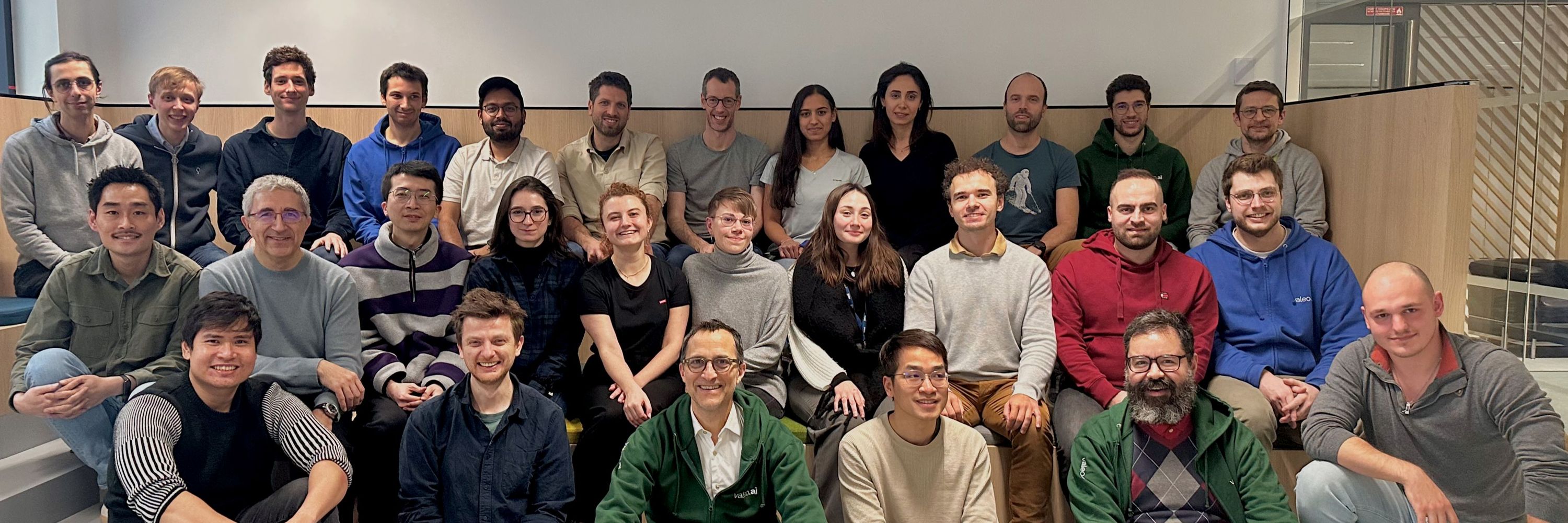
We are a research team on artificial intelligence for automotive applications working toward assisted and autonomous driving.
--> https://valeoai.github.io/ <--
--> https://valeoai.github.io/ <--
Pinned
valeo.ai
@valeoai.bsky.social
· 26d

1/🧵 Q: Can we have both a simple and SOTA architecture in autonomous driving?
R: Yes! 😍
Introducing Driving on Registers (DrivoR):
a pure Transformer backbone that achieves SOTA results in NAVSIM v1 / v2 and closed-loop HUGSIM evaluation.
Here is how 👇
R: Yes! 😍
Introducing Driving on Registers (DrivoR):
a pure Transformer backbone that achieves SOTA results in NAVSIM v1 / v2 and closed-loop HUGSIM evaluation.
Here is how 👇
Reposted by valeo.ai

IPA: An Information-Reconstructive Input Projection Framework for Efficient Foundation Model Adap...
Yuan Yin, Shashanka Venkataramanan, Tuan-Hung Vu, Andrei Bursuc, Matthieu Cord
Action editor: Ofir Lindenbaum
https://openreview.net/forum?id=aLmQeZx2pR
#projector #adaptation
Yuan Yin, Shashanka Venkataramanan, Tuan-Hung Vu, Andrei Bursuc, Matthieu Cord
Action editor: Ofir Lindenbaum
https://openreview.net/forum?id=aLmQeZx2pR
#projector #adaptation
February 3, 2026 at 5:19 AM
IPA: An Information-Reconstructive Input Projection Framework for Efficient Foundation Model Adap...
Yuan Yin, Shashanka Venkataramanan, Tuan-Hung Vu, Andrei Bursuc, Matthieu Cord
Action editor: Ofir Lindenbaum
https://openreview.net/forum?id=aLmQeZx2pR
#projector #adaptation
Yuan Yin, Shashanka Venkataramanan, Tuan-Hung Vu, Andrei Bursuc, Matthieu Cord
Action editor: Ofir Lindenbaum
https://openreview.net/forum?id=aLmQeZx2pR
#projector #adaptation
Reposted by valeo.ai

The unreasonable magic of simplicity!
Meet DrivoR (Driving on Registers): our latest end2end autonomous driving model.
We teared down complex dependencies & modules from current models to
obtain a pure Transformer-based SOTA driving agent (NAVSIM v1 & v2, HUGSIM).
Find out more 👇
Meet DrivoR (Driving on Registers): our latest end2end autonomous driving model.
We teared down complex dependencies & modules from current models to
obtain a pure Transformer-based SOTA driving agent (NAVSIM v1 & v2, HUGSIM).
Find out more 👇
1/🧵 Q: Can we have both a simple and SOTA architecture in autonomous driving?
R: Yes! 😍
Introducing Driving on Registers (DrivoR):
a pure Transformer backbone that achieves SOTA results in NAVSIM v1 / v2 and closed-loop HUGSIM evaluation.
Here is how 👇
R: Yes! 😍
Introducing Driving on Registers (DrivoR):
a pure Transformer backbone that achieves SOTA results in NAVSIM v1 / v2 and closed-loop HUGSIM evaluation.
Here is how 👇
January 9, 2026 at 5:02 PM
The unreasonable magic of simplicity!
Meet DrivoR (Driving on Registers): our latest end2end autonomous driving model.
We teared down complex dependencies & modules from current models to
obtain a pure Transformer-based SOTA driving agent (NAVSIM v1 & v2, HUGSIM).
Find out more 👇
Meet DrivoR (Driving on Registers): our latest end2end autonomous driving model.
We teared down complex dependencies & modules from current models to
obtain a pure Transformer-based SOTA driving agent (NAVSIM v1 & v2, HUGSIM).
Find out more 👇
7/ 📄 Read the paper & get the code: valeoai.github.io/driving-on-r...
Congratulations to the whole team!
Congratulations to the whole team!

January 9, 2026 at 5:00 PM
7/ 📄 Read the paper & get the code: valeoai.github.io/driving-on-r...
Congratulations to the whole team!
Congratulations to the whole team!
6/ Furthermore, this scoring architecture allowed us to tweak the agent's behavior.
We were able to induce a more passive, safer driving style—which proved important for reaching SOTA performance on the rigorous NAVSIM-v2 benchmark. 🛡️
We were able to induce a more passive, safer driving style—which proved important for reaching SOTA performance on the rigorous NAVSIM-v2 benchmark. 🛡️

January 9, 2026 at 4:57 PM
6/ Furthermore, this scoring architecture allowed us to tweak the agent's behavior.
We were able to induce a more passive, safer driving style—which proved important for reaching SOTA performance on the rigorous NAVSIM-v2 benchmark. 🛡️
We were able to induce a more passive, safer driving style—which proved important for reaching SOTA performance on the rigorous NAVSIM-v2 benchmark. 🛡️
5/ Given the success of trajectory scoring methods (like GTRS), we dove deep into the scoring module.
Thanks to the wizardry of Yihong Xu, we discovered that disentangling the tokens used for generation from those used for scoring was key.
Thanks to the wizardry of Yihong Xu, we discovered that disentangling the tokens used for generation from those used for scoring was key.

January 9, 2026 at 4:56 PM
5/ Given the success of trajectory scoring methods (like GTRS), we dove deep into the scoring module.
Thanks to the wizardry of Yihong Xu, we discovered that disentangling the tokens used for generation from those used for scoring was key.
Thanks to the wizardry of Yihong Xu, we discovered that disentangling the tokens used for generation from those used for scoring was key.
4/ This mimics human driving intuition! 🧠
We pay max attention to the road ahead (front camera), while only occasionally glancing at the rear (back camera).
Visualizing the attention maps confirms this: front tokens specialize; back tokens collapse to a single pattern.
We pay max attention to the road ahead (front camera), while only occasionally glancing at the rear (back camera).
Visualizing the attention maps confirms this: front tokens specialize; back tokens collapse to a single pattern.

January 9, 2026 at 4:56 PM
4/ This mimics human driving intuition! 🧠
We pay max attention to the road ahead (front camera), while only occasionally glancing at the rear (back camera).
Visualizing the attention maps confirms this: front tokens specialize; back tokens collapse to a single pattern.
We pay max attention to the road ahead (front camera), while only occasionally glancing at the rear (back camera).
Visualizing the attention maps confirms this: front tokens specialize; back tokens collapse to a single pattern.
3/ These registers act as "scene-tokens" and demonstrate signs of learned compression.
Cosine similarity analysis reveals high differentiation for the front camera, while representations progressively "collapse" as we move toward the back camera.
Cosine similarity analysis reveals high differentiation for the front camera, while representations progressively "collapse" as we move toward the back camera.

January 9, 2026 at 4:56 PM
3/ These registers act as "scene-tokens" and demonstrate signs of learned compression.
Cosine similarity analysis reveals high differentiation for the front camera, while representations progressively "collapse" as we move toward the back camera.
Cosine similarity analysis reveals high differentiation for the front camera, while representations progressively "collapse" as we move toward the back camera.
2/ We explored specific reasons to use a pre-trained ViT as image encoder.
We imbue DINOv2 with registers LoRA-finetuned on driving data, reducing the # of patch tokens over 250x using camera aware register tokens.
This efficiency could impact future works on VLMs in driving
We imbue DINOv2 with registers LoRA-finetuned on driving data, reducing the # of patch tokens over 250x using camera aware register tokens.
This efficiency could impact future works on VLMs in driving

January 9, 2026 at 4:55 PM
2/ We explored specific reasons to use a pre-trained ViT as image encoder.
We imbue DINOv2 with registers LoRA-finetuned on driving data, reducing the # of patch tokens over 250x using camera aware register tokens.
This efficiency could impact future works on VLMs in driving
We imbue DINOv2 with registers LoRA-finetuned on driving data, reducing the # of patch tokens over 250x using camera aware register tokens.
This efficiency could impact future works on VLMs in driving
1/🧵 Q: Can we have both a simple and SOTA architecture in autonomous driving?
R: Yes! 😍
Introducing Driving on Registers (DrivoR):
a pure Transformer backbone that achieves SOTA results in NAVSIM v1 / v2 and closed-loop HUGSIM evaluation.
Here is how 👇
R: Yes! 😍
Introducing Driving on Registers (DrivoR):
a pure Transformer backbone that achieves SOTA results in NAVSIM v1 / v2 and closed-loop HUGSIM evaluation.
Here is how 👇
January 9, 2026 at 4:55 PM
1/🧵 Q: Can we have both a simple and SOTA architecture in autonomous driving?
R: Yes! 😍
Introducing Driving on Registers (DrivoR):
a pure Transformer backbone that achieves SOTA results in NAVSIM v1 / v2 and closed-loop HUGSIM evaluation.
Here is how 👇
R: Yes! 😍
Introducing Driving on Registers (DrivoR):
a pure Transformer backbone that achieves SOTA results in NAVSIM v1 / v2 and closed-loop HUGSIM evaluation.
Here is how 👇
Our @spyrosgidaris.bsky.social is speaking this morning (Wed, Dec 10th, 11:00 am Paris time) about "Latent Representations for Better Generative Image Modeling" in the Hi! PARIS - ELLIS monthly seminar.
The talk will be live-streamed: www.hi-paris.fr/2025/09/26/a...
The talk will be live-streamed: www.hi-paris.fr/2025/09/26/a...
AI Seminar Cycle – Hi! PARIS
www.hi-paris.fr
December 10, 2025 at 9:15 AM
Our @spyrosgidaris.bsky.social is speaking this morning (Wed, Dec 10th, 11:00 am Paris time) about "Latent Representations for Better Generative Image Modeling" in the Hi! PARIS - ELLIS monthly seminar.
The talk will be live-streamed: www.hi-paris.fr/2025/09/26/a...
The talk will be live-streamed: www.hi-paris.fr/2025/09/26/a...
Perfect timing for this keynote on open, re-purposable foundation models at #aiPULSE2025
@abursuc.bsky.social taking the stage this afternoon! 👇
@abursuc.bsky.social taking the stage this afternoon! 👇
I'm speaking at #aiPULSE2025 today on Open & re-purposable foundation models for the automotive industry.
The morning keynotes talked a lot about open source so my slide here might be timely.
The morning keynotes talked a lot about open source so my slide here might be timely.

December 4, 2025 at 12:14 PM
Perfect timing for this keynote on open, re-purposable foundation models at #aiPULSE2025
@abursuc.bsky.social taking the stage this afternoon! 👇
@abursuc.bsky.social taking the stage this afternoon! 👇
Find out more about all these works at the posters, over a coffee or, if you’re shy, on our webpage: valeoai.github.io/posts/neurip...
valeo.ai at NeurIPS 2025 | valeo.ai - valeo.ai research page
Loïck Chambon, Spyros Gidaris, Andrei Bursuc, Eloi Zablocki
valeoai.github.io
December 3, 2025 at 10:52 PM
Find out more about all these works at the posters, over a coffee or, if you’re shy, on our webpage: valeoai.github.io/posts/neurip...
IPA: An Information-Preserving Input Projection Framework for Efficient Foundation Model Adaptation
by: Y. Yin, S. Venkataramanan, T.H. Vu, A. Bursuc, M. Cord
📄: arxiv.org/abs/2509.04398
tl;dr: a PEFT method that improves upon LoRA by explicitly preserving information in the low-rank space
by: Y. Yin, S. Venkataramanan, T.H. Vu, A. Bursuc, M. Cord
📄: arxiv.org/abs/2509.04398
tl;dr: a PEFT method that improves upon LoRA by explicitly preserving information in the low-rank space

December 3, 2025 at 10:52 PM
IPA: An Information-Preserving Input Projection Framework for Efficient Foundation Model Adaptation
by: Y. Yin, S. Venkataramanan, T.H. Vu, A. Bursuc, M. Cord
📄: arxiv.org/abs/2509.04398
tl;dr: a PEFT method that improves upon LoRA by explicitly preserving information in the low-rank space
by: Y. Yin, S. Venkataramanan, T.H. Vu, A. Bursuc, M. Cord
📄: arxiv.org/abs/2509.04398
tl;dr: a PEFT method that improves upon LoRA by explicitly preserving information in the low-rank space
Multi-Token Prediction Needs Registers
by: A. Gerontopoulos, S. Gidaris, N. Komodakis
📄: arxiv.org/abs/2505.10518
tl;dr: a simple way to enable multi-token prediction in LLMs by interleaving learnable "register tokens" into the input sequence to forecast future targets.
by: A. Gerontopoulos, S. Gidaris, N. Komodakis
📄: arxiv.org/abs/2505.10518
tl;dr: a simple way to enable multi-token prediction in LLMs by interleaving learnable "register tokens" into the input sequence to forecast future targets.

December 3, 2025 at 10:51 PM
Multi-Token Prediction Needs Registers
by: A. Gerontopoulos, S. Gidaris, N. Komodakis
📄: arxiv.org/abs/2505.10518
tl;dr: a simple way to enable multi-token prediction in LLMs by interleaving learnable "register tokens" into the input sequence to forecast future targets.
by: A. Gerontopoulos, S. Gidaris, N. Komodakis
📄: arxiv.org/abs/2505.10518
tl;dr: a simple way to enable multi-token prediction in LLMs by interleaving learnable "register tokens" into the input sequence to forecast future targets.
Boosting Generative Image Modeling via Joint Image-Feature Synthesis
by: T. Kouzelis, E. Karypidis, I. Kakogeorgiou, S. Gidaris, N. Komodakis
📄: arxiv.org/abs/2504.16064
- tl;dr: improve generation w/ a single diffusion model to jointly synthesize low-level latents & high-level semantic features
by: T. Kouzelis, E. Karypidis, I. Kakogeorgiou, S. Gidaris, N. Komodakis
📄: arxiv.org/abs/2504.16064
- tl;dr: improve generation w/ a single diffusion model to jointly synthesize low-level latents & high-level semantic features

December 3, 2025 at 10:51 PM
Boosting Generative Image Modeling via Joint Image-Feature Synthesis
by: T. Kouzelis, E. Karypidis, I. Kakogeorgiou, S. Gidaris, N. Komodakis
📄: arxiv.org/abs/2504.16064
- tl;dr: improve generation w/ a single diffusion model to jointly synthesize low-level latents & high-level semantic features
by: T. Kouzelis, E. Karypidis, I. Kakogeorgiou, S. Gidaris, N. Komodakis
📄: arxiv.org/abs/2504.16064
- tl;dr: improve generation w/ a single diffusion model to jointly synthesize low-level latents & high-level semantic features
Learning to Steer: Input-dependent Steering for Multimodal LLMs
by: J. Parekh, P. Khayatan, M. Shukor, A. Dapogny, A. Newson, M. Cord
📄: arxiv.org/abs/2508.12815
- tl;dr: steering multimodal LLMs (MLLMs) by training a lightweight auxiliary module to predict input-specific steering vectors
by: J. Parekh, P. Khayatan, M. Shukor, A. Dapogny, A. Newson, M. Cord
📄: arxiv.org/abs/2508.12815
- tl;dr: steering multimodal LLMs (MLLMs) by training a lightweight auxiliary module to predict input-specific steering vectors

December 3, 2025 at 10:51 PM
Learning to Steer: Input-dependent Steering for Multimodal LLMs
by: J. Parekh, P. Khayatan, M. Shukor, A. Dapogny, A. Newson, M. Cord
📄: arxiv.org/abs/2508.12815
- tl;dr: steering multimodal LLMs (MLLMs) by training a lightweight auxiliary module to predict input-specific steering vectors
by: J. Parekh, P. Khayatan, M. Shukor, A. Dapogny, A. Newson, M. Cord
📄: arxiv.org/abs/2508.12815
- tl;dr: steering multimodal LLMs (MLLMs) by training a lightweight auxiliary module to predict input-specific steering vectors
DINO-Foresight: Looking into the Future with DINO
by E. Karypidis, I. Kakogeorgiou, S. Gidaris, N. Komodakis
📄: arxiv.org/abs/2412.11673
tl;dr: self-supervision by predicting future scene dynamics in the semantic feature space of foundation models (like DINO) rather than generating costly pixels.
by E. Karypidis, I. Kakogeorgiou, S. Gidaris, N. Komodakis
📄: arxiv.org/abs/2412.11673
tl;dr: self-supervision by predicting future scene dynamics in the semantic feature space of foundation models (like DINO) rather than generating costly pixels.

December 3, 2025 at 10:50 PM
DINO-Foresight: Looking into the Future with DINO
by E. Karypidis, I. Kakogeorgiou, S. Gidaris, N. Komodakis
📄: arxiv.org/abs/2412.11673
tl;dr: self-supervision by predicting future scene dynamics in the semantic feature space of foundation models (like DINO) rather than generating costly pixels.
by E. Karypidis, I. Kakogeorgiou, S. Gidaris, N. Komodakis
📄: arxiv.org/abs/2412.11673
tl;dr: self-supervision by predicting future scene dynamics in the semantic feature space of foundation models (like DINO) rather than generating costly pixels.
JAFAR: Jack up Any Feature at Any Resolution
by P. Couairon, L. Chambon, L. Serrano, M. Cord, N. Thome
📄: arxiv.org/abs/2506.11136
tl;dr: lightweight, flexible, plug & play upsampler that scales features from any vision foundation model to arbitrary resolutions w/o needing high-res supervision
by P. Couairon, L. Chambon, L. Serrano, M. Cord, N. Thome
📄: arxiv.org/abs/2506.11136
tl;dr: lightweight, flexible, plug & play upsampler that scales features from any vision foundation model to arbitrary resolutions w/o needing high-res supervision

December 3, 2025 at 10:50 PM
JAFAR: Jack up Any Feature at Any Resolution
by P. Couairon, L. Chambon, L. Serrano, M. Cord, N. Thome
📄: arxiv.org/abs/2506.11136
tl;dr: lightweight, flexible, plug & play upsampler that scales features from any vision foundation model to arbitrary resolutions w/o needing high-res supervision
by P. Couairon, L. Chambon, L. Serrano, M. Cord, N. Thome
📄: arxiv.org/abs/2506.11136
tl;dr: lightweight, flexible, plug & play upsampler that scales features from any vision foundation model to arbitrary resolutions w/o needing high-res supervision
Check out our works at @NeurIPSConf #NeurIPS2025 this week!
We present 5 full papers + 1 workshop about:
💡 self-supervised & representation learning
🖼️ generative image models
🧠 finetuning and understanding LLMs & multimodal LLMs
🔎 feature upsampling
valeoai.github.io/posts/neurip...
We present 5 full papers + 1 workshop about:
💡 self-supervised & representation learning
🖼️ generative image models
🧠 finetuning and understanding LLMs & multimodal LLMs
🔎 feature upsampling
valeoai.github.io/posts/neurip...

December 3, 2025 at 10:50 PM
Check out our works at @NeurIPSConf #NeurIPS2025 this week!
We present 5 full papers + 1 workshop about:
💡 self-supervised & representation learning
🖼️ generative image models
🧠 finetuning and understanding LLMs & multimodal LLMs
🔎 feature upsampling
valeoai.github.io/posts/neurip...
We present 5 full papers + 1 workshop about:
💡 self-supervised & representation learning
🖼️ generative image models
🧠 finetuning and understanding LLMs & multimodal LLMs
🔎 feature upsampling
valeoai.github.io/posts/neurip...
Reposted by valeo.ai
We fermented our thoughts on understanding LoRA & ended up with IPA🍺
We found an asymmetry in LoRA: during training, A changes little & B eats most task-specific adaptation.
So we pre-train A to preserve information before adaptation w/ excellent parameter efficiency #NeurIPS2025 #CCFM 👇
We found an asymmetry in LoRA: during training, A changes little & B eats most task-specific adaptation.
So we pre-train A to preserve information before adaptation w/ excellent parameter efficiency #NeurIPS2025 #CCFM 👇
1/Serve your PEFT with a fresh IPA!🍺
Finetuning large models is cheaper thanks to LoRA, but is its random init optimal?🤔
Meet IPA: a feature-aware alternative to random projections
#NeurIPS2025 WS #CCFM Oral+Best Paper
Work w/
S. Venkataramanan @tuanhungvu.bsky.social @abursuc.bsky.social M. Cord
🧵
Finetuning large models is cheaper thanks to LoRA, but is its random init optimal?🤔
Meet IPA: a feature-aware alternative to random projections
#NeurIPS2025 WS #CCFM Oral+Best Paper
Work w/
S. Venkataramanan @tuanhungvu.bsky.social @abursuc.bsky.social M. Cord
🧵
December 2, 2025 at 11:16 AM
We fermented our thoughts on understanding LoRA & ended up with IPA🍺
We found an asymmetry in LoRA: during training, A changes little & B eats most task-specific adaptation.
So we pre-train A to preserve information before adaptation w/ excellent parameter efficiency #NeurIPS2025 #CCFM 👇
We found an asymmetry in LoRA: during training, A changes little & B eats most task-specific adaptation.
So we pre-train A to preserve information before adaptation w/ excellent parameter efficiency #NeurIPS2025 #CCFM 👇
Reposted by valeo.ai

1/Serve your PEFT with a fresh IPA!🍺
Finetuning large models is cheaper thanks to LoRA, but is its random init optimal?🤔
Meet IPA: a feature-aware alternative to random projections
#NeurIPS2025 WS #CCFM Oral+Best Paper
Work w/
S. Venkataramanan @tuanhungvu.bsky.social @abursuc.bsky.social M. Cord
🧵
Finetuning large models is cheaper thanks to LoRA, but is its random init optimal?🤔
Meet IPA: a feature-aware alternative to random projections
#NeurIPS2025 WS #CCFM Oral+Best Paper
Work w/
S. Venkataramanan @tuanhungvu.bsky.social @abursuc.bsky.social M. Cord
🧵
December 2, 2025 at 11:11 AM
1/Serve your PEFT with a fresh IPA!🍺
Finetuning large models is cheaper thanks to LoRA, but is its random init optimal?🤔
Meet IPA: a feature-aware alternative to random projections
#NeurIPS2025 WS #CCFM Oral+Best Paper
Work w/
S. Venkataramanan @tuanhungvu.bsky.social @abursuc.bsky.social M. Cord
🧵
Finetuning large models is cheaper thanks to LoRA, but is its random init optimal?🤔
Meet IPA: a feature-aware alternative to random projections
#NeurIPS2025 WS #CCFM Oral+Best Paper
Work w/
S. Venkataramanan @tuanhungvu.bsky.social @abursuc.bsky.social M. Cord
🧵
Reposted by valeo.ai

That was a cool project brillantly led by Ellington Kirby during his internship.
We were curious if we could train diffusion models on sets of point coordinates.
For images, this is a step towards spatial diffusion, with pixels reorganizing themselves, instead of diffusing in rgb values space only.
We were curious if we could train diffusion models on sets of point coordinates.
For images, this is a step towards spatial diffusion, with pixels reorganizing themselves, instead of diffusing in rgb values space only.
LOGen: Toward Lidar Object Generation by Point Diffusion
by: E. Kirby, @mickaelchen.bsky.social, R. Marlet, N. Samet
tl;dr: a diffusion-based method producing lidar point clouds of dataset objects, with an extensive control of the generation
📄 arxiv.org/abs/2412.07385
Code: ✅
by: E. Kirby, @mickaelchen.bsky.social, R. Marlet, N. Samet
tl;dr: a diffusion-based method producing lidar point clouds of dataset objects, with an extensive control of the generation
📄 arxiv.org/abs/2412.07385
Code: ✅

November 26, 2025 at 1:19 PM
That was a cool project brillantly led by Ellington Kirby during his internship.
We were curious if we could train diffusion models on sets of point coordinates.
For images, this is a step towards spatial diffusion, with pixels reorganizing themselves, instead of diffusing in rgb values space only.
We were curious if we could train diffusion models on sets of point coordinates.
For images, this is a step towards spatial diffusion, with pixels reorganizing themselves, instead of diffusing in rgb values space only.
Reposted by valeo.ai
Check out NAF: an effective ViT feature upsampler to produce excellent (and eye-candy) pixel-level feature maps.
NAF outperform both VFM-specific upsamplers (FeatUp, JAFAR) and VFM-agnostic methods (JBU, AnyUp) over multiple downstream tasks 👇
NAF outperform both VFM-specific upsamplers (FeatUp, JAFAR) and VFM-agnostic methods (JBU, AnyUp) over multiple downstream tasks 👇
Need pixel-level features from your backbone (DINOv3, CLIP, RADIO, FRANCA...)?
🚀Introducing NAF: A universal, zero-shot feature upsampler.
It turns low-res ViT features into pixel-perfect maps.
-⚡ Model-agnostic
-🥇 SoTA results
-🚀 4× faster than SoTA
-📈 Scales up to 2K res
🚀Introducing NAF: A universal, zero-shot feature upsampler.
It turns low-res ViT features into pixel-perfect maps.
-⚡ Model-agnostic
-🥇 SoTA results
-🚀 4× faster than SoTA
-📈 Scales up to 2K res
November 25, 2025 at 6:36 PM
Check out NAF: an effective ViT feature upsampler to produce excellent (and eye-candy) pixel-level feature maps.
NAF outperform both VFM-specific upsamplers (FeatUp, JAFAR) and VFM-agnostic methods (JBU, AnyUp) over multiple downstream tasks 👇
NAF outperform both VFM-specific upsamplers (FeatUp, JAFAR) and VFM-agnostic methods (JBU, AnyUp) over multiple downstream tasks 👇
Paper: arxiv.org/abs/2511.18452
by Loïck Chambon (loickch.github.io), @paulcouairon.bsky.social, @eloizablocki.bsky.social, @alexandreboulch.bsky.social, @nicolasthome.bsky.social, @matthieucord.bsky.social
Collab with @mlia-isir.bsky.social
by Loïck Chambon (loickch.github.io), @paulcouairon.bsky.social, @eloizablocki.bsky.social, @alexandreboulch.bsky.social, @nicolasthome.bsky.social, @matthieucord.bsky.social
Collab with @mlia-isir.bsky.social

NAF: Zero-Shot Feature Upsampling via Neighborhood Attention Filtering
Vision Foundation Models (VFMs) extract spatially downsampled representations, posing challenges for pixel-level tasks. Existing upsampling approaches face a fundamental trade-off: classical filters a...
arxiv.org
November 25, 2025 at 10:44 AM
Paper: arxiv.org/abs/2511.18452
by Loïck Chambon (loickch.github.io), @paulcouairon.bsky.social, @eloizablocki.bsky.social, @alexandreboulch.bsky.social, @nicolasthome.bsky.social, @matthieucord.bsky.social
Collab with @mlia-isir.bsky.social
by Loïck Chambon (loickch.github.io), @paulcouairon.bsky.social, @eloizablocki.bsky.social, @alexandreboulch.bsky.social, @nicolasthome.bsky.social, @matthieucord.bsky.social
Collab with @mlia-isir.bsky.social
📢 NAF is fully open-source!
The repo contains:
✅ Pretrained model
✅ Example notebooks
✅ Evaluation and training codes
Check it out & ⭐ the repo: github.com/valeoai/NAF
The repo contains:
✅ Pretrained model
✅ Example notebooks
✅ Evaluation and training codes
Check it out & ⭐ the repo: github.com/valeoai/NAF

November 25, 2025 at 10:44 AM
📢 NAF is fully open-source!
The repo contains:
✅ Pretrained model
✅ Example notebooks
✅ Evaluation and training codes
Check it out & ⭐ the repo: github.com/valeoai/NAF
The repo contains:
✅ Pretrained model
✅ Example notebooks
✅ Evaluation and training codes
Check it out & ⭐ the repo: github.com/valeoai/NAF