



Sophie Caron
@thecaronlab.bsky.social
Je me souviens, Drosophila edition
🧪,🧠,🪰,🔥🧘🏻♀️&💗
Associate Professor
School of Biological Sciences
University of Utah
www.thecaronlab.com
🧪,🧠,🪰,🔥🧘🏻♀️&💗
Associate Professor
School of Biological Sciences
University of Utah
www.thecaronlab.com
Pinned
Sophie Caron
@thecaronlab.bsky.social
· Oct 30
1/ Hello Drosophila-philists and braino-maniacs! 👋🪰🧠🧪
The Caron lab has a new preprint, and it is about 🥁🥁🥁 democracy!
Neuro-democracy, to be precise. So: drop EVERYTHING and listen up — a 🧶!
www.biorxiv.org/content/10.1...
The Caron lab has a new preprint, and it is about 🥁🥁🥁 democracy!
Neuro-democracy, to be precise. So: drop EVERYTHING and listen up — a 🧶!
www.biorxiv.org/content/10.1...
Reposted by Sophie Caron

Have you ever wondered what you would find if you could keep your eyes on a bee for more than a few meters? Us, too!
preprint (with videos!) + thread 🧵
Precise, individualized foraging flights in honey #bees 🐝 revealed by multicopter drone-based tracking
www.biorxiv.org/content/10.6...
1/9
preprint (with videos!) + thread 🧵
Precise, individualized foraging flights in honey #bees 🐝 revealed by multicopter drone-based tracking
www.biorxiv.org/content/10.6...
1/9
December 6, 2025 at 2:01 PM
Have you ever wondered what you would find if you could keep your eyes on a bee for more than a few meters? Us, too!
preprint (with videos!) + thread 🧵
Precise, individualized foraging flights in honey #bees 🐝 revealed by multicopter drone-based tracking
www.biorxiv.org/content/10.6...
1/9
preprint (with videos!) + thread 🧵
Precise, individualized foraging flights in honey #bees 🐝 revealed by multicopter drone-based tracking
www.biorxiv.org/content/10.6...
1/9
Reposted by Sophie Caron
Reminder for neuro postdocs on the market - apply for this soon! Emory Biology is a fantastic place to start a lab
My department at Emory is a hiring a tenure-track neuroscientist!
Anyone who's talked to me in the last 4 years knows I cannot say enough good things about my dept and the neuroscience community here. My colleagues are so wonderfully supportive. Postdocs, please apply!
apply.interfolio.com/174371
Anyone who's talked to me in the last 4 years knows I cannot say enough good things about my dept and the neuroscience community here. My colleagues are so wonderfully supportive. Postdocs, please apply!
apply.interfolio.com/174371
Apply - Interfolio
{{$ctrl.$state.data.pageTitle}} - Apply - Interfolio
apply.interfolio.com
November 20, 2025 at 2:04 PM
Reminder for neuro postdocs on the market - apply for this soon! Emory Biology is a fantastic place to start a lab
Reposted by Sophie Caron

Thrilled to finally share the magnum opus of my PhD that focuses on the genetic basis of evolutionary change! Specifically, we know we can map the genetic basis of a trait, but can we tell which genes will underlie the trait shift when it evolves? doi.org/10.1101/2025...

High-resolution mapping of a rapidly evolving complex trait reveals genotype-phenotype stability and an unpredictable genetic architecture of adaptation
The extent to which adaptation can be predicted, particularly for traits with complex genetic bases, is unknown. Here, we leveraged a model complex trait, model species, and high-powered longitudinal ...
doi.org
November 18, 2025 at 12:15 AM
Thrilled to finally share the magnum opus of my PhD that focuses on the genetic basis of evolutionary change! Specifically, we know we can map the genetic basis of a trait, but can we tell which genes will underlie the trait shift when it evolves? doi.org/10.1101/2025...
Reposted by Sophie Caron
Excited to share my most recent postdoctoral work in the Jeanne lab @yaleneuro.bsky.social !
“Sensory processing reformats odor coding around valence and dynamics”
www.biorxiv.org/content/10.1...
We ask: how is a sensory code transformed across multiple stages of processing to inform behavior?
“Sensory processing reformats odor coding around valence and dynamics”
www.biorxiv.org/content/10.1...
We ask: how is a sensory code transformed across multiple stages of processing to inform behavior?

Sensory processing reformats odor coding around valence and dynamics
Extracting relevant features of a complex sensory signal typically involves sequential processing through multiple brain regions. However, identifying the logic and mechanisms of these transformations...
www.biorxiv.org
November 9, 2025 at 12:58 PM
Excited to share my most recent postdoctoral work in the Jeanne lab @yaleneuro.bsky.social !
“Sensory processing reformats odor coding around valence and dynamics”
www.biorxiv.org/content/10.1...
We ask: how is a sensory code transformed across multiple stages of processing to inform behavior?
“Sensory processing reformats odor coding around valence and dynamics”
www.biorxiv.org/content/10.1...
We ask: how is a sensory code transformed across multiple stages of processing to inform behavior?
1/ Hello Drosophila-philists and braino-maniacs! 👋🪰🧠🧪
The Caron lab has a new preprint, and it is about 🥁🥁🥁 democracy!
Neuro-democracy, to be precise. So: drop EVERYTHING and listen up — a 🧶!
www.biorxiv.org/content/10.1...
The Caron lab has a new preprint, and it is about 🥁🥁🥁 democracy!
Neuro-democracy, to be precise. So: drop EVERYTHING and listen up — a 🧶!
www.biorxiv.org/content/10.1...
October 30, 2025 at 5:47 PM
1/ Hello Drosophila-philists and braino-maniacs! 👋🪰🧠🧪
The Caron lab has a new preprint, and it is about 🥁🥁🥁 democracy!
Neuro-democracy, to be precise. So: drop EVERYTHING and listen up — a 🧶!
www.biorxiv.org/content/10.1...
The Caron lab has a new preprint, and it is about 🥁🥁🥁 democracy!
Neuro-democracy, to be precise. So: drop EVERYTHING and listen up — a 🧶!
www.biorxiv.org/content/10.1...
📢 Fresh off the press! Our article on Arc is out in @currentbiology.bsky.social:
www.cell.com/current-biol...
🧶 Full thread on our discoveries here: bsky.app/profile/thec...
www.cell.com/current-biol...
🧶 Full thread on our discoveries here: bsky.app/profile/thec...
August 12, 2025 at 6:36 PM
📢 Fresh off the press! Our article on Arc is out in @currentbiology.bsky.social:
www.cell.com/current-biol...
🧶 Full thread on our discoveries here: bsky.app/profile/thec...
www.cell.com/current-biol...
🧶 Full thread on our discoveries here: bsky.app/profile/thec...
Reposted by Sophie Caron
This paper with @thecaronlab.bsky.social now ACCEPTED at @currentbiology.bsky.social! Congrats Sven! (He’s on the job market now folks). Stay tuned for the final version. www.biorxiv.org/content/10.1... dArc1 controls sugar reward valuation in Drosophila melanogaster | bioRxiv

dArc1 controls sugar reward valuation in Drosophila melanogaster
The Arc genes — which include Drosophila Arc1 and Arc2 ( dArc ) — evolved from Ty3 retrotransposons and encode proteins that form virus-like capsids. These capsids enable a novel form of intercellular...
www.biorxiv.org
July 18, 2025 at 2:05 PM
This paper with @thecaronlab.bsky.social now ACCEPTED at @currentbiology.bsky.social! Congrats Sven! (He’s on the job market now folks). Stay tuned for the final version. www.biorxiv.org/content/10.1... dArc1 controls sugar reward valuation in Drosophila melanogaster | bioRxiv
Reposted by Sophie Caron
I've had the privilege & luck of having NSF funding for >25 yrs. #WithoutNSF we would not have discovered new mechanisms of chemosensation, described how gut bacteria influence neuronal function, trained many who are now scientists & educators, & appreciated the joys & rewards of science outreach.
May 3, 2025 at 3:31 AM
I've had the privilege & luck of having NSF funding for >25 yrs. #WithoutNSF we would not have discovered new mechanisms of chemosensation, described how gut bacteria influence neuronal function, trained many who are now scientists & educators, & appreciated the joys & rewards of science outreach.
Evidence trumps ignorance — join us as we March for Science! 🧪🥼🔬👣
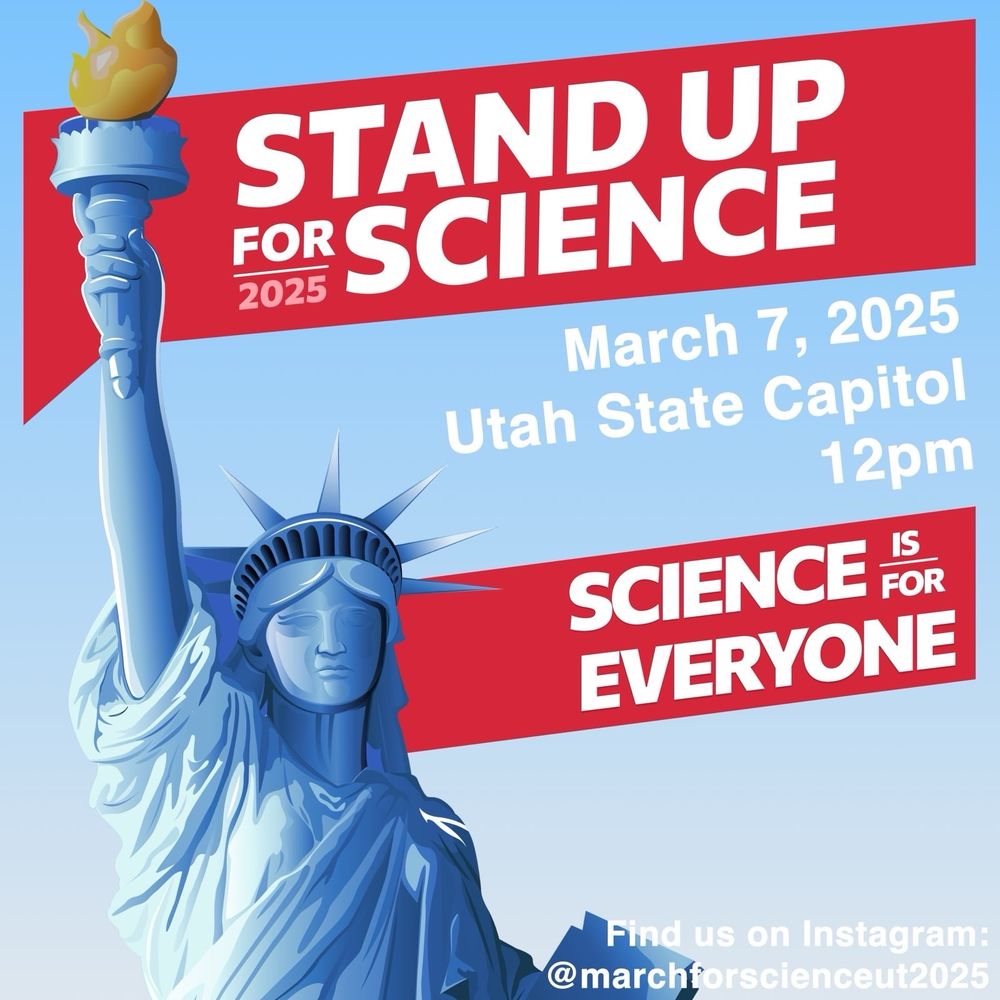
March 7, 2025 at 6:14 PM
Evidence trumps ignorance — join us as we March for Science! 🧪🥼🔬👣
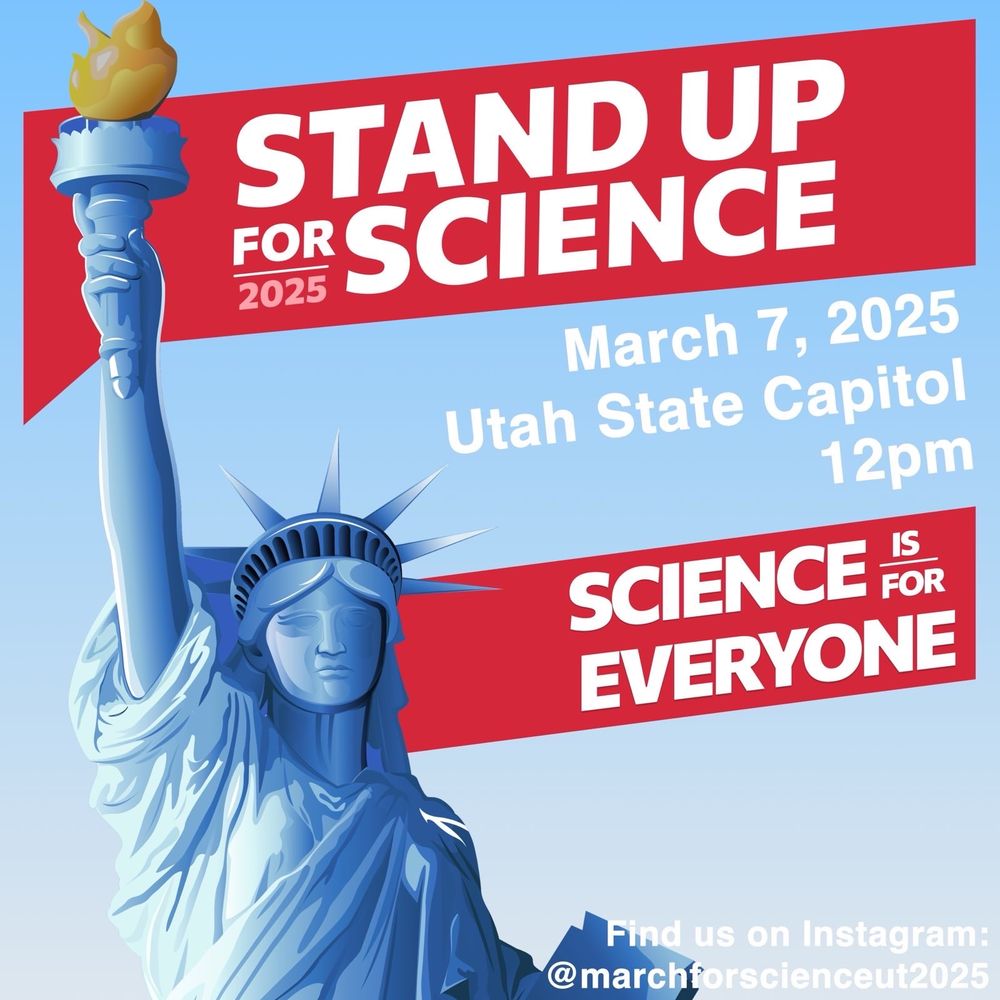
🧪 Stand Up for Science. Science is for everyone. 🫶
Join us as we #marchforscience — for truth, discovery, and a future where research is valued and people matter. Science uplifts everyone, empowers communities, and drives real change. Stand up, Utah!
📍 Utah State Capitol
📅 March 7th 2025 at noon
Join us as we #marchforscience — for truth, discovery, and a future where research is valued and people matter. Science uplifts everyone, empowers communities, and drives real change. Stand up, Utah!
📍 Utah State Capitol
📅 March 7th 2025 at noon
March 1, 2025 at 12:36 AM
🧪 Stand Up for Science. Science is for everyone. 🫶
Join us as we #marchforscience — for truth, discovery, and a future where research is valued and people matter. Science uplifts everyone, empowers communities, and drives real change. Stand up, Utah!
📍 Utah State Capitol
📅 March 7th 2025 at noon
Join us as we #marchforscience — for truth, discovery, and a future where research is valued and people matter. Science uplifts everyone, empowers communities, and drives real change. Stand up, Utah!
📍 Utah State Capitol
📅 March 7th 2025 at noon
Reposted by Sophie Caron
This was supposed to be a post about my lab's first funding of the year, a diversity supplement to fund our amazing research technician. The award never arrived.
Now it's a post about the value of diversity and trying to persevere in these dark times.
devinenilab.org/news/diversi...
Now it's a post about the value of diversity and trying to persevere in these dark times.
devinenilab.org/news/diversi...

Diversity is core to science — Devineni Lab
This was supposed to be a post about how we received our first grant of the year. It never arrived.
devinenilab.org
February 23, 2025 at 9:27 PM
This was supposed to be a post about my lab's first funding of the year, a diversity supplement to fund our amazing research technician. The award never arrived.
Now it's a post about the value of diversity and trying to persevere in these dark times.
devinenilab.org/news/diversi...
Now it's a post about the value of diversity and trying to persevere in these dark times.
devinenilab.org/news/diversi...
Reposted by Sophie Caron

Ok scientists & those who love science 🧪: here is another exhortation. Call Congress TODAY about the freeze on NIH Council Meetings and Study Sections. Emphasize that this means NO new grants are being funded & labs will soon start to shut down and fire employees. Phone numbers are at:
5calls.org
5calls.org

5 Calls
Spend 5 minutes. Make 5 calls. Make your voice heard.
5calls.org
February 21, 2025 at 5:23 PM
Ok scientists & those who love science 🧪: here is another exhortation. Call Congress TODAY about the freeze on NIH Council Meetings and Study Sections. Emphasize that this means NO new grants are being funded & labs will soon start to shut down and fire employees. Phone numbers are at:
5calls.org
5calls.org
Scientists and lovers of 🧪: @sfn.org has a great tool to help you engage with your local representatives and make your voice heard on *questionable* decisions in DC. 🇺🇸✉️ It is quick, impactful (we hope), and customizable — edit the text, make it your own! #floodthemailbox www.sfn.org/Advocacy/Adv...
www.sfn.org
February 7, 2025 at 3:04 PM
Scientists and lovers of 🧪: @sfn.org has a great tool to help you engage with your local representatives and make your voice heard on *questionable* decisions in DC. 🇺🇸✉️ It is quick, impactful (we hope), and customizable — edit the text, make it your own! #floodthemailbox www.sfn.org/Advocacy/Adv...
Reposted by Sophie Caron

Federal restrictions & funding freezes threaten vital research and halts scientific progress that benefits all Americans.
Join fellow #NeuroAdvocates in urging Congress to protect congressionally approved funding & ensure uninterrupted support for the scientific workforce.
👇 #NeuroSky
Join fellow #NeuroAdvocates in urging Congress to protect congressionally approved funding & ensure uninterrupted support for the scientific workforce.
👇 #NeuroSky
February 6, 2025 at 6:45 PM
Federal restrictions & funding freezes threaten vital research and halts scientific progress that benefits all Americans.
Join fellow #NeuroAdvocates in urging Congress to protect congressionally approved funding & ensure uninterrupted support for the scientific workforce.
👇 #NeuroSky
Join fellow #NeuroAdvocates in urging Congress to protect congressionally approved funding & ensure uninterrupted support for the scientific workforce.
👇 #NeuroSky
Every state relies on federal 💰 to sustain research operations, with each dollar in funding generating $2.50 in economic growth — now that is efficiency!🚀 Frustrated by the freeze? 🥶 Here is a guide on how to push back against policies that could stand between you and your groundbreaking research. 🧪

a close up of a man 's face with a beard and long hair in the snow .
ALT: a close up of a man 's face with a beard and long hair in the snow .
media.tenor.com
January 30, 2025 at 12:39 AM
Every state relies on federal 💰 to sustain research operations, with each dollar in funding generating $2.50 in economic growth — now that is efficiency!🚀 Frustrated by the freeze? 🥶 Here is a guide on how to push back against policies that could stand between you and your groundbreaking research. 🧪
Reposted by Sophie Caron

Want to see the numbers for how NIH funding impacts your state? Remind your Representatives, Senators, and fellow citizens how federally-funded biomedical research advances health, created jobs, and fosters innovation and economic growth.
www.unitedformedicalresearch.org/nih-in-your-...
www.unitedformedicalresearch.org/nih-in-your-...
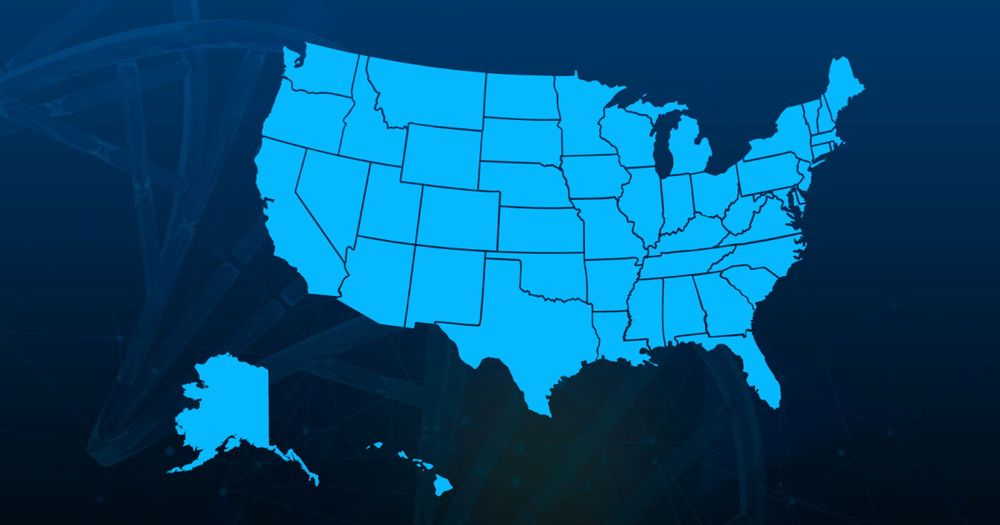
NIH In Your State - United For Medical Research
Select a state on the map to see the impact of NIH funding across America.
www.unitedformedicalresearch.org
January 23, 2025 at 12:35 PM
Want to see the numbers for how NIH funding impacts your state? Remind your Representatives, Senators, and fellow citizens how federally-funded biomedical research advances health, created jobs, and fosters innovation and economic growth.
www.unitedformedicalresearch.org/nih-in-your-...
www.unitedformedicalresearch.org/nih-in-your-...
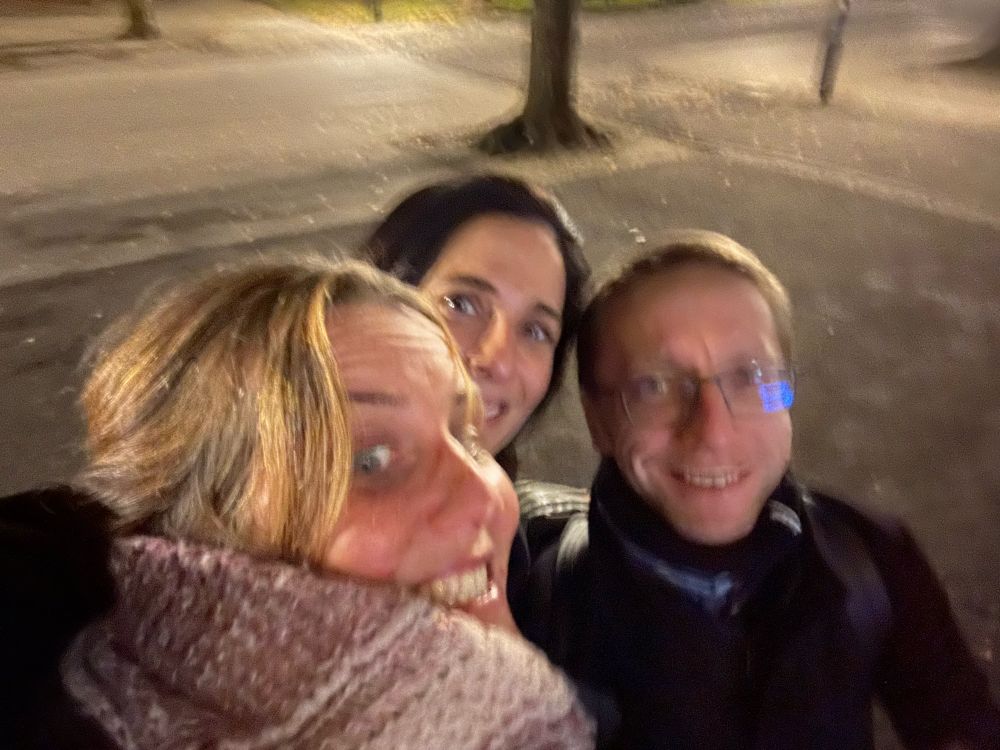
I had a blast💥visiting @unil.bsky.social! I loved sharing our work on species interactions and evolution of learning, and having lively discussions with everyone. Thank you @bentonlab.bsky.social and @nvastenhouw.bsky.social for the warm welcome — voir des amis qui cartonnent is always ❤️warming!😘
December 18, 2024 at 1:18 PM
I had a blast💥visiting @unil.bsky.social! I loved sharing our work on species interactions and evolution of learning, and having lively discussions with everyone. Thank you @bentonlab.bsky.social and @nvastenhouw.bsky.social for the warm welcome — voir des amis qui cartonnent is always ❤️warming!😘
November 18, 2024 at 11:55 PM
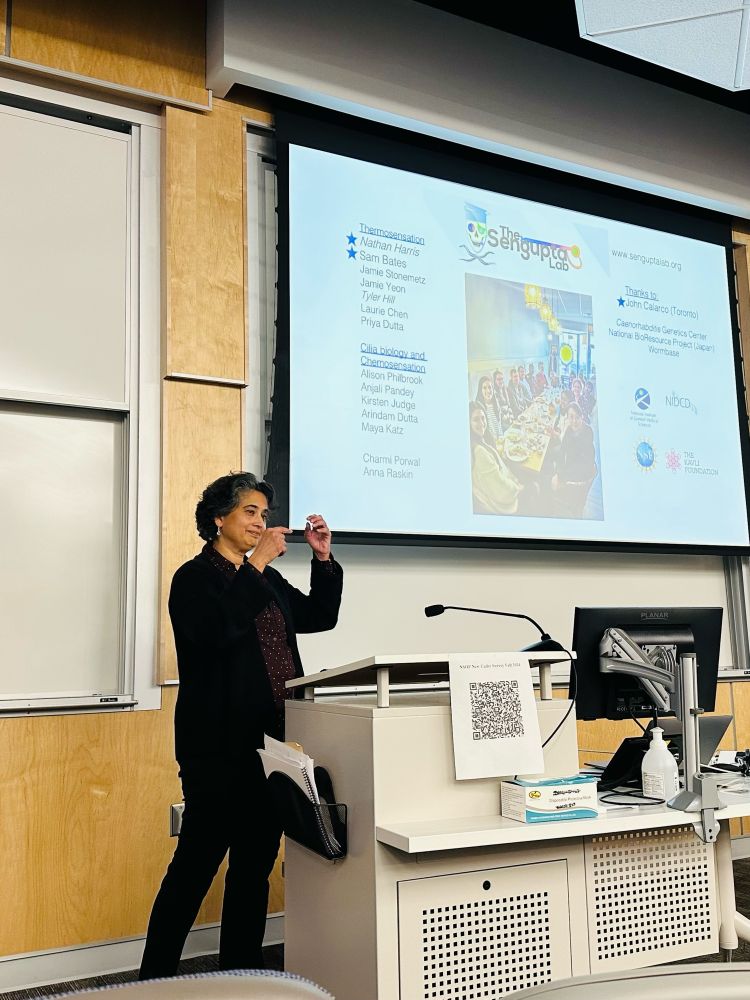
Thank you @senguptalab.bsky.social for an awe-inspiring talk on how a single thermosensory neuron encodes experience through intricate molecular signaling — a much-needed reminder, today, that curiosity-driven science can unlock the secrets of the natural world and the 🧩🧩🧩 that is the 🧠. #Onward 🧪🪱
November 15, 2024 at 4:10 AM
Thank you @senguptalab.bsky.social for an awe-inspiring talk on how a single thermosensory neuron encodes experience through intricate molecular signaling — a much-needed reminder, today, that curiosity-driven science can unlock the secrets of the natural world and the 🧩🧩🧩 that is the 🧠. #Onward 🧪🪱
They say drosophilists always speak last at #entsoc2024 — a rite of passage for those sort of entomologists… 🤷♀️ They also say save the best for last!! 🤭 Calling on all bug lovers: don’t miss InFormers: Computational Insights from the Insect Nervous System led by @tedpavlic.bsky.social TODAY in 126B!

a robot with the word awesome written on it
ALT: a robot with the word awesome written on it
media.tenor.com
November 13, 2024 at 3:28 PM
They say drosophilists always speak last at #entsoc2024 — a rite of passage for those sort of entomologists… 🤷♀️ They also say save the best for last!! 🤭 Calling on all bug lovers: don’t miss InFormers: Computational Insights from the Insect Nervous System led by @tedpavlic.bsky.social TODAY in 126B!
Reposted by Sophie Caron

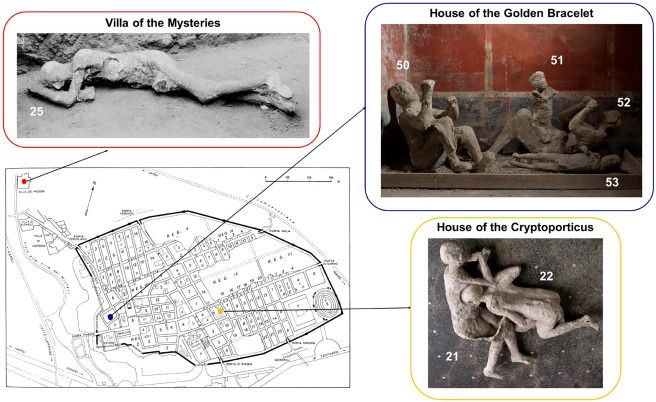
We're 'Current' Biology, but we love studies of history through the lens of modern science.
Often such studies challenge the archaeological or historical narrative.
Like the story of the plaster casts of #Pompeii as told by #DNA 🌋🏚️🧬🧪👇👇👇👇
cell.com/current-biol...
Often such studies challenge the archaeological or historical narrative.
Like the story of the plaster casts of #Pompeii as told by #DNA 🌋🏚️🧬🧪👇👇👇👇
cell.com/current-biol...
November 11, 2024 at 4:27 PM
We're 'Current' Biology, but we love studies of history through the lens of modern science.
Often such studies challenge the archaeological or historical narrative.
Like the story of the plaster casts of #Pompeii as told by #DNA 🌋🏚️🧬🧪👇👇👇👇
cell.com/current-biol...
Often such studies challenge the archaeological or historical narrative.
Like the story of the plaster casts of #Pompeii as told by #DNA 🌋🏚️🧬🧪👇👇👇👇
cell.com/current-biol...
Reposted by Sophie Caron
Every year we invite a late-stage #PhD student working in circuit #neuroscience or neurogenetics to present their research at our lab meeting at Durham University (UK).
Are you interested? Then do get in touch! Dates are flexible between January-March 2024.
#neuroskyence
Are you interested? Then do get in touch! Dates are flexible between January-March 2024.
#neuroskyence
November 11, 2024 at 9:09 PM
Every year we invite a late-stage #PhD student working in circuit #neuroscience or neurogenetics to present their research at our lab meeting at Durham University (UK).
Are you interested? Then do get in touch! Dates are flexible between January-March 2024.
#neuroskyence
Are you interested? Then do get in touch! Dates are flexible between January-March 2024.
#neuroskyence
Reposted by Sophie Caron
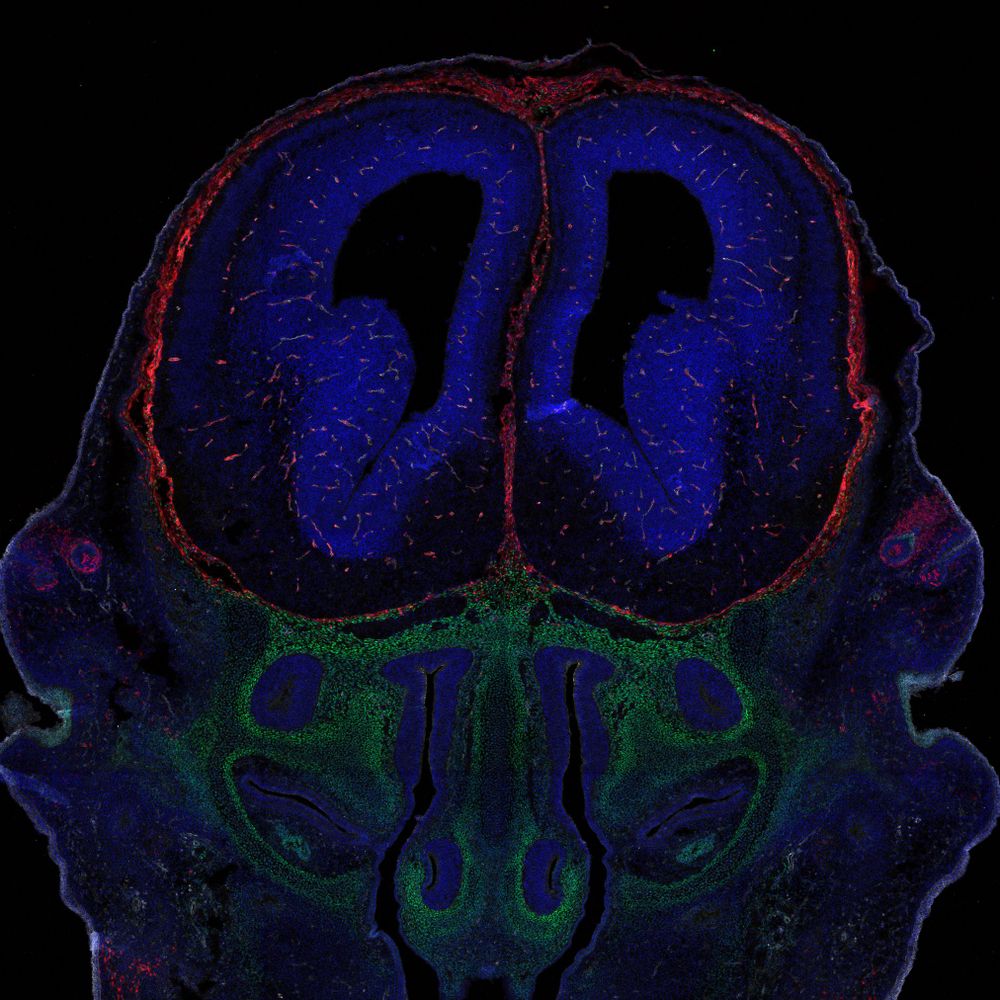
🧪
Opening for a lab manager/Res Asst! This is a great position if you want more research experience (& perhaps co-author a paper or two!) before heading to grad school. We are a sociable, supportive, inclusive, and dynamic group - come join us.
brandeis.wd5.myworkdayjobs.com/Jobs/job/Bra...
Opening for a lab manager/Res Asst! This is a great position if you want more research experience (& perhaps co-author a paper or two!) before heading to grad school. We are a sociable, supportive, inclusive, and dynamic group - come join us.
brandeis.wd5.myworkdayjobs.com/Jobs/job/Bra...

Research Technician
The Sengupta lab (www.senguptalab.org) in the Department of Biology at Brandeis University is looking for a responsible and organized individual to join the lab as a Research Technician. The lab is a ...
brandeis.wd5.myworkdayjobs.com
November 10, 2024 at 3:05 PM
1/ I cannot think of a better first post in the fresh blue sky to introduce the Caron lab than a thread about 👾Arc👾 and our newest preprint. So, buckle up science butterflies!🦋🧞♂️ #neuroscience #Drosophila #ArcGenes #WomenInSTEM
a bunch of butterflies flying in a blue sky with the words sci-universe below them
ALT: a bunch of butterflies flying in a blue sky with the words sci-universe below them
media.tenor.com
November 10, 2024 at 2:16 AM
1/ I cannot think of a better first post in the fresh blue sky to introduce the Caron lab than a thread about 👾Arc👾 and our newest preprint. So, buckle up science butterflies!🦋🧞♂️ #neuroscience #Drosophila #ArcGenes #WomenInSTEM