



Runhao Lu | 陆润豪
@runhaolu.bsky.social
CIHR Postdoc Fellow at the MNI @theneuro.bsky.social | PhD @mrccbu.bsky.social in Cambridge | Cognitive control, Attention, Domain-general brain networks | Multimodal neuroimaging | Gates Cambridge Scholar
Pinned
Runhao Lu | 陆润豪
@runhaolu.bsky.social
· Nov 17

🚨New Results! Really excited to share this work -
Feedback doesn’t just signal right or wrong, it reorganizes population geometry of learning targets in vlPFC, moving representations toward future retrieval states. Notably, oscillations (TG-PAC & beta) gate when this transformation occurs.
🧵👇
Feedback doesn’t just signal right or wrong, it reorganizes population geometry of learning targets in vlPFC, moving representations toward future retrieval states. Notably, oscillations (TG-PAC & beta) gate when this transformation occurs.
🧵👇
Reposted by Runhao Lu | 陆润豪

Soon hiring a lab manager! Looking for someone who is really interested in language neuroscience, who is organised, motivated, a great communicator, and who works well in a research team. Express interest by submitting this form: tinyurl.com/glysn-labman...
Reposts appreciated!
Reposts appreciated!
tinyurl.com
February 3, 2026 at 4:14 PM
Soon hiring a lab manager! Looking for someone who is really interested in language neuroscience, who is organised, motivated, a great communicator, and who works well in a research team. Express interest by submitting this form: tinyurl.com/glysn-labman...
Reposts appreciated!
Reposts appreciated!
Reposted by Runhao Lu | 陆润豪

Great work by Roni Tibon (not on BlueSky) - surprising that negligible difference in fMRI correlates of semantic vs episodic retrieval?

Are episodic and semantic memory really that different? Using closely matched tasks, a new study found no substantial neural differences between recalling personal experiences and general knowledge: www.nature.com/articles/s41...

Neural activations and representations during episodic versus semantic memory retrieval - Nature Human Behaviour
In this Stage 2 Registered Report, Tibon et al. showed using fMRI that neural activity associated with successful memory retrieval did not differ between semantic and episodic memory, using a task wit...
www.nature.com
January 27, 2026 at 11:37 AM
Great work by Roni Tibon (not on BlueSky) - surprising that negligible difference in fMRI correlates of semantic vs episodic retrieval?
Reposted by Runhao Lu | 陆润豪

Ripple oscillations are central for memory and sleep.
But ripple detection in humans remains challenging. Here we introduce a simulation approach in @natcomms.nature.com as common ripple detectors mainly pick up 1/f noise and not genuine oscillations
👇
www.nature.com/articles/s41...
#neuroskyence
But ripple detection in humans remains challenging. Here we introduce a simulation approach in @natcomms.nature.com as common ripple detectors mainly pick up 1/f noise and not genuine oscillations
👇
www.nature.com/articles/s41...
#neuroskyence

Aperiodic 1/f noise drives ripple activity in humans - Nature Communications
How aperiodic 1/f noise drives ripple activity in human brain and impacts on ripple detections is not fully understood. Here authors show that ripple detections should be driven by the 1/f noise, whic...
www.nature.com
January 21, 2026 at 6:57 PM
Ripple oscillations are central for memory and sleep.
But ripple detection in humans remains challenging. Here we introduce a simulation approach in @natcomms.nature.com as common ripple detectors mainly pick up 1/f noise and not genuine oscillations
👇
www.nature.com/articles/s41...
#neuroskyence
But ripple detection in humans remains challenging. Here we introduce a simulation approach in @natcomms.nature.com as common ripple detectors mainly pick up 1/f noise and not genuine oscillations
👇
www.nature.com/articles/s41...
#neuroskyence
Reposted by Runhao Lu | 陆润豪

After 5 years of data collection, our WARN-D machine learning competition to forecast depression onset is now LIVE! We hope many of you will participate—we have incredibly rich data.
If you share a single thing of my lab this year, please make it this competition.
eiko-fried.com/warn-d-machi...
If you share a single thing of my lab this year, please make it this competition.
eiko-fried.com/warn-d-machi...

WARN-D machine learning competition is live » Eiko Fried
If you share one single thing of our team in 2026—on social media or per email with your colleagues—please let it be this machine learning competition. It was half a decade of work to get here, especi...
eiko-fried.com
January 7, 2026 at 7:39 PM
After 5 years of data collection, our WARN-D machine learning competition to forecast depression onset is now LIVE! We hope many of you will participate—we have incredibly rich data.
If you share a single thing of my lab this year, please make it this competition.
eiko-fried.com/warn-d-machi...
If you share a single thing of my lab this year, please make it this competition.
eiko-fried.com/warn-d-machi...
Reposted by Runhao Lu | 陆润豪
📆 updated for 2026!
list of summer schools & short courses in the realm of (computational) neuroscience or data analysis of EEG / MEG / LFP: 🔗 docs.google.com/spreadsheets...
list of summer schools & short courses in the realm of (computational) neuroscience or data analysis of EEG / MEG / LFP: 🔗 docs.google.com/spreadsheets...

various computational neuroscience / MEEG / LFP short courses and summer schools
docs.google.com
December 19, 2025 at 4:37 PM
📆 updated for 2026!
list of summer schools & short courses in the realm of (computational) neuroscience or data analysis of EEG / MEG / LFP: 🔗 docs.google.com/spreadsheets...
list of summer schools & short courses in the realm of (computational) neuroscience or data analysis of EEG / MEG / LFP: 🔗 docs.google.com/spreadsheets...
Reposted by Runhao Lu | 陆润豪

New paper in Imaging Neuroscience by Ajay D. Halai, Marta M. Correia, et al:
Comparing the effect of multi-gradient echo and multi-band fMRI during a semantic task
doi.org/10.1162/IMAG...
Comparing the effect of multi-gradient echo and multi-band fMRI during a semantic task
doi.org/10.1162/IMAG...

December 11, 2025 at 11:12 PM
New paper in Imaging Neuroscience by Ajay D. Halai, Marta M. Correia, et al:
Comparing the effect of multi-gradient echo and multi-band fMRI during a semantic task
doi.org/10.1162/IMAG...
Comparing the effect of multi-gradient echo and multi-band fMRI during a semantic task
doi.org/10.1162/IMAG...
Reposted by Runhao Lu | 陆润豪
fMRI signals “up,” but neural metabolism might be going “down.”
In our @natneuro.nature.com paper, we demonstrate that about 40% of voxels with robust BOLD responses exhibit opposite oxygen metabolism, revealing two distinct hemodynamic modes.
rdcu.be/eUPO8
funds @erc.europa.eu
#neuroskyence 🧵:
In our @natneuro.nature.com paper, we demonstrate that about 40% of voxels with robust BOLD responses exhibit opposite oxygen metabolism, revealing two distinct hemodynamic modes.
rdcu.be/eUPO8
funds @erc.europa.eu
#neuroskyence 🧵:

December 16, 2025 at 3:43 PM
fMRI signals “up,” but neural metabolism might be going “down.”
In our @natneuro.nature.com paper, we demonstrate that about 40% of voxels with robust BOLD responses exhibit opposite oxygen metabolism, revealing two distinct hemodynamic modes.
rdcu.be/eUPO8
funds @erc.europa.eu
#neuroskyence 🧵:
In our @natneuro.nature.com paper, we demonstrate that about 40% of voxels with robust BOLD responses exhibit opposite oxygen metabolism, revealing two distinct hemodynamic modes.
rdcu.be/eUPO8
funds @erc.europa.eu
#neuroskyence 🧵:
Reposted by Runhao Lu | 陆润豪

How distributed is the brain-wide network that is recruited for cognition? A Perspective by Matthew C. Rosen & David J. Freedman
#neuroscience #neuroskyence
www.nature.com/articles/s41...
#neuroscience #neuroskyence
www.nature.com/articles/s41...

How distributed is the brain-wide network that is recruited for cognition? - Nature Reviews Neuroscience
Both localized and distributed views on the functional organization of the brain have been put forward. In this Perspective, Rosen and Freedman examine the degree to which these two views account for ...
www.nature.com
December 4, 2025 at 9:30 AM
How distributed is the brain-wide network that is recruited for cognition? A Perspective by Matthew C. Rosen & David J. Freedman
#neuroscience #neuroskyence
www.nature.com/articles/s41...
#neuroscience #neuroskyence
www.nature.com/articles/s41...
Reposted by Runhao Lu | 陆润豪
New paper in Imaging Neuroscience by Runhao Lu, Elizabeth Pollitt & Alexandra Woolgar:
Distinct and complementary mechanisms of oscillatory and aperiodic alpha activity in visuospatial attention
doi.org/10.1162/IMAG...
Distinct and complementary mechanisms of oscillatory and aperiodic alpha activity in visuospatial attention
doi.org/10.1162/IMAG...

December 1, 2025 at 8:56 PM
New paper in Imaging Neuroscience by Runhao Lu, Elizabeth Pollitt & Alexandra Woolgar:
Distinct and complementary mechanisms of oscillatory and aperiodic alpha activity in visuospatial attention
doi.org/10.1162/IMAG...
Distinct and complementary mechanisms of oscillatory and aperiodic alpha activity in visuospatial attention
doi.org/10.1162/IMAG...
Reposted by Runhao Lu | 陆润豪

Please repost: another kind of Black-Friday deal!

November 28, 2025 at 6:43 PM
Please repost: another kind of Black-Friday deal!
Reposted by Runhao Lu | 陆润豪
Special issue of Neuropsychologia celebrating the career of John Duncan.
www.sciencedirect.com/special-issu...
#neuroscience
www.sciencedirect.com/special-issu...
#neuroscience
Neuropsychologia | Cooperating brain systems and intelligent behaviour: Special issue in honour of John Duncan | ScienceDirect.com by Elsevier
Throughout his distinguished career, John Duncan has made numerous influential contributions to understanding the behavioural and brain basis of attention and intelligence. John’s ideas, invariably co...
www.sciencedirect.com
November 27, 2025 at 2:29 PM
Special issue of Neuropsychologia celebrating the career of John Duncan.
www.sciencedirect.com/special-issu...
#neuroscience
www.sciencedirect.com/special-issu...
#neuroscience
Reposted by Runhao Lu | 陆润豪
We just published a paper in PNAS, showing microstructural changes to the hippocampus in aging and presymptomatic Alzheimer's disease - in humans, in vivo.
We continue to show the value of structural MRI beyond simply measuring large-scale atrophy!
Read here: ow.ly/1NvV50XkXnX
We continue to show the value of structural MRI beyond simply measuring large-scale atrophy!
Read here: ow.ly/1NvV50XkXnX
November 9, 2025 at 5:00 PM
We just published a paper in PNAS, showing microstructural changes to the hippocampus in aging and presymptomatic Alzheimer's disease - in humans, in vivo.
We continue to show the value of structural MRI beyond simply measuring large-scale atrophy!
Read here: ow.ly/1NvV50XkXnX
We continue to show the value of structural MRI beyond simply measuring large-scale atrophy!
Read here: ow.ly/1NvV50XkXnX
Reposted by Runhao Lu | 陆润豪

New pontification piece with @awestbrook.bsky.social and Jean Daunizeau, just out in TICS:
Why is cognitive effort experienced as costly?
(or why does it hurt to think)
never written a review paper before in my life, that was a new and unusual experience
Why is cognitive effort experienced as costly?
(or why does it hurt to think)
never written a review paper before in my life, that was a new and unusual experience

Why is cognitive effort experienced as costly?
A widespread observation is that people avoid mentally effortful courses of action,
and much recent work examining cognitive effort has explained subjective effort evaluation
– and, consequently, pref...
www.cell.com
November 19, 2025 at 2:48 PM
New pontification piece with @awestbrook.bsky.social and Jean Daunizeau, just out in TICS:
Why is cognitive effort experienced as costly?
(or why does it hurt to think)
never written a review paper before in my life, that was a new and unusual experience
Why is cognitive effort experienced as costly?
(or why does it hurt to think)
never written a review paper before in my life, that was a new and unusual experience
🚨New Results! Really excited to share this work -
Feedback doesn’t just signal right or wrong, it reorganizes population geometry of learning targets in vlPFC, moving representations toward future retrieval states. Notably, oscillations (TG-PAC & beta) gate when this transformation occurs.
🧵👇
Feedback doesn’t just signal right or wrong, it reorganizes population geometry of learning targets in vlPFC, moving representations toward future retrieval states. Notably, oscillations (TG-PAC & beta) gate when this transformation occurs.
🧵👇
November 17, 2025 at 6:11 PM
🚨New Results! Really excited to share this work -
Feedback doesn’t just signal right or wrong, it reorganizes population geometry of learning targets in vlPFC, moving representations toward future retrieval states. Notably, oscillations (TG-PAC & beta) gate when this transformation occurs.
🧵👇
Feedback doesn’t just signal right or wrong, it reorganizes population geometry of learning targets in vlPFC, moving representations toward future retrieval states. Notably, oscillations (TG-PAC & beta) gate when this transformation occurs.
🧵👇
Reposted by Runhao Lu | 陆润豪

Exciting news from the chairs of Biomag 2026, Prof. Jiahong Gao and Prof. Huan Luo — the conference website is now live: biomag2026.scimeeting.cn The meetings take place in Beijing, 23–25 August 2026. Save the date and start thinking about ideas for posters and symposia! Please share with colleagues

BIOMAG 2025,在线会议,会议直播平台,网络会议直播,美迪康会务通,学术会议管理系统,会议活动管理,注册签到管理,会场幻灯片传输转播,PPT传输,会议网络直播,电子壁报管理系统,医学会,会员管理系统
biomag2026.scimeeting.cn
November 11, 2025 at 5:28 PM
Exciting news from the chairs of Biomag 2026, Prof. Jiahong Gao and Prof. Huan Luo — the conference website is now live: biomag2026.scimeeting.cn The meetings take place in Beijing, 23–25 August 2026. Save the date and start thinking about ideas for posters and symposia! Please share with colleagues
Now out in Imaging Neuroscience! Using TMS-EEG, we showed that alpha rh-TMS could differentiatially modulate alpha oscillations and aperiodic activity, and then improved representation of visuospatial attention. #TMS #EEG
doi.org/10.1162/IMAG...
doi.org/10.1162/IMAG...
November 11, 2025 at 3:26 AM
Now out in Imaging Neuroscience! Using TMS-EEG, we showed that alpha rh-TMS could differentiatially modulate alpha oscillations and aperiodic activity, and then improved representation of visuospatial attention. #TMS #EEG
doi.org/10.1162/IMAG...
doi.org/10.1162/IMAG...
Reposted by Runhao Lu | 陆润豪
🎓Recruiting Ph.D. students for Fall 2026!🎓
The Feilong Lab @sc.edu studies commonalities & differences across brains, and how they relate to cognition, language, & disorders.
We develop brain templates, improve hyperalignment, and compare human brains with monkey brains & DNNs.
feilonglab.github.io
The Feilong Lab @sc.edu studies commonalities & differences across brains, and how they relate to cognition, language, & disorders.
We develop brain templates, improve hyperalignment, and compare human brains with monkey brains & DNNs.
feilonglab.github.io
Feilong Lab @ UofSC — Feilong Lab
feilonglab.github.io
November 7, 2025 at 5:55 PM
🎓Recruiting Ph.D. students for Fall 2026!🎓
The Feilong Lab @sc.edu studies commonalities & differences across brains, and how they relate to cognition, language, & disorders.
We develop brain templates, improve hyperalignment, and compare human brains with monkey brains & DNNs.
feilonglab.github.io
The Feilong Lab @sc.edu studies commonalities & differences across brains, and how they relate to cognition, language, & disorders.
We develop brain templates, improve hyperalignment, and compare human brains with monkey brains & DNNs.
feilonglab.github.io
Reposted by Runhao Lu | 陆润豪

Many thanks to the 60 gorgeous #TMS researchers who took a few minutes to complete our user survey.
The quantitative results have been processed and summarised, and are now available in full on our GitHub page:
github.com/TMSMultiLab/...
A quick breakdown follows in this thread:
#PieChartHeaven
The quantitative results have been processed and summarised, and are now available in full on our GitHub page:
github.com/TMSMultiLab/...
A quick breakdown follows in this thread:
#PieChartHeaven

TMS User Survey
Resources, data and code to help you run a TMS laboratory - TMSMultiLab/TMSMultiLab
github.com
November 2, 2025 at 1:34 PM
Many thanks to the 60 gorgeous #TMS researchers who took a few minutes to complete our user survey.
The quantitative results have been processed and summarised, and are now available in full on our GitHub page:
github.com/TMSMultiLab/...
A quick breakdown follows in this thread:
#PieChartHeaven
The quantitative results have been processed and summarised, and are now available in full on our GitHub page:
github.com/TMSMultiLab/...
A quick breakdown follows in this thread:
#PieChartHeaven
Reposted by Runhao Lu | 陆润豪

This was a fabulous, once in a lifetime colloquium -- and now the videos are available in high quality on the College de France web site @college-de-france.fr
www.college-de-france.fr/fr/agenda/co...
With talks by Edvard Moser, Nancy Kanwisher, Liz Spelke, Manuela Piazza, Luca Bonatti and more!
www.college-de-france.fr/fr/agenda/co...
With talks by Edvard Moser, Nancy Kanwisher, Liz Spelke, Manuela Piazza, Luca Bonatti and more!
November 2, 2025 at 3:08 PM
This was a fabulous, once in a lifetime colloquium -- and now the videos are available in high quality on the College de France web site @college-de-france.fr
www.college-de-france.fr/fr/agenda/co...
With talks by Edvard Moser, Nancy Kanwisher, Liz Spelke, Manuela Piazza, Luca Bonatti and more!
www.college-de-france.fr/fr/agenda/co...
With talks by Edvard Moser, Nancy Kanwisher, Liz Spelke, Manuela Piazza, Luca Bonatti and more!
Reposted by Runhao Lu | 陆润豪

Open postdoc position👈
We have an open position, starting early 2026, to work on an exciting project aiming at better understanding the role of thalamo-cortical brain oscillations in perception with a comparative, cross-species (animal-human) component based on electrophysiology (incl. scalp EEG).
We have an open position, starting early 2026, to work on an exciting project aiming at better understanding the role of thalamo-cortical brain oscillations in perception with a comparative, cross-species (animal-human) component based on electrophysiology (incl. scalp EEG).
September 27, 2025 at 11:21 AM
Open postdoc position👈
We have an open position, starting early 2026, to work on an exciting project aiming at better understanding the role of thalamo-cortical brain oscillations in perception with a comparative, cross-species (animal-human) component based on electrophysiology (incl. scalp EEG).
We have an open position, starting early 2026, to work on an exciting project aiming at better understanding the role of thalamo-cortical brain oscillations in perception with a comparative, cross-species (animal-human) component based on electrophysiology (incl. scalp EEG).
Reposted by Runhao Lu | 陆润豪
In our Trends in Cogn Sci paper we point to the connectivity crisis in task-based human EEG/MEG research: many connectivity metrics, too little replication. Time for community-wide benchmarking to build robust, generalisable measures across labs & tasks. www.sciencedirect.com/science/arti...
Confronting the connectivity crisis in human M/EEG research
The cognitive neuroscience community using M/EEG has not converged on measures of task-related inter-regional brain connectivity that generalize acros…
www.sciencedirect.com
September 18, 2025 at 3:23 PM
In our Trends in Cogn Sci paper we point to the connectivity crisis in task-based human EEG/MEG research: many connectivity metrics, too little replication. Time for community-wide benchmarking to build robust, generalisable measures across labs & tasks. www.sciencedirect.com/science/arti...
Reposted by Runhao Lu | 陆润豪

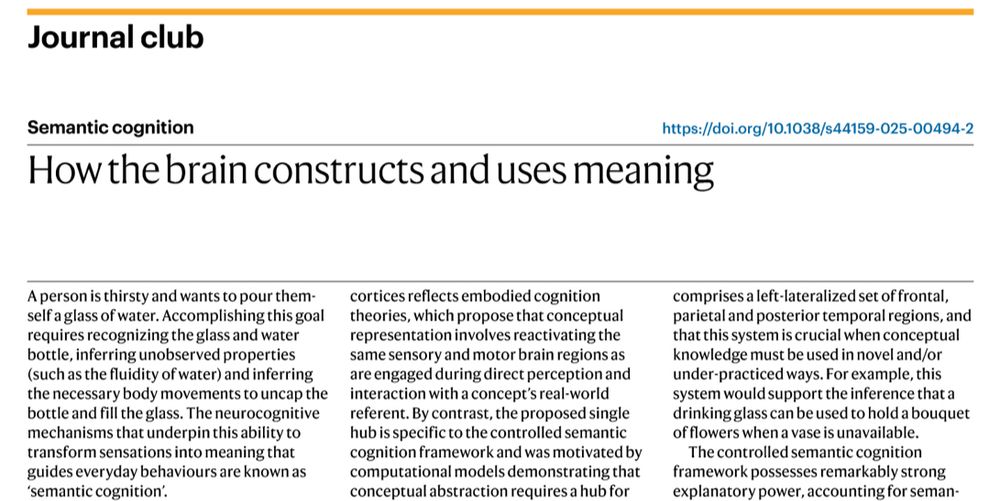
🧠 Interested in how the brain constructs and uses meaning?
In my Journal Club piece for @natrevpsychol.nature.com, I summarize the Controlled Semantic Cognition Framework by Lambon Ralph et al. — a leading model of how the brain represents and flexibly applies semantic knowledge.
👉🏼 rdcu.be/eE31i
In my Journal Club piece for @natrevpsychol.nature.com, I summarize the Controlled Semantic Cognition Framework by Lambon Ralph et al. — a leading model of how the brain represents and flexibly applies semantic knowledge.
👉🏼 rdcu.be/eE31i
September 9, 2025 at 1:54 PM
🧠 Interested in how the brain constructs and uses meaning?
In my Journal Club piece for @natrevpsychol.nature.com, I summarize the Controlled Semantic Cognition Framework by Lambon Ralph et al. — a leading model of how the brain represents and flexibly applies semantic knowledge.
👉🏼 rdcu.be/eE31i
In my Journal Club piece for @natrevpsychol.nature.com, I summarize the Controlled Semantic Cognition Framework by Lambon Ralph et al. — a leading model of how the brain represents and flexibly applies semantic knowledge.
👉🏼 rdcu.be/eE31i
Reposted by Runhao Lu | 陆润豪
Launched in 2023, Imaging Neuroscience is now firmly established, with full indexing (PubMed, etc.) and 700 papers to date.
We're very happy to announce that we are able to reduce the APC to $1400.
Huge thanks to all authors, reviewers, editorial team+board, and MIT Press.
We're very happy to announce that we are able to reduce the APC to $1400.
Huge thanks to all authors, reviewers, editorial team+board, and MIT Press.
September 5, 2025 at 2:59 AM
Launched in 2023, Imaging Neuroscience is now firmly established, with full indexing (PubMed, etc.) and 700 papers to date.
We're very happy to announce that we are able to reduce the APC to $1400.
Huge thanks to all authors, reviewers, editorial team+board, and MIT Press.
We're very happy to announce that we are able to reduce the APC to $1400.
Huge thanks to all authors, reviewers, editorial team+board, and MIT Press.
Reposted by Runhao Lu | 陆润豪
Large-scale cortical functional networks are organized in structured cycles
🧠🟦 🧠🤖
www.nature.com/articles/s41...
🧠🟦 🧠🤖
www.nature.com/articles/s41...

Large-scale cortical functional networks are organized in structured cycles - Nature Neuroscience
The human brain cycles through a repertoire of brain networks on a 1-second timescale during rest and tasks. This cycling appears to allow periodic engagement of essential cognitive functions, with th...
www.nature.com
August 28, 2025 at 7:19 AM
Large-scale cortical functional networks are organized in structured cycles
🧠🟦 🧠🤖
www.nature.com/articles/s41...
🧠🟦 🧠🤖
www.nature.com/articles/s41...
Reposted by Runhao Lu | 陆润豪
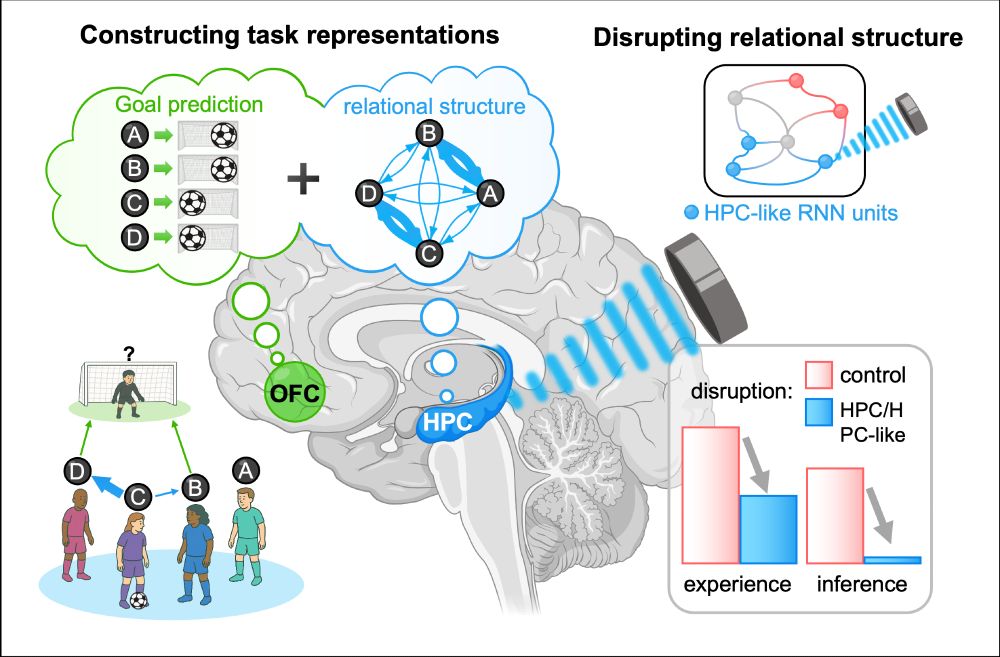
🚨We believe this is a major step forward in how we study hippocampus function in healthy humans.
Using novel behavioral tasks, fMRI, RL & RNN modeling, and transcranial ultrasound stimulation (TUS), we demonstrate the causal role of hippocampus in relational structure learning.
Using novel behavioral tasks, fMRI, RL & RNN modeling, and transcranial ultrasound stimulation (TUS), we demonstrate the causal role of hippocampus in relational structure learning.
August 28, 2025 at 2:00 PM
🚨We believe this is a major step forward in how we study hippocampus function in healthy humans.
Using novel behavioral tasks, fMRI, RL & RNN modeling, and transcranial ultrasound stimulation (TUS), we demonstrate the causal role of hippocampus in relational structure learning.
Using novel behavioral tasks, fMRI, RL & RNN modeling, and transcranial ultrasound stimulation (TUS), we demonstrate the causal role of hippocampus in relational structure learning.