



Rabiraj Banerjee
@rabirajb.bsky.social
I focus on data learnability, model representation and uncertainty for subjective NLP tasks
PhDing on Interpretable NLP + CSS @gesis.org Prev: Masters Student + Researcher at @ubuffalo.bsky.social and Sr. Data Scientist at Coursera
PhDing on Interpretable NLP + CSS @gesis.org Prev: Masters Student + Researcher at @ubuffalo.bsky.social and Sr. Data Scientist at Coursera
Reposted by Rabiraj Banerjee

Why don’t neural networks learn all at once, but instead progress from simple to complex solutions? And what does “simple” even mean across different neural network architectures?
Sharing our new paper @iclr_conf led by Yedi Zhang with Peter Latham
arxiv.org/abs/2512.20607
Sharing our new paper @iclr_conf led by Yedi Zhang with Peter Latham
arxiv.org/abs/2512.20607
February 3, 2026 at 4:19 PM
Why don’t neural networks learn all at once, but instead progress from simple to complex solutions? And what does “simple” even mean across different neural network architectures?
Sharing our new paper @iclr_conf led by Yedi Zhang with Peter Latham
arxiv.org/abs/2512.20607
Sharing our new paper @iclr_conf led by Yedi Zhang with Peter Latham
arxiv.org/abs/2512.20607
Reposted by Rabiraj Banerjee
1/ 🌍 How does mixing data from hundreds of languages affect LLM training?
In our new paper "Revisiting Multilingual Data Mixtures in Language Model Pretraining" we revisit core assumptions about multilinguality using 1.1B-3B models trained on up to 400 languages.
🧵👇
In our new paper "Revisiting Multilingual Data Mixtures in Language Model Pretraining" we revisit core assumptions about multilinguality using 1.1B-3B models trained on up to 400 languages.
🧵👇
December 15, 2025 at 6:18 PM
1/ 🌍 How does mixing data from hundreds of languages affect LLM training?
In our new paper "Revisiting Multilingual Data Mixtures in Language Model Pretraining" we revisit core assumptions about multilinguality using 1.1B-3B models trained on up to 400 languages.
🧵👇
In our new paper "Revisiting Multilingual Data Mixtures in Language Model Pretraining" we revisit core assumptions about multilinguality using 1.1B-3B models trained on up to 400 languages.
🧵👇
Reposted by Rabiraj Banerjee

So @lchoshen.bsky.social posted a thread on X about how different training runs tend to converge, and I just had to argue with him. Training variation is fascinating, and I think we've kinda cracked it!
x.com
December 12, 2025 at 6:53 PM
So @lchoshen.bsky.social posted a thread on X about how different training runs tend to converge, and I just had to argue with him. Training variation is fascinating, and I think we've kinda cracked it!
Reposted by Rabiraj Banerjee

we released Olmo 3! lot of exciting stuff but wanna focus on:
🐟Olmo 3 32B Base, the best fully-open base model to-date, near Qwen 2.5 & Gemma 3 on diverse evals
🐠Olmo 3 32B Think, first fully-open reasoning model approaching Qwen 3 levels
🐡12 training datasets corresp to different staged training
🐟Olmo 3 32B Base, the best fully-open base model to-date, near Qwen 2.5 & Gemma 3 on diverse evals
🐠Olmo 3 32B Think, first fully-open reasoning model approaching Qwen 3 levels
🐡12 training datasets corresp to different staged training


November 20, 2025 at 6:20 PM
we released Olmo 3! lot of exciting stuff but wanna focus on:
🐟Olmo 3 32B Base, the best fully-open base model to-date, near Qwen 2.5 & Gemma 3 on diverse evals
🐠Olmo 3 32B Think, first fully-open reasoning model approaching Qwen 3 levels
🐡12 training datasets corresp to different staged training
🐟Olmo 3 32B Base, the best fully-open base model to-date, near Qwen 2.5 & Gemma 3 on diverse evals
🐠Olmo 3 32B Think, first fully-open reasoning model approaching Qwen 3 levels
🐡12 training datasets corresp to different staged training
Reposted by Rabiraj Banerjee

I’m excited to share our Findings of EMNLP paper w/ @cocoscilab.bsky.social , @rtommccoy.bsky.social, and @rdhawkins.bsky.social !
Language models, unlike humans, require large amounts of data, which suggests the need for an inductive bias.
But what kind of inductive biases do we need?
Language models, unlike humans, require large amounts of data, which suggests the need for an inductive bias.
But what kind of inductive biases do we need?

November 7, 2025 at 9:17 AM
I’m excited to share our Findings of EMNLP paper w/ @cocoscilab.bsky.social , @rtommccoy.bsky.social, and @rdhawkins.bsky.social !
Language models, unlike humans, require large amounts of data, which suggests the need for an inductive bias.
But what kind of inductive biases do we need?
Language models, unlike humans, require large amounts of data, which suggests the need for an inductive bias.
But what kind of inductive biases do we need?
Reposted by Rabiraj Banerjee
In the year since LRMs ("reasoning models") hit the scene, we have been trying to understand, analyze and demystify them.. Here are our efforts to date--conveniently all in one place..👇
www.linkedin.com/posts/subbar...
www.linkedin.com/posts/subbar...

In the year since LRMs ("reasoning models") hit the scene, we have been trying to understand, analyze and demystify them.. Here are our efforts to date--conveniently all in one… | Subbarao K...
In the year since LRMs ("reasoning models") hit the scene, we have been trying to understand, analyze and demystify them.. Here are our efforts to date--conveniently all in one place..
(𝗙𝗶𝗿𝘀𝘁..) 𝗘𝘃𝗮𝗹...
www.linkedin.com
September 14, 2025 at 10:00 PM
In the year since LRMs ("reasoning models") hit the scene, we have been trying to understand, analyze and demystify them.. Here are our efforts to date--conveniently all in one place..👇
www.linkedin.com/posts/subbar...
www.linkedin.com/posts/subbar...
Reposted by Rabiraj Banerjee

A Survey of Reinforcement Learning for Large Reasoning Models
Five sections:
- Foundational Components
- Foundational Problems
- Training Resources
- Applications
- Future Directions
Five sections:
- Foundational Components
- Foundational Problems
- Training Resources
- Applications
- Future Directions

September 11, 2025 at 11:42 PM
A Survey of Reinforcement Learning for Large Reasoning Models
Five sections:
- Foundational Components
- Foundational Problems
- Training Resources
- Applications
- Future Directions
Five sections:
- Foundational Components
- Foundational Problems
- Training Resources
- Applications
- Future Directions
Reposted by Rabiraj Banerjee

When reading AI reasoning text (aka CoT), we (humans) form a narrative about the underlying computation process, which we take as a transparent explanation of model behavior. But what if our narratives are wrong? We measure that and find it usually is.
Now on arXiv: arxiv.org/abs/2508.16599
Now on arXiv: arxiv.org/abs/2508.16599

Humans Perceive Wrong Narratives from AI Reasoning Texts
A new generation of AI models generates step-by-step reasoning text before producing an answer. This text appears to offer a human-readable window into their computation process, and is increasingly r...
arxiv.org
August 27, 2025 at 9:30 PM
When reading AI reasoning text (aka CoT), we (humans) form a narrative about the underlying computation process, which we take as a transparent explanation of model behavior. But what if our narratives are wrong? We measure that and find it usually is.
Now on arXiv: arxiv.org/abs/2508.16599
Now on arXiv: arxiv.org/abs/2508.16599
Reposted by Rabiraj Banerjee

Great interview with @stevenstrogatz.com with a lot of discussion of research advising. Parts reminded me of @eegilbert.org and @informor.bsky.social's (excellent) guides to PhD mentorship, with a big focus on ideation.
Eric's: docs.google.com/document/d/1...
Mor's: s.tech.cornell.edu/phd-syllabus/
Eric's: docs.google.com/document/d/1...
Mor's: s.tech.cornell.edu/phd-syllabus/
August 24, 2025 at 2:26 PM
Great interview with @stevenstrogatz.com with a lot of discussion of research advising. Parts reminded me of @eegilbert.org and @informor.bsky.social's (excellent) guides to PhD mentorship, with a big focus on ideation.
Eric's: docs.google.com/document/d/1...
Mor's: s.tech.cornell.edu/phd-syllabus/
Eric's: docs.google.com/document/d/1...
Mor's: s.tech.cornell.edu/phd-syllabus/
Reposted by Rabiraj Banerjee

We try to avoid self-promoting too much, but we (with @sjgreenwood.bsky.social) built a personalized feed with posts about papers from your network. Many people say it's the closest they can get to old academic twitter, and I hope you enjoy it and share with others too!
bsky.app/profile/pape...
bsky.app/profile/pape...
**Please repost** If you're enjoying Paper Skygest -- our personalized feed of academic content on Bluesky -- we'd appreciate you reposting this! We’ve found that the most effective way for us to reach new users and communities is through users sharing it with their network
August 20, 2025 at 12:46 PM
We try to avoid self-promoting too much, but we (with @sjgreenwood.bsky.social) built a personalized feed with posts about papers from your network. Many people say it's the closest they can get to old academic twitter, and I hope you enjoy it and share with others too!
bsky.app/profile/pape...
bsky.app/profile/pape...
Reposted by Rabiraj Banerjee


Reposted by Rabiraj Banerjee

🤖 But wait! There's more! You can check out @shiraamitchell.bsky.social 's most recent update on the details of Calibration, posted yesterday! statmodeling.stat.columbia.edu/2025/08/12/s...
August 13, 2025 at 6:38 PM
🤖 But wait! There's more! You can check out @shiraamitchell.bsky.social 's most recent update on the details of Calibration, posted yesterday! statmodeling.stat.columbia.edu/2025/08/12/s...
Reposted by Rabiraj Banerjee
#acl2025 anyone get a good quote of phil resnik's last comment?
context: (some?all?) panelists & him agree the field needs more deep, careful research on smaller models to do better science. everyone is frustrated with impossibility of large-scale pretraining experiments
context: (some?all?) panelists & him agree the field needs more deep, careful research on smaller models to do better science. everyone is frustrated with impossibility of large-scale pretraining experiments
July 28, 2025 at 3:24 PM
#acl2025 anyone get a good quote of phil resnik's last comment?
context: (some?all?) panelists & him agree the field needs more deep, careful research on smaller models to do better science. everyone is frustrated with impossibility of large-scale pretraining experiments
context: (some?all?) panelists & him agree the field needs more deep, careful research on smaller models to do better science. everyone is frustrated with impossibility of large-scale pretraining experiments
@kennyjoseph.bsky.social , Kenny check this thread out
What are your favorite recent papers on using LMs for annotation (especially in a loop with human annotators), synthetic data for task-specific prediction, active learning, and similar?
Looking for practical methods for settings where human annotations are costly.
A few examples in thread ↴
Looking for practical methods for settings where human annotations are costly.
A few examples in thread ↴
July 24, 2025 at 11:38 AM
@kennyjoseph.bsky.social , Kenny check this thread out
Reposted by Rabiraj Banerjee

What are your favorite recent papers on using LMs for annotation (especially in a loop with human annotators), synthetic data for task-specific prediction, active learning, and similar?
Looking for practical methods for settings where human annotations are costly.
A few examples in thread ↴
Looking for practical methods for settings where human annotations are costly.
A few examples in thread ↴
July 23, 2025 at 8:10 AM
What are your favorite recent papers on using LMs for annotation (especially in a loop with human annotators), synthetic data for task-specific prediction, active learning, and similar?
Looking for practical methods for settings where human annotations are costly.
A few examples in thread ↴
Looking for practical methods for settings where human annotations are costly.
A few examples in thread ↴
Reposted by Rabiraj Banerjee
UB's new Department of AI and Society is hiring faculty across ranks (Assistant, Associate, Full Professor). We’re looking for transdisciplinary scholars interested in building AI by society, for society. Start dates begin Fall 2025.
More info: www.ubjobs.buffalo.edu/postings/57734
More info: www.ubjobs.buffalo.edu/postings/57734

Assistant, Associate or Full Professor, AI & Society
The Department of AI and Society (AIS) at the University at Buffalo (UB) invites candidates to apply for multiple positions as Assistant Professor, Associate Professor, or Full Professor. The new AIS ...
www.ubjobs.buffalo.edu
July 17, 2025 at 4:11 PM
UB's new Department of AI and Society is hiring faculty across ranks (Assistant, Associate, Full Professor). We’re looking for transdisciplinary scholars interested in building AI by society, for society. Start dates begin Fall 2025.
More info: www.ubjobs.buffalo.edu/postings/57734
More info: www.ubjobs.buffalo.edu/postings/57734
Reposted by Rabiraj Banerjee

Reposted by Rabiraj Banerjee

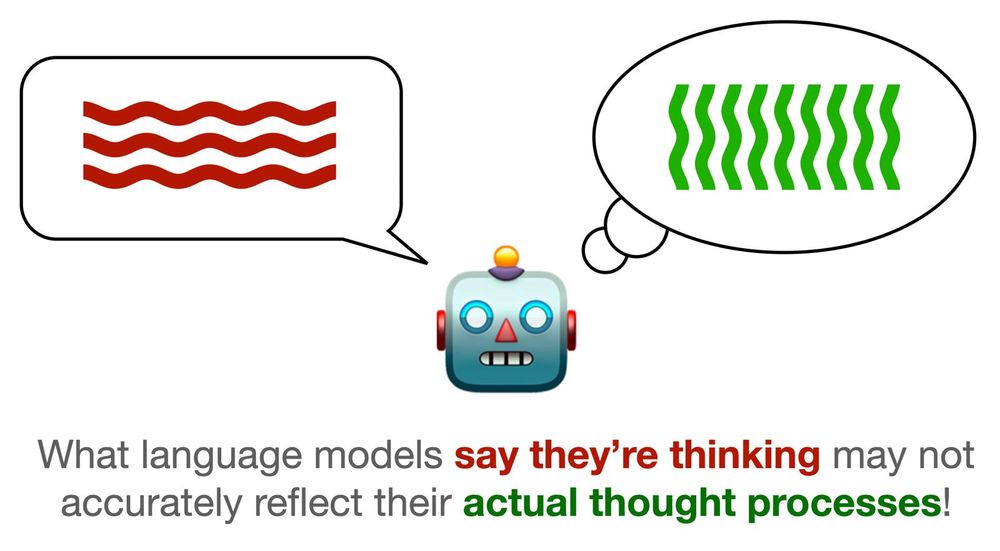
Check out our take on Chain-of-Thought.
I really like this paper as a survey on the current literature on what CoT is, but more importantly on what it's not.
It also serves as a cautionary tale to the (apparently quite common) misuse of CoT as an interpretable method.
I really like this paper as a survey on the current literature on what CoT is, but more importantly on what it's not.
It also serves as a cautionary tale to the (apparently quite common) misuse of CoT as an interpretable method.
Excited to share our paper: "Chain-of-Thought Is Not Explainability"! We unpack a critical misconception in AI: models explaining their steps (CoT) aren't necessarily revealing their true reasoning. Spoiler: the transparency can be an illusion. (1/9) 🧵
July 1, 2025 at 5:45 PM
Check out our take on Chain-of-Thought.
I really like this paper as a survey on the current literature on what CoT is, but more importantly on what it's not.
It also serves as a cautionary tale to the (apparently quite common) misuse of CoT as an interpretable method.
I really like this paper as a survey on the current literature on what CoT is, but more importantly on what it's not.
It also serves as a cautionary tale to the (apparently quite common) misuse of CoT as an interpretable method.
Reposted by Rabiraj Banerjee

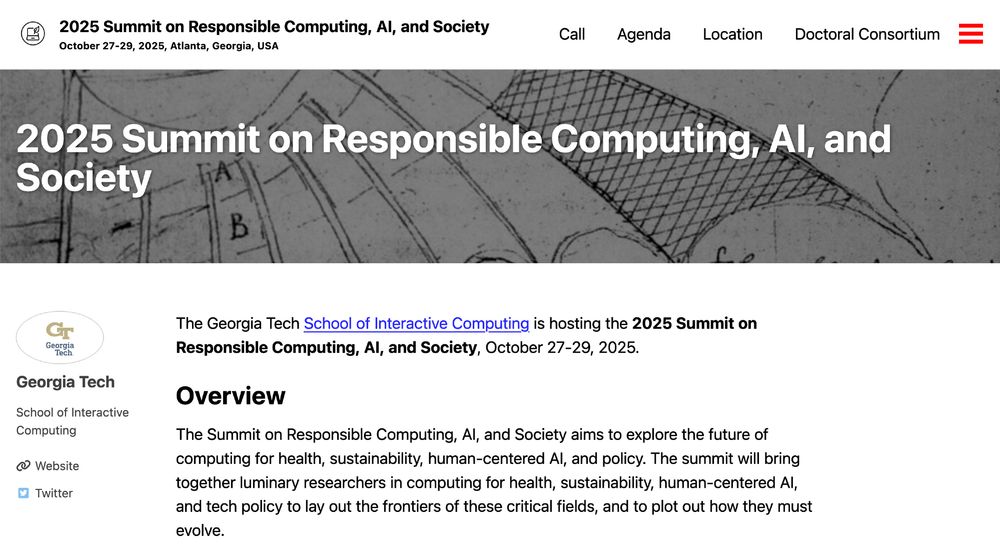
Hi everyone. I'm excited to announce that I will be organizing a 2nd Summit on Responsible Computing, AI, and Society rcais.github.io October 27-29, 2025.
We will explore the future of computing for health, sustainability, human-centered AI, and policy.
Please consider submitting a 1-page abstract
We will explore the future of computing for health, sustainability, human-centered AI, and policy.
Please consider submitting a 1-page abstract
July 1, 2025 at 4:41 PM
Hi everyone. I'm excited to announce that I will be organizing a 2nd Summit on Responsible Computing, AI, and Society rcais.github.io October 27-29, 2025.
We will explore the future of computing for health, sustainability, human-centered AI, and policy.
Please consider submitting a 1-page abstract
We will explore the future of computing for health, sustainability, human-centered AI, and policy.
Please consider submitting a 1-page abstract
So ICWSM concluded today and it was a blast, was a great honor to attend @icwsm.bsky.social at Copenhagen and present my work with @kennyjoseph.bsky.social and other colleagues. The paper link is here :
ojs.aaai.org/index.php/IC...,
ojs.aaai.org/index.php/IC...,
View of Measuring Dimensions of Self-Presentation in Twitter Bios and their Links to Misinformation Sharing
ojs.aaai.org
June 26, 2025 at 9:39 PM
So ICWSM concluded today and it was a blast, was a great honor to attend @icwsm.bsky.social at Copenhagen and present my work with @kennyjoseph.bsky.social and other colleagues. The paper link is here :
ojs.aaai.org/index.php/IC...,
ojs.aaai.org/index.php/IC...,
Reposted by Rabiraj Banerjee
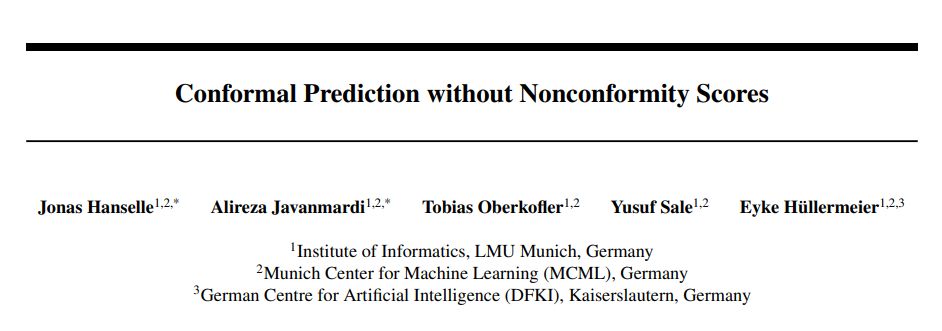
This is great! The idea is somewhat obvious (good!), and I'm sure many have toyed with the connection to learning-to-rank. However, no work had developed it. This should be relevant for constructing valid PIs from just preferential feedback. openreview.net/pdf?id=ENJd3...
June 26, 2025 at 11:17 AM
This is great! The idea is somewhat obvious (good!), and I'm sure many have toyed with the connection to learning-to-rank. However, no work had developed it. This should be relevant for constructing valid PIs from just preferential feedback. openreview.net/pdf?id=ENJd3...
Reposted by Rabiraj Banerjee
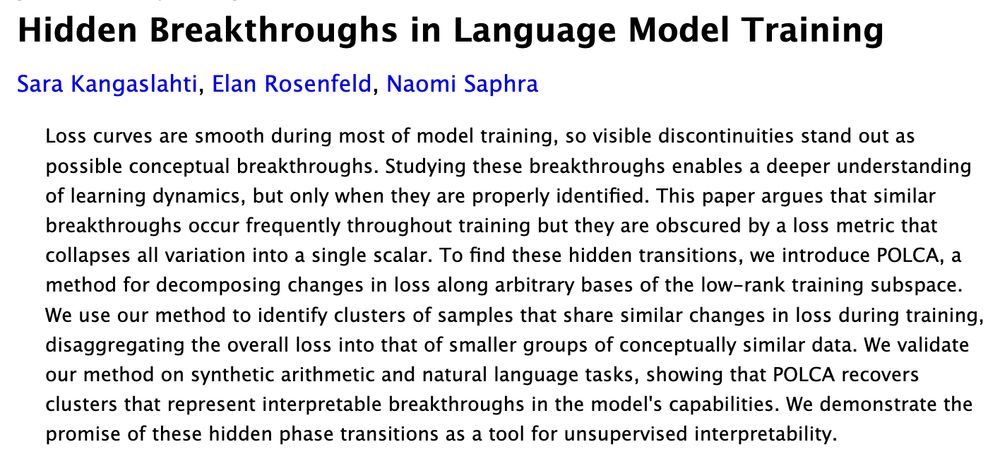
🚨 New preprint! 🚨
Phase transitions! We love to see them during LM training. Syntactic attention structure, induction heads, grokking; they seem to suggest the model has learned a discrete, interpretable concept. Unfortunately, they’re pretty rare—or are they?
Phase transitions! We love to see them during LM training. Syntactic attention structure, induction heads, grokking; they seem to suggest the model has learned a discrete, interpretable concept. Unfortunately, they’re pretty rare—or are they?
June 24, 2025 at 6:29 PM
🚨 New preprint! 🚨
Phase transitions! We love to see them during LM training. Syntactic attention structure, induction heads, grokking; they seem to suggest the model has learned a discrete, interpretable concept. Unfortunately, they’re pretty rare—or are they?
Phase transitions! We love to see them during LM training. Syntactic attention structure, induction heads, grokking; they seem to suggest the model has learned a discrete, interpretable concept. Unfortunately, they’re pretty rare—or are they?
Reposted by Rabiraj Banerjee

Generative language systems are everywhere, and many of them stereotype, demean, or erase particular social groups.
June 16, 2025 at 9:49 PM
Generative language systems are everywhere, and many of them stereotype, demean, or erase particular social groups.
Reposted by Rabiraj Banerjee
Alright, people, let's be honest: GenAI systems are everywhere, and figuring out whether they're any good is a total mess. Should we use them? Where? How? Do they need a total overhaul?
(1/6)
(1/6)
June 15, 2025 at 12:20 AM
Alright, people, let's be honest: GenAI systems are everywhere, and figuring out whether they're any good is a total mess. Should we use them? Where? How? Do they need a total overhaul?
(1/6)
(1/6)
Reposted by Rabiraj Banerjee

🧵 1/ Las redes están llenas de odio. ¿Puede la inteligencia artificial ayudarnos a detectarlo…
⚖️ sin discriminar,
🚫 sin reforzar estereotipos,
🔁 y sin aprender a odiar?
Esa es la gran pregunta de mi tesis.
👇 Te lo cuento en este #HiloTesis @crueuniversidades.bsky.social @filarramendi.bsky.social
⚖️ sin discriminar,
🚫 sin reforzar estereotipos,
🔁 y sin aprender a odiar?
Esa es la gran pregunta de mi tesis.
👇 Te lo cuento en este #HiloTesis @crueuniversidades.bsky.social @filarramendi.bsky.social
June 10, 2025 at 9:20 AM
🧵 1/ Las redes están llenas de odio. ¿Puede la inteligencia artificial ayudarnos a detectarlo…
⚖️ sin discriminar,
🚫 sin reforzar estereotipos,
🔁 y sin aprender a odiar?
Esa es la gran pregunta de mi tesis.
👇 Te lo cuento en este #HiloTesis @crueuniversidades.bsky.social @filarramendi.bsky.social
⚖️ sin discriminar,
🚫 sin reforzar estereotipos,
🔁 y sin aprender a odiar?
Esa es la gran pregunta de mi tesis.
👇 Te lo cuento en este #HiloTesis @crueuniversidades.bsky.social @filarramendi.bsky.social