




Nick Gaspelin
@ngaspelin.bsky.social
Associate Professor (he/him)
University of Missouri, Columbia
https://gaspelinblog.wordpress.com
attention | vision | eye movements | ERPs
University of Missouri, Columbia
https://gaspelinblog.wordpress.com
attention | vision | eye movements | ERPs
Reposted by Nick Gaspelin

❗New paper published in Cognition❗ "A common signal-strength factor limits awareness and precise knowledge of multiple moving objects across the adult lifespan" from Iris Wiegand, Igor S. Utochkin, Ava Mitra, Chia-Chien Wu, and Jeremy M. Wolfe
authors.elsevier.com/sd/article/S...
authors.elsevier.com/sd/article/S...
ScienceDirect.com | Science, health and medical journals, full text articles and books.
authors.elsevier.com
January 28, 2026 at 2:46 PM
❗New paper published in Cognition❗ "A common signal-strength factor limits awareness and precise knowledge of multiple moving objects across the adult lifespan" from Iris Wiegand, Igor S. Utochkin, Ava Mitra, Chia-Chien Wu, and Jeremy M. Wolfe
authors.elsevier.com/sd/article/S...
authors.elsevier.com/sd/article/S...
Elaine (my daughter) is officially the mascot for our Linux-based stimulus machines in the lab. All coding frustrations can now be addressed by viewing this picture.
>> sudo get-cuteness
>> sudo get-cuteness

January 9, 2026 at 4:55 PM
Elaine (my daughter) is officially the mascot for our Linux-based stimulus machines in the lab. All coding frustrations can now be addressed by viewing this picture.
>> sudo get-cuteness
>> sudo get-cuteness
Here's a new paper in which we analyzed >700,000 eye movements to understand attentional suppression of distracting stimuli. This large dataset helps resolve some longstanding questions about the timing and learning of suppression.
@kaitlyndrennan.bsky.social
www.sciencedirect.com/science/arti...
@kaitlyndrennan.bsky.social
www.sciencedirect.com/science/arti...

What can a half-million saccades tell us about distractor suppression?
Salient distractions in the environment compete for attention and have the potential to interfere with our goals. An abundance of research has therefo…
www.sciencedirect.com
December 18, 2025 at 9:50 PM
Here's a new paper in which we analyzed >700,000 eye movements to understand attentional suppression of distracting stimuli. This large dataset helps resolve some longstanding questions about the timing and learning of suppression.
@kaitlyndrennan.bsky.social
www.sciencedirect.com/science/arti...
@kaitlyndrennan.bsky.social
www.sciencedirect.com/science/arti...
Reposted by Nick Gaspelin

new paper in TICS officially out today. great learning from and writing with Anastasia, and super cool cover art from Prof. Pinar Yoldas.
www.cell.com/trends/cogni...
www.cell.com/trends/cogni...

Sensory reformatting for a working visual memory
A core function of visual working memory (WM) is to sustain mental representations
of recent visual inputs, thereby bridging moments of experience. This is thought to
occur in part by recruiting early...
www.cell.com
December 4, 2025 at 1:21 AM
new paper in TICS officially out today. great learning from and writing with Anastasia, and super cool cover art from Prof. Pinar Yoldas.
www.cell.com/trends/cogni...
www.cell.com/trends/cogni...
What can we learn from >700,000 eye movements about distractor suppression? Tonight, Kaitlyn Drennan will present a large data set that aims to resolve difficult-to-answer questions about distractor suppression. Stop by her poster to see beautiful data!

November 21, 2025 at 9:00 PM
What can we learn from >700,000 eye movements about distractor suppression? Tonight, Kaitlyn Drennan will present a large data set that aims to resolve difficult-to-answer questions about distractor suppression. Stop by her poster to see beautiful data!
Are working memory representations feature-based or object-based? This afternoon, Chenye Bao will present some awesome ERP work using the CDA component to test between these accounts. She finds an interesting discrepancy between behavior and ERPs. Don't miss her talk! @chenyebao.bsky.social

November 21, 2025 at 5:00 PM
Are working memory representations feature-based or object-based? This afternoon, Chenye Bao will present some awesome ERP work using the CDA component to test between these accounts. She finds an interesting discrepancy between behavior and ERPs. Don't miss her talk! @chenyebao.bsky.social
How do we learn to ignore salient distractors? This morning, Yue Zhang will be present fascinating work suggesting successful ignoring actually requires an initial instance of capture. This learning can occur rapidly within 1-2 trials! Don't miss her talk. @yuezhang-mu.bsky.social

November 21, 2025 at 3:00 PM
How do we learn to ignore salient distractors? This morning, Yue Zhang will be present fascinating work suggesting successful ignoring actually requires an initial instance of capture. This learning can occur rapidly within 1-2 trials! Don't miss her talk. @yuezhang-mu.bsky.social
Great keynote by Joy Geng at OPAM! Super cool research and great early career advice. Very inspiring and motivational to see!

November 20, 2025 at 11:52 PM
Great keynote by Joy Geng at OPAM! Super cool research and great early career advice. Very inspiring and motivational to see!
Does the breadth of attentional focus determine whether salient stimuli capture attention? Theeuwes has suggested prior evidence of signal suppression can be explained by parallel search. Xiaojin Ma put this to the test. Stop by her poster to learn more! @xiaojinma.bsky.social

November 20, 2025 at 6:00 PM
Does the breadth of attentional focus determine whether salient stimuli capture attention? Theeuwes has suggested prior evidence of signal suppression can be explained by parallel search. Xiaojin Ma put this to the test. Stop by her poster to learn more! @xiaojinma.bsky.social
Reposted by Nick Gaspelin

The human-neuroscience N2pc marker of covert and internal attention co-occurs with spatial biases in microsaccades, 200-300 ms after prompted to shift attention. (How) are these empirical phenomena related? Check it out in the latest work led by @baiweiliu.bsky.social:
doi.org/10.1371/jour...
doi.org/10.1371/jour...

Microsaccades strongly modulate but do not directly cause the EEG N2pc marker of spatial attention
Researchers often study human attention using microsaccades and the N2pc EEG marker, but it is unclear to what extent microsaccades contribute to N2pc. This study shows that microsaccades modulate N2p...
doi.org
October 7, 2025 at 6:59 AM
The human-neuroscience N2pc marker of covert and internal attention co-occurs with spatial biases in microsaccades, 200-300 ms after prompted to shift attention. (How) are these empirical phenomena related? Check it out in the latest work led by @baiweiliu.bsky.social:
doi.org/10.1371/jour...
doi.org/10.1371/jour...
Upcoming presentations at Psychonomics. We have many super-cool projects on attention and working memory that you don't want to miss! See you in Denver! @psychonomicsociety.bsky.social @xiaojinma.bsky.social @chenyebao.bsky.social @yuezhang-mu.bsky.social @kaitlyndrennan.bsky.social

November 18, 2025 at 5:30 PM
Upcoming presentations at Psychonomics. We have many super-cool projects on attention and working memory that you don't want to miss! See you in Denver! @psychonomicsociety.bsky.social @xiaojinma.bsky.social @chenyebao.bsky.social @yuezhang-mu.bsky.social @kaitlyndrennan.bsky.social
Reposted by Nick Gaspelin



Reposted by Nick Gaspelin

Any early-career researchers in #workingmemory wanting to contribute to an #openscience initiative? I'm looking for help building up a data hub resource for the field. Volunteers can expect to devote a few hours, and might pick up insights into handling research data and how to use Github.
OpenWMData
A collection of publicly available<br>working memory datasets
williamngiam.github.io
October 22, 2025 at 1:56 AM
Any early-career researchers in #workingmemory wanting to contribute to an #openscience initiative? I'm looking for help building up a data hub resource for the field. Volunteers can expect to devote a few hours, and might pick up insights into handling research data and how to use Github.
Reposted by Nick Gaspelin
Job announcement! UN Reno Psychology (Cognitive & Brain Sciences division) is hiring for a tenure-track position. Come join us! We have a great group! Deadline December 1. Please share!
nshe.wd1.myworkdayjobs.com/UNR-external...
#neuroskyence #neuroscience
nshe.wd1.myworkdayjobs.com/UNR-external...
#neuroskyence #neuroscience

Assistant Professor, Cognitive and Brain Sciences
The University of Nevada, Reno (UNR) appreciates your interest in employment at our growing institution. We want your application process to go smoothly and quickly. Final applications must be submitt...
nshe.wd1.myworkdayjobs.com
October 21, 2025 at 3:43 PM
Job announcement! UN Reno Psychology (Cognitive & Brain Sciences division) is hiring for a tenure-track position. Come join us! We have a great group! Deadline December 1. Please share!
nshe.wd1.myworkdayjobs.com/UNR-external...
#neuroskyence #neuroscience
nshe.wd1.myworkdayjobs.com/UNR-external...
#neuroskyence #neuroscience
I am accepting a Ph.D. student to begin Fall 2026. The position would be part of the Cognition and Neuroscience program at Mizzou. Great opportunities to learn eye tracking and ERPs. Ideal candidates will have some background in attentional capture and visual search. If interested, please email me!
October 20, 2025 at 5:34 PM
I am accepting a Ph.D. student to begin Fall 2026. The position would be part of the Cognition and Neuroscience program at Mizzou. Great opportunities to learn eye tracking and ERPs. Ideal candidates will have some background in attentional capture and visual search. If interested, please email me!
Reposted by Nick Gaspelin

We found attentional suppression might be related to re-coding salient singleton locations in a inverted format to target locations
www.biorxiv.org/content/10.1...
www.biorxiv.org/content/10.1...

Rapid inversion of singleton distractor representations underlies learned attentional suppression
In visually complex and dynamically changing environments, humans often face the challenge of filtering out salient stimuli that are presently irrelevant to their tasks. Recent evidence suggests that ...
www.biorxiv.org
October 10, 2025 at 1:21 PM
We found attentional suppression might be related to re-coding salient singleton locations in a inverted format to target locations
www.biorxiv.org/content/10.1...
www.biorxiv.org/content/10.1...
We published a review paper updating the Signal Suppression Account to version 2.0. We explain challenges to the original theory and how it has been updated in response. This refined theory makes new predictions about learned suppression that need testing.
gaspelinblog.wordpress.com/2025/10/09/t...
gaspelinblog.wordpress.com/2025/10/09/t...

The Signal Suppression Account 2.0: What’s New?
Gaspelin, N., Ma, X., & Luck, S. J. (2025). Signal suppression 2.0: An updated account of attentional capture and suppression. Psychonomic Bulletin & Review, 1-21. [Link to Article] Do sali…
gaspelinblog.wordpress.com
October 9, 2025 at 3:50 PM
We published a review paper updating the Signal Suppression Account to version 2.0. We explain challenges to the original theory and how it has been updated in response. This refined theory makes new predictions about learned suppression that need testing.
gaspelinblog.wordpress.com/2025/10/09/t...
gaspelinblog.wordpress.com/2025/10/09/t...
Reposted by Nick Gaspelin

1/ Why are we so easily distracted? 🧠 In our new EEG preprint w/ Henry Jones, @monicarosenb.bsky.social and @edvogel.bsky.social we show that distractibility is associated w/ reduced neural connectivity — and can be predicted from EEG with ~80% accuracy using machine learning.

September 28, 2025 at 7:14 PM
1/ Why are we so easily distracted? 🧠 In our new EEG preprint w/ Henry Jones, @monicarosenb.bsky.social and @edvogel.bsky.social we show that distractibility is associated w/ reduced neural connectivity — and can be predicted from EEG with ~80% accuracy using machine learning.
Reposted by Nick Gaspelin

By integrating the 'pinging' technique with fMRI-based multivariate pattern analysis, we provide evidence for a dual-format representation of attention during the preparatory period.
doi.org/10.7554/eLif...
doi.org/10.7554/eLif...
doi.org
September 12, 2025 at 10:23 PM
By integrating the 'pinging' technique with fMRI-based multivariate pattern analysis, we provide evidence for a dual-format representation of attention during the preparatory period.
doi.org/10.7554/eLif...
doi.org/10.7554/eLif...
Reposted by Nick Gaspelin

We are looking for our next colleague. Feel free to reach out to me if you have questions!

UC Davis is hiring! A tenure-track assistant professor of psychology, in human cognition or cognitive neuroscience #psychjobs recruit.ucdavis.edu/JPF07300

Assistant Professor of Psychology - Human Cognition or Cognitive Neuroscience
University of California, Davis is hiring. Apply now!
recruit.ucdavis.edu
September 8, 2025 at 9:19 PM
We are looking for our next colleague. Feel free to reach out to me if you have questions!
New paper from my lab testing how the breadth of attentional focus influences visual distraction by salient stimuli. Across six experiments, we find no ERP or behavioral evidence in support of the attentional window account.
Read about it on my blog:
gaspelinblog.wordpress.com/2025/09/08/t...
Read about it on my blog:
gaspelinblog.wordpress.com/2025/09/08/t...

Testing the Attentional Window Account of Capture
Ma, X., Luck, S.J., & Gaspelin, N., (in press). Ignoring salient distractors inside and outside the attentional window. Journal of Cognitive Neuroscience. [PDF] Many studies have shown that ind…
gaspelinblog.wordpress.com
September 8, 2025 at 7:12 PM
New paper from my lab testing how the breadth of attentional focus influences visual distraction by salient stimuli. Across six experiments, we find no ERP or behavioral evidence in support of the attentional window account.
Read about it on my blog:
gaspelinblog.wordpress.com/2025/09/08/t...
Read about it on my blog:
gaspelinblog.wordpress.com/2025/09/08/t...
Reposted by Nick Gaspelin

Vision peeps...
Gah! What's the citation demonstrating people's ability to track objects defined purely by common motion, as in this demo?
I've been racking my brain for days. Thanks!
Gah! What's the citation demonstrating people's ability to track objects defined purely by common motion, as in this demo?
I've been racking my brain for days. Thanks!
August 27, 2025 at 10:26 AM
Vision peeps...
Gah! What's the citation demonstrating people's ability to track objects defined purely by common motion, as in this demo?
I've been racking my brain for days. Thanks!
Gah! What's the citation demonstrating people's ability to track objects defined purely by common motion, as in this demo?
I've been racking my brain for days. Thanks!
Reposted by Nick Gaspelin

Our new paper using transformers to understanding scene semantics has finally dropped in Open Mind. Fully open access. #cognition #percepton (If you follow me for music you can ignore this one.) direct.mit.edu/opmi/article...

DeepMeaning: Estimating and Interpreting Scene Meaning for Attention Using a Vision-Language Transformer
Abstract. Humans rapidly process and understand real-world scenes with ease. Our stored semantic knowledge gained from experience is thought to be central to this ability by organizing perceptual info...
direct.mit.edu
August 25, 2025 at 3:20 PM
Our new paper using transformers to understanding scene semantics has finally dropped in Open Mind. Fully open access. #cognition #percepton (If you follow me for music you can ignore this one.) direct.mit.edu/opmi/article...
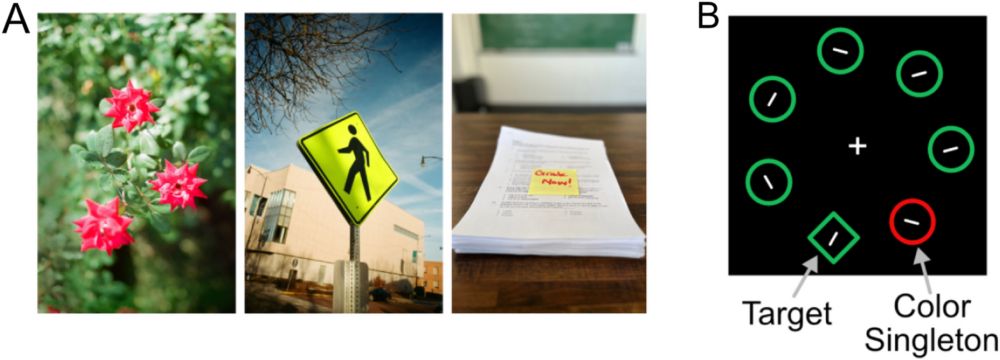
Excited this review paper is out! We update the signal suppression account to explain recent findings related to attention capture by salient stimuli. We also propose new mechanisms of learned attentional control. Written with Steve Luck and @xiaojinma.bsky.social
link.springer.com/article/10.3...
link.springer.com/article/10.3...
Signal suppression 2.0: An updated account of attentional capture and suppression - Psychonomic Bulletin & Review
The signal suppression account of attentional capture was proposed in 2010 to resolve a longstanding debate between bottom-up and top-down theories of capture by proposing that a top-down suppressive ...
link.springer.com
July 29, 2025 at 5:15 PM
Excited this review paper is out! We update the signal suppression account to explain recent findings related to attention capture by salient stimuli. We also propose new mechanisms of learned attentional control. Written with Steve Luck and @xiaojinma.bsky.social
link.springer.com/article/10.3...
link.springer.com/article/10.3...
A great tutorial by Xiaojin Ma on how to use PsychoPy for programming a cognitive task.

I recorded a step-by-step tutorial of programming experiments in PsychoPy for undergrad thesis students in my lab. Sharing it here for anyone new to programming in psychology, or those transitioning to PsychoPy from other software. www.youtube.com/watch?v=CMJX...

using PsychoPy to build a cognitive psychology experiment from scratch
YouTube video by Xiaojin Ma
www.youtube.com
July 23, 2025 at 3:42 PM
A great tutorial by Xiaojin Ma on how to use PsychoPy for programming a cognitive task.