



Marcel S. Kehl
@mskehl.bsky.social
Oxford Postdoc in the Staresina Lab | Sleep | Memory | Human Olfaction & Single Neurons
Pinned
Marcel S. Kehl
@mskehl.bsky.social
· Oct 27

Semantic Tuning of Single Neurons in the Human Medial Temporal Lobe
The Medial Temporal Lobe (MTL) is key to human cognition, supporting memory, emotional processing, navigation, and semantic coding. Rare direct human MTL recordings revealed concept cells, which were ...
doi.org
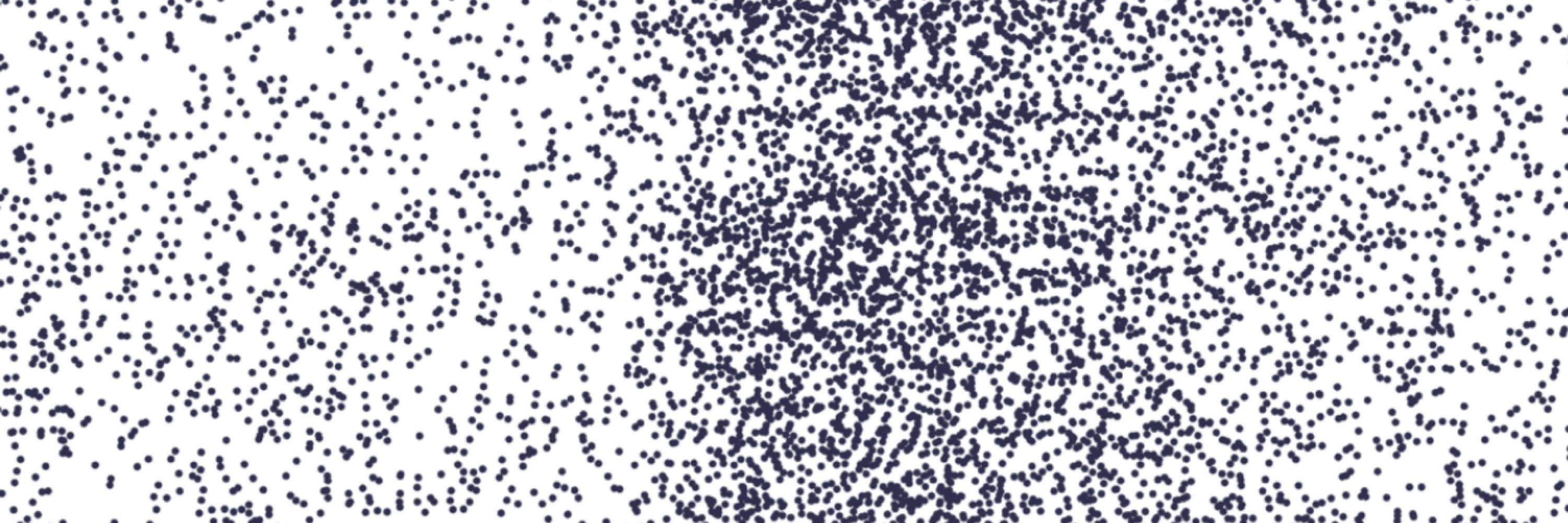
🚨Preprint: Semantic Tuning of Single Neurons in the Human Medial Temporal Lobe
1/8: How do human neurons encode meaning?
In this work, led by Katharina Karkowski, we recorded hundreds of human MTL neurons to study semantic coding in the human brain:
doi.org/10.1101/2025...
1/8: How do human neurons encode meaning?
In this work, led by Katharina Karkowski, we recorded hundreds of human MTL neurons to study semantic coding in the human brain:
doi.org/10.1101/2025...
Reposted by Marcel S. Kehl

Finally out in eLife!!
"Early foveal cortex predicts the features of saccade targets through feedback from higher cortical areas."
elifesciences.org/articles/107...
"Early foveal cortex predicts the features of saccade targets through feedback from higher cortical areas."
elifesciences.org/articles/107...
January 26, 2026 at 2:21 PM
Finally out in eLife!!
"Early foveal cortex predicts the features of saccade targets through feedback from higher cortical areas."
elifesciences.org/articles/107...
"Early foveal cortex predicts the features of saccade targets through feedback from higher cortical areas."
elifesciences.org/articles/107...
Reposted by Marcel S. Kehl

Last week to apply! Cognitive Neuroscience Research Laboratory Manager at @oxexppsy.bsky.social (with links to @oxcin.bsky.social and @ox.ac.uk)
www.jobs.ac.uk/job/DPZ833/c...
www.jobs.ac.uk/job/DPZ833/c...

Cognitive Neuroscience Research Laboratory Manager at University of Oxford
Check out jobs.ac.uk for opportunities in professional services, including Cognitive Neuroscience Research Laboratory Manager. Apply today and learn more about the role.
www.jobs.ac.uk
January 19, 2026 at 3:46 PM
Last week to apply! Cognitive Neuroscience Research Laboratory Manager at @oxexppsy.bsky.social (with links to @oxcin.bsky.social and @ox.ac.uk)
www.jobs.ac.uk/job/DPZ833/c...
www.jobs.ac.uk/job/DPZ833/c...
Reposted by Marcel S. Kehl
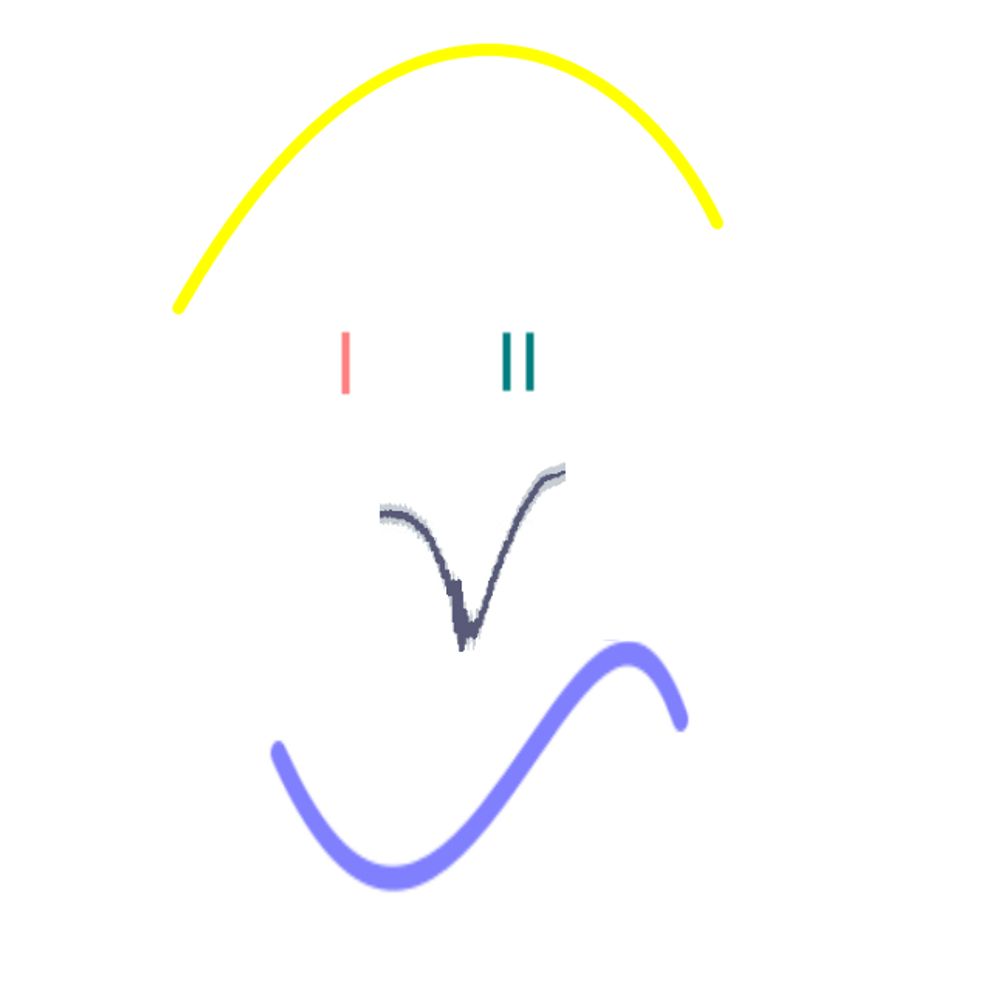
How are memories consolidated during sleep?
Excited to share another preprint: hippocampal SWRs route memory content to the cortex via interregional co-reactivation of concept cells, optimized by slow-oscillation–spindle coupling. With the great @tschreiner.bsky.social @humansingleneuron.bsky.social
Excited to share another preprint: hippocampal SWRs route memory content to the cortex via interregional co-reactivation of concept cells, optimized by slow-oscillation–spindle coupling. With the great @tschreiner.bsky.social @humansingleneuron.bsky.social
Sequential coupling of sleep oscillations enables concept-neuron reactivation and supports information flow across the human hippocampal-cortical circuit https://www.biorxiv.org/content/10.64898/2026.01.15.699122v1
January 18, 2026 at 1:46 PM
How are memories consolidated during sleep?
Excited to share another preprint: hippocampal SWRs route memory content to the cortex via interregional co-reactivation of concept cells, optimized by slow-oscillation–spindle coupling. With the great @tschreiner.bsky.social @humansingleneuron.bsky.social
Excited to share another preprint: hippocampal SWRs route memory content to the cortex via interregional co-reactivation of concept cells, optimized by slow-oscillation–spindle coupling. With the great @tschreiner.bsky.social @humansingleneuron.bsky.social
Reposted by Marcel S. Kehl

Nature research paper: Distinct neuronal populations in the human brain combine content and context
go.nature.com/4jCecge
go.nature.com/4jCecge

Distinct neuronal populations in the human brain combine content and context - Nature
Single-neuron recordings in humans reveal largely separate content and context neurons whose coordinated activity flexibly places memory items in context.
go.nature.com
January 13, 2026 at 9:08 AM
Nature research paper: Distinct neuronal populations in the human brain combine content and context
go.nature.com/4jCecge
go.nature.com/4jCecge
Reposted by Marcel S. Kehl
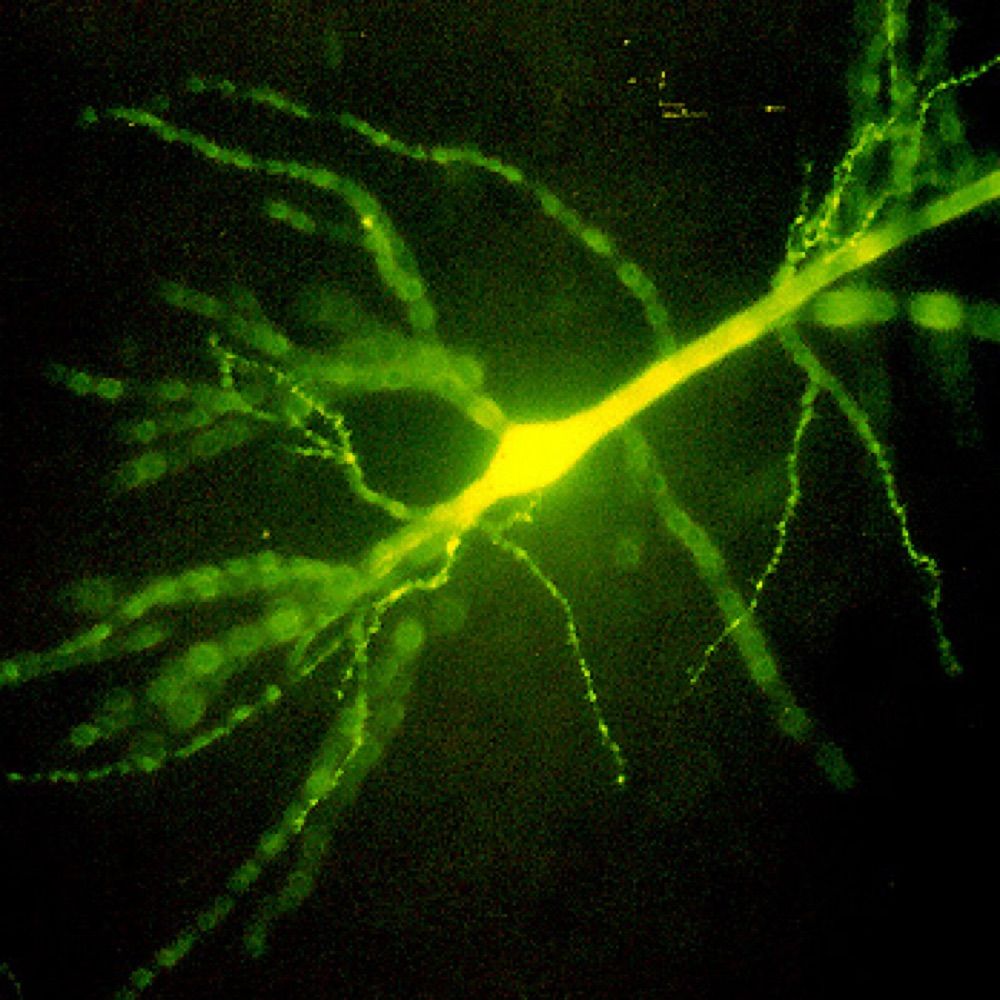
What is a 🧠 ripple? See our @cellpress.bsky.social perspective on ripple diversity and the grammar of memory replay: connecting key pieces from current work across the field. 👉🏼 www.sciencedirect.com:5037/science/arti...

December 18, 2025 at 8:04 PM
What is a 🧠 ripple? See our @cellpress.bsky.social perspective on ripple diversity and the grammar of memory replay: connecting key pieces from current work across the field. 👉🏼 www.sciencedirect.com:5037/science/arti...
Reposted by Marcel S. Kehl
I'm happy to share my debut as first-author with the recent publication of our article in #JNeurosci:
www.jneurosci.org/content/earl...
Big thanks again to @tschreiner.bsky.social and the whole team who made this possible! 🧠🌬️
www.jneurosci.org/content/earl...
Big thanks again to @tschreiner.bsky.social and the whole team who made this possible! 🧠🌬️
December 4, 2025 at 8:09 AM
I'm happy to share my debut as first-author with the recent publication of our article in #JNeurosci:
www.jneurosci.org/content/earl...
Big thanks again to @tschreiner.bsky.social and the whole team who made this possible! 🧠🌬️
www.jneurosci.org/content/earl...
Big thanks again to @tschreiner.bsky.social and the whole team who made this possible! 🧠🌬️
Reposted by Marcel S. Kehl
Thrilled that my recent paper, Hippocampal Ripples during Offline Periods Predict Human Motor Sequence Learning, was selected for the “This Week in The Journal” highlight! 🤩
Huge thanks to @bstaresina.bsky.social and our collaborators who made this work possible!
doi.org/10.1523/JNEU...
#JNeurosci
Huge thanks to @bstaresina.bsky.social and our collaborators who made this work possible!
doi.org/10.1523/JNEU...
#JNeurosci
November 24, 2025 at 2:59 PM
Reposted by Marcel S. Kehl
How is the semantic content of a movie processed by our brains? 🧠🎬
We decode characters, events, & other features and investigate how populations and single neurons represent movie features. Check my poster @sfn.org #sfn25!
Sat. Nov 15, 6:45-8:45pm, Hall E, poster S5
Wed. Nov 19, 9-10am, poster NN5
We decode characters, events, & other features and investigate how populations and single neurons represent movie features. Check my poster @sfn.org #sfn25!
Sat. Nov 15, 6:45-8:45pm, Hall E, poster S5
Wed. Nov 19, 9-10am, poster NN5

November 14, 2025 at 10:59 PM
Reposted by Marcel S. Kehl

New work from the lab published in @cp-neuron.bsky.social by @jonasterlau.bsky.social and Jan Martini. We describe that trial-by-trial variability indexes recurrent connectivity across the cortical hierarchy, which supports reliable and flexible coding www.cell.com/neuron/abstr... (1/4)

Structure in noise: Recurrent connectivity shapes neural variability to balance perceptual and cognitive demands in the human brain
Does neural variability reflect random noise or a feature that benefits adaptive behavior?
Using intracranial recordings in humans, Terlau et al. demonstrate that neural variability
results from the r...
www.cell.com
November 10, 2025 at 5:06 PM
New work from the lab published in @cp-neuron.bsky.social by @jonasterlau.bsky.social and Jan Martini. We describe that trial-by-trial variability indexes recurrent connectivity across the cortical hierarchy, which supports reliable and flexible coding www.cell.com/neuron/abstr... (1/4)
Reposted by Marcel S. Kehl

My Lab @unlv.edu is recruiting motivated students interested in human memory and brain research! Learn #EEG, #fMRI, and data analysis while exploring how we remember 🧠
📧 DM me or check out #PhD program www.unlv.edu/degree/phd-n... & www.unlv.edu/psychology/g...
Plus, Vegas is a fun place to live!🤟
📧 DM me or check out #PhD program www.unlv.edu/degree/phd-n... & www.unlv.edu/psychology/g...
Plus, Vegas is a fun place to live!🤟
Doctor of Philosophy - Neuroscience
This interdisciplinary Ph.D. program provides coursework and research training in neuroscience, with research mentoring spanning a range of different dimensions (basic to applied/clinical neuroscience...
www.unlv.edu
November 5, 2025 at 7:58 PM
My Lab @unlv.edu is recruiting motivated students interested in human memory and brain research! Learn #EEG, #fMRI, and data analysis while exploring how we remember 🧠
📧 DM me or check out #PhD program www.unlv.edu/degree/phd-n... & www.unlv.edu/psychology/g...
Plus, Vegas is a fun place to live!🤟
📧 DM me or check out #PhD program www.unlv.edu/degree/phd-n... & www.unlv.edu/psychology/g...
Plus, Vegas is a fun place to live!🤟
Reposted by Marcel S. Kehl
Please repost! I am looking for a PhD candidate in the area of Computational Cognitive Neuroscience to start in early 2026.
The position is funded as part of the Excellence Cluster "The Adaptive Mind" at @jlugiessen.bsky.social.
Please apply here until Nov 25:
www.uni-giessen.de/de/ueber-uns...
The position is funded as part of the Excellence Cluster "The Adaptive Mind" at @jlugiessen.bsky.social.
Please apply here until Nov 25:
www.uni-giessen.de/de/ueber-uns...

November 4, 2025 at 1:57 PM
Please repost! I am looking for a PhD candidate in the area of Computational Cognitive Neuroscience to start in early 2026.
The position is funded as part of the Excellence Cluster "The Adaptive Mind" at @jlugiessen.bsky.social.
Please apply here until Nov 25:
www.uni-giessen.de/de/ueber-uns...
The position is funded as part of the Excellence Cluster "The Adaptive Mind" at @jlugiessen.bsky.social.
Please apply here until Nov 25:
www.uni-giessen.de/de/ueber-uns...
🚨Preprint: Semantic Tuning of Single Neurons in the Human Medial Temporal Lobe
1/8: How do human neurons encode meaning?
In this work, led by Katharina Karkowski, we recorded hundreds of human MTL neurons to study semantic coding in the human brain:
doi.org/10.1101/2025...
1/8: How do human neurons encode meaning?
In this work, led by Katharina Karkowski, we recorded hundreds of human MTL neurons to study semantic coding in the human brain:
doi.org/10.1101/2025...
Semantic Tuning of Single Neurons in the Human Medial Temporal Lobe
The Medial Temporal Lobe (MTL) is key to human cognition, supporting memory, emotional processing, navigation, and semantic coding. Rare direct human MTL recordings revealed concept cells, which were ...
doi.org
October 27, 2025 at 3:32 PM
🚨Preprint: Semantic Tuning of Single Neurons in the Human Medial Temporal Lobe
1/8: How do human neurons encode meaning?
In this work, led by Katharina Karkowski, we recorded hundreds of human MTL neurons to study semantic coding in the human brain:
doi.org/10.1101/2025...
1/8: How do human neurons encode meaning?
In this work, led by Katharina Karkowski, we recorded hundreds of human MTL neurons to study semantic coding in the human brain:
doi.org/10.1101/2025...
Reposted by Marcel S. Kehl

Semantic Tuning of Single Neurons in the Human Medial Temporal Lobe https://www.biorxiv.org/content/10.1101/2025.10.21.682935v1
October 27, 2025 at 10:15 AM
Semantic Tuning of Single Neurons in the Human Medial Temporal Lobe https://www.biorxiv.org/content/10.1101/2025.10.21.682935v1
Reposted by Marcel S. Kehl
Hippocampal stimulation reveals causal role of persistent neural activity in human working memory https://www.biorxiv.org/content/10.1101/2025.08.20.671301v1
August 22, 2025 at 7:15 AM
Hippocampal stimulation reveals causal role of persistent neural activity in human working memory https://www.biorxiv.org/content/10.1101/2025.08.20.671301v1
Reposted by Marcel S. Kehl
Excited to share our new paper on theta-phase locking of single neurons during human spatial memory:
www.nature.com/articles/s41...
With @lukaskunz.bsky.social, Joshua Jacobs, and our colleagues from the University of Freiburg
www.nature.com/articles/s41...
With @lukaskunz.bsky.social, Joshua Jacobs, and our colleagues from the University of Freiburg

August 11, 2025 at 4:04 PM
Excited to share our new paper on theta-phase locking of single neurons during human spatial memory:
www.nature.com/articles/s41...
With @lukaskunz.bsky.social, Joshua Jacobs, and our colleagues from the University of Freiburg
www.nature.com/articles/s41...
With @lukaskunz.bsky.social, Joshua Jacobs, and our colleagues from the University of Freiburg
Reposted by Marcel S. Kehl
How reliable is OPM-MEG, and how does it compare to other neuroimaging modalities? 🤔
In a new preprint with @s-michelmann.bsky.social, we evaluate the reliability of OPM-MEG within & between individuals, and compare it to fMRI & iEEG during repeated movie viewing. 🧠
📄 doi.org/10.1101/2025...
In a new preprint with @s-michelmann.bsky.social, we evaluate the reliability of OPM-MEG within & between individuals, and compare it to fMRI & iEEG during repeated movie viewing. 🧠
📄 doi.org/10.1101/2025...

Reliability and signal comparison of OPM-MEG, fMRI & iEEG in a repeated movie viewing paradigm
Optically pumped magnetometers (OPMs) offer a promising advancement in noninvasive neuroimaging via magnetoencephalography (MEG), but establishing their reliability and comparability to existing metho...
doi.org
July 19, 2025 at 4:10 PM
How reliable is OPM-MEG, and how does it compare to other neuroimaging modalities? 🤔
In a new preprint with @s-michelmann.bsky.social, we evaluate the reliability of OPM-MEG within & between individuals, and compare it to fMRI & iEEG during repeated movie viewing. 🧠
📄 doi.org/10.1101/2025...
In a new preprint with @s-michelmann.bsky.social, we evaluate the reliability of OPM-MEG within & between individuals, and compare it to fMRI & iEEG during repeated movie viewing. 🧠
📄 doi.org/10.1101/2025...
Reposted by Marcel S. Kehl

In this Article, Paluch et al. show that unattended working memory items, as well as attended ones, are encoded in persistent activity in the medial temporal lobe. @jankaminski.bsky.social
www.nature.com/articles/s41...
www.nature.com/articles/s41...
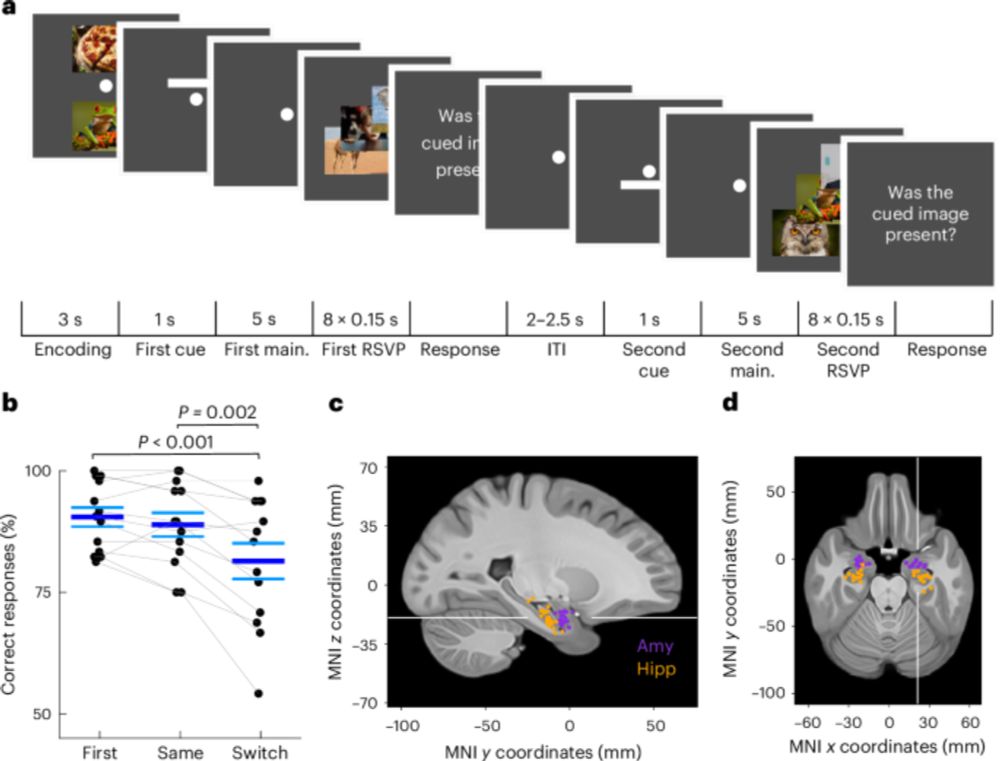
Unattended working memory items are coded by persistent activity in human medial temporal lobe neurons - Nature Human Behaviour
Paluch et al. show that unattended working memory items, as well as attended ones, are encoded in persistent activity in the medial temporal lobe.
www.nature.com
July 9, 2025 at 11:33 AM
In this Article, Paluch et al. show that unattended working memory items, as well as attended ones, are encoded in persistent activity in the medial temporal lobe. @jankaminski.bsky.social
www.nature.com/articles/s41...
www.nature.com/articles/s41...
Reposted by Marcel S. Kehl
What makes humans similar or different to AI? In a paper out in @natmachintell.nature.com led by @florianmahner.bsky.social & @lukasmut.bsky.social, w/ Umut Güclü, we took a deep look at the factors underlying their representational alignment, with surprising results.
www.nature.com/articles/s42...
www.nature.com/articles/s42...
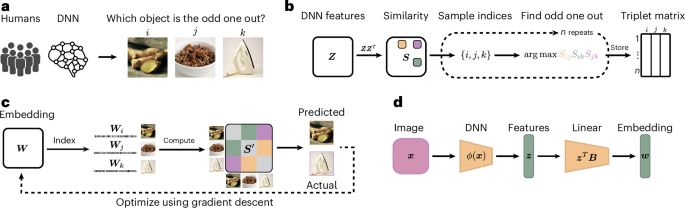
Dimensions underlying the representational alignment of deep neural networks with humans - Nature Machine Intelligence
An interpretability framework that compares how humans and deep neural networks process images has been presented. Their findings reveal that, unlike humans, deep neural networks focus more on visual ...
www.nature.com
June 23, 2025 at 8:03 PM
What makes humans similar or different to AI? In a paper out in @natmachintell.nature.com led by @florianmahner.bsky.social & @lukasmut.bsky.social, w/ Umut Güclü, we took a deep look at the factors underlying their representational alignment, with surprising results.
www.nature.com/articles/s42...
www.nature.com/articles/s42...
Reposted by Marcel S. Kehl

How does our brain learn that thunder follows lightning? We don't just remember two separate events; we build a predictive model to anticipate the world. My research dives into this very question: how we learn and predict the order of events. 🧵👇 1/9 #neuroscience #memory #sleep
June 16, 2025 at 9:33 AM
How does our brain learn that thunder follows lightning? We don't just remember two separate events; we build a predictive model to anticipate the world. My research dives into this very question: how we learn and predict the order of events. 🧵👇 1/9 #neuroscience #memory #sleep
How does sequence learning reshape item representations? We found that the brain incorporates high-level successor representations even outside the sequence task. This process is supported by slow-wave sleep. Great work by @xianhuihe.bsky.social and the team!
www.biorxiv.org/content/10.1...
www.biorxiv.org/content/10.1...
www.biorxiv.org
June 16, 2025 at 8:37 AM
How does sequence learning reshape item representations? We found that the brain incorporates high-level successor representations even outside the sequence task. This process is supported by slow-wave sleep. Great work by @xianhuihe.bsky.social and the team!
www.biorxiv.org/content/10.1...
www.biorxiv.org/content/10.1...
Reposted by Marcel S. Kehl
Sleep strengthens successor representations of learned sequences https://www.biorxiv.org/content/10.1101/2025.06.11.658893v1
June 16, 2025 at 2:17 AM
Sleep strengthens successor representations of learned sequences https://www.biorxiv.org/content/10.1101/2025.06.11.658893v1
Reposted by Marcel S. Kehl
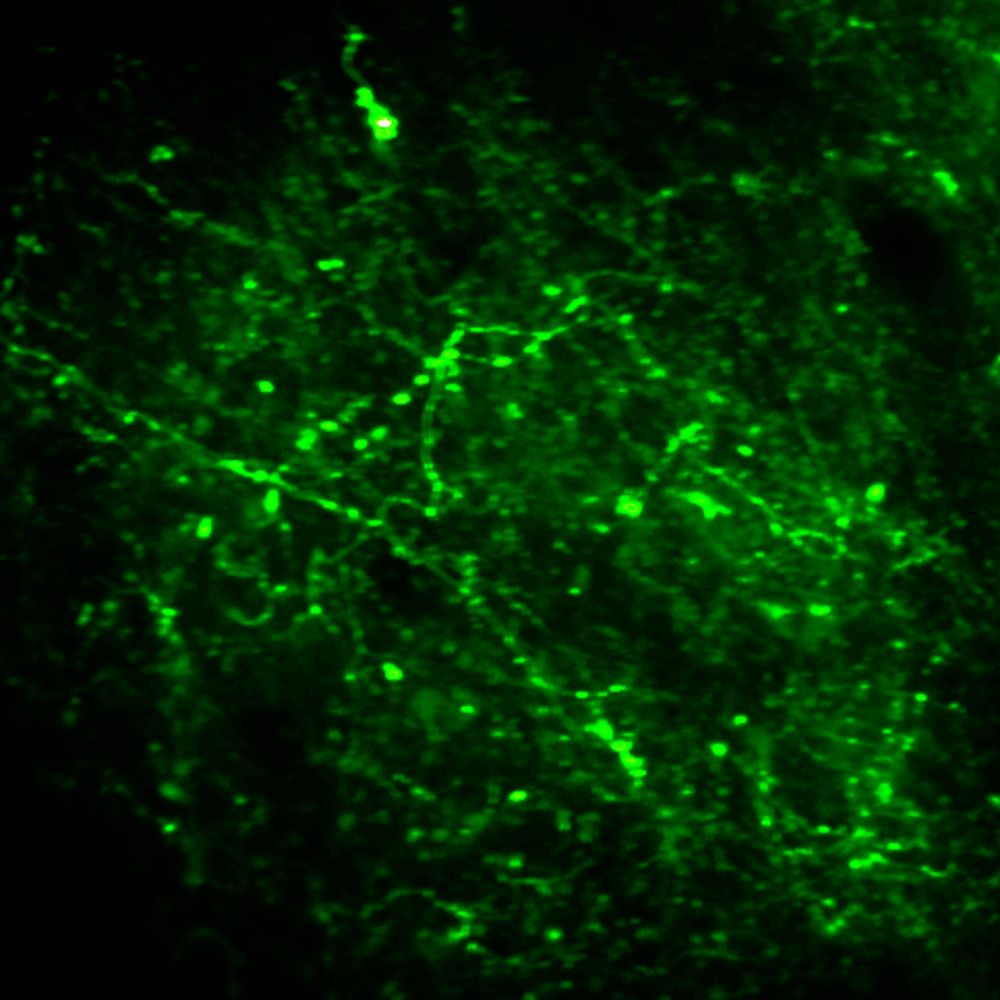
New study of the lab showing that sleep preserve sound representations geometry in the auditory cortex but intermittently blocks the transfer of sensory information, possibly to provide both opportunities for surveillance and offline processing.
www.biorxiv.org/content/10.1...
www.biorxiv.org/content/10.1...
www.biorxiv.org
June 15, 2025 at 7:45 AM
New study of the lab showing that sleep preserve sound representations geometry in the auditory cortex but intermittently blocks the transfer of sensory information, possibly to provide both opportunities for surveillance and offline processing.
www.biorxiv.org/content/10.1...
www.biorxiv.org/content/10.1...
Reposted by Marcel S. Kehl

Born from a collaboration with @danlikesbrains.bsky.social ’s team, this project shows how your breathing shapes brain excitability across the entire wake–sleep cycle. Huge shoutout to everyone involved — go check it out! 💥
#neuroskyence
#neuroskyence
Curious about how your brain’s excitability aligns with your breath, even while asleep? Check out our new preprint!!
www.biorxiv.org/content/10.1...
A great collaboration between @tschreiner.bsky.social 's lab and @danlikesbrains.bsky.social 's lab.
(1/5)
www.biorxiv.org/content/10.1...
A great collaboration between @tschreiner.bsky.social 's lab and @danlikesbrains.bsky.social 's lab.
(1/5)

Respiratory coordination of excitability states across the human wake-sleep cycle
While the respiratory rhythm is increasingly recognized as a key modulator of oscillatory brain activity across the wake-sleep cycle in humans, very little is known about its influence on aperiodic br...
www.biorxiv.org
June 9, 2025 at 1:36 PM
Born from a collaboration with @danlikesbrains.bsky.social ’s team, this project shows how your breathing shapes brain excitability across the entire wake–sleep cycle. Huge shoutout to everyone involved — go check it out! 💥
#neuroskyence
#neuroskyence
Reposted by Marcel S. Kehl
Just published my first paper!
Really grateful to everyone at the plasticity lab @oxcin.bsky.social who made this possible.
huge thanks to my co-authors — couldn’t have done it without you.
If you want to check it out:
📄 paper: www.nature.com/articles/s41...
Really grateful to everyone at the plasticity lab @oxcin.bsky.social who made this possible.
huge thanks to my co-authors — couldn’t have done it without you.
If you want to check it out:
📄 paper: www.nature.com/articles/s41...
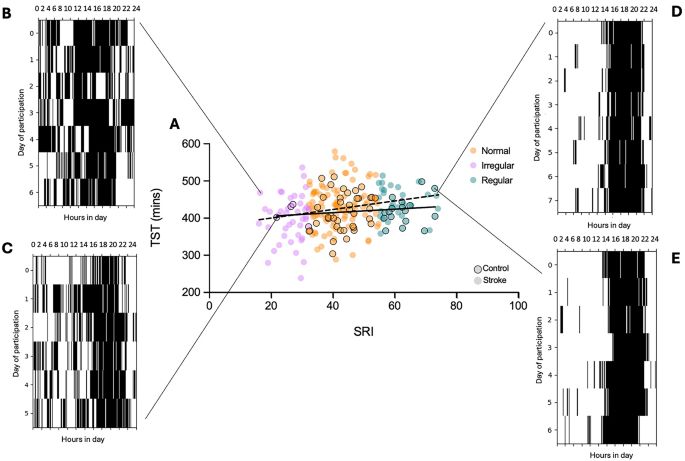
Sleep regularity index as a novel indicator of sleep disturbance in stroke survivors: a secondary data analysis - Scientific Reports
Scientific Reports - Sleep regularity index as a novel indicator of sleep disturbance in stroke survivors: a secondary data analysis
www.nature.com
May 21, 2025 at 2:51 PM
Just published my first paper!
Really grateful to everyone at the plasticity lab @oxcin.bsky.social who made this possible.
huge thanks to my co-authors — couldn’t have done it without you.
If you want to check it out:
📄 paper: www.nature.com/articles/s41...
Really grateful to everyone at the plasticity lab @oxcin.bsky.social who made this possible.
huge thanks to my co-authors — couldn’t have done it without you.
If you want to check it out:
📄 paper: www.nature.com/articles/s41...
Reposted by Marcel S. Kehl
🚨 Preprint alert! 🚨
Can mice estimate the distance to an odour source?
New work led by Cristina Marin and colleagues, jointly supervised by @andreas-t-schaefer.bsky.social at the @crick.ac.uk and myself.
Spoiler alert: Yes, they can!
Read the paper here: bit.ly/43A9tF9
Short 🧵 below
Can mice estimate the distance to an odour source?
New work led by Cristina Marin and colleagues, jointly supervised by @andreas-t-schaefer.bsky.social at the @crick.ac.uk and myself.
Spoiler alert: Yes, they can!
Read the paper here: bit.ly/43A9tF9
Short 🧵 below
May 18, 2025 at 8:41 AM
🚨 Preprint alert! 🚨
Can mice estimate the distance to an odour source?
New work led by Cristina Marin and colleagues, jointly supervised by @andreas-t-schaefer.bsky.social at the @crick.ac.uk and myself.
Spoiler alert: Yes, they can!
Read the paper here: bit.ly/43A9tF9
Short 🧵 below
Can mice estimate the distance to an odour source?
New work led by Cristina Marin and colleagues, jointly supervised by @andreas-t-schaefer.bsky.social at the @crick.ac.uk and myself.
Spoiler alert: Yes, they can!
Read the paper here: bit.ly/43A9tF9
Short 🧵 below