




Marianne V. Lemée
@mariannevlemee.bsky.social
PhD, Neurodevelopment & Genetics
Also creating SciArt 🎨🖌️
mariannelemee.my.canva.site/2025-portfolio
Also creating SciArt 🎨🖌️
mariannelemee.my.canva.site/2025-portfolio
Reposted by Marianne V. Lemée
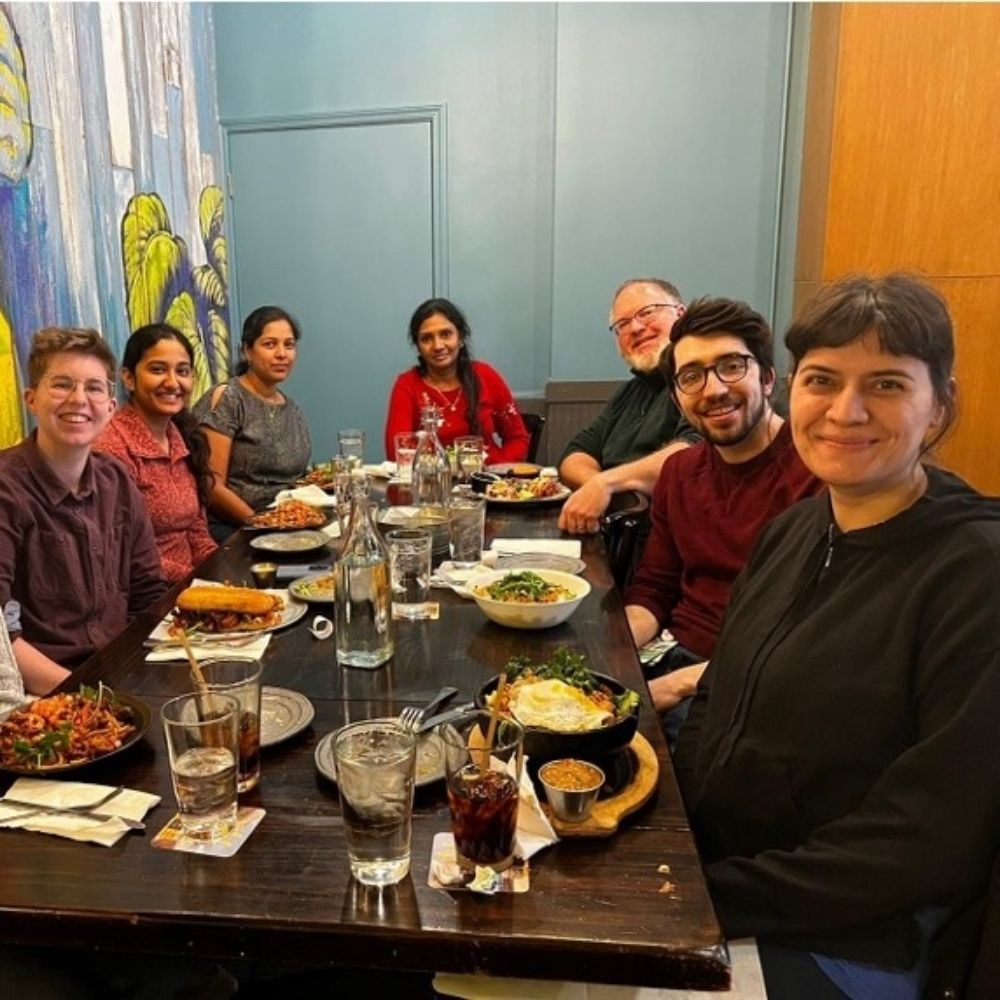
Extrusive and cohesive cohesin cooperate to repair double-strand breaks in DNA @science.org @albertomarin.bsky.social @gerlichlab.bsky.social @imbavienna.bsky.social
www.science.org/doi/10.1126/...
www.science.org/doi/10.1126/...
www.science.org/doi/10.1126/...
www.science.org/doi/10.1126/...
www.science.org/doi/10.1126/...
www.science.org/doi/10.1126/...

December 5, 2025 at 3:28 AM
Extrusive and cohesive cohesin cooperate to repair double-strand breaks in DNA @science.org @albertomarin.bsky.social @gerlichlab.bsky.social @imbavienna.bsky.social
www.science.org/doi/10.1126/...
www.science.org/doi/10.1126/...
www.science.org/doi/10.1126/...
www.science.org/doi/10.1126/...
www.science.org/doi/10.1126/...
www.science.org/doi/10.1126/...
Reposted by Marianne V. Lemée
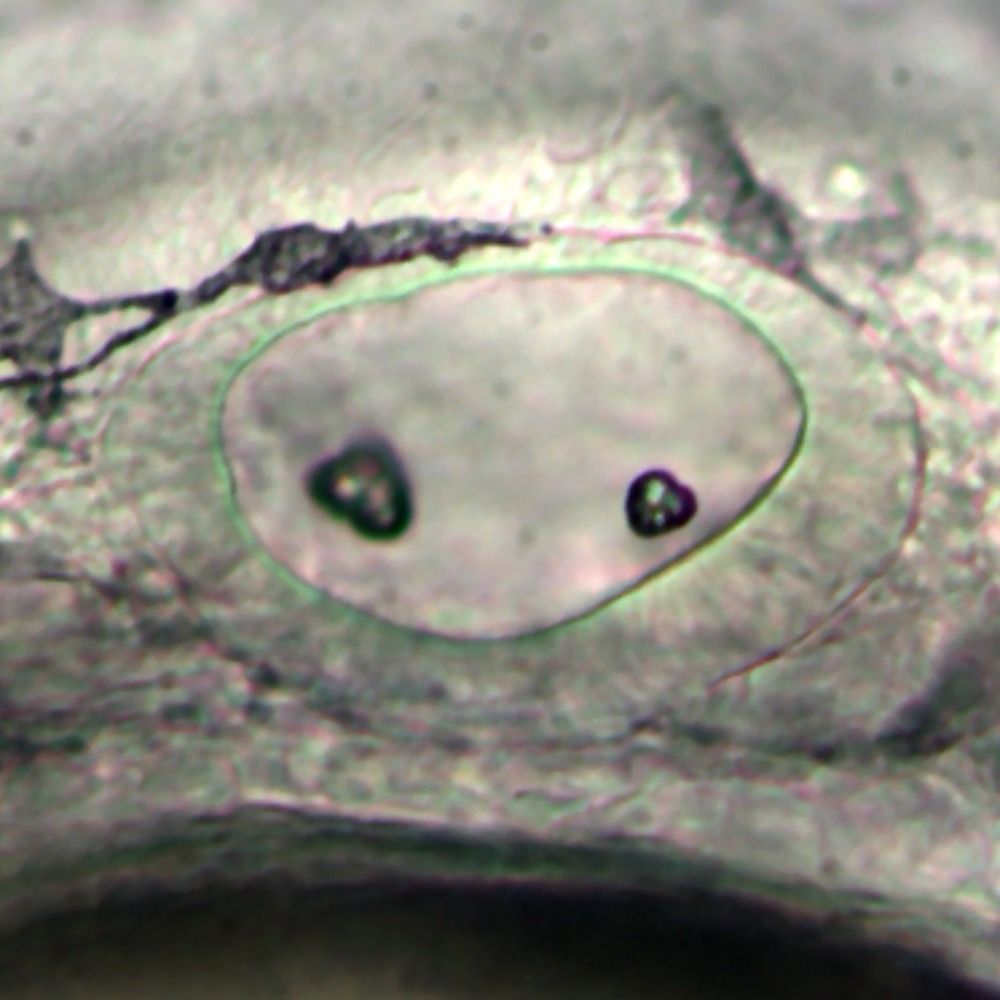
Folks, it is finally out! Our paper on T2T assemblies of the zebrafish genome is on BioRxiv:
www.biorxiv.org/content/10.1...
www.biorxiv.org/content/10.1...
www.biorxiv.org
November 17, 2025 at 11:22 PM
Folks, it is finally out! Our paper on T2T assemblies of the zebrafish genome is on BioRxiv:
www.biorxiv.org/content/10.1...
www.biorxiv.org/content/10.1...
Reposted by Marianne V. Lemée

More than two decades have passed since we discovered that rare disruptions of the FOXP2 gene disturb development of proficient speech/language skills. Today we know of multiple FOXP genes that are directly implicated in distinct brain-related conditions with differences in symptoms & severity.🧪 1/n

October 29, 2025 at 5:09 PM
More than two decades have passed since we discovered that rare disruptions of the FOXP2 gene disturb development of proficient speech/language skills. Today we know of multiple FOXP genes that are directly implicated in distinct brain-related conditions with differences in symptoms & severity.🧪 1/n
Reposted by Marianne V. Lemée

First neurons didn’t appear overnight. We trace their roots to ancient secretory cells - showing how lifestyle & behavior shaped the evolution of first synapses.🧠🌊 #Evolution #Neuroscience
Our latest in @natrevneuro.nature.com
Link: rdcu.be/eMX3E
@jeffcolgren.bsky.social @msarscentre.bsky.social
Our latest in @natrevneuro.nature.com
Link: rdcu.be/eMX3E
@jeffcolgren.bsky.social @msarscentre.bsky.social

The evolutionary origins of synaptic proteins and their changing roles in different organisms across evolution
Nature Reviews Neuroscience - Recent studies have shed further light on the evolutionary origins of chemical synapses, In this Review, Colgren and Burkhardt explore how ancient proteins were...
rdcu.be
October 27, 2025 at 6:48 PM
First neurons didn’t appear overnight. We trace their roots to ancient secretory cells - showing how lifestyle & behavior shaped the evolution of first synapses.🧠🌊 #Evolution #Neuroscience
Our latest in @natrevneuro.nature.com
Link: rdcu.be/eMX3E
@jeffcolgren.bsky.social @msarscentre.bsky.social
Our latest in @natrevneuro.nature.com
Link: rdcu.be/eMX3E
@jeffcolgren.bsky.social @msarscentre.bsky.social
Reposted by Marianne V. Lemée
Thank you @helloeacr.bsky.social for sharing these job offers to join the @mpimarinemicrobio.bsky.social! 🙌 We are seeking a #PostDoc & a #PhD student to investigate marine transmissible cancers. 🧬
➡️ Postdoc: career.mpi-bremen.de/jobposting/a...
🎓 PhD position: career.mpi-bremen.de/jobposting/f...
➡️ Postdoc: career.mpi-bremen.de/jobposting/a...
🎓 PhD position: career.mpi-bremen.de/jobposting/f...


October 20, 2025 at 11:34 AM
Thank you @helloeacr.bsky.social for sharing these job offers to join the @mpimarinemicrobio.bsky.social! 🙌 We are seeking a #PostDoc & a #PhD student to investigate marine transmissible cancers. 🧬
➡️ Postdoc: career.mpi-bremen.de/jobposting/a...
🎓 PhD position: career.mpi-bremen.de/jobposting/f...
➡️ Postdoc: career.mpi-bremen.de/jobposting/a...
🎓 PhD position: career.mpi-bremen.de/jobposting/f...
Reposted by Marianne V. Lemée

Did transposable elements shape brain evolution — and if so, which ones, and in which cell states and lineages? Led by @tyamadat.bsky.social, we explored this question in cerebellum development using sequence-based deep learning models!
www.biorxiv.org/content/10.1...
www.biorxiv.org/content/10.1...

October 16, 2025 at 10:01 PM
Did transposable elements shape brain evolution — and if so, which ones, and in which cell states and lineages? Led by @tyamadat.bsky.social, we explored this question in cerebellum development using sequence-based deep learning models!
www.biorxiv.org/content/10.1...
www.biorxiv.org/content/10.1...
Reposted by Marianne V. Lemée

Incredible new paper from @schacherer.bsky.social et al rdcu.be/eLcTH
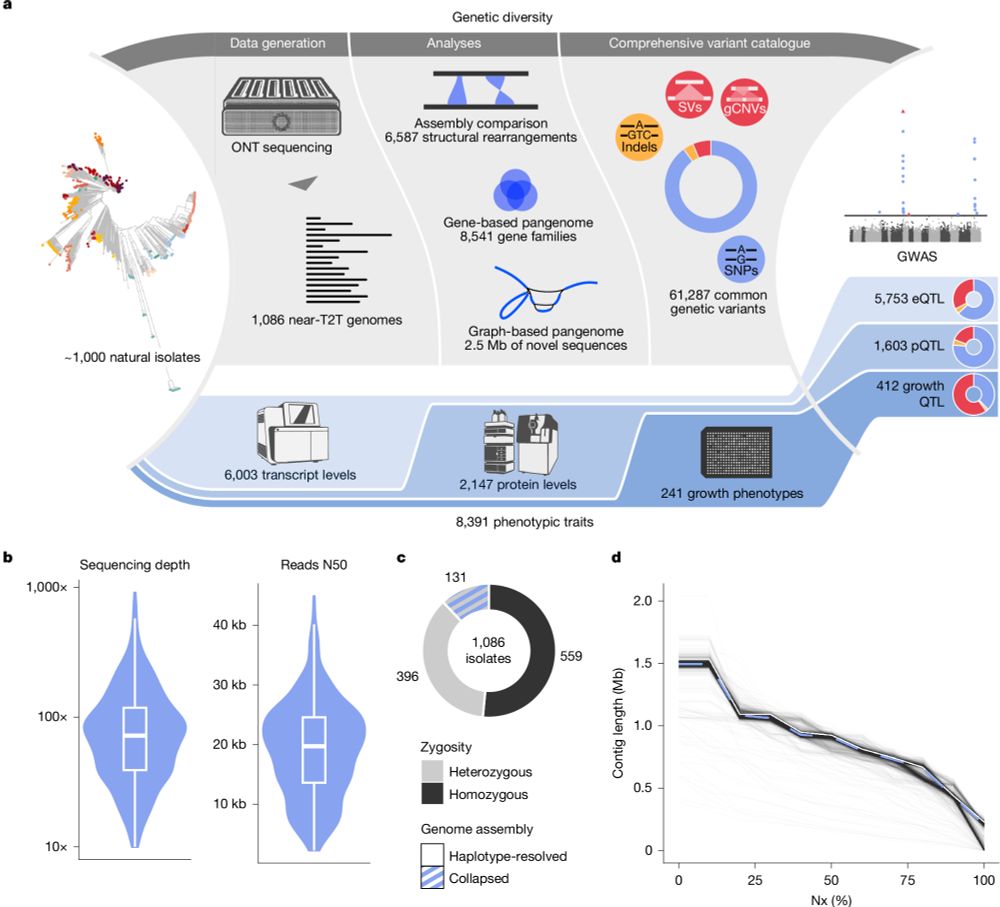
From genotype to phenotype with 1,086 near telomere-to-telomere yeast genomes
Nature - A newly compiled atlas of species-wide structural variants and gene-based and graph pangenomes derived from highly complete assemblies of genomes from 1,086 natural isolates enable...
rdcu.be
October 15, 2025 at 9:06 PM
Incredible new paper from @schacherer.bsky.social et al rdcu.be/eLcTH
Reposted by Marianne V. Lemée
We are thrilled to share our new preprint entitled “The origin and molecular evolution of the mammalian liver cell architecture” www.biorxiv.org/content/10.1...
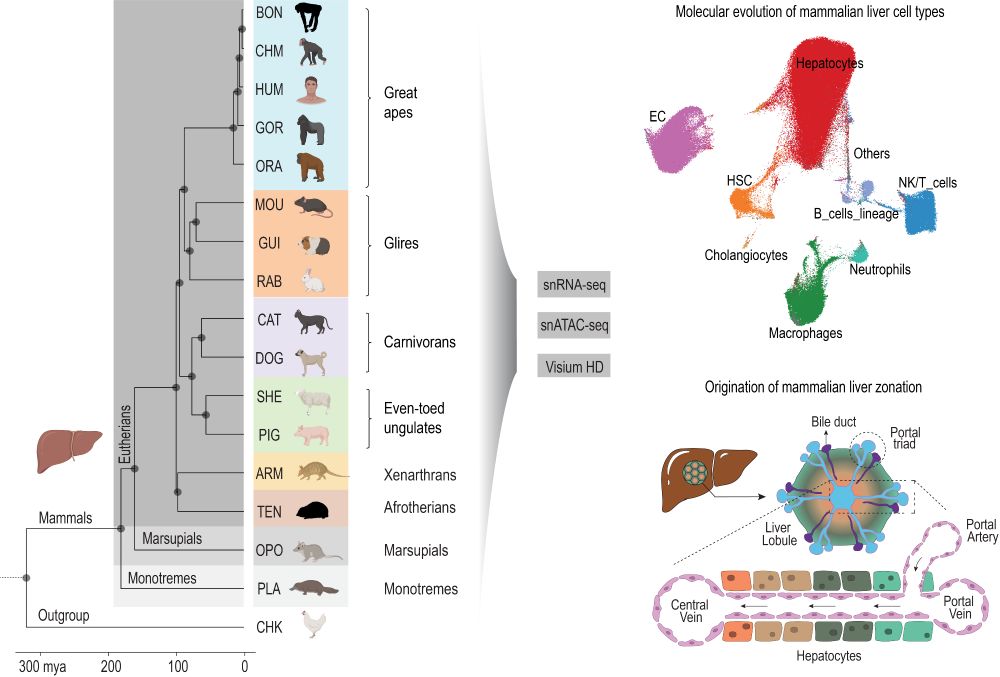
October 15, 2025 at 12:51 PM
We are thrilled to share our new preprint entitled “The origin and molecular evolution of the mammalian liver cell architecture” www.biorxiv.org/content/10.1...
Excited to share our new study on the 1q21.1 locus and its implication in neurodevelopmental disorders 🧠🧬
Read the full publication here ⬇️
@golzio-lab.bsky.social @igbmc.bsky.social @unistra.fr
Read the full publication here ⬇️
@golzio-lab.bsky.social @igbmc.bsky.social @unistra.fr
⭐ NAR Breakthrough! ⭐
New research highlights CHD1L in the chromosome 1q21.1 region—linked to #autism, head size & growth.
🧠 It controls #DNApackaging & genes for #braindevelopment, #cellfate & #connectivity.
Read more: doi.org/10.1093/nar/...
#NARBreakthrough #Neuroscience @igbmc.bsky.social
New research highlights CHD1L in the chromosome 1q21.1 region—linked to #autism, head size & growth.
🧠 It controls #DNApackaging & genes for #braindevelopment, #cellfate & #connectivity.
Read more: doi.org/10.1093/nar/...
#NARBreakthrough #Neuroscience @igbmc.bsky.social

Disrupted transcriptional networks regulated by CHD1L during neurodevelopment underlie the mirrored neuroanatomical and growth phenotypes of the 1q21.1 copy number variant
Abstract. Distal 1q21.1 deletions and duplications are associated with variable phenotypes including autism, head circumference and height defects. To eluc
doi.org
September 24, 2025 at 6:32 PM
Excited to share our new study on the 1q21.1 locus and its implication in neurodevelopmental disorders 🧠🧬
Read the full publication here ⬇️
@golzio-lab.bsky.social @igbmc.bsky.social @unistra.fr
Read the full publication here ⬇️
@golzio-lab.bsky.social @igbmc.bsky.social @unistra.fr
Reposted by Marianne V. Lemée
⭐ NAR Breakthrough! ⭐
New research highlights CHD1L in the chromosome 1q21.1 region—linked to #autism, head size & growth.
🧠 It controls #DNApackaging & genes for #braindevelopment, #cellfate & #connectivity.
Read more: doi.org/10.1093/nar/...
#NARBreakthrough #Neuroscience @igbmc.bsky.social
New research highlights CHD1L in the chromosome 1q21.1 region—linked to #autism, head size & growth.
🧠 It controls #DNApackaging & genes for #braindevelopment, #cellfate & #connectivity.
Read more: doi.org/10.1093/nar/...
#NARBreakthrough #Neuroscience @igbmc.bsky.social
Disrupted transcriptional networks regulated by CHD1L during neurodevelopment underlie the mirrored neuroanatomical and growth phenotypes of the 1q21.1 copy number variant
Abstract. Distal 1q21.1 deletions and duplications are associated with variable phenotypes including autism, head circumference and height defects. To eluc
doi.org
September 24, 2025 at 5:34 PM
⭐ NAR Breakthrough! ⭐
New research highlights CHD1L in the chromosome 1q21.1 region—linked to #autism, head size & growth.
🧠 It controls #DNApackaging & genes for #braindevelopment, #cellfate & #connectivity.
Read more: doi.org/10.1093/nar/...
#NARBreakthrough #Neuroscience @igbmc.bsky.social
New research highlights CHD1L in the chromosome 1q21.1 region—linked to #autism, head size & growth.
🧠 It controls #DNApackaging & genes for #braindevelopment, #cellfate & #connectivity.
Read more: doi.org/10.1093/nar/...
#NARBreakthrough #Neuroscience @igbmc.bsky.social
Reposted by Marianne V. Lemée

How many chromosomes can an animal have?
In our paper out now in @currentbiology.bsky.social we show that the Atlas blue butterfly has 229 chromosome pairs- the highest in diploid Metazoa! These arose by rapid autosome fragmentation while sex chromosomes stayed intact.
www.cell.com/current-biol...
In our paper out now in @currentbiology.bsky.social we show that the Atlas blue butterfly has 229 chromosome pairs- the highest in diploid Metazoa! These arose by rapid autosome fragmentation while sex chromosomes stayed intact.
www.cell.com/current-biol...
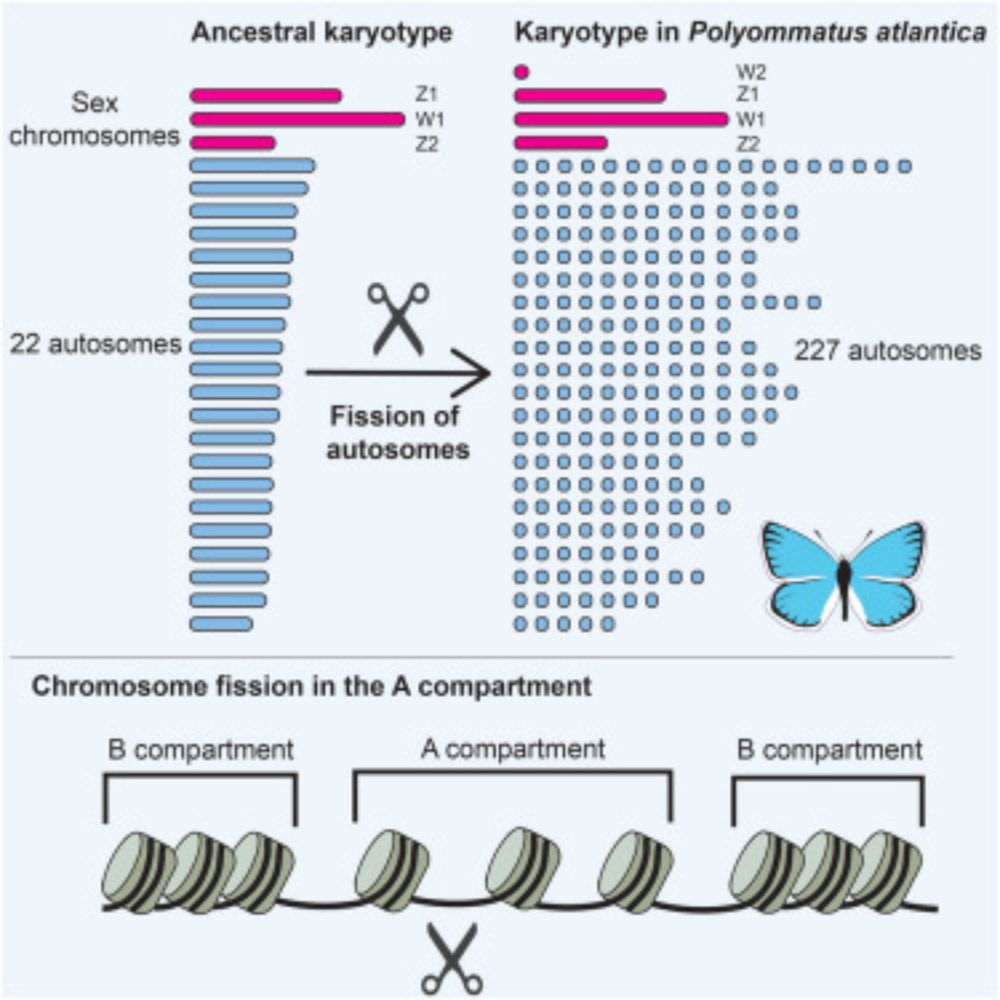
Constraints on chromosome evolution revealed by the 229 chromosome pairs of the Atlas blue butterfly
The genome of the Atlas blue butterfly contains ten times more chromosomes than most
butterflies, and more than any other known diploid animal. Wright et al. show that
this extraordinary karyotype is ...
tinyurl.com
September 11, 2025 at 3:22 PM
How many chromosomes can an animal have?
In our paper out now in @currentbiology.bsky.social we show that the Atlas blue butterfly has 229 chromosome pairs- the highest in diploid Metazoa! These arose by rapid autosome fragmentation while sex chromosomes stayed intact.
www.cell.com/current-biol...
In our paper out now in @currentbiology.bsky.social we show that the Atlas blue butterfly has 229 chromosome pairs- the highest in diploid Metazoa! These arose by rapid autosome fragmentation while sex chromosomes stayed intact.
www.cell.com/current-biol...
Reposted by Marianne V. Lemée

The typeset version of our article, "Reconstruction of the human amylase locus reveals ancient duplications seeding modern-day variation", is now online. This thread will provide an overview of how gene duplications have shaped modern variation in the amylase locus.
www.science.org/doi/10.1126/...
www.science.org/doi/10.1126/...

Reconstruction of the human amylase locus reveals ancient duplications seeding modern-day variation
Previous studies suggested that the copy number of the human salivary amylase gene, AMY1, correlates with starch-rich diets. However, evolutionary analyses are hampered by the absence of accurate, seq...
www.science.org
November 22, 2024 at 2:07 PM
The typeset version of our article, "Reconstruction of the human amylase locus reveals ancient duplications seeding modern-day variation", is now online. This thread will provide an overview of how gene duplications have shaped modern variation in the amylase locus.
www.science.org/doi/10.1126/...
www.science.org/doi/10.1126/...
Reposted by Marianne V. Lemée
Our study on a male-essential microRNA and the evolution of other dosage compensation mechanisms in birds is now out in Nature! www.nature.com/articles/s41...
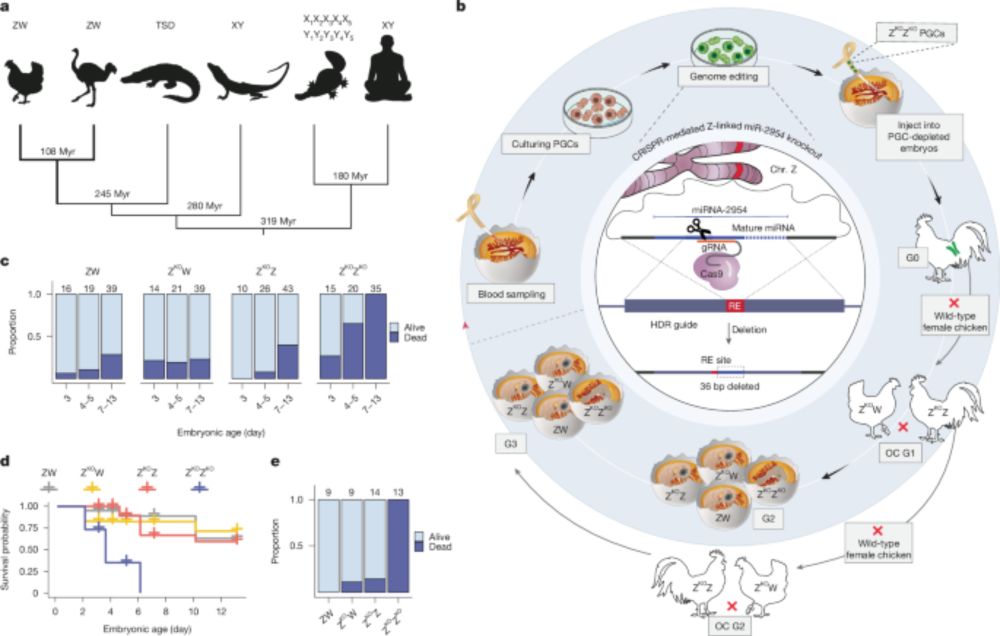
A male-essential miRNA is key for avian sex chromosome dosage compensation - Nature
Birds have evolved a unique sex chromosome dosage compensation mechanism involving the male-biased microRNA (miR-2954), which is essential for male survival by regulating the expression of dosage-sens...
www.nature.com
July 16, 2025 at 3:23 PM
Our study on a male-essential microRNA and the evolution of other dosage compensation mechanisms in birds is now out in Nature! www.nature.com/articles/s41...
Reposted by Marianne V. Lemée
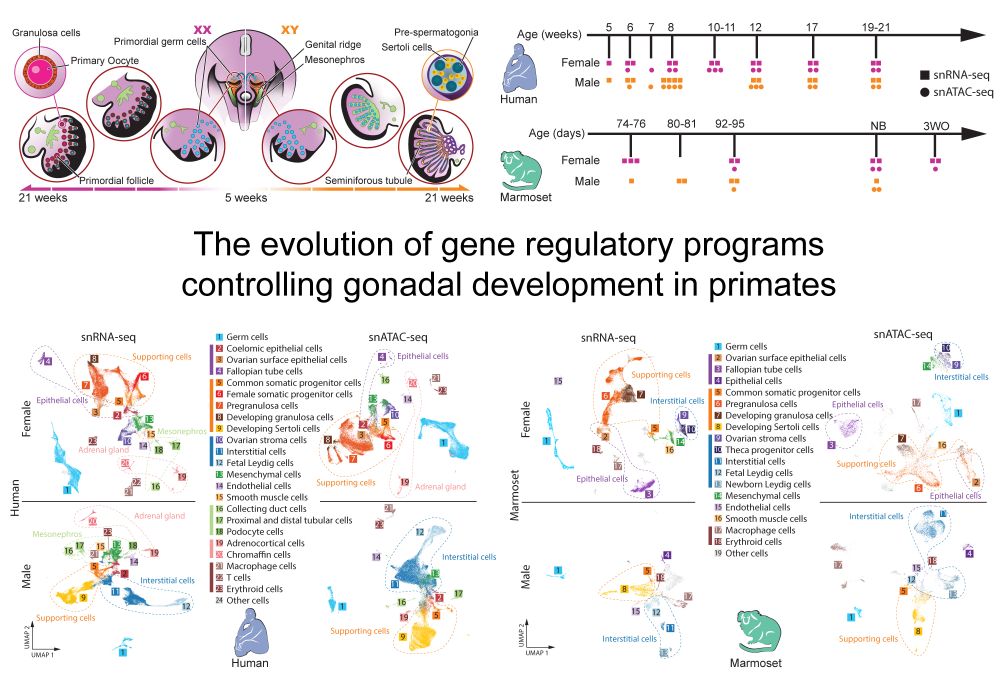
We are delighted to share our new preprint “The evolution of gene regulatory programs controlling gonadal development in primates” www.biorxiv.org/content/10.1...
June 20, 2025 at 8:13 AM
We are delighted to share our new preprint “The evolution of gene regulatory programs controlling gonadal development in primates” www.biorxiv.org/content/10.1...
Reposted by Marianne V. Lemée
Stop the doom scrolling! A new 🗞️ from my lab, describing one of our flagship projects of many years we are super excited to share:
"Inducible formation of fusion transcripts upregulates haploinsufficient CHD2 gene expression".
A 🧵
biorxiv.org/content/earl...
"Inducible formation of fusion transcripts upregulates haploinsufficient CHD2 gene expression".
A 🧵
biorxiv.org/content/earl...

Inducible formation of fusion transcripts upregulates haploinsufficient CHD2 gene expression
Modes of action of long noncoding RNAs (lncRNAs) are poorly understood. CHASERR is a broadly expressed lncRNA located immediately upstream of the promoter of the CHD2 gene. We show that antisense olig...
biorxiv.org
May 29, 2025 at 12:35 PM
Stop the doom scrolling! A new 🗞️ from my lab, describing one of our flagship projects of many years we are super excited to share:
"Inducible formation of fusion transcripts upregulates haploinsufficient CHD2 gene expression".
A 🧵
biorxiv.org/content/earl...
"Inducible formation of fusion transcripts upregulates haploinsufficient CHD2 gene expression".
A 🧵
biorxiv.org/content/earl...
Reposted by Marianne V. Lemée

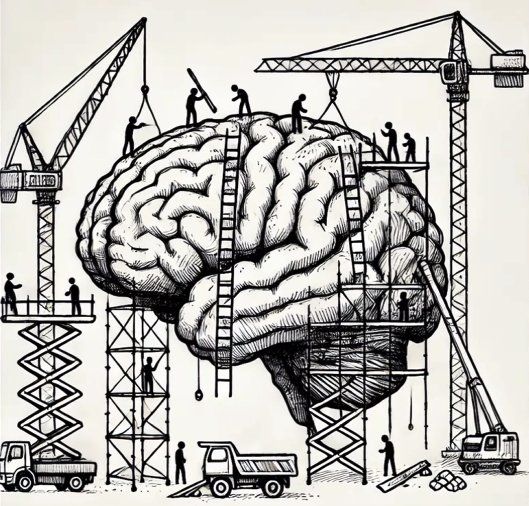
✨ We tend to think of species-specific differences as resulting from the presence of species-specific genes. In our latest work with @djabaudon.bsky.social, we show that building brains is not only about which genes you use, but also about when and where you do.
www.biorxiv.org/content/10.1...
www.biorxiv.org/content/10.1...
February 20, 2025 at 8:11 AM
✨ We tend to think of species-specific differences as resulting from the presence of species-specific genes. In our latest work with @djabaudon.bsky.social, we show that building brains is not only about which genes you use, but also about when and where you do.
www.biorxiv.org/content/10.1...
www.biorxiv.org/content/10.1...
Reposted by Marianne V. Lemée

Genetic diversity and regulatory features of human-specific NOTCH2NL duplications https://www.biorxiv.org/content/10.1101/2025.03.14.643395v1
March 16, 2025 at 10:31 AM
Genetic diversity and regulatory features of human-specific NOTCH2NL duplications https://www.biorxiv.org/content/10.1101/2025.03.14.643395v1
Reposted by Marianne V. Lemée

How did Coati get their stripes? Not yet known ... but we know how another Carnivore loses them! 3 mutations in gene TAQPEP changes a cat from tabby striped to blotchy #RIP #2025MMM www.science.org/doi/10.1126/...

March 27, 2025 at 12:12 AM
How did Coati get their stripes? Not yet known ... but we know how another Carnivore loses them! 3 mutations in gene TAQPEP changes a cat from tabby striped to blotchy #RIP #2025MMM www.science.org/doi/10.1126/...
Reposted by Marianne V. Lemée
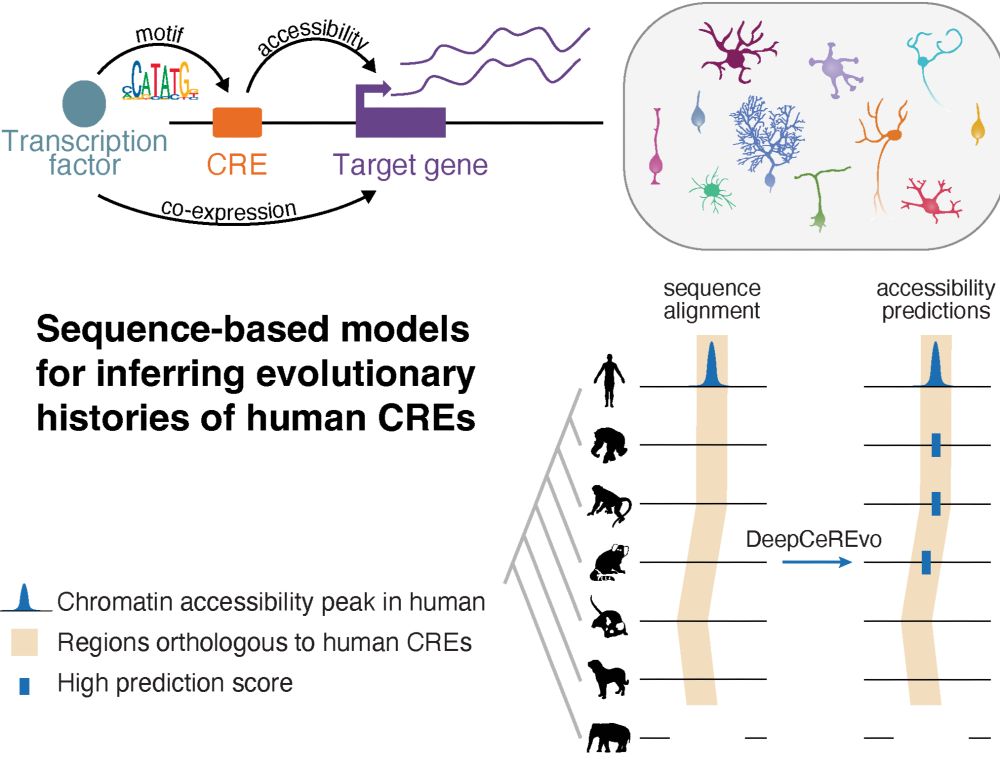
How does gene regulation shape brain evolution? Our new preprint dives into this question in the context of mammalian cerebellum development! rb.gy/dbcxjz
Led by @ioansarr.bsky.social, @marisepp.bsky.social and @tyamadat.bsky.social, in collaboration with @steinaerts.bsky.social
Led by @ioansarr.bsky.social, @marisepp.bsky.social and @tyamadat.bsky.social, in collaboration with @steinaerts.bsky.social
March 16, 2025 at 10:31 AM
How does gene regulation shape brain evolution? Our new preprint dives into this question in the context of mammalian cerebellum development! rb.gy/dbcxjz
Led by @ioansarr.bsky.social, @marisepp.bsky.social and @tyamadat.bsky.social, in collaboration with @steinaerts.bsky.social
Led by @ioansarr.bsky.social, @marisepp.bsky.social and @tyamadat.bsky.social, in collaboration with @steinaerts.bsky.social
Reposted by Marianne V. Lemée
Now live! The #DanioDigest for February 2025 is now posted to @the-node.bsky.social 😎 Don't worry, we will still post to Bluesky in a mega-thread in the coming days but until then, get a sneak peek of the latest happenings in the #zebrafish community! #RockOn thenode.biologists.com/daniodigest-... 🧪

#DanioDigest (February 2025) - the Node
An easily-consumable recap of the latest happenings in the #zebrafish community! Use these links below to get to the section you want: Community news
thenode.biologists.com
March 12, 2025 at 9:28 PM
Now live! The #DanioDigest for February 2025 is now posted to @the-node.bsky.social 😎 Don't worry, we will still post to Bluesky in a mega-thread in the coming days but until then, get a sneak peek of the latest happenings in the #zebrafish community! #RockOn thenode.biologists.com/daniodigest-... 🧪
Reposted by Marianne V. Lemée

Very nice work by @xiekuicui.bsky.social & Han Yang (Yin Shen lab; also K. Pollard @brainevodevo.bsky.social), providing a detailed characterization of human accelerated regions in neurons. Prime-editing experiments highlight differences in neuritogenesis between humans and chimps 🧪🧬🧠
@nature.com
@nature.com

Comparative characterization of human accelerated regions in neurons - Nature
The cis-regulatory functions of human accelerated regions of genomic loci and their potential contribution to human brain evolution are revealed.
www.nature.com
February 27, 2025 at 10:30 AM
Very nice work by @xiekuicui.bsky.social & Han Yang (Yin Shen lab; also K. Pollard @brainevodevo.bsky.social), providing a detailed characterization of human accelerated regions in neurons. Prime-editing experiments highlight differences in neuritogenesis between humans and chimps 🧪🧬🧠
@nature.com
@nature.com
Reposted by Marianne V. Lemée


Thrilled to share our latest research! Our manuscript on CHD1L’s role in neurodevelopment and its implications in 1q21.1 syndromes is now on BioRxiv! 🧬🐟🧠
🔬 Read our findings: doi.org/10.1101/2025...
#Neurodevelopment #1q21.1 #Zebrafish #hiPSC
@golzio-lab.bsky.social
@igbmc.bsky.social
🔬 Read our findings: doi.org/10.1101/2025...
#Neurodevelopment #1q21.1 #Zebrafish #hiPSC
@golzio-lab.bsky.social
@igbmc.bsky.social
www.biorxiv.org
February 20, 2025 at 11:58 AM
Thrilled to share our latest research! Our manuscript on CHD1L’s role in neurodevelopment and its implications in 1q21.1 syndromes is now on BioRxiv! 🧬🐟🧠
🔬 Read our findings: doi.org/10.1101/2025...
#Neurodevelopment #1q21.1 #Zebrafish #hiPSC
@golzio-lab.bsky.social
@igbmc.bsky.social
🔬 Read our findings: doi.org/10.1101/2025...
#Neurodevelopment #1q21.1 #Zebrafish #hiPSC
@golzio-lab.bsky.social
@igbmc.bsky.social
Reposted by Marianne V. Lemée
And please check out the wonderful Perspective by Maria Tosches and Giacomo Gattoni on our paper and the two related ones by the groups of @steinaerts.bsky.social and Fernando Garcia-Moreno!!
www.science.org/doi/10.1126/...
www.science.org/doi/10.1126/...
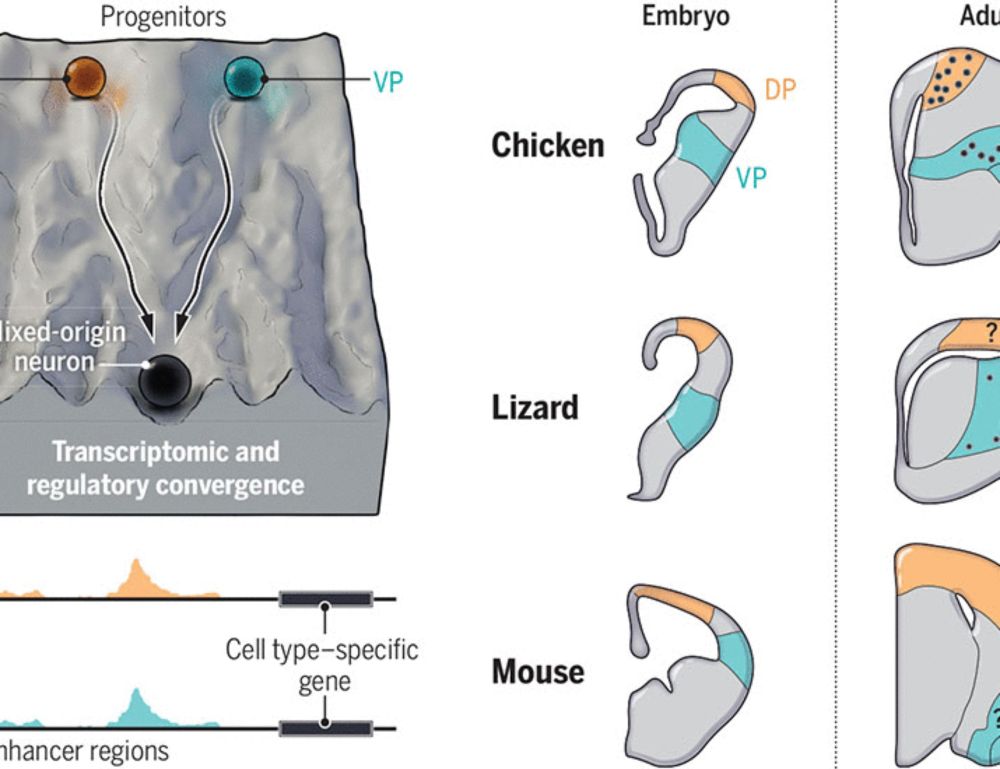
Constrained roads to complex brains
Neural development and brain circuit evolution converged in birds and mammals
www.science.org
February 13, 2025 at 10:32 PM
And please check out the wonderful Perspective by Maria Tosches and Giacomo Gattoni on our paper and the two related ones by the groups of @steinaerts.bsky.social and Fernando Garcia-Moreno!!
www.science.org/doi/10.1126/...
www.science.org/doi/10.1126/...
Reposted by Marianne V. Lemée
Three fantastic @science.org papers on convergent development & evolution of neurons + their connections in the bird &
mammalian pallia, by @kaessmannlab.bsky.social @steinaerts.bsky.social & Fernando García-Moreno.
Expertly synthesised by @giacomogattoni.bsky.social & Maria Antonietta Tosches 🧪🧠
mammalian pallia, by @kaessmannlab.bsky.social @steinaerts.bsky.social & Fernando García-Moreno.
Expertly synthesised by @giacomogattoni.bsky.social & Maria Antonietta Tosches 🧪🧠

Constrained roads to complex brains
Neural development and brain circuit evolution converged in birds and mammals
www.science.org
February 14, 2025 at 6:52 AM
Three fantastic @science.org papers on convergent development & evolution of neurons + their connections in the bird &
mammalian pallia, by @kaessmannlab.bsky.social @steinaerts.bsky.social & Fernando García-Moreno.
Expertly synthesised by @giacomogattoni.bsky.social & Maria Antonietta Tosches 🧪🧠
mammalian pallia, by @kaessmannlab.bsky.social @steinaerts.bsky.social & Fernando García-Moreno.
Expertly synthesised by @giacomogattoni.bsky.social & Maria Antonietta Tosches 🧪🧠