



Bob Pellegrino
@kingfunk.bsky.social
Human psychophysicist interested in all things smell.
📸: @smellboi24_7
📸: @smellboi24_7
Reposted by Bob Pellegrino

A long, absolutely must-read article from Cory Doctorow: www.theguardian.com/us-news/ng-i...

AI companies will fail. We can salvage something from the wreckage | Cory Doctorow
AI is asbestos in the walls of our tech society, stuffed there by monopolists run amok. A serious fight against it must strike at its roots
www.theguardian.com
January 18, 2026 at 9:01 PM
A long, absolutely must-read article from Cory Doctorow: www.theguardian.com/us-news/ng-i...
Reposted by Bob Pellegrino

High-Fidelity Tuning of Olfactory Mixture Distances in the Perceptual Space of Smell Through a Community Effort https://www.biorxiv.org/content/10.64898/2025.12.13.694160v1
December 17, 2025 at 3:15 AM
High-Fidelity Tuning of Olfactory Mixture Distances in the Perceptual Space of Smell Through a Community Effort https://www.biorxiv.org/content/10.64898/2025.12.13.694160v1
Reposted by Bob Pellegrino

And the latest from @dreamchallenges.bsky.social
High-Fidelity Tuning of Olfactory Mixture Distances in the Perceptual Space of Smell Through a Community Effort https://www.biorxiv.org/content/10.64898/2025.12.13.694160v1
December 19, 2025 at 1:20 PM
And the latest from @dreamchallenges.bsky.social
1/3 The humble glass jar is a workhorse in olfactory research, but comes w/ hidden problems:
- Unknown headspace concentration
- Concentration dilution by ambient air
These add noise to odor measurements.
Our preprint introduces something new, something bag.🧪 @jmainland.bsky.social & Matt Andres
- Unknown headspace concentration
- Concentration dilution by ambient air
These add noise to odor measurements.
Our preprint introduces something new, something bag.🧪 @jmainland.bsky.social & Matt Andres
Odor Sampling Bags Enable Reliable Delivery of Controlled Odor Concentrations
Precise control of odorant concentration is essential for reliable olfactory research, yet existing odorant delivery methods often suffer from solvent interactions and dilution from ambient air, limiting stimulus consistency in olfactory research. We developed an odor sampling bag system using Nalophan plastic to create a closed headspace with air as the carrier medium, eliminating solvent-related variability and ambient air dilution. In two independent experiments, 15 trained panelists each rated the perceived intensity of seven concentrations of benzaldehyde and 2-heptanone using both gas-sampling bags and glass jars. Bags produced higher maximum perceptual intensities (p < 0.001) and greater test-retest reliability than jars (Experiment 1: r = 0.89 vs. 0.81, p < 0.001; Experiment 2: r = 0.86 vs. 0.72, p < 0.001). Notably, the two tested odorants showed different maximum intensities in bags (p < 0.001) but not jars (p = 0.85), suggesting bags better preserve odorant-specific concentration differences. Photoionization detector measurements confirmed stable headspace concentrations over time, comparable to industry-standard Tedlar bags. This cost-effective approach offers improved stimulus control for olfactory psychophysics research. ### Competing Interest Statement Joel D. Mainland serves on the scientific advisory board of Osmo Labs, PBC and receives compensation for these activities. National Institutes of Health, https://ror.org/01cwqze88, F32 DC020380, T32 DC000014, U19 NS112953, R01 DC017757, R01 DC021663
www.biorxiv.org
January 16, 2026 at 8:29 PM
1/3 The humble glass jar is a workhorse in olfactory research, but comes w/ hidden problems:
- Unknown headspace concentration
- Concentration dilution by ambient air
These add noise to odor measurements.
Our preprint introduces something new, something bag.🧪 @jmainland.bsky.social & Matt Andres
- Unknown headspace concentration
- Concentration dilution by ambient air
These add noise to odor measurements.
Our preprint introduces something new, something bag.🧪 @jmainland.bsky.social & Matt Andres
Reposted by Bob Pellegrino
Superior cf what? Full of ultraprocessed constituents.
The relentless and inappropriate marketing of David protein bars
Here's a roundup of facts about protein intake and unnecessary preoccupation erictopol.substack.com/p/our-preocc...
The relentless and inappropriate marketing of David protein bars
Here's a roundup of facts about protein intake and unnecessary preoccupation erictopol.substack.com/p/our-preocc...

January 14, 2026 at 1:01 AM
Superior cf what? Full of ultraprocessed constituents.
The relentless and inappropriate marketing of David protein bars
Here's a roundup of facts about protein intake and unnecessary preoccupation erictopol.substack.com/p/our-preocc...
The relentless and inappropriate marketing of David protein bars
Here's a roundup of facts about protein intake and unnecessary preoccupation erictopol.substack.com/p/our-preocc...
1/5
Odor intensity isn’t just about concentration! We have a new preprint to prove it: www.biorxiv.org/content/10.1...
In cahoots with @jmainland.bsky.social, @alexkoulakov.bsky.social, Rick Gerkin, Khristina Samoilova and others not on bluesky. 🧪
Which of these molecules smells stronger?
Odor intensity isn’t just about concentration! We have a new preprint to prove it: www.biorxiv.org/content/10.1...
In cahoots with @jmainland.bsky.social, @alexkoulakov.bsky.social, Rick Gerkin, Khristina Samoilova and others not on bluesky. 🧪
Which of these molecules smells stronger?

August 12, 2025 at 8:34 PM
1/5
Odor intensity isn’t just about concentration! We have a new preprint to prove it: www.biorxiv.org/content/10.1...
In cahoots with @jmainland.bsky.social, @alexkoulakov.bsky.social, Rick Gerkin, Khristina Samoilova and others not on bluesky. 🧪
Which of these molecules smells stronger?
Odor intensity isn’t just about concentration! We have a new preprint to prove it: www.biorxiv.org/content/10.1...
In cahoots with @jmainland.bsky.social, @alexkoulakov.bsky.social, Rick Gerkin, Khristina Samoilova and others not on bluesky. 🧪
Which of these molecules smells stronger?
Reposted by Bob Pellegrino

New preprint!
tl;dr — We ran around late at night to record wild rats in NYC and figured out how to quantify their behavior and environment. 🧵
w/ Dima Batenkov, @zamakany.bsky.social, Emily Mackevicius
www.biorxiv.org/content/10.1...
tl;dr — We ran around late at night to record wild rats in NYC and figured out how to quantify their behavior and environment. 🧵
w/ Dima Batenkov, @zamakany.bsky.social, Emily Mackevicius
www.biorxiv.org/content/10.1...

Computational Urban Ecology of New York City Rats
Urban rats are highly adaptable, thriving in the dynamic and often inhospitable conditions of modern cities. Despite substantial mitigation efforts, they remain an enduring presence in urban environme...
www.biorxiv.org
July 25, 2025 at 3:57 PM
New preprint!
tl;dr — We ran around late at night to record wild rats in NYC and figured out how to quantify their behavior and environment. 🧵
w/ Dima Batenkov, @zamakany.bsky.social, Emily Mackevicius
www.biorxiv.org/content/10.1...
tl;dr — We ran around late at night to record wild rats in NYC and figured out how to quantify their behavior and environment. 🧵
w/ Dima Batenkov, @zamakany.bsky.social, Emily Mackevicius
www.biorxiv.org/content/10.1...
Sometimes I forget that Todd Rundgren doesn't want to work but just wants to bang on the drum all day.
June 26, 2025 at 7:14 PM
Sometimes I forget that Todd Rundgren doesn't want to work but just wants to bang on the drum all day.
Reposted by Bob Pellegrino

Distinguishing performance gains from learning when using generative AI
Comment by Lixiang Yan, Samuel Greiff, Jason M. Lodge & Dragan Gašević
go.nature.com/3FJqTq3
Comment by Lixiang Yan, Samuel Greiff, Jason M. Lodge & Dragan Gašević
go.nature.com/3FJqTq3

June 18, 2025 at 12:58 PM
Distinguishing performance gains from learning when using generative AI
Comment by Lixiang Yan, Samuel Greiff, Jason M. Lodge & Dragan Gašević
go.nature.com/3FJqTq3
Comment by Lixiang Yan, Samuel Greiff, Jason M. Lodge & Dragan Gašević
go.nature.com/3FJqTq3
Large language models (LLMs) can mirror human thinking in vision and language, but can they smell and taste?
New study with @rbrainengineer.bsky.social show stochastic LLMs rate creative flavor pairings like humans, prioritizing novelty over taste. #AI #creativity #foodscience
New study with @rbrainengineer.bsky.social show stochastic LLMs rate creative flavor pairings like humans, prioritizing novelty over taste. #AI #creativity #foodscience

Automating chemosensory creativity assessment with large language models
Chemosensory creativity, the ability to innovate using taste and smell, is a crucial yet understudied aspect of human ingenuity. This study explores t…
www.sciencedirect.com
May 28, 2025 at 6:09 PM
Large language models (LLMs) can mirror human thinking in vision and language, but can they smell and taste?
New study with @rbrainengineer.bsky.social show stochastic LLMs rate creative flavor pairings like humans, prioritizing novelty over taste. #AI #creativity #foodscience
New study with @rbrainengineer.bsky.social show stochastic LLMs rate creative flavor pairings like humans, prioritizing novelty over taste. #AI #creativity #foodscience
Reposted by Bob Pellegrino

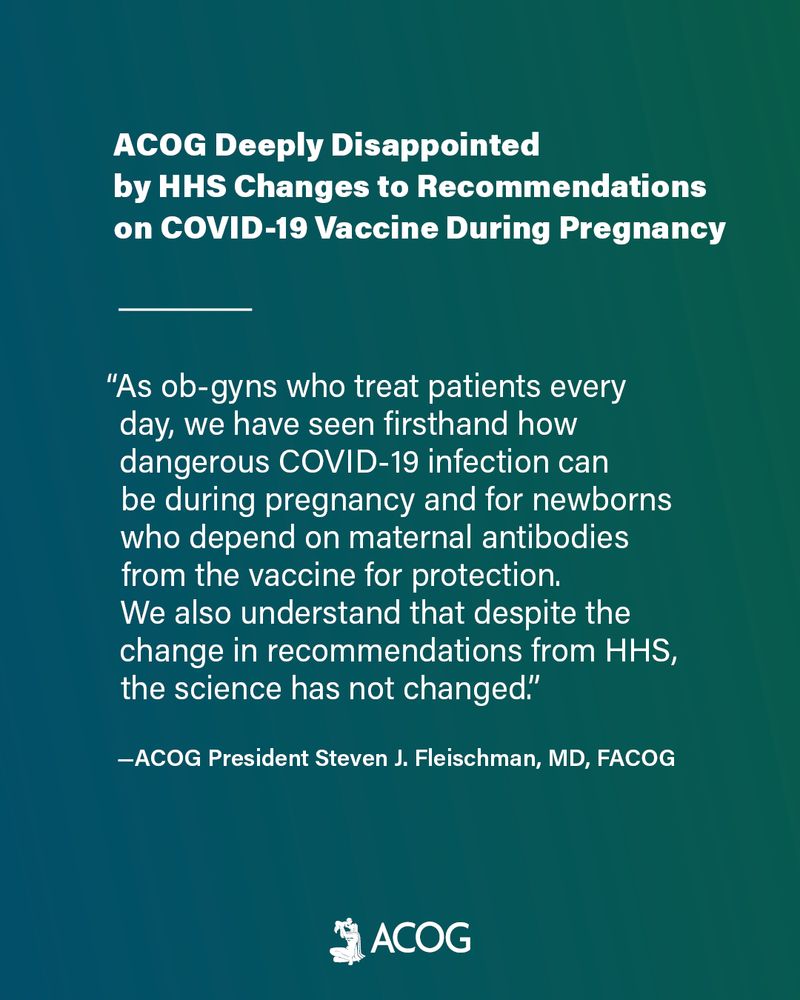
ACOG is deeply disappointed by HHS’s move to drop COVID-19 vaccine recommendations in pregnancy. The science is clear: COVID-19 remains dangerous in pregnancy and vaccination protects both patients and newborns. The vaccine is safe and protects families. Read our full statement: buff.ly/OGue7sO
May 27, 2025 at 6:34 PM
ACOG is deeply disappointed by HHS’s move to drop COVID-19 vaccine recommendations in pregnancy. The science is clear: COVID-19 remains dangerous in pregnancy and vaccination protects both patients and newborns. The vaccine is safe and protects families. Read our full statement: buff.ly/OGue7sO
Reposted by Bob Pellegrino

Regular smell and taste testing could aid early detection of impairments that negatively impact health, safety, and quality of life, and could also reveal underlying disease. But how do we get there? This new whitepaper is out today:

Towards Universal Chemosensory Testing: Needs, Barriers and Opportunities
doi.org
May 20, 2025 at 4:12 PM
Regular smell and taste testing could aid early detection of impairments that negatively impact health, safety, and quality of life, and could also reveal underlying disease. But how do we get there? This new whitepaper is out today:
One of the few bands I’ve been listening to since the 90s and still putting out great stuff

Lust For Gold
YouTube video by Starflyer 59 - Topic
m.youtube.com
May 10, 2025 at 2:40 AM
One of the few bands I’ve been listening to since the 90s and still putting out great stuff
Reposted by Bob Pellegrino

With a contemporary smartphone, capturing, transmitting, and replicating sounds and visuals is a breeze, yet replicating scents remains elusive. If you want to change this, consider joining the 2025 DREAM Olfaction Challenge at www.synapse.org/Synapse:syn6....
@oldbap.bsky.social
@oldbap.bsky.social
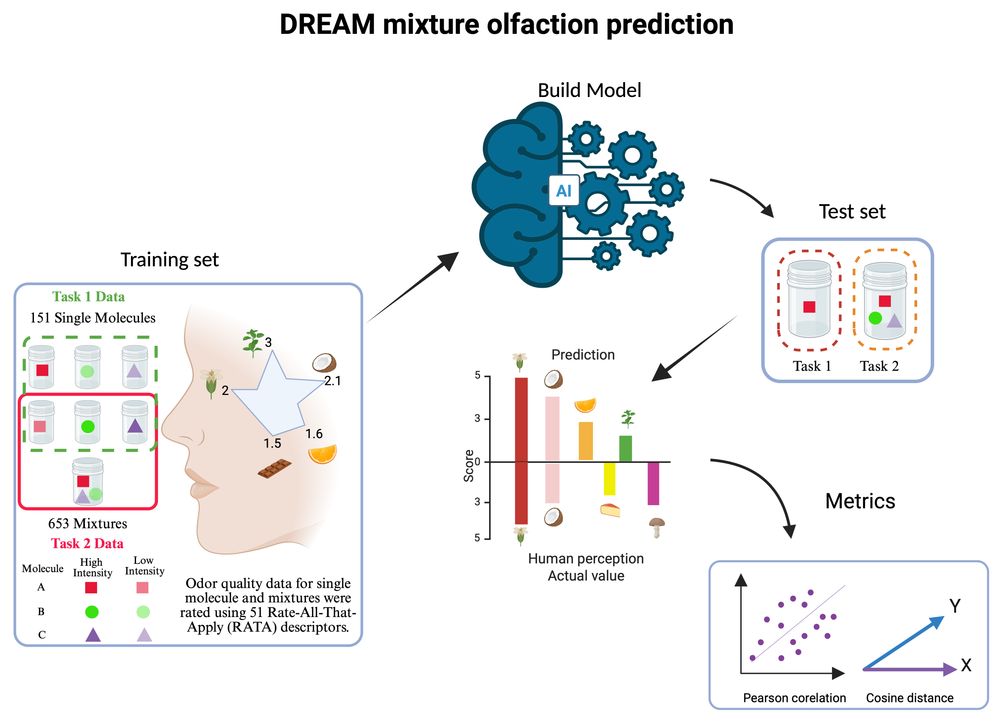
DREAM Olfactory Mixtures Prediction Challenge 2025
'DREAM Olfactory Mixtures Prediction Challenge 2025' (Synapse ID: syn64743570) is a project on Synapse. Synapse is a platform for supporting scientific collaborations centered around shared biomed...
www.synapse.org
May 7, 2025 at 11:38 PM
With a contemporary smartphone, capturing, transmitting, and replicating sounds and visuals is a breeze, yet replicating scents remains elusive. If you want to change this, consider joining the 2025 DREAM Olfaction Challenge at www.synapse.org/Synapse:syn6....
@oldbap.bsky.social
@oldbap.bsky.social
Reposted by Bob Pellegrino
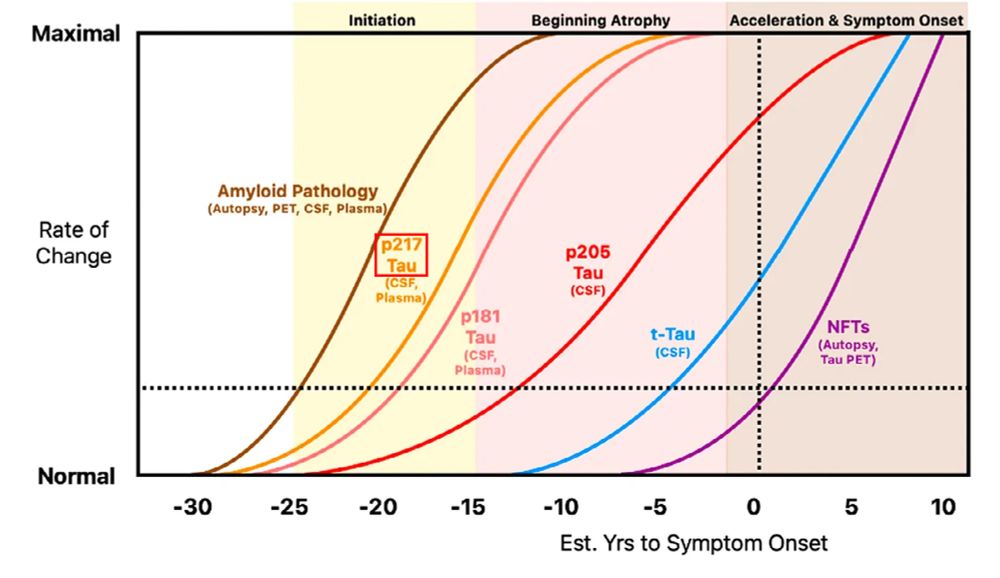
Most people haven’t heard of this test, which is available in the US. It accurately predicts Alzheimer’s (not just if there’s a risk, but when). It is modulated by exercise and likely other lifestyle factors.
Here’s (almost) everything we know about it
erictopol.substack.com/p/the-breakt...
Here’s (almost) everything we know about it
erictopol.substack.com/p/the-breakt...
April 14, 2025 at 1:48 PM
Most people haven’t heard of this test, which is available in the US. It accurately predicts Alzheimer’s (not just if there’s a risk, but when). It is modulated by exercise and likely other lifestyle factors.
Here’s (almost) everything we know about it
erictopol.substack.com/p/the-breakt...
Here’s (almost) everything we know about it
erictopol.substack.com/p/the-breakt...
Reposted by Bob Pellegrino

Excited to share the sequel to our 2022 paper! In this follow-up, we show that the stable head direction (HD) signals we reported in blind mice rely on stereo olfaction—that is, the comparison of odor info. between the two nostrils.
Link: www.nature.com/articles/s41...
🧵highlights below
Link: www.nature.com/articles/s41...
🧵highlights below
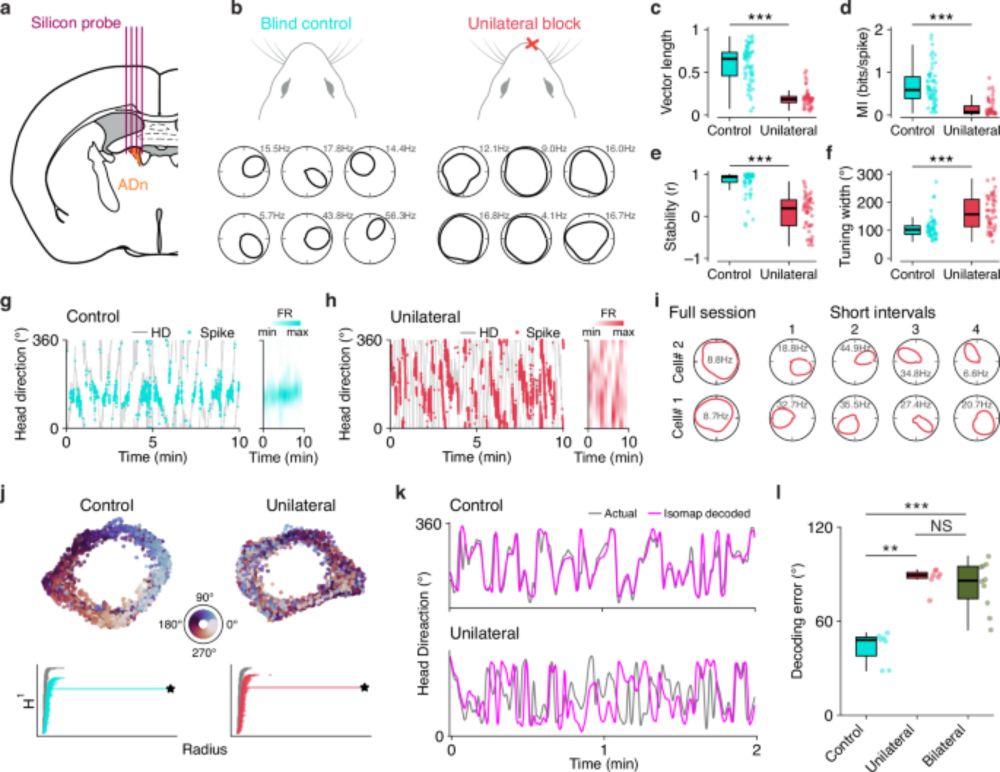
Stereo olfaction underlies stable coding of head direction in blind mice - Nature Communications
Stereo olfaction involves comparing odor differences between the two nostrils. Here, using neuronal recordings and a behavioral test, the authors demonstrate that blind mice use stereo olfaction to fo...
www.nature.com
April 15, 2025 at 6:26 AM
Excited to share the sequel to our 2022 paper! In this follow-up, we show that the stable head direction (HD) signals we reported in blind mice rely on stereo olfaction—that is, the comparison of odor info. between the two nostrils.
Link: www.nature.com/articles/s41...
🧵highlights below
Link: www.nature.com/articles/s41...
🧵highlights below
Reposted by Bob Pellegrino

Very proud of this paper, which spans three decades of work. (1/17) onlinelibrary.wiley.com/doi/10.1111/...

Piriform cortex is an ictogenic trigger zone in the primate brain
Objective Area tempestas, a functionally defined region in the anterior piriform cortex, was identified as a crucial ictogenic trigger zone in the rat brain in the 1980s. However, whether the primat...
onlinelibrary.wiley.com
March 22, 2025 at 3:04 PM
Very proud of this paper, which spans three decades of work. (1/17) onlinelibrary.wiley.com/doi/10.1111/...
Reposted by Bob Pellegrino

Welcome to the Bluesky account for Stand Up for Science 2025!
Keep an eye on this space for updates, event information, and ways to get involved. We can't wait to see everyone #standupforscience2025 on March 7th, both in DC and locations nationwide!
#scienceforall #sciencenotsilence
Keep an eye on this space for updates, event information, and ways to get involved. We can't wait to see everyone #standupforscience2025 on March 7th, both in DC and locations nationwide!
#scienceforall #sciencenotsilence

February 12, 2025 at 5:04 PM
Welcome to the Bluesky account for Stand Up for Science 2025!
Keep an eye on this space for updates, event information, and ways to get involved. We can't wait to see everyone #standupforscience2025 on March 7th, both in DC and locations nationwide!
#scienceforall #sciencenotsilence
Keep an eye on this space for updates, event information, and ways to get involved. We can't wait to see everyone #standupforscience2025 on March 7th, both in DC and locations nationwide!
#scienceforall #sciencenotsilence
New video tracking suite for social behavior + large dataset to benchmark other tracking suites.

Mapping the landscape of social behavior
Computer vision and machine learning approaches map a multi-scale social behavioral
landscape, revealing ASD signatures and establishing an atlas of rodent sociality.
www.cell.com
March 7, 2025 at 2:40 PM
New video tracking suite for social behavior + large dataset to benchmark other tracking suites.
Reposted by Bob Pellegrino
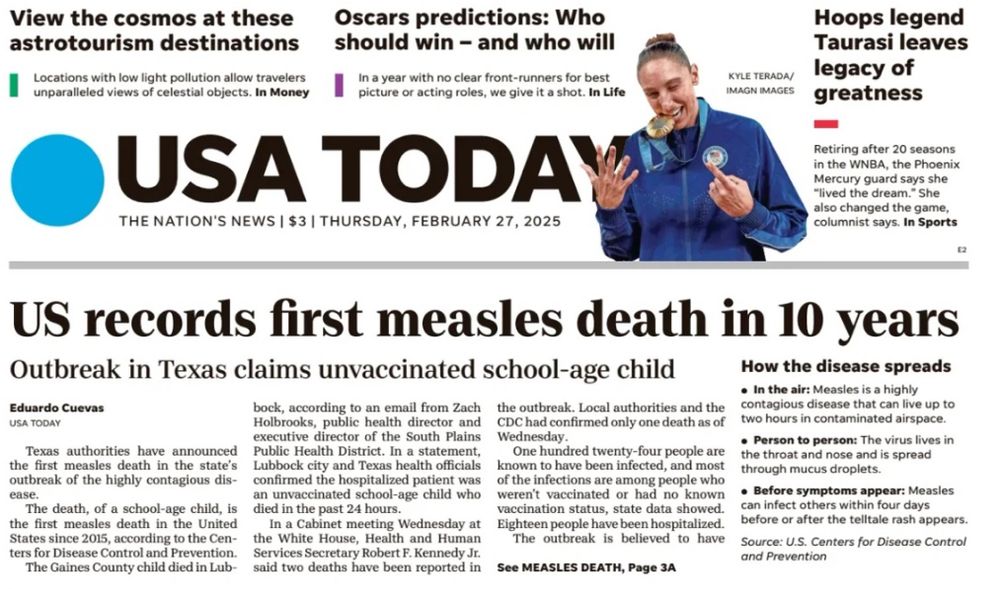
Today's @usatoday.com front page
First US death from measles in 10 years
First child to die from measles in 22 years in the US
All of this fully preventable
First US death from measles in 10 years
First child to die from measles in 22 years in the US
All of this fully preventable
February 27, 2025 at 2:09 PM
Today's @usatoday.com front page
First US death from measles in 10 years
First child to die from measles in 22 years in the US
All of this fully preventable
First US death from measles in 10 years
First child to die from measles in 22 years in the US
All of this fully preventable
Reposted by Bob Pellegrino
One more day to get your paper in.
CFP: Olfactory Philosophy Workshop at UNR Lake Tahoe
philevents.org/event/show/1...
Please spread the CFP widely to PhD students and ECRs - the deadline is January 31
philevents.org/event/show/1...
Please spread the CFP widely to PhD students and ECRs - the deadline is January 31

Olfactory Philosophy Workshop
Call For Papers: Olfactory Philosophy, April 30 - May 3, 2025
The Department of Philosophy at the University of Nevada, Reno will be hosting a workshop on Olfactory Philosophy April 30 - May 3, 2025 a...
philevents.org
January 30, 2025 at 9:22 PM
One more day to get your paper in.
Reposted by Bob Pellegrino
Learning the language of life with A.I.
@science.org
In today's essay, I review the phenomenal progress in foundation models of DNA, RNA, proteins, ligands, cells, their interactions, the Virtual Lab, and the aspiration for the Virtual Cell
www.science.org/doi/10.1126/...
@science.org
In today's essay, I review the phenomenal progress in foundation models of DNA, RNA, proteins, ligands, cells, their interactions, the Virtual Lab, and the aspiration for the Virtual Cell
www.science.org/doi/10.1126/...

Learning the language of life with AI
In 2021, a year before ChatGPT took the world by storm amid the excitement about generative artificial intelligence (AI), AlphaFold 2 cracked the 50-year-old protein-folding problem, predicting three-...
www.science.org
January 30, 2025 at 7:40 PM
Learning the language of life with A.I.
@science.org
In today's essay, I review the phenomenal progress in foundation models of DNA, RNA, proteins, ligands, cells, their interactions, the Virtual Lab, and the aspiration for the Virtual Cell
www.science.org/doi/10.1126/...
@science.org
In today's essay, I review the phenomenal progress in foundation models of DNA, RNA, proteins, ligands, cells, their interactions, the Virtual Lab, and the aspiration for the Virtual Cell
www.science.org/doi/10.1126/...
Reposted by Bob Pellegrino

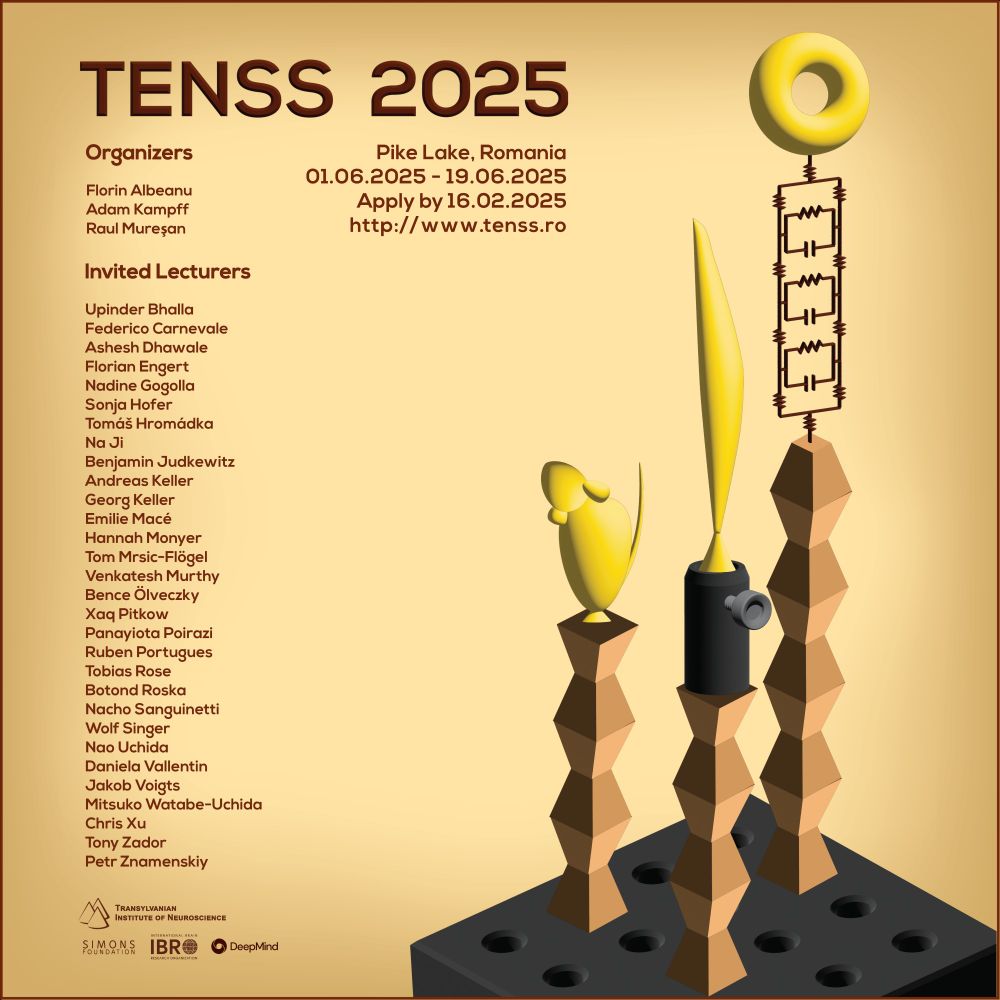
Interested in understanding how things work? In particular the tools you use to study the brain? Join us at TENSS 2025 where we brainstorm ideas, build and debug microscopes, electrophysiology and behavior rigs amidst the picturesque Transylvanian hills! tenss.ro
Apply by: February 16th!
Apply by: February 16th!
January 14, 2025 at 4:58 AM
Interested in understanding how things work? In particular the tools you use to study the brain? Join us at TENSS 2025 where we brainstorm ideas, build and debug microscopes, electrophysiology and behavior rigs amidst the picturesque Transylvanian hills! tenss.ro
Apply by: February 16th!
Apply by: February 16th!
Alexander Fjaeldstad and I have a new chapter in the book Smell, Taste, Eat: The Role of the Chemical Senses in Eating Behaviour, edited by @LorenzoDStafford. Lots of great insights here.
From our chapter, it’s clear that smell loss and its impact on ingestion remain vastly underexplored."
From our chapter, it’s clear that smell loss and its impact on ingestion remain vastly underexplored."
The Effect of Olfactory Disorder (and Other Chemosensory Disorders) on Perception, Acceptance, and Consumption of Food
People with changes in the overall sensory experience of food often complain of taste disturbances, although the problem is normally caused by the loss of aroma in the food (thus an olfactory disorder...
link.springer.com
January 26, 2025 at 3:31 PM
Alexander Fjaeldstad and I have a new chapter in the book Smell, Taste, Eat: The Role of the Chemical Senses in Eating Behaviour, edited by @LorenzoDStafford. Lots of great insights here.
From our chapter, it’s clear that smell loss and its impact on ingestion remain vastly underexplored."
From our chapter, it’s clear that smell loss and its impact on ingestion remain vastly underexplored."
Reposted by Bob Pellegrino

We have a fresh new paper!
The PhD project of the talented Mark Conway.
A learning-induced change in the sensitivity of olfactory receptor neurons enables consistent perception of an odor. #olfaction #neuroscience
www.science.org/doi/10.1126/...
The PhD project of the talented Mark Conway.
A learning-induced change in the sensitivity of olfactory receptor neurons enables consistent perception of an odor. #olfaction #neuroscience
www.science.org/doi/10.1126/...
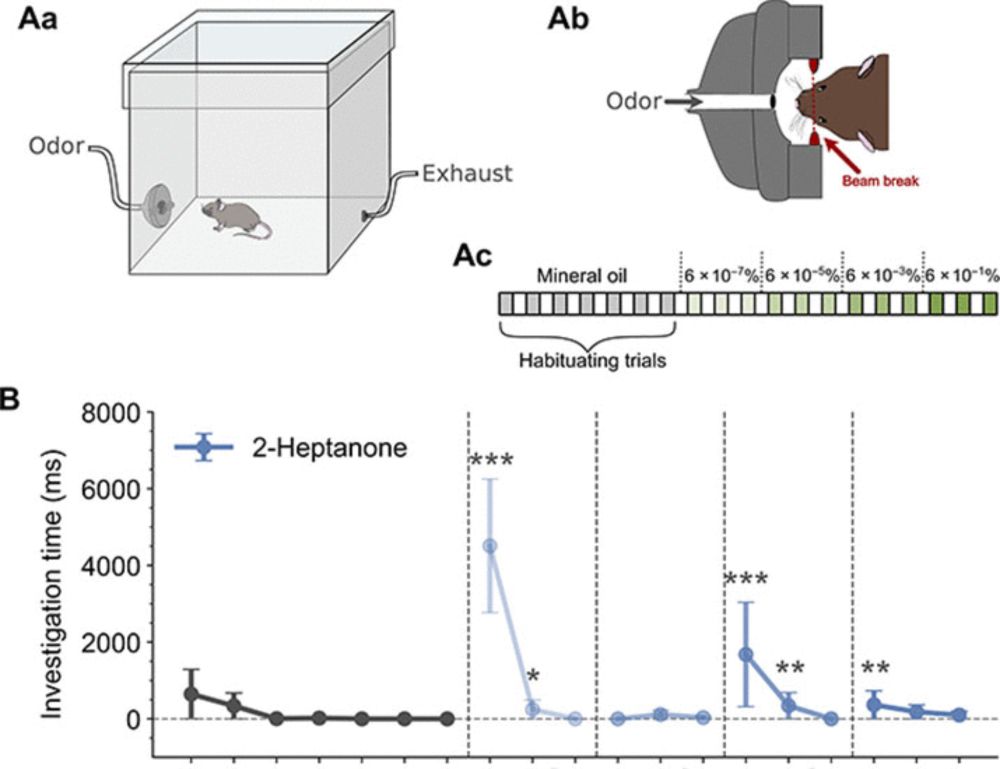
Perceptual constancy for an odor is acquired through changes in primary sensory neurons
Learning-induced changes in primary sensory neurons support concentration-invariant perception of an odor.
www.science.org
December 11, 2024 at 7:42 PM
We have a fresh new paper!
The PhD project of the talented Mark Conway.
A learning-induced change in the sensitivity of olfactory receptor neurons enables consistent perception of an odor. #olfaction #neuroscience
www.science.org/doi/10.1126/...
The PhD project of the talented Mark Conway.
A learning-induced change in the sensitivity of olfactory receptor neurons enables consistent perception of an odor. #olfaction #neuroscience
www.science.org/doi/10.1126/...