


Kathryn (Katy) Appler
@katyappler.bsky.social
💻 Postdoc, Institut Pasteur | Dr. Simonetta Gribaldo
🌊 Ph.D. in Marine Science @UTMSI, University of Texas at Austin | Dr. Brett Baker’s Lab
🧬 Exploring Asgard archaea, deep-sea ecosystems, and the evolution of complex life.
🌊 Ph.D. in Marine Science @UTMSI, University of Texas at Austin | Dr. Brett Baker’s Lab
🧬 Exploring Asgard archaea, deep-sea ecosystems, and the evolution of complex life.
Pinned
Beyond thrilled to share that our study has been published!
This project encompasses years of work, including my thesis research on Asgard archaea in the @archaeal.bsky.social lab at @utmsi.bsky.social and
@texasscience.bsky.social!!!
#MicroSky #ArchaeaSky 1/12
This project encompasses years of work, including my thesis research on Asgard archaea in the @archaeal.bsky.social lab at @utmsi.bsky.social and
@texasscience.bsky.social!!!
#MicroSky #ArchaeaSky 1/12
Reposted by Kathryn (Katy) Appler
One of the biggest questions in biology is how complex cells evolved about 2 billion years ago. Here's my new story on how scientists are solving the mystery of eukaryotes like us. Gift link: nyti.ms/4qMbo22

February 18, 2026 at 7:17 PM
One of the biggest questions in biology is how complex cells evolved about 2 billion years ago. Here's my new story on how scientists are solving the mystery of eukaryotes like us. Gift link: nyti.ms/4qMbo22
Reposted by Kathryn (Katy) Appler
Finally out in @nature.com: a new piece of the puzzle of how complex life evolved. Lead by @archaeal.bsky.social & @katyappler.bsky.social. Great collab with @greening.bsky.social and @kassipan.bsky.social. More pieces to follow soon! www.nature.com/articles/s41...

February 18, 2026 at 5:59 PM
Finally out in @nature.com: a new piece of the puzzle of how complex life evolved. Lead by @archaeal.bsky.social & @katyappler.bsky.social. Great collab with @greening.bsky.social and @kassipan.bsky.social. More pieces to follow soon! www.nature.com/articles/s41...

Reposted by Kathryn (Katy) Appler
New paper from my team detailing a greatly expanded genomic database of Asgard archaea revealing of high energy metabolism those related to eukaryotes! Led by @katyappler.bsky.social lots of help from @jameslingford.bsky.social @valdeanda.bsky.social @kassipan.bsky.social doi.org/10.1038/s415...


February 18, 2026 at 4:00 PM
New paper from my team detailing a greatly expanded genomic database of Asgard archaea revealing of high energy metabolism those related to eukaryotes! Led by @katyappler.bsky.social lots of help from @jameslingford.bsky.social @valdeanda.bsky.social @kassipan.bsky.social doi.org/10.1038/s415...
Beyond thrilled to share that our study has been published!
This project encompasses years of work, including my thesis research on Asgard archaea in the @archaeal.bsky.social lab at @utmsi.bsky.social and
@texasscience.bsky.social!!!
#MicroSky #ArchaeaSky 1/12
This project encompasses years of work, including my thesis research on Asgard archaea in the @archaeal.bsky.social lab at @utmsi.bsky.social and
@texasscience.bsky.social!!!
#MicroSky #ArchaeaSky 1/12
February 18, 2026 at 4:22 PM
Beyond thrilled to share that our study has been published!
This project encompasses years of work, including my thesis research on Asgard archaea in the @archaeal.bsky.social lab at @utmsi.bsky.social and
@texasscience.bsky.social!!!
#MicroSky #ArchaeaSky 1/12
This project encompasses years of work, including my thesis research on Asgard archaea in the @archaeal.bsky.social lab at @utmsi.bsky.social and
@texasscience.bsky.social!!!
#MicroSky #ArchaeaSky 1/12
Reposted by Kathryn (Katy) Appler
Our latest preprint: Together with the team of Jan Löwe, @danieltamarit.bsky.social and many others we discovered and characterized several Asgard tubulin genes and propose that microtubule architecture and dynamics evolved in Asgard archaea prior to eukaryogenesis
www.biorxiv.org/content/10.6...
www.biorxiv.org/content/10.6...

February 16, 2026 at 4:43 PM
Our latest preprint: Together with the team of Jan Löwe, @danieltamarit.bsky.social and many others we discovered and characterized several Asgard tubulin genes and propose that microtubule architecture and dynamics evolved in Asgard archaea prior to eukaryogenesis
www.biorxiv.org/content/10.6...
www.biorxiv.org/content/10.6...
Reposted by Kathryn (Katy) Appler

🌟Célébrons celles qui façonnent la recherche
72 femmes scientifiques seront gravées sur la Tour Eiffel dont 5 Pasteuriennes, parmi lesquelles Agnes Ullmann
Son nom a été donné à notre Centre d’enseignement en 2024, 1er bâtiment dédié à une chercheuse pasteurienne sur notre campus
👉 bit.ly/4asd8HC
72 femmes scientifiques seront gravées sur la Tour Eiffel dont 5 Pasteuriennes, parmi lesquelles Agnes Ullmann
Son nom a été donné à notre Centre d’enseignement en 2024, 1er bâtiment dédié à une chercheuse pasteurienne sur notre campus
👉 bit.ly/4asd8HC


February 11, 2026 at 11:22 AM
🌟Célébrons celles qui façonnent la recherche
72 femmes scientifiques seront gravées sur la Tour Eiffel dont 5 Pasteuriennes, parmi lesquelles Agnes Ullmann
Son nom a été donné à notre Centre d’enseignement en 2024, 1er bâtiment dédié à une chercheuse pasteurienne sur notre campus
👉 bit.ly/4asd8HC
72 femmes scientifiques seront gravées sur la Tour Eiffel dont 5 Pasteuriennes, parmi lesquelles Agnes Ullmann
Son nom a été donné à notre Centre d’enseignement en 2024, 1er bâtiment dédié à une chercheuse pasteurienne sur notre campus
👉 bit.ly/4asd8HC
Reposted by Kathryn (Katy) Appler
The immune systems paradox
Some widespread prokaryotic immune systems are absent in eukaryotes, whereas relatively rare ones became central to eukaryotic innate immunity
@audeber.bsky.social & E. Koonin hypothesize the answer is #HGT
shareable link: rdcu.be/e2EmD
www.nature.com/articles/s41...
Some widespread prokaryotic immune systems are absent in eukaryotes, whereas relatively rare ones became central to eukaryotic innate immunity
@audeber.bsky.social & E. Koonin hypothesize the answer is #HGT
shareable link: rdcu.be/e2EmD
www.nature.com/articles/s41...

The paradox of immune systems conservation between prokaryotes and eukaryotes - Nature Reviews Microbiology
The widespread prokaryotic immune systems, in particular restriction–modification, CRISPR–Cas and defensive toxin–antitoxin systems, are absent in eukaryotes, whereas relatively rare ones, such as Arg...
www.nature.com
February 6, 2026 at 10:22 AM
The immune systems paradox
Some widespread prokaryotic immune systems are absent in eukaryotes, whereas relatively rare ones became central to eukaryotic innate immunity
@audeber.bsky.social & E. Koonin hypothesize the answer is #HGT
shareable link: rdcu.be/e2EmD
www.nature.com/articles/s41...
Some widespread prokaryotic immune systems are absent in eukaryotes, whereas relatively rare ones became central to eukaryotic innate immunity
@audeber.bsky.social & E. Koonin hypothesize the answer is #HGT
shareable link: rdcu.be/e2EmD
www.nature.com/articles/s41...
Reposted by Kathryn (Katy) Appler

Passioned by #bioenergetics? Do not miss our new article on the evolutionary history of oxidoreductases with G. Borrel and @sgribaldo.bsky.social @archaeal.bsky.social @valdeanda.bsky.social @pasteur.fr @cnrs.fr @cnrsbiologie.bsky.social @natecoevo.nature.com (www.nature.com/articles/s41...).

Evolution and diversity of oxidoreductases involved in redox balance and energy conservation - Nature Ecology & Evolution
HORBEC are protein complexes involved in the regulation of redox balance and energy conservation. The authors develop a bioinformatic tool for HORBEC annotation in bacterial and archaeal genomes and r...
www.nature.com
February 3, 2026 at 10:52 AM
Passioned by #bioenergetics? Do not miss our new article on the evolutionary history of oxidoreductases with G. Borrel and @sgribaldo.bsky.social @archaeal.bsky.social @valdeanda.bsky.social @pasteur.fr @cnrs.fr @cnrsbiologie.bsky.social @natecoevo.nature.com (www.nature.com/articles/s41...).
Reposted by Kathryn (Katy) Appler
Archaea, the ultimate survivor www.embl.org/news/science...

Archaea, the ultimate survivor | EMBL
EMBL researchers are investigating archaea, hoping these understudied organisms can answer questions about evolution, adaptability, & more.
www.embl.org
January 30, 2026 at 3:29 PM
Archaea, the ultimate survivor www.embl.org/news/science...
Reposted by Kathryn (Katy) Appler

Positive ocean news 🌊
With the High Seas Treaty and France's ban on PFAS now in force, to a boost in whale numbers and rescued manatees, there's plenty of ocean optimism to enjoy this month
Head to our blog to discover the latest ocean news 👉 mcsuk.org/positive-ocean-news-january-26
With the High Seas Treaty and France's ban on PFAS now in force, to a boost in whale numbers and rescued manatees, there's plenty of ocean optimism to enjoy this month
Head to our blog to discover the latest ocean news 👉 mcsuk.org/positive-ocean-news-january-26

January 30, 2026 at 11:40 AM
Positive ocean news 🌊
With the High Seas Treaty and France's ban on PFAS now in force, to a boost in whale numbers and rescued manatees, there's plenty of ocean optimism to enjoy this month
Head to our blog to discover the latest ocean news 👉 mcsuk.org/positive-ocean-news-january-26
With the High Seas Treaty and France's ban on PFAS now in force, to a boost in whale numbers and rescued manatees, there's plenty of ocean optimism to enjoy this month
Head to our blog to discover the latest ocean news 👉 mcsuk.org/positive-ocean-news-january-26
Reposted by Kathryn (Katy) Appler

The study shows that nitrogenase enzymes have maintained stable isotope signatures over billions of years, revealing how ancient #microbes shaped Earth’s #nitrogen cycle and offering a new experimental framework for probing early life.
www.nature.com/articles/s41...
www.nature.com/articles/s41...

Resurrected nitrogenases recapitulate canonical N-isotope biosignatures over two billion years - Nature Communications
The study shows that nitrogenase enzymes have maintained stable isotope signatures over billions of years, revealing how ancient microbes shaped Earth’s nitrogen cycle and offering a new experimental ...
www.nature.com
January 27, 2026 at 7:18 PM
The study shows that nitrogenase enzymes have maintained stable isotope signatures over billions of years, revealing how ancient #microbes shaped Earth’s #nitrogen cycle and offering a new experimental framework for probing early life.
www.nature.com/articles/s41...
www.nature.com/articles/s41...
Reposted by Kathryn (Katy) Appler
Our latest. Led by the very talented @ahoiching.bsky.social
Cell cycle dysregulation of globally important SAR11 bacteria resulting from environmental perturbation www.nature.com/articles/s41... #jcampubs 🌊
Cell cycle dysregulation of globally important SAR11 bacteria resulting from environmental perturbation www.nature.com/articles/s41... #jcampubs 🌊

Cell cycle dysregulation of globally important SAR11 bacteria resulting from environmental perturbation - Nature Microbiology
Without key cell cycle control genes, SAR11 cells experience aneuploidy and growth inhibition when exposed to changes in nutrients, carbon sources or temperature stress, a vulnerability that may repre...
www.nature.com
January 22, 2026 at 2:24 PM
Our latest. Led by the very talented @ahoiching.bsky.social
Cell cycle dysregulation of globally important SAR11 bacteria resulting from environmental perturbation www.nature.com/articles/s41... #jcampubs 🌊
Cell cycle dysregulation of globally important SAR11 bacteria resulting from environmental perturbation www.nature.com/articles/s41... #jcampubs 🌊
A Brown Swiss Cow
“Apart from humans, this ability to use a single tool for multiple purposes has only been seen in chimpanzees”
“Apart from humans, this ability to use a single tool for multiple purposes has only been seen in chimpanzees”

January 23, 2026 at 7:42 PM
A Brown Swiss Cow
“Apart from humans, this ability to use a single tool for multiple purposes has only been seen in chimpanzees”
“Apart from humans, this ability to use a single tool for multiple purposes has only been seen in chimpanzees”
Reposted by Kathryn (Katy) Appler
New paper out: An archaeal genetic code with all TAG codons as pyrrolysine: www.science.org/doi/10.1126/...

An archaeal genetic code with all TAG codons as pyrrolysine
Multiple genetic codes developed during the evolution of eukaryotes and bacteria, yet no alternative genetic code is known for archaea. We used proteomics to confirm our prediction that certain archae...
www.science.org
November 23, 2025 at 7:22 PM
New paper out: An archaeal genetic code with all TAG codons as pyrrolysine: www.science.org/doi/10.1126/...
Reposted by Kathryn (Katy) Appler
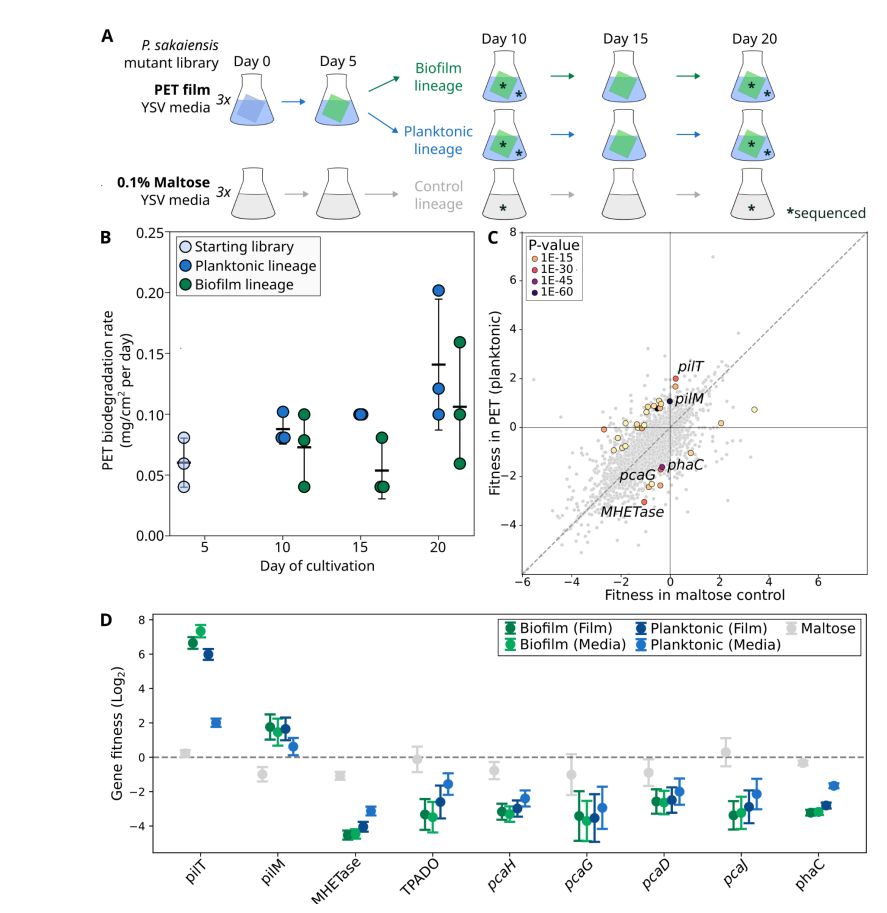
Very happy to share our recent work @cultivarium.bsky.social on genetic tools for Ideonella sakaiensis, a (Betaproteo-)bacterium that degrades PET plastic.
We identified a plasmid vector for the strain and generated a large RB-TnSeq library, screening for genes impacting plastic degradation.
We identified a plasmid vector for the strain and generated a large RB-TnSeq library, screening for genes impacting plastic degradation.
November 12, 2025 at 7:05 PM
Very happy to share our recent work @cultivarium.bsky.social on genetic tools for Ideonella sakaiensis, a (Betaproteo-)bacterium that degrades PET plastic.
We identified a plasmid vector for the strain and generated a large RB-TnSeq library, screening for genes impacting plastic degradation.
We identified a plasmid vector for the strain and generated a large RB-TnSeq library, screening for genes impacting plastic degradation.
New publication: Congratulations to Dan and Daryl, and team!
Excited to be a part of this project identifying a broad diversity of deep-ocean plastic-degrading enzymes (PETases/BHETases).
doi.org/10.1093/isme...
Excited to be a part of this project identifying a broad diversity of deep-ocean plastic-degrading enzymes (PETases/BHETases).
doi.org/10.1093/isme...
Validate User
doi.org
November 12, 2025 at 5:31 PM
New publication: Congratulations to Dan and Daryl, and team!
Excited to be a part of this project identifying a broad diversity of deep-ocean plastic-degrading enzymes (PETases/BHETases).
doi.org/10.1093/isme...
Excited to be a part of this project identifying a broad diversity of deep-ocean plastic-degrading enzymes (PETases/BHETases).
doi.org/10.1093/isme...
Reposted by Kathryn (Katy) Appler

Reposted by Kathryn (Katy) Appler
A wonderful collaboration between my lab and Andy Ellington and Edward Marcotte here at UT.
We obtained lots of thermal stable plastic degrading enzymes from the deep sea (Guaymas Basin, Gulf of California)
We obtained lots of thermal stable plastic degrading enzymes from the deep sea (Guaymas Basin, Gulf of California)

Plastic degradation by enzymes from uncultured deep sea microorganisms
Abstract. Polyethylene terephthalate (PET)-hydrolyzing enzymes (PETases) are a recently discovered enzyme class capable of plastic degradation. PETases are
academic.oup.com
November 10, 2025 at 6:04 PM
A wonderful collaboration between my lab and Andy Ellington and Edward Marcotte here at UT.
We obtained lots of thermal stable plastic degrading enzymes from the deep sea (Guaymas Basin, Gulf of California)
We obtained lots of thermal stable plastic degrading enzymes from the deep sea (Guaymas Basin, Gulf of California)
Reposted by Kathryn (Katy) Appler

We are looking for a PhD student to work on an exciting plastid endosymbiosis in microbial eukaryotes. This position involves sampling, exciting microscopy such as CARDFISH, ExM and FIBSEM, single-cell transcriptomics and more. #protistsonsky 1/2

November 12, 2025 at 9:50 AM
We are looking for a PhD student to work on an exciting plastid endosymbiosis in microbial eukaryotes. This position involves sampling, exciting microscopy such as CARDFISH, ExM and FIBSEM, single-cell transcriptomics and more. #protistsonsky 1/2
Reposted by Kathryn (Katy) Appler
We're thrilled to announce SeqHub, an AI-enabled platform for biological sequence analysis. SeqHub brings together sequence search, genome annotation, and data sharing in one place.
October 28, 2025 at 1:47 PM
We're thrilled to announce SeqHub, an AI-enabled platform for biological sequence analysis. SeqHub brings together sequence search, genome annotation, and data sharing in one place.
Reposted by Kathryn (Katy) Appler
🚨New preprint out!
We present a foundational genomic resource of human gut microbiome viruses. It delivers high-quality, deeply curated data spanning taxonomy, predicted hosts, structures, and functions, providing a reference for gut virome research. (1/8)
www.biorxiv.org/content/10.1...
We present a foundational genomic resource of human gut microbiome viruses. It delivers high-quality, deeply curated data spanning taxonomy, predicted hosts, structures, and functions, providing a reference for gut virome research. (1/8)
www.biorxiv.org/content/10.1...

November 6, 2025 at 5:26 PM
🚨New preprint out!
We present a foundational genomic resource of human gut microbiome viruses. It delivers high-quality, deeply curated data spanning taxonomy, predicted hosts, structures, and functions, providing a reference for gut virome research. (1/8)
www.biorxiv.org/content/10.1...
We present a foundational genomic resource of human gut microbiome viruses. It delivers high-quality, deeply curated data spanning taxonomy, predicted hosts, structures, and functions, providing a reference for gut virome research. (1/8)
www.biorxiv.org/content/10.1...
Reposted by Kathryn (Katy) Appler
Bacteria can sense when a virus starts shredding their genome — by detecting methylated mononucleotides.
Here’s the story of how we discovered the Metis defense system 👇
www.biorxiv.org/content/10.1...
Here’s the story of how we discovered the Metis defense system 👇
www.biorxiv.org/content/10.1...

November 6, 2025 at 5:00 AM
Bacteria can sense when a virus starts shredding their genome — by detecting methylated mononucleotides.
Here’s the story of how we discovered the Metis defense system 👇
www.biorxiv.org/content/10.1...
Here’s the story of how we discovered the Metis defense system 👇
www.biorxiv.org/content/10.1...
Reposted by Kathryn (Katy) Appler

Check out M. smithii 👀
Congrats Romain and team!!
Congrats Romain and team!!
November 3, 2025 at 3:01 PM
Check out M. smithii 👀
Congrats Romain and team!!
Congrats Romain and team!!