


Gerard van der Schrier
@gerardvdschrier.bsky.social
Climate scientist at the Royal Netherlands Meteorological Institute and principal scientist for the European Climate Assessment & Dataset - providing the E-OBS dataset.
Reposted by Gerard van der Schrier

New dashboard to visualise CRU-TS country averages (i.e. CRU-CY) for temperature, precipitation, humidity and drought area (using our scPDSI indicator).
(It takes a little while to first load, but is quite responsive after that)
climate.uea.co/CRU-Timeseri...
(It takes a little while to first load, but is quite responsive after that)
climate.uea.co/CRU-Timeseri...

February 16, 2026 at 3:10 PM
New dashboard to visualise CRU-TS country averages (i.e. CRU-CY) for temperature, precipitation, humidity and drought area (using our scPDSI indicator).
(It takes a little while to first load, but is quite responsive after that)
climate.uea.co/CRU-Timeseri...
(It takes a little while to first load, but is quite responsive after that)
climate.uea.co/CRU-Timeseri...
Reposted by Gerard van der Schrier

How warm was Europe in 2025? 🔍 It was the third‑warmest year on record for Europe, with an average temperature of 10.41°C, 1.17°C above the 1991–2020 average and 0.30°C below the record year of 2024. #CopernicusClimate #GCH2025
🔗 climate.copernicus.eu/global-clima...
@ecmwf.int
🔗 climate.copernicus.eu/global-clima...
@ecmwf.int

January 17, 2026 at 10:20 AM
How warm was Europe in 2025? 🔍 It was the third‑warmest year on record for Europe, with an average temperature of 10.41°C, 1.17°C above the 1991–2020 average and 0.30°C below the record year of 2024. #CopernicusClimate #GCH2025
🔗 climate.copernicus.eu/global-clima...
@ecmwf.int
🔗 climate.copernicus.eu/global-clima...
@ecmwf.int
Reposted by Gerard van der Schrier

In the @copernicusecmwf.bsky.social Global Climate Highlights 2025 report we used #dataviz to present its key messages and bring them to a wider audience. This first example shows daily temperature anomalies from 1940 to 2025 and it was inspired by the work of @erwanrivault.com (BBC)

January 14, 2026 at 1:58 PM
In the @copernicusecmwf.bsky.social Global Climate Highlights 2025 report we used #dataviz to present its key messages and bring them to a wider audience. This first example shows daily temperature anomalies from 1940 to 2025 and it was inspired by the work of @erwanrivault.com (BBC)
Reposted by Gerard van der Schrier

Global mean temperature 2025: 1.44 ± 0.13 °C above the 1850-1900 average, based on a synthesis of eight international datasets.
2025 was the second or third warmest year on record. 2024 remains the warmest.
That makes the past 3 years are the 3 warmest years on record.
wmo.int/news/media-c...
2025 was the second or third warmest year on record. 2024 remains the warmest.
That makes the past 3 years are the 3 warmest years on record.
wmo.int/news/media-c...

WMO confirms 2025 was one of warmest years on record
wmo.int
January 14, 2026 at 2:06 PM
Global mean temperature 2025: 1.44 ± 0.13 °C above the 1850-1900 average, based on a synthesis of eight international datasets.
2025 was the second or third warmest year on record. 2024 remains the warmest.
That makes the past 3 years are the 3 warmest years on record.
wmo.int/news/media-c...
2025 was the second or third warmest year on record. 2024 remains the warmest.
That makes the past 3 years are the 3 warmest years on record.
wmo.int/news/media-c...
Reposted by Gerard van der Schrier
Have you seen our overview of the 2025 wildfire season?
Data from #CopernicusAtmosphere shows how record emissions in Europe and major wildfires in the Northern Hemisphere sent smoke and pollution far beyond the fire zones, degrading air quality across continents.
⬇️
Data from #CopernicusAtmosphere shows how record emissions in Europe and major wildfires in the Northern Hemisphere sent smoke and pollution far beyond the fire zones, degrading air quality across continents.
⬇️
December 30, 2025 at 11:28 AM
Have you seen our overview of the 2025 wildfire season?
Data from #CopernicusAtmosphere shows how record emissions in Europe and major wildfires in the Northern Hemisphere sent smoke and pollution far beyond the fire zones, degrading air quality across continents.
⬇️
Data from #CopernicusAtmosphere shows how record emissions in Europe and major wildfires in the Northern Hemisphere sent smoke and pollution far beyond the fire zones, degrading air quality across continents.
⬇️
Unusual amounts of snow for the Netherlands the last few days. Here’s an animation based on measurements of ~300 observers.

❄️ Het sneeuwdek van afgelopen week.
📏 Elke dag om 9u (in de winter en 10u in de zomer) meten de ruim 300 vrijwillige neerslagwaarnemers van het KNMI hoeveel neerslag er is gevallen, deze dagen is dat sneeuw. Dankzij hun metingen krijgen we beter inzicht in de verdeling van de neerslag in Nederland.
📏 Elke dag om 9u (in de winter en 10u in de zomer) meten de ruim 300 vrijwillige neerslagwaarnemers van het KNMI hoeveel neerslag er is gevallen, deze dagen is dat sneeuw. Dankzij hun metingen krijgen we beter inzicht in de verdeling van de neerslag in Nederland.
January 10, 2026 at 5:39 PM
Unusual amounts of snow for the Netherlands the last few days. Here’s an animation based on measurements of ~300 observers.
Reposted by Gerard van der Schrier

Permafrost (frozen ground) is the backbone of northern ecosystems. Watch this field video for a visual demonstration of what happens when we lose that permafrost to thaw.
January 6, 2026 at 6:41 PM
Permafrost (frozen ground) is the backbone of northern ecosystems. Watch this field video for a visual demonstration of what happens when we lose that permafrost to thaw.
Great illustration of changing drought conditions in the US, based on the wonderful US Drought Monitor and compiled by Jared Rennie.

United States Drought Monitor from 2000-2025 #StateOfClimate
January 5, 2026 at 7:46 PM
Great illustration of changing drought conditions in the US, based on the wonderful US Drought Monitor and compiled by Jared Rennie.
Reposted by Gerard van der Schrier

2025 was the warmest year on record for Central England in a dataset that starts in 1659.
(Daily data available since 1772.)
www.metoffice.gov.uk/hadobs/hadce...
(Daily data available since 1772.)
www.metoffice.gov.uk/hadobs/hadce...

January 1, 2026 at 2:56 PM
2025 was the warmest year on record for Central England in a dataset that starts in 1659.
(Daily data available since 1772.)
www.metoffice.gov.uk/hadobs/hadce...
(Daily data available since 1772.)
www.metoffice.gov.uk/hadobs/hadce...
Arctic sea ice in November has been ~12% below the 1991-2020 average - close to the 2016 lowest value on record. Sea ice coverage in 2025 has been well below average all year. Data source: EUMETSAT OSI SAF Sea Ice Index v2.3. Credit: C3S/ECMWF/EUMETSAT.

December 27, 2025 at 2:59 PM
Arctic sea ice in November has been ~12% below the 1991-2020 average - close to the 2016 lowest value on record. Sea ice coverage in 2025 has been well below average all year. Data source: EUMETSAT OSI SAF Sea Ice Index v2.3. Credit: C3S/ECMWF/EUMETSAT.
Reposted by Gerard van der Schrier


December 21, 2025 at 5:43 PM
Reposted by Gerard van der Schrier

New AMS Statement: Dismantling NSF’s National Center for Atmospheric Research would weaken U.S. leadership in weather, water, and climate science, putting public safety at risk.
For more than 60 years, NSF NCAR has improved forecasts and early warnings that save lives. More: https://bit.ly/4q6eChn
For more than 60 years, NSF NCAR has improved forecasts and early warnings that save lives. More: https://bit.ly/4q6eChn

December 19, 2025 at 10:54 PM
New AMS Statement: Dismantling NSF’s National Center for Atmospheric Research would weaken U.S. leadership in weather, water, and climate science, putting public safety at risk.
For more than 60 years, NSF NCAR has improved forecasts and early warnings that save lives. More: https://bit.ly/4q6eChn
For more than 60 years, NSF NCAR has improved forecasts and early warnings that save lives. More: https://bit.ly/4q6eChn
Reposted by Gerard van der Schrier
The Google Gemini3 LLM is remarkably excellent at reading weather observations from handwritten logbooks.
Example of recovering hourly pressure observations taken in Oxford in December 1883 and January 1884, compared to human-keyed data from relatively nearby sites.
Climate data rescue solved?
Example of recovering hourly pressure observations taken in Oxford in December 1883 and January 1884, compared to human-keyed data from relatively nearby sites.
Climate data rescue solved?


December 8, 2025 at 11:40 AM
The Google Gemini3 LLM is remarkably excellent at reading weather observations from handwritten logbooks.
Example of recovering hourly pressure observations taken in Oxford in December 1883 and January 1884, compared to human-keyed data from relatively nearby sites.
Climate data rescue solved?
Example of recovering hourly pressure observations taken in Oxford in December 1883 and January 1884, compared to human-keyed data from relatively nearby sites.
Climate data rescue solved?
Reposted by Gerard van der Schrier

And now we know that the volume of #Arctic sea ice also dropped to a record low in October (zacklabe.com/archive-2025/).
It's been a historic fall in the #Arctic, which is already a season of rapid climate change. Not good.
It's been a historic fall in the #Arctic, which is already a season of rapid climate change. Not good.
October 2025 was the warmest October on record for the #Arctic. Arctic sea-ice extent is currently the lowest on record for late November. My newest 'climate viz of the month' summarizes some of this latest data: zacklabe.com/climate-viz-...
#ClimateChange #SciComm #OpenScience #OpenData #DataViz
#ClimateChange #SciComm #OpenScience #OpenData #DataViz

Climate Viz of the Month
October 2025 Hi everyone! Instead of designing a new special feature visualization, this next ‘climate viz of the month’ blog will focus on briefly summarizing the recent extremes in th…
zacklabe.com
December 6, 2025 at 4:35 PM
And now we know that the volume of #Arctic sea ice also dropped to a record low in October (zacklabe.com/archive-2025/).
It's been a historic fall in the #Arctic, which is already a season of rapid climate change. Not good.
It's been a historic fall in the #Arctic, which is already a season of rapid climate change. Not good.
Reposted by Gerard van der Schrier

Floods in Southeast Asia have claimed hundreds of lives and caused massive economic disruption.
WMO Members are working around the clock to provide forecasts and early warnings to inform emergency action.
More details here:
🔗 https://bit.ly/3Xte2NU
WMO Members are working around the clock to provide forecasts and early warnings to inform emergency action.
More details here:
🔗 https://bit.ly/3Xte2NU

December 3, 2025 at 2:12 PM
Floods in Southeast Asia have claimed hundreds of lives and caused massive economic disruption.
WMO Members are working around the clock to provide forecasts and early warnings to inform emergency action.
More details here:
🔗 https://bit.ly/3Xte2NU
WMO Members are working around the clock to provide forecasts and early warnings to inform emergency action.
More details here:
🔗 https://bit.ly/3Xte2NU
Reposted by Gerard van der Schrier

Bijgewerkte versie tellingen warme en koude dagen per jaar, De Bilt, NL.

November 30, 2025 at 7:51 AM
Bijgewerkte versie tellingen warme en koude dagen per jaar, De Bilt, NL.
It seems boring but it is actually a REVOLUTION! SOFF is the hope that the huge gaps in our global observing system are filled.
At #COP30, the Systematic Observations Financing Facility (SOFF) – a UN Fund proudly co-created by WMO, @undp.org and @unep.org - will announce a first-of-its-kind instrument to help close this gap: The SOFF Impact Bond.
Share. Join. Invest.
🔗 https://bit.ly/4nPo6vd
#CloseTheDataGap
Share. Join. Invest.
🔗 https://bit.ly/4nPo6vd
#CloseTheDataGap
November 14, 2025 at 5:53 PM
It seems boring but it is actually a REVOLUTION! SOFF is the hope that the huge gaps in our global observing system are filled.
Reposted by Gerard van der Schrier
How much carbon budget do we have left if we want to stay below 1.5˚C?
Just 2 more years at current rates. It is essentially impossible to avoid global temperature rise exceeding 1.5˚C.
climatelabbook.substack.com/p/the-shrink...
Just 2 more years at current rates. It is essentially impossible to avoid global temperature rise exceeding 1.5˚C.
climatelabbook.substack.com/p/the-shrink...
November 13, 2025 at 1:19 PM
How much carbon budget do we have left if we want to stay below 1.5˚C?
Just 2 more years at current rates. It is essentially impossible to avoid global temperature rise exceeding 1.5˚C.
climatelabbook.substack.com/p/the-shrink...
Just 2 more years at current rates. It is essentially impossible to avoid global temperature rise exceeding 1.5˚C.
climatelabbook.substack.com/p/the-shrink...
Reposted by Gerard van der Schrier
🧵
Greenhouse gases are on a steady rise and saw their highest annual levels ever recorded in the atmosphere in 2024.
Greenhouse gases are on a steady rise and saw their highest annual levels ever recorded in the atmosphere in 2024.

November 10, 2025 at 2:47 PM
🧵
Greenhouse gases are on a steady rise and saw their highest annual levels ever recorded in the atmosphere in 2024.
Greenhouse gases are on a steady rise and saw their highest annual levels ever recorded in the atmosphere in 2024.
The exceptionally wet conditions in Viet Nam have led to widespread flooding. In this image, acquired by one of the Copernicus Sentinel-1 satellites on 27 October 2025, flooded areas along the Vu Gia and Thu Bồn rivers near Ái Nghĩa, Điện Bàn, and Hội An appear in blue tones.

November 7, 2025 at 9:07 PM
The exceptionally wet conditions in Viet Nam have led to widespread flooding. In this image, acquired by one of the Copernicus Sentinel-1 satellites on 27 October 2025, flooded areas along the Vu Gia and Thu Bồn rivers near Ái Nghĩa, Điện Bàn, and Hội An appear in blue tones.
The Vietnamese Bach Ma Mountain Peak station recorded one-day rainfall of 1,739 mm - close to the global one-day record and perhaps a new record for the northern hemisphere. It is part of a deluge Viet Nam has seen in October, shattering 35 precip records. e.vnexpress.net/news/news/en...

Vietnam sees 35 rainfall records broken in October - VnExpress International
Vietnam's northern and central regions saw a total of 35 rain records broken in October alone as two storms, Matmo and Fengshen, caused unprecedented downpours.
e.vnexpress.net
November 7, 2025 at 9:00 PM
The Vietnamese Bach Ma Mountain Peak station recorded one-day rainfall of 1,739 mm - close to the global one-day record and perhaps a new record for the northern hemisphere. It is part of a deluge Viet Nam has seen in October, shattering 35 precip records. e.vnexpress.net/news/news/en...
Reposted by Gerard van der Schrier
WMO's #StateOfClimate Update 2025.
It combines consolidated data for 2024 with preliminary data for 2025 to where available.
Watch to find 5 key facts from the report, read the full report to find out the latest on all key climate indicators:
🔗 https://bit.ly/4qZR52q
It combines consolidated data for 2024 with preliminary data for 2025 to where available.
Watch to find 5 key facts from the report, read the full report to find out the latest on all key climate indicators:
🔗 https://bit.ly/4qZR52q
November 7, 2025 at 2:18 PM
WMO's #StateOfClimate Update 2025.
It combines consolidated data for 2024 with preliminary data for 2025 to where available.
Watch to find 5 key facts from the report, read the full report to find out the latest on all key climate indicators:
🔗 https://bit.ly/4qZR52q
It combines consolidated data for 2024 with preliminary data for 2025 to where available.
Watch to find 5 key facts from the report, read the full report to find out the latest on all key climate indicators:
🔗 https://bit.ly/4qZR52q
Reposted by Gerard van der Schrier

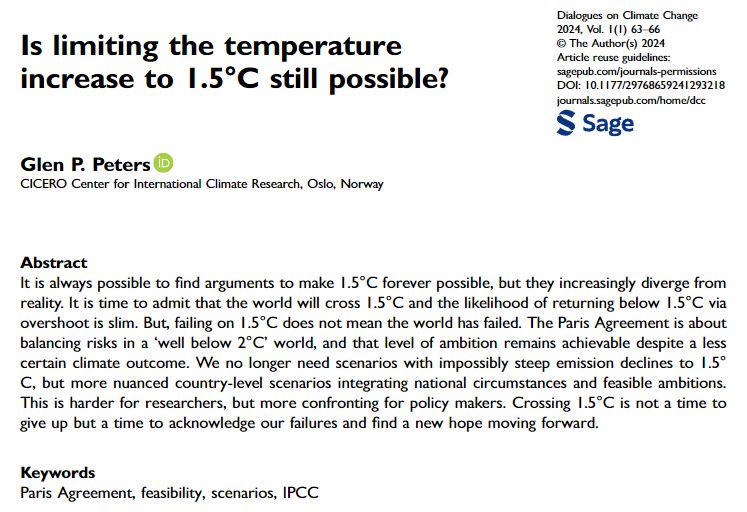
As we approach the 30th United Nations Climate Change conference, @dialoguescc.bsky.social asked @glenpeters.bsky.social: is limiting the temperature increase to 1.5°C still possible? journals.sagepub.com/doi/full/10....
November 7, 2025 at 11:19 AM
As we approach the 30th United Nations Climate Change conference, @dialoguescc.bsky.social asked @glenpeters.bsky.social: is limiting the temperature increase to 1.5°C still possible? journals.sagepub.com/doi/full/10....
Reposted by Gerard van der Schrier
New dataset: sea ice drift, tracked daily. Discover daily gridded data from satellite sensors showing how Arctic and Antarctic ice moves. Essential for tracking climate change impacts.
Access the new dataset: cds.climate.copernicus.eu/datasets/sat...
⬇️
Access the new dataset: cds.climate.copernicus.eu/datasets/sat...
⬇️

November 6, 2025 at 10:22 AM
New dataset: sea ice drift, tracked daily. Discover daily gridded data from satellite sensors showing how Arctic and Antarctic ice moves. Essential for tracking climate change impacts.
Access the new dataset: cds.climate.copernicus.eu/datasets/sat...
⬇️
Access the new dataset: cds.climate.copernicus.eu/datasets/sat...
⬇️
Reposted by Gerard van der Schrier
📣 #StateOfClimate Update 2025 is out now
🌡️ From January to August 2025, average temperature was +1.42°C hotter than pre-industrial level, on track to be second or third hottest year on record.
🔗 Press release: https://bit.ly/3LoawS9
🔗 Full report: https://bit.ly/4qZR52q
🌡️ From January to August 2025, average temperature was +1.42°C hotter than pre-industrial level, on track to be second or third hottest year on record.
🔗 Press release: https://bit.ly/3LoawS9
🔗 Full report: https://bit.ly/4qZR52q
November 6, 2025 at 6:06 PM
📣 #StateOfClimate Update 2025 is out now
🌡️ From January to August 2025, average temperature was +1.42°C hotter than pre-industrial level, on track to be second or third hottest year on record.
🔗 Press release: https://bit.ly/3LoawS9
🔗 Full report: https://bit.ly/4qZR52q
🌡️ From January to August 2025, average temperature was +1.42°C hotter than pre-industrial level, on track to be second or third hottest year on record.
🔗 Press release: https://bit.ly/3LoawS9
🔗 Full report: https://bit.ly/4qZR52q