



Shu-Sin Chng
@figlegend.bsky.social
Assoc Professor @ National University of Singapore. 🇸🇬 NUS Assoc Dir for SCELSE. Membrane/lipid biochemist. Educator who teaches chemistry in biology. Advocate (Vice Dean) for students. Horn player. 📯📯
https://chemistry.nus.edu.sg/people/chng-shu-sin/
https://chemistry.nus.edu.sg/people/chng-shu-sin/
Pinned
Shu-Sin Chng
@figlegend.bsky.social
· Jun 17
www.biorxiv.org
Super excited to share our latest work revealing impt of protein-lipid interactions for the pri fn of the Tol-Pal complex in maintaining outer memb lipid homeostasis in E. coli! Huge discovery by Nadege Lim in collab @pstansfeld.bsky.social @robincorey.bsky.social 1/7
www.biorxiv.org/content/10.1...
www.biorxiv.org/content/10.1...
Reposted by Shu-Sin Chng

We are hiring! If you are a hardcore single molecule biophysicist specializing in fluorescence imaging, check it out here: apply.interfolio.com/179992
Apply - Interfolio
{{$ctrl.$state.data.pageTitle}} - Apply - Interfolio
apply.interfolio.com
January 15, 2026 at 5:22 PM
We are hiring! If you are a hardcore single molecule biophysicist specializing in fluorescence imaging, check it out here: apply.interfolio.com/179992
Reposted by Shu-Sin Chng
New publication from Pete Gwynne from @TuftsLyme in PlosPathogens doing a deep dive into lipid scavenging by B. burgdorferi. Once again and example of Bb being lazy and depending on its environment 😀 journals.plos.org/plospathogen...

Lipid scavenging by the Lyme disease spirochete Borrelia burgdorferi
Author summary Lyme disease is caused by a bacterium, Borrelia burgdorferi, which has an unusually small genome; it scavenges most of the nutrients it needs to survive from its hosts. This scavenging ...
journals.plos.org
January 15, 2026 at 3:58 AM
New publication from Pete Gwynne from @TuftsLyme in PlosPathogens doing a deep dive into lipid scavenging by B. burgdorferi. Once again and example of Bb being lazy and depending on its environment 😀 journals.plos.org/plospathogen...
Reposted by Shu-Sin Chng

Discover how SCELSE advanced biofilm & microbiome research in FY2024. From top-ranked publications to education, industry engagement, and real-world impact. Scan to read the SCELSE Year in Review flipbook now.
@fillouxlab.bsky.social @cwhitch.bsky.social @drlauranolan.bsky.social
@fillouxlab.bsky.social @cwhitch.bsky.social @drlauranolan.bsky.social

January 15, 2026 at 9:49 AM
Discover how SCELSE advanced biofilm & microbiome research in FY2024. From top-ranked publications to education, industry engagement, and real-world impact. Scan to read the SCELSE Year in Review flipbook now.
@fillouxlab.bsky.social @cwhitch.bsky.social @drlauranolan.bsky.social
@fillouxlab.bsky.social @cwhitch.bsky.social @drlauranolan.bsky.social
Reposted by Shu-Sin Chng

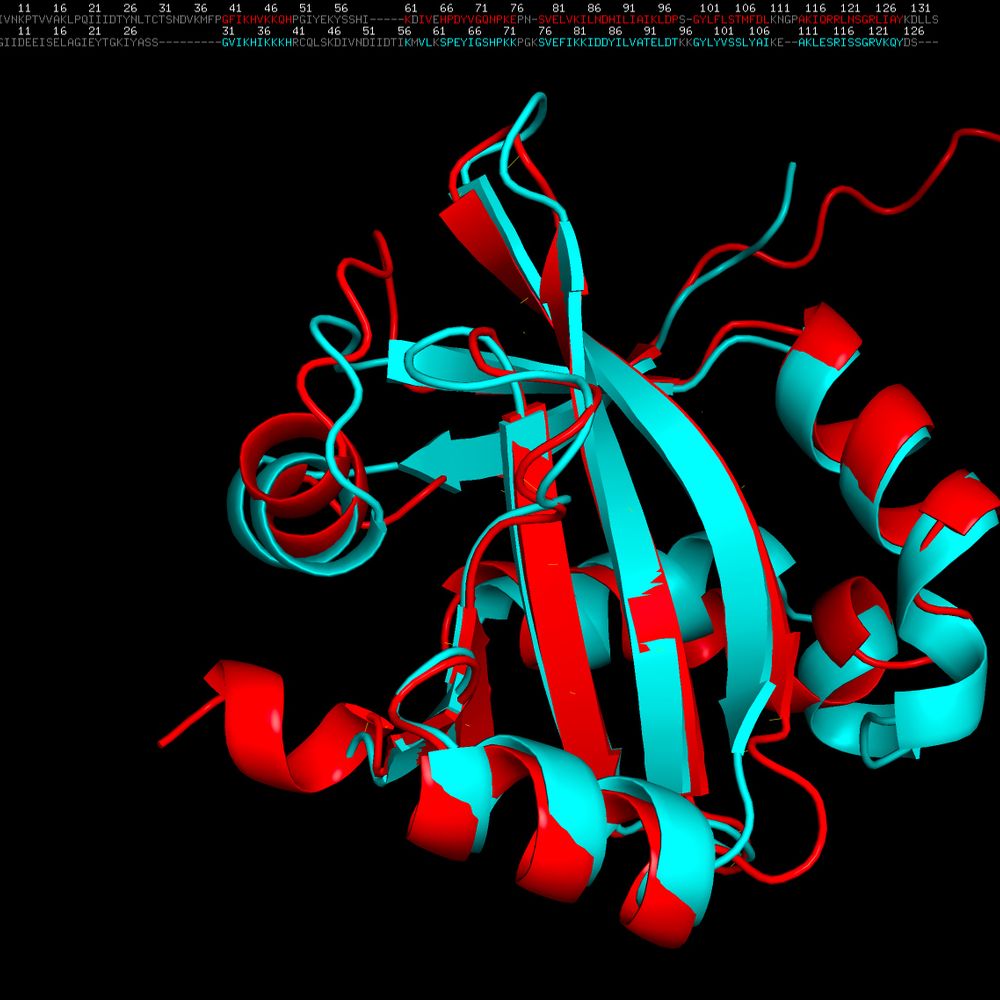
Fabian was quicker :) But yes, we have an open postdoc position in bacterial bioenergetics and membrane biology, using on B. subtilis as the model. Come join us! @cbcb-newcastle.bsky.social is a great place to work, and we are a friendly, international lab. Visa+IHS fees covered. #microsky

January 14, 2026 at 8:56 PM
Fabian was quicker :) But yes, we have an open postdoc position in bacterial bioenergetics and membrane biology, using on B. subtilis as the model. Come join us! @cbcb-newcastle.bsky.social is a great place to work, and we are a friendly, international lab. Visa+IHS fees covered. #microsky
Reposted by Shu-Sin Chng
💊 We are excited to share our preprint that describes an inhibitor of the widespread and highly conserved Two-Partner Secretion (TPS) system that is critical for Gram-negative pathogens to export a multitude of diverse virulence factors.
(1/6)
www.biorxiv.org/content/10.6...
(1/6)
www.biorxiv.org/content/10.6...

First inhibitor of a bacterial two-partner secretion system.
Two-partner secretion system transporter proteins (TpsB) are widely conserved across Gram-negative pathogens. TpsB family proteins secrete exoprotein virulence factors that perform a myriad of functions such as adhesion and immune modulation. Despite their incredible importance in bacterial infectious disease, TpsB inhibitors have not yet been discovered. Here, we describe a potent inhibitor of FhaC, a TpsB protein produced by Bordetella spp . FhaC secretes the exoprotein FhaB that is essential for the establishment of whooping cough. We designed a peptide called P1 that we predicted would prevent substrate binding and lock FhaC in a secretion-inactive state. Simulations and biochemical assays supported our hypothesis and identified interactions important for P1 binding to FhaC. Strikingly, we observed that the peptide strongly inhibited FhaB secretion from clinical isolates and broadly reduced correlates of virulence. Together, this work provides a strong case for further development of a novel class of anti-TpsB anti-virulence compounds. ### Competing Interest Statement The authors have declared no competing interest. National Institute of Allergy and Infectious Diseases, R21AI180112
www.biorxiv.org
January 13, 2026 at 7:02 AM
💊 We are excited to share our preprint that describes an inhibitor of the widespread and highly conserved Two-Partner Secretion (TPS) system that is critical for Gram-negative pathogens to export a multitude of diverse virulence factors.
(1/6)
www.biorxiv.org/content/10.6...
(1/6)
www.biorxiv.org/content/10.6...
Reposted by Shu-Sin Chng

Metabolic control of porin permeability
www.nature.com/articles/s41...
www.nature.com/articles/s41...

Metabolic control of porin permeability influences antibiotic resistance in Escherichia coli - Nature Microbiology
The permeability of bacterial porins is dynamically regulated by periplasmic proton and potassium concentrations, altering antibiotic resistance.
www.nature.com
December 13, 2025 at 9:49 AM
Metabolic control of porin permeability
www.nature.com/articles/s41...
www.nature.com/articles/s41...
Reposted by Shu-Sin Chng

YfgH is a transmembrane glycine-zipper containing lipoprotein that stabilizes excess cardiolipin and outer membrane proteins during envelope stress https://www.biorxiv.org/content/10.64898/2025.12.22.696046v1
December 25, 2025 at 4:17 AM
YfgH is a transmembrane glycine-zipper containing lipoprotein that stabilizes excess cardiolipin and outer membrane proteins during envelope stress https://www.biorxiv.org/content/10.64898/2025.12.22.696046v1
Finally remembering to post about #SGBUG again. A good start to the new year with Qiu Ting LAW from group of @fillouxlab.bsky.social @scelse.bsky.social presenting on her work on T6SS! #MicroSky

January 8, 2026 at 8:58 AM
Finally remembering to post about #SGBUG again. A good start to the new year with Qiu Ting LAW from group of @fillouxlab.bsky.social @scelse.bsky.social presenting on her work on T6SS! #MicroSky
Reposted by Shu-Sin Chng
Thrilled to share our latest study, led by @reikatei.bsky.social, in @natchembio.nature.com! We began by asking a simple question—how do cells know if they have too much of a lipid in a particular membrane, and how do they respond to rectify this imbalance?
www.nature.com/articles/s41...
More info 👇
www.nature.com/articles/s41...
More info 👇

Membrane editing with proximity labeling reveals regulators of lipid homeostasis - Nature Chemical Biology
Coupling an optogenetic lipid-modifying enzyme with proximity labeling reveals protein networks and mechanisms regulating lipid homeostasis in the membranes of target organelles.
www.nature.com
January 7, 2026 at 2:59 PM
Thrilled to share our latest study, led by @reikatei.bsky.social, in @natchembio.nature.com! We began by asking a simple question—how do cells know if they have too much of a lipid in a particular membrane, and how do they respond to rectify this imbalance?
www.nature.com/articles/s41...
More info 👇
www.nature.com/articles/s41...
More info 👇
Reposted by Shu-Sin Chng

Reposted by Shu-Sin Chng

We’re excited to share our latest study that reshapes our understanding of Mycobacterium tuberculosis (Mtb) lipid composition, with major implications for drug discovery, immunity, and vaccine development.
www.nature.com/articles/s41...
A thread.
www.nature.com/articles/s41...
A thread.

Mycobacterium tuberculosis overcomes phosphate starvation by extensively remodelling its lipidome with phosphorus-free lipids - Nature Communications
Here, the authors show that Mycobacterium tuberculosis manipulates lipid metabolism to overcome host restriction, by remodelling its lipidome and utilising host lipids as an alternative phosphate sour...
www.nature.com
December 22, 2025 at 1:11 PM
We’re excited to share our latest study that reshapes our understanding of Mycobacterium tuberculosis (Mtb) lipid composition, with major implications for drug discovery, immunity, and vaccine development.
www.nature.com/articles/s41...
A thread.
www.nature.com/articles/s41...
A thread.
Reposted by Shu-Sin Chng

🚨My lab is hiring a postdoc!🚨
If you’re interested in working out the mechanism and physiological impact of bacterial lipid transport processes then please apply!
Job advert is here: tinyurl.com/4swddfda
Get in touch by email (c.mulligan@kent.ac.uk) for informal enquiries
Please repost!
Thanks!
If you’re interested in working out the mechanism and physiological impact of bacterial lipid transport processes then please apply!
Job advert is here: tinyurl.com/4swddfda
Get in touch by email (c.mulligan@kent.ac.uk) for informal enquiries
Please repost!
Thanks!
December 17, 2025 at 2:41 PM
🚨My lab is hiring a postdoc!🚨
If you’re interested in working out the mechanism and physiological impact of bacterial lipid transport processes then please apply!
Job advert is here: tinyurl.com/4swddfda
Get in touch by email (c.mulligan@kent.ac.uk) for informal enquiries
Please repost!
Thanks!
If you’re interested in working out the mechanism and physiological impact of bacterial lipid transport processes then please apply!
Job advert is here: tinyurl.com/4swddfda
Get in touch by email (c.mulligan@kent.ac.uk) for informal enquiries
Please repost!
Thanks!
Reposted by Shu-Sin Chng

Are authors fairly judged by assessing the #journals in which their work is published? @bihutchins.bsky.social &co reveal that most influential papers are published in lower tier journals, and more authors would be better recognized with #ArticleLevelMetrics #ALMs @plosbiology.org 🧪 plos.io/4oV58Ed

December 17, 2025 at 5:30 PM
Are authors fairly judged by assessing the #journals in which their work is published? @bihutchins.bsky.social &co reveal that most influential papers are published in lower tier journals, and more authors would be better recognized with #ArticleLevelMetrics #ALMs @plosbiology.org 🧪 plos.io/4oV58Ed
Reposted by Shu-Sin Chng

I'm happy to share that our work describing the #cryoEM #structure of the glycosyltransferase ArnC from Salmonella enterica has been published in Nature Communications. #membrane #protein #PetrouLab
The article is open access and available at:
www.nature.com/articles/s41...
The article is open access and available at:
www.nature.com/articles/s41...

Structural basis of undecaprenyl phosphate glycosylation leading to polymyxin resistance in Gram-negative bacteria - Nature Communications
The study reveals the structure of ArnC, a membrane glycosyltransferase that modifies undecaprenyl phosphate with aminoarabinose (L-Ara4N), leading to polymyxin resistance. The structure of ArnC in tw...
www.nature.com
December 9, 2025 at 9:56 PM
I'm happy to share that our work describing the #cryoEM #structure of the glycosyltransferase ArnC from Salmonella enterica has been published in Nature Communications. #membrane #protein #PetrouLab
The article is open access and available at:
www.nature.com/articles/s41...
The article is open access and available at:
www.nature.com/articles/s41...
Reposted by Shu-Sin Chng

If you or someone you know is looking for a post-doctoral position working on mycobacterial envelope biology, please get in touch. I am recruiting here at the University of Western Ontario in London, Ontario, Canada.
December 2, 2025 at 3:21 PM
If you or someone you know is looking for a post-doctoral position working on mycobacterial envelope biology, please get in touch. I am recruiting here at the University of Western Ontario in London, Ontario, Canada.
Reposted by Shu-Sin Chng
Published version up at @natcomms.nature.com
New data with Aspergillus getting into tuberculous granulomas and growing like it's a member of the extended Myco family
doi.org/10.1038/s414...
New data with Aspergillus getting into tuberculous granulomas and growing like it's a member of the extended Myco family
doi.org/10.1038/s414...
November 29, 2025 at 12:21 AM
Published version up at @natcomms.nature.com
New data with Aspergillus getting into tuberculous granulomas and growing like it's a member of the extended Myco family
doi.org/10.1038/s414...
New data with Aspergillus getting into tuberculous granulomas and growing like it's a member of the extended Myco family
doi.org/10.1038/s414...
Reposted by Shu-Sin Chng
rdcu.be/eRxNf here our new study on the characterization of the lipopolysaccharide holotranslocon, LptDE and the newly identified subunits LptM and LptY. Great collaboration with @fronzeslab.bsky.social @pstansfeld.bsky.social @JulienMarcoux @YvesQuentin
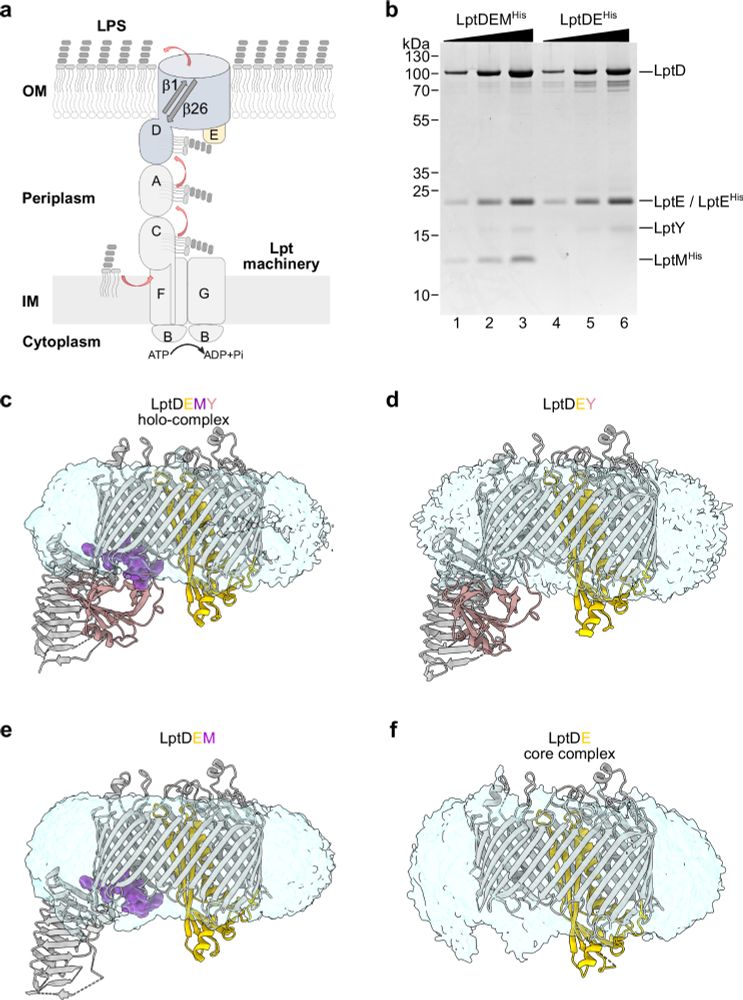
Structural basis of lipopolysaccharide assembly by the outer membrane translocon holo-complex
Nature Communications - The asymmetric distribution of lipopolysaccharide (LPS) on the surface of the bacterial outer membrane is essential and crucial for antibiotic resistance. Here, authors...
rdcu.be
November 24, 2025 at 4:08 PM
rdcu.be/eRxNf here our new study on the characterization of the lipopolysaccharide holotranslocon, LptDE and the newly identified subunits LptM and LptY. Great collaboration with @fronzeslab.bsky.social @pstansfeld.bsky.social @JulienMarcoux @YvesQuentin
Reposted by Shu-Sin Chng

Why does daptomycin resistance appear so fast in Enterococcus? We finally have a clue.
DAP resistance in enterococci pops up quickly. What’s been missing is why resistance-associated membrane changes look the way they do, and why the classic path of mutations is so predictable.
DAP resistance in enterococci pops up quickly. What’s been missing is why resistance-associated membrane changes look the way they do, and why the classic path of mutations is so predictable.

A two-component system signaling hub controls enterococcal membrane remodeling in response to daptomycin https://www.biorxiv.org/content/10.1101/2025.11.16.688641v1
November 17, 2025 at 8:27 PM
Why does daptomycin resistance appear so fast in Enterococcus? We finally have a clue.
DAP resistance in enterococci pops up quickly. What’s been missing is why resistance-associated membrane changes look the way they do, and why the classic path of mutations is so predictable.
DAP resistance in enterococci pops up quickly. What’s been missing is why resistance-associated membrane changes look the way they do, and why the classic path of mutations is so predictable.
Reposted by Shu-Sin Chng
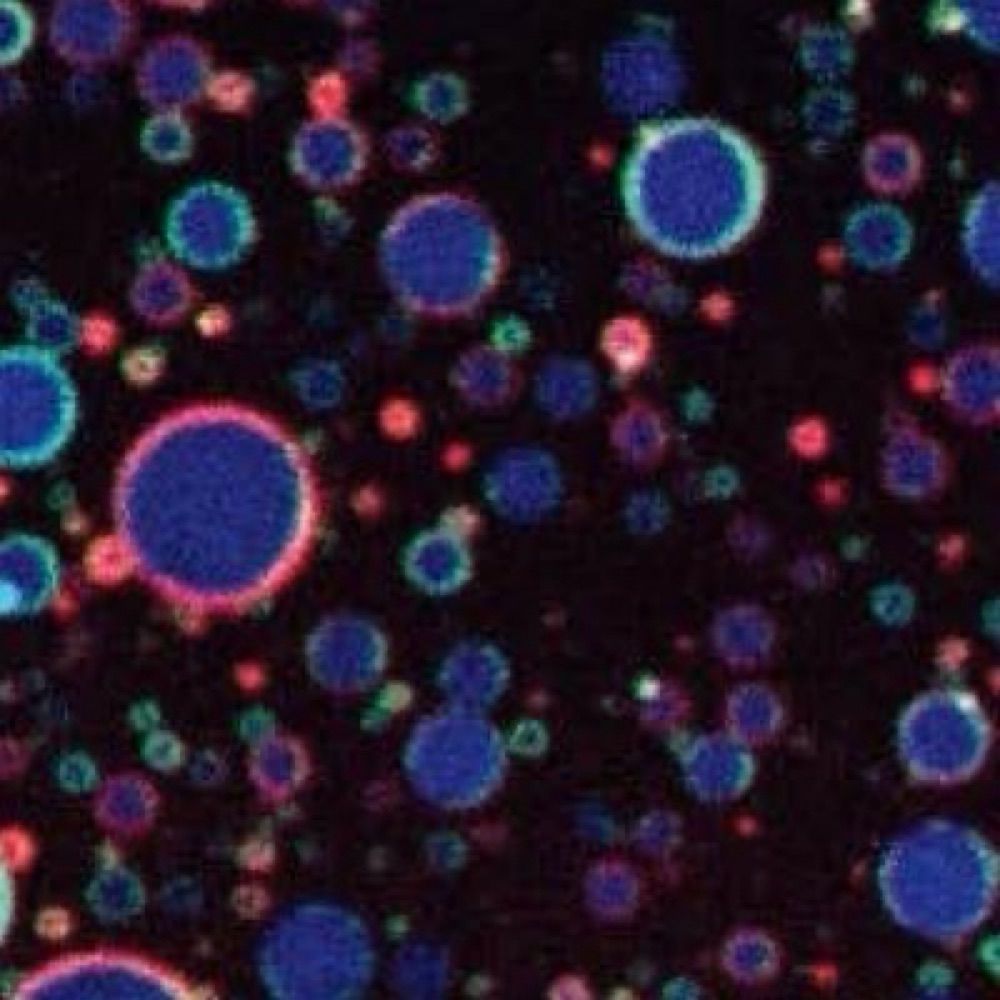
Thrilled to share our latest work showing that the bridge lipid transport protein ATG2A transfers diacylglycerol (DAG), and some TAG/PA, from the ER to LDs, thereby recruiting DGAT2 to drive local TAG synthesis, promoting LD expansion while protecting ER membranes.
www.nature.com/articles/s41...
www.nature.com/articles/s41...

ATG2A-mediated DAG transfer recruits DGAT2 for lipid droplet growth - Nature Structural & Molecular Biology
Elhan et al. show that ATG2A acts with DGAT2, the enzyme producing triacylglycerol (TAG), in lipid droplet growth. By delivering diacylglycerol to lipid droplets, ATG2A not only fuels TAG production b...
www.nature.com
November 17, 2025 at 10:57 PM
Thrilled to share our latest work showing that the bridge lipid transport protein ATG2A transfers diacylglycerol (DAG), and some TAG/PA, from the ER to LDs, thereby recruiting DGAT2 to drive local TAG synthesis, promoting LD expansion while protecting ER membranes.
www.nature.com/articles/s41...
www.nature.com/articles/s41...
Reposted by Shu-Sin Chng

Kat Blow has developed CCD2MD, a suite of packages for preparing co-folded outputs for MD simulations.
Created for protein–lipid interactions in integral membrane proteins, it also works for peripheral and lipid-anchored proteins too.
pubs.acs.org/doi/full/10....
github.com/keb721/ccd2md
Created for protein–lipid interactions in integral membrane proteins, it also works for peripheral and lipid-anchored proteins too.
pubs.acs.org/doi/full/10....
github.com/keb721/ccd2md

CCD2MD: A Suite of Packages for Preparing Co-Folded Outputs for Molecular Dynamics Simulations
Protein–lipid interactions play a crucial role in the stability and function of membrane proteins. While experimental approaches to characterize these interactions in a native-like membrane environmen...
pubs.acs.org
November 12, 2025 at 11:53 AM
Kat Blow has developed CCD2MD, a suite of packages for preparing co-folded outputs for MD simulations.
Created for protein–lipid interactions in integral membrane proteins, it also works for peripheral and lipid-anchored proteins too.
pubs.acs.org/doi/full/10....
github.com/keb721/ccd2md
Created for protein–lipid interactions in integral membrane proteins, it also works for peripheral and lipid-anchored proteins too.
pubs.acs.org/doi/full/10....
github.com/keb721/ccd2md
Reposted by Shu-Sin Chng

An Asgard archaeon with internal membrane compartments
Brilliant study led by @fmacleod.bsky.social and Andriko von Kügelgen. Tight collaboration with @buzzbaum.bsky.social and lab. Congrats to all authors!
www.biorxiv.org/content/10.1...
Brilliant study led by @fmacleod.bsky.social and Andriko von Kügelgen. Tight collaboration with @buzzbaum.bsky.social and lab. Congrats to all authors!
www.biorxiv.org/content/10.1...

November 7, 2025 at 10:44 AM
An Asgard archaeon with internal membrane compartments
Brilliant study led by @fmacleod.bsky.social and Andriko von Kügelgen. Tight collaboration with @buzzbaum.bsky.social and lab. Congrats to all authors!
www.biorxiv.org/content/10.1...
Brilliant study led by @fmacleod.bsky.social and Andriko von Kügelgen. Tight collaboration with @buzzbaum.bsky.social and lab. Congrats to all authors!
www.biorxiv.org/content/10.1...
Reposted by Shu-Sin Chng
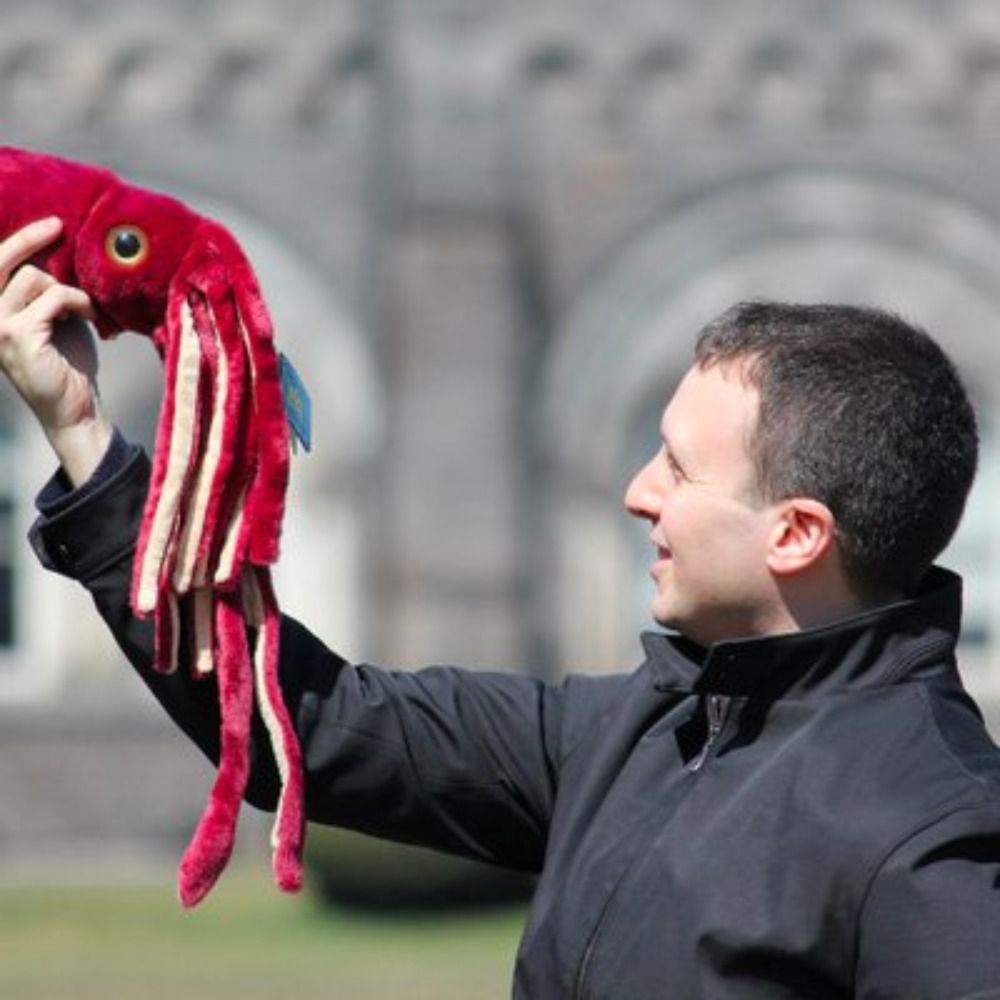
New lab preprint!
@zestytoast.bsky.social tagged a scarce mycobacterial protein in M. smegmatis with TwinStep but got… something? @kjamali.bsky.social's ModelAngelo built models & @martinsteinegger.bsky.social's FoldSeek IDed them as the biotin-containing MCC & LCC complexes
🧵
tinyurl.com/ukny4ptz
@zestytoast.bsky.social tagged a scarce mycobacterial protein in M. smegmatis with TwinStep but got… something? @kjamali.bsky.social's ModelAngelo built models & @martinsteinegger.bsky.social's FoldSeek IDed them as the biotin-containing MCC & LCC complexes
🧵
tinyurl.com/ukny4ptz

October 30, 2025 at 3:21 AM
New lab preprint!
@zestytoast.bsky.social tagged a scarce mycobacterial protein in M. smegmatis with TwinStep but got… something? @kjamali.bsky.social's ModelAngelo built models & @martinsteinegger.bsky.social's FoldSeek IDed them as the biotin-containing MCC & LCC complexes
🧵
tinyurl.com/ukny4ptz
@zestytoast.bsky.social tagged a scarce mycobacterial protein in M. smegmatis with TwinStep but got… something? @kjamali.bsky.social's ModelAngelo built models & @martinsteinegger.bsky.social's FoldSeek IDed them as the biotin-containing MCC & LCC complexes
🧵
tinyurl.com/ukny4ptz
Reposted by Shu-Sin Chng

🚨Our paper is out! 🥳
Hijacking a bacterial ABC transporter for efficient genetic code expansion.
Many congrats to everyone involved - a multi-year effort led by @taruniype.bsky.social @maxfottner.bsky.social
www.nature.com/articles/s41...
it all started years ago with a failed experiment
🧵👇 1/9
Hijacking a bacterial ABC transporter for efficient genetic code expansion.
Many congrats to everyone involved - a multi-year effort led by @taruniype.bsky.social @maxfottner.bsky.social
www.nature.com/articles/s41...
it all started years ago with a failed experiment
🧵👇 1/9

Hijacking a bacterial ABC transporter for genetic code expansion - Nature
Bacterial ATP-binding cassette (ABC) transporters can be utilized and engineered to transport non-canonical amino acids into Escherichia coli for highly efficient synthesis of proteins with novel func...
www.nature.com
October 16, 2025 at 2:06 PM
🚨Our paper is out! 🥳
Hijacking a bacterial ABC transporter for efficient genetic code expansion.
Many congrats to everyone involved - a multi-year effort led by @taruniype.bsky.social @maxfottner.bsky.social
www.nature.com/articles/s41...
it all started years ago with a failed experiment
🧵👇 1/9
Hijacking a bacterial ABC transporter for efficient genetic code expansion.
Many congrats to everyone involved - a multi-year effort led by @taruniype.bsky.social @maxfottner.bsky.social
www.nature.com/articles/s41...
it all started years ago with a failed experiment
🧵👇 1/9
Reposted by Shu-Sin Chng

PhD opportunity in my lab: exploring how commensals and pathogens build biofilm communities on endotracheal (ventilator) tubes. Microbial ecology, medical microbiology and fancy imaging! Co-supervised with the fabulous Saskia Bakker and Jeremy Webb warwick.ac.uk/fac/cross_fa... #MicroSky
Dr Freya Harrison
Dr Freya Harrison
warwick.ac.uk
October 15, 2025 at 8:09 PM
PhD opportunity in my lab: exploring how commensals and pathogens build biofilm communities on endotracheal (ventilator) tubes. Microbial ecology, medical microbiology and fancy imaging! Co-supervised with the fabulous Saskia Bakker and Jeremy Webb warwick.ac.uk/fac/cross_fa... #MicroSky
Reposted by Shu-Sin Chng
Attention membrane traffickers! I'm recruiting a post-doc to my lab in Dundee. We're dissecting the functions of intrinsically disordered domains of COPII coat proteins. We think they control timing of coat assembly and morphology of carriers.
www.dundee.ac.uk/work-for-us/...
www.dundee.ac.uk/work-for-us/...

Postdoctoral Research Assistant - MCDB - UOD2016
Closing date: Thursday 6 November 2025, 23:59
www.dundee.ac.uk
October 15, 2025 at 12:53 PM
Attention membrane traffickers! I'm recruiting a post-doc to my lab in Dundee. We're dissecting the functions of intrinsically disordered domains of COPII coat proteins. We think they control timing of coat assembly and morphology of carriers.
www.dundee.ac.uk/work-for-us/...
www.dundee.ac.uk/work-for-us/...