



Darius Suplica
@dsuplica.bsky.social
working in neuroscience / psychology / cognition @UChicago w/ Awh-Vogel Lab
Reposted by Darius Suplica

Spatial attention and working memory are popularly thought to be tightly coupled. Yet, distinct neural activity tracks attentional breadth and WM load.
In a new paper @jocn.bsky.social, we show that pupil size independently tracks breadth and load.
doi.org/10.1162/JOCN...
In a new paper @jocn.bsky.social, we show that pupil size independently tracks breadth and load.
doi.org/10.1162/JOCN...

October 14, 2025 at 2:04 PM
Spatial attention and working memory are popularly thought to be tightly coupled. Yet, distinct neural activity tracks attentional breadth and WM load.
In a new paper @jocn.bsky.social, we show that pupil size independently tracks breadth and load.
doi.org/10.1162/JOCN...
In a new paper @jocn.bsky.social, we show that pupil size independently tracks breadth and load.
doi.org/10.1162/JOCN...
Reposted by Darius Suplica

We found attentional suppression might be related to re-coding salient singleton locations in a inverted format to target locations
www.biorxiv.org/content/10.1...
www.biorxiv.org/content/10.1...

Rapid inversion of singleton distractor representations underlies learned attentional suppression
In visually complex and dynamically changing environments, humans often face the challenge of filtering out salient stimuli that are presently irrelevant to their tasks. Recent evidence suggests that ...
www.biorxiv.org
October 10, 2025 at 1:21 PM
We found attentional suppression might be related to re-coding salient singleton locations in a inverted format to target locations
www.biorxiv.org/content/10.1...
www.biorxiv.org/content/10.1...
Reposted by Darius Suplica

1/ Why are we so easily distracted? 🧠 In our new EEG preprint w/ Henry Jones, @monicarosenb.bsky.social and @edvogel.bsky.social we show that distractibility is associated w/ reduced neural connectivity — and can be predicted from EEG with ~80% accuracy using machine learning.

September 28, 2025 at 7:14 PM
1/ Why are we so easily distracted? 🧠 In our new EEG preprint w/ Henry Jones, @monicarosenb.bsky.social and @edvogel.bsky.social we show that distractibility is associated w/ reduced neural connectivity — and can be predicted from EEG with ~80% accuracy using machine learning.
Reposted by Darius Suplica

How does the visual system track moving objects while remembering the color of those objects? My latest research article (co-first with Piotr @styrkowiec.bsky.social) exploring this question using EEG is out in JoCN! @jocn.bsky.social #workingmemory #cognition #cogneuro #cogsci #neuro

Item-based Parsing of Dynamic Scenes in a Combined Attentional Tracking and Working Memory Task
Abstract. Human visual processing is limited—we can only track a few moving objects at a time and store a few items in visual working memory (WM). A shared mechanism that may underlie these performanc...
doi.org
September 18, 2025 at 2:56 PM
How does the visual system track moving objects while remembering the color of those objects? My latest research article (co-first with Piotr @styrkowiec.bsky.social) exploring this question using EEG is out in JoCN! @jocn.bsky.social #workingmemory #cognition #cogneuro #cogsci #neuro
Reposted by Darius Suplica
New pre-print day! Distributed and drifting signals for working memory load in human cortex 🧠 (with Ed Awh & @serences.bsky.social)
www.biorxiv.org/content/10.1...
www.biorxiv.org/content/10.1...

Distributed and drifting signals for working memory load in human cortex
Increasing working memory (WM) load incurs behavioral costs, and whether the neural constraints on behavioral costs are localized (i.e., emanating from the intraparietal sulcus) or distributed across ...
www.biorxiv.org
September 16, 2025 at 1:18 PM
New pre-print day! Distributed and drifting signals for working memory load in human cortex 🧠 (with Ed Awh & @serences.bsky.social)
www.biorxiv.org/content/10.1...
www.biorxiv.org/content/10.1...
Very excited to announce my first paper is out in @currentbiology.bsky.social! Using EEG, we identify an item-based measure of storage in working memory that generalizes across auditory and visual items.
authors.elsevier.com/a/1ljFF3QW8S...
#PsychSciSky #neuroskyence #workingmemory
authors.elsevier.com/a/1ljFF3QW8S...
#PsychSciSky #neuroskyence #workingmemory
authors.elsevier.com
September 4, 2025 at 4:34 PM
Very excited to announce my first paper is out in @currentbiology.bsky.social! Using EEG, we identify an item-based measure of storage in working memory that generalizes across auditory and visual items.
authors.elsevier.com/a/1ljFF3QW8S...
#PsychSciSky #neuroskyence #workingmemory
authors.elsevier.com/a/1ljFF3QW8S...
#PsychSciSky #neuroskyence #workingmemory
Reposted by Darius Suplica
Splitting 5-4 (with Chief Justice Roberts joining the three Democratic appointees in dissent), #SCOTUS grants *partial* stay to Trump administration in NIH funding case; holds that challenges to grant terminations (but *not* the underlying guidance) need to be filed in the Court of Federal Claims:
www.supremecourt.gov
August 21, 2025 at 8:41 PM
Splitting 5-4 (with Chief Justice Roberts joining the three Democratic appointees in dissent), #SCOTUS grants *partial* stay to Trump administration in NIH funding case; holds that challenges to grant terminations (but *not* the underlying guidance) need to be filed in the Court of Federal Claims:
Reposted by Darius Suplica
Domain general frontoparietal regions show modality-dependent coding of auditory and visual rules
direct.mit.edu/imag/article...
direct.mit.edu/imag/article...

Domain general frontoparietal regions show modality-dependent coding of auditory and visual rules
Abstract. A defining feature of human cognition is our ability to respond flexibly to what we see and hear, changing how we respond depending on our current goals. In fact, we can rapidly associate al...
direct.mit.edu
June 20, 2025 at 6:18 PM
Domain general frontoparietal regions show modality-dependent coding of auditory and visual rules
direct.mit.edu/imag/article...
direct.mit.edu/imag/article...
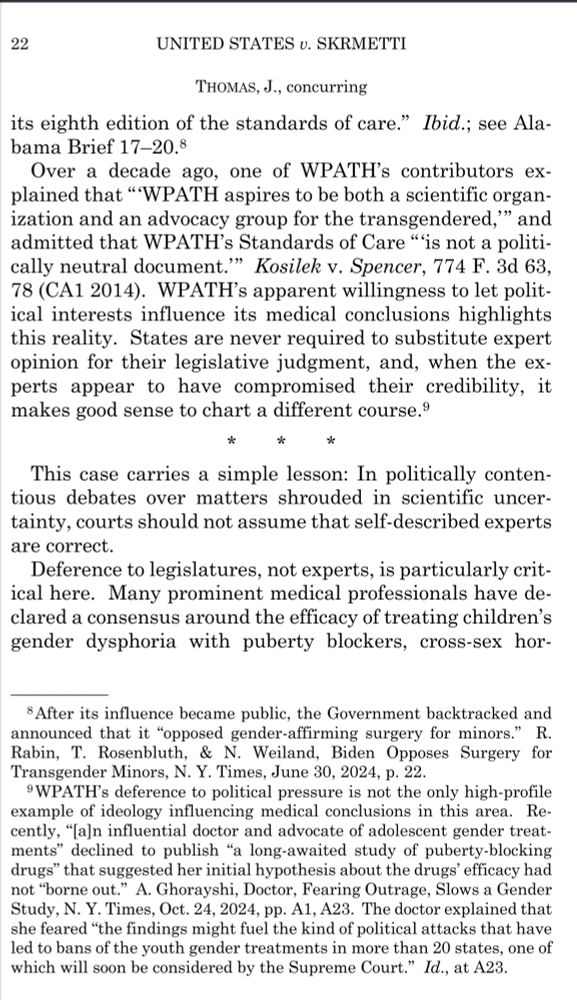
Not looking forward to this getting quoted - may be one of the dumbest words committed to judicial opinion. Don't assume that "experts" are correct, but assume that judges are better at science than scientists?
June 18, 2025 at 3:53 PM
Not looking forward to this getting quoted - may be one of the dumbest words committed to judicial opinion. Don't assume that "experts" are correct, but assume that judges are better at science than scientists?
Reposted by Darius Suplica
UChicago has ~$108 million in NIH grants. According to most recent F&A rate info I found (2019-20), UChicago has an F&A rate of 62% for on-campus grants, so around $67million in F&A support. If the rate is cut to 15%, that’ll be a loss of $50 million in support. That’s thousands of jobs lost
February 8, 2025 at 2:02 AM
UChicago has ~$108 million in NIH grants. According to most recent F&A rate info I found (2019-20), UChicago has an F&A rate of 62% for on-campus grants, so around $67million in F&A support. If the rate is cut to 15%, that’ll be a loss of $50 million in support. That’s thousands of jobs lost
Reposted by Darius Suplica

One doctor’s recommendation to deny a 43-year-woman coverage “contained errors on practically every aspect” of her condition, the Labor Department said in 2012.
United and other insurers continued to hire the doctor over the next decade.
propub.li/3BQjJ1e
United and other insurers continued to hire the doctor over the next decade.
propub.li/3BQjJ1e

Insurers Continue to Rely on Doctors Whose Judgments Have Been Criticized by Courts
In dozens of cases ProPublica reviewed, judges found that some doctors working for these companies engaged in “selective readings” of medical evidence and “shut their eyes” to medical opinions opposing their conclusions.
propub.li
December 30, 2024 at 1:00 PM
One doctor’s recommendation to deny a 43-year-woman coverage “contained errors on practically every aspect” of her condition, the Labor Department said in 2012.
United and other insurers continued to hire the doctor over the next decade.
propub.li/3BQjJ1e
United and other insurers continued to hire the doctor over the next decade.
propub.li/3BQjJ1e
Reposted by Darius Suplica
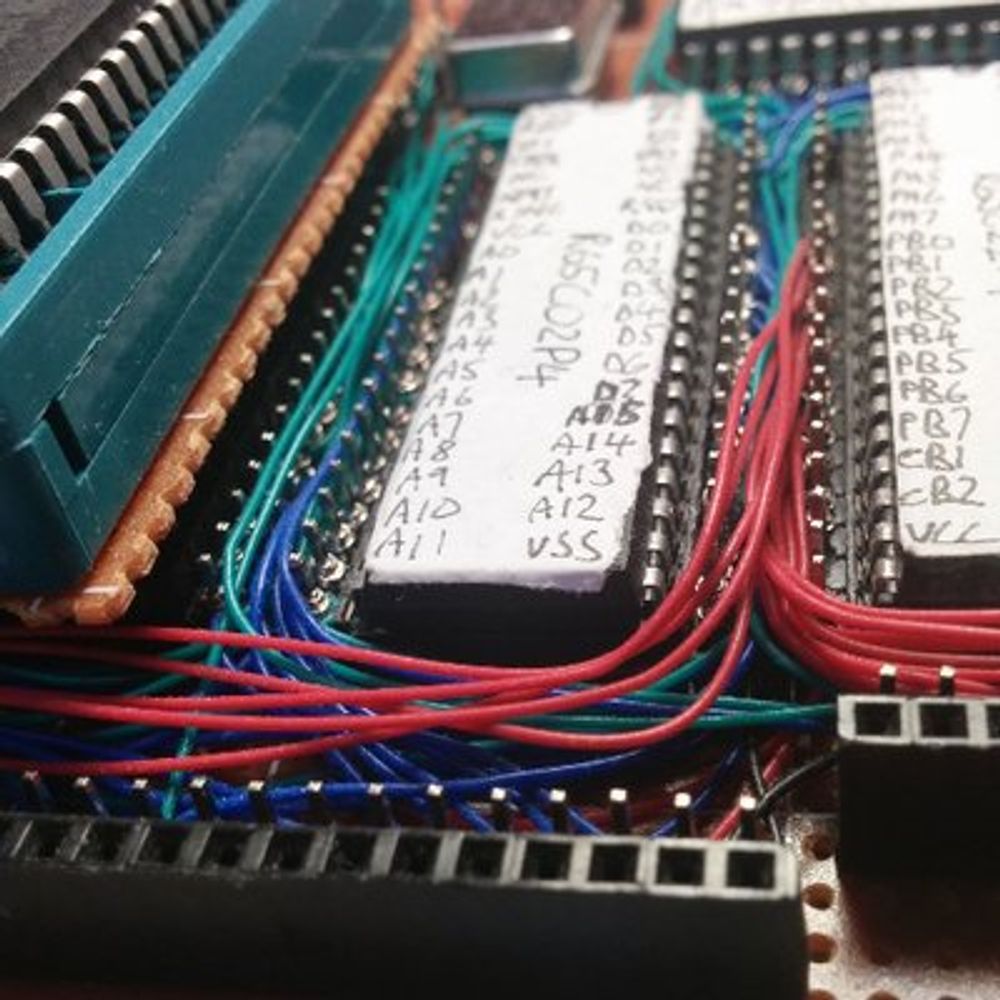
variable names *are* code comments
December 22, 2024 at 8:22 PM
variable names *are* code comments
Reposted by Darius Suplica
Terrific! Paywalls are disappearing! No more 12 month embargo between when NIH funded work appears in a journal and when it becomes accessible to all (as of December 2025).
www.nih.gov/about-nih/wh...
www.nih.gov/about-nih/wh...
NIH issues new policy to speed access to agency-funded research results
The 12-month embargo period before manuscripts resulting from NIH funding must be made publicly available is removed.
www.nih.gov
December 18, 2024 at 3:41 PM
Terrific! Paywalls are disappearing! No more 12 month embargo between when NIH funded work appears in a journal and when it becomes accessible to all (as of December 2025).
www.nih.gov/about-nih/wh...
www.nih.gov/about-nih/wh...
Reposted by Darius Suplica

A modern staging of Agamemnon where the chorus is referred to as “chat.”
December 16, 2024 at 5:57 PM
A modern staging of Agamemnon where the chorus is referred to as “chat.”