



Cole Hurwitz
@colehurwitz.bsky.social
AI Architect, Core AI, IBM | Agentic AI & AgentOps - find my posts on LinkedIn
We are hiring on the IBM Core AI team. Feel free to DM me. 🙂 Job posting form - forms.gle/zZ2FHDg5sPVq...
Our group builds the technology that makes agentic AI reliable, observable, and governable at enterprise scale, with open research and tooling for evaluating agents and improving them.
Our group builds the technology that makes agentic AI reliable, observable, and governable at enterprise scale, with open research and tooling for evaluating agents and improving them.
forms.gle
December 3, 2025 at 10:13 PM
We are hiring on the IBM Core AI team. Feel free to DM me. 🙂 Job posting form - forms.gle/zZ2FHDg5sPVq...
Our group builds the technology that makes agentic AI reliable, observable, and governable at enterprise scale, with open research and tooling for evaluating agents and improving them.
Our group builds the technology that makes agentic AI reliable, observable, and governable at enterprise scale, with open research and tooling for evaluating agents and improving them.
After nearly a decade in academia, I am thrilled to share my next chapter: I am joining IBM as an AI Architect in the new Core AI group.
We are building an AgentOps platform to observe, evaluate, and optimize enterprise AI agents and we are hiring. DM me if interested.
We are building an AgentOps platform to observe, evaluate, and optimize enterprise AI agents and we are hiring. DM me if interested.

November 17, 2025 at 7:32 PM
After nearly a decade in academia, I am thrilled to share my next chapter: I am joining IBM as an AI Architect in the new Core AI group.
We are building an AgentOps platform to observe, evaluate, and optimize enterprise AI agents and we are hiring. DM me if interested.
We are building an AgentOps platform to observe, evaluate, and optimize enterprise AI agents and we are hiring. DM me if interested.
Reposted by Cole Hurwitz

Very happy for this to finally be published! We developed new machine learning methods for scalable mapping of synaptic connectivity using holographic optogenetics and compressed sensing.
www.nature.com/articles/s41...
www.nature.com/articles/s41...
A pair of papers on using holographic optogenetics and compressed sensing for connectomics:
Rapid learning of neural circuitry from holographic ensemble stimulation enabled by model-based compressed sensing
www.nature.com/articles/s41...
Rapid learning of neural circuitry from holographic ensemble stimulation enabled by model-based compressed sensing
www.nature.com/articles/s41...

Rapid learning of neural circuitry from holographic ensemble stimulation enabled by model-based compressed sensing - Nature Neuroscience
The authors develop a new computational system for high-throughput mapping of synaptic connectivity using two-photon holographic optogenetics and intracellular recordings.
www.nature.com
September 29, 2025 at 7:26 PM
Very happy for this to finally be published! We developed new machine learning methods for scalable mapping of synaptic connectivity using holographic optogenetics and compressed sensing.
www.nature.com/articles/s41...
www.nature.com/articles/s41...
Reposted by Cole Hurwitz
We present our preprint on ViV1T, a transformer for dynamic mouse V1 response prediction. We reveal novel response properties and confirm them in vivo.
With @wulfdewolf.bsky.social, Danai Katsanevaki, @arnoonken.bsky.social, @rochefortlab.bsky.social.
Paper and code at the end of the thread!
🧵1/7
With @wulfdewolf.bsky.social, Danai Katsanevaki, @arnoonken.bsky.social, @rochefortlab.bsky.social.
Paper and code at the end of the thread!
🧵1/7
September 19, 2025 at 12:37 PM
We present our preprint on ViV1T, a transformer for dynamic mouse V1 response prediction. We reveal novel response properties and confirm them in vivo.
With @wulfdewolf.bsky.social, Danai Katsanevaki, @arnoonken.bsky.social, @rochefortlab.bsky.social.
Paper and code at the end of the thread!
🧵1/7
With @wulfdewolf.bsky.social, Danai Katsanevaki, @arnoonken.bsky.social, @rochefortlab.bsky.social.
Paper and code at the end of the thread!
🧵1/7
Reposted by Cole Hurwitz
Two flagship papers from the International Brain Laboratory, now out in @Nature.com:
🧠 Brain-wide map of neural activity during complex behaviour: doi.org/10.1038/s41586-025-09235-0
🧠 Brain-wide representations of prior information in mouse decision-making: doi.org/10.1038/s41586-025-09226-1 +
🧠 Brain-wide map of neural activity during complex behaviour: doi.org/10.1038/s41586-025-09235-0
🧠 Brain-wide representations of prior information in mouse decision-making: doi.org/10.1038/s41586-025-09226-1 +

September 3, 2025 at 4:22 PM
Two flagship papers from the International Brain Laboratory, now out in @Nature.com:
🧠 Brain-wide map of neural activity during complex behaviour: doi.org/10.1038/s41586-025-09235-0
🧠 Brain-wide representations of prior information in mouse decision-making: doi.org/10.1038/s41586-025-09226-1 +
🧠 Brain-wide map of neural activity during complex behaviour: doi.org/10.1038/s41586-025-09235-0
🧠 Brain-wide representations of prior information in mouse decision-making: doi.org/10.1038/s41586-025-09226-1 +
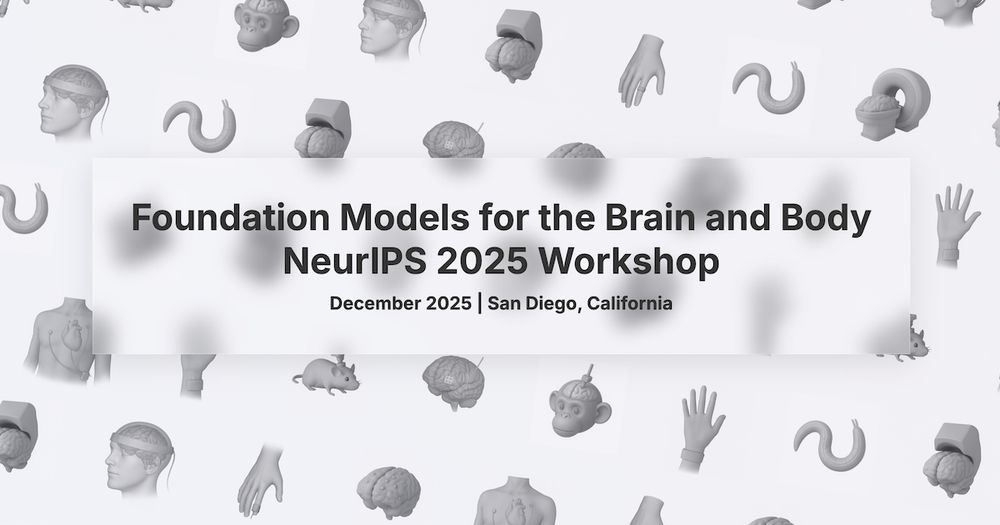
Excited to co-organize our NeurIPS 2025 workshop on Foundation Models for the Brain and Body!
We welcome work across ML, neuroscience, and biosignals — from new approaches to large-scale models. Submit your paper or demo! 🧠 🧪 🦾
We welcome work across ML, neuroscience, and biosignals — from new approaches to large-scale models. Submit your paper or demo! 🧠 🧪 🦾
Excited to announce the Foundation Models for the Brain and Body workshop at #NeurIPS2025! 🧠📈 🧪
We invite short papers or interactive demos on AI for neural, physiological or behavioral data.
Submit by Aug 22 👉 brainbodyfm-workshop.github.io
We invite short papers or interactive demos on AI for neural, physiological or behavioral data.
Submit by Aug 22 👉 brainbodyfm-workshop.github.io
July 11, 2025 at 7:51 PM
Excited to co-organize our NeurIPS 2025 workshop on Foundation Models for the Brain and Body!
We welcome work across ML, neuroscience, and biosignals — from new approaches to large-scale models. Submit your paper or demo! 🧠 🧪 🦾
We welcome work across ML, neuroscience, and biosignals — from new approaches to large-scale models. Submit your paper or demo! 🧠 🧪 🦾
Reposted by Cole Hurwitz
Excited to announce the Foundation Models for the Brain and Body workshop at #NeurIPS2025! 🧠📈 🧪
We invite short papers or interactive demos on AI for neural, physiological or behavioral data.
Submit by Aug 22 👉 brainbodyfm-workshop.github.io
We invite short papers or interactive demos on AI for neural, physiological or behavioral data.
Submit by Aug 22 👉 brainbodyfm-workshop.github.io
July 11, 2025 at 5:01 PM
Excited to announce the Foundation Models for the Brain and Body workshop at #NeurIPS2025! 🧠📈 🧪
We invite short papers or interactive demos on AI for neural, physiological or behavioral data.
Submit by Aug 22 👉 brainbodyfm-workshop.github.io
We invite short papers or interactive demos on AI for neural, physiological or behavioral data.
Submit by Aug 22 👉 brainbodyfm-workshop.github.io
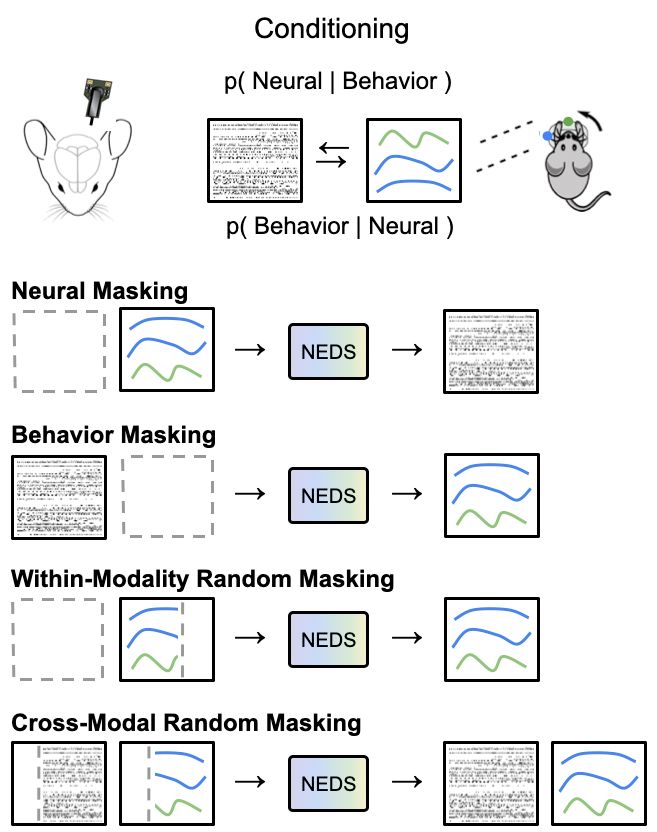
Neural Encoding and Decoding at Scale (NEDS) is now accepted to @icmlconf.bsky.social as a spotlight (top 2.6%)! 🧠 🧪
Another step toward a foundation model of the mouse brain: "Neural Encoding and Decoding at Scale (NEDS)"
Trained on neural and behavioral data from 70+ mice, NEDS achieves state-of-the-art prediction of behavior (decoding) and neural responses (encoding) on held-out animals. 🐀
Trained on neural and behavioral data from 70+ mice, NEDS achieves state-of-the-art prediction of behavior (decoding) and neural responses (encoding) on held-out animals. 🐀
May 2, 2025 at 3:17 PM
Neural Encoding and Decoding at Scale (NEDS) is now accepted to @icmlconf.bsky.social as a spotlight (top 2.6%)! 🧠 🧪
Super cool. 😀 Exciting to see the practical use cases of electrical stimulation for treating neurological disorders
A trial will try to treat tinnitus in people who have only just developed persistent ringing or buzzing in the ears.
Newcastle University researchers funded by the American Tinnitus Association will use electrical brain stimulation & sound therapy.
🧪🧠👂🏼 #neuroskyence
www.bbc.co.uk/news/videos/...
Newcastle University researchers funded by the American Tinnitus Association will use electrical brain stimulation & sound therapy.
🧪🧠👂🏼 #neuroskyence
www.bbc.co.uk/news/videos/...

Newcastle University trial to tackle tinnitus before it takes hold
The Newcastle study gives both electrical stimulus and sound therapy to people with early tinnitus.
www.bbc.co.uk
May 1, 2025 at 3:36 PM
Super cool. 😀 Exciting to see the practical use cases of electrical stimulation for treating neurological disorders
Reposted by Cole Hurwitz
We’re hiring postdocs to join my lab at UNC. If you’re interested in adolescence, brain, and social development, DM me. Our work incorporates fMRI, social media, and longitudinal methods. We study risks and opportunities in adolescence. If you’re at #SRCD2025 and want to meet, please reach out!
April 30, 2025 at 7:31 PM
We’re hiring postdocs to join my lab at UNC. If you’re interested in adolescence, brain, and social development, DM me. Our work incorporates fMRI, social media, and longitudinal methods. We study risks and opportunities in adolescence. If you’re at #SRCD2025 and want to meet, please reach out!
Reposted by Cole Hurwitz
I asked "on the other platform" what were the most important improvements to the original 2017 transformer.
That was quite popular and here is a synthesis of the responses:
That was quite popular and here is a synthesis of the responses:
April 28, 2025 at 6:47 AM
I asked "on the other platform" what were the most important improvements to the original 2017 transformer.
That was quite popular and here is a synthesis of the responses:
That was quite popular and here is a synthesis of the responses:
Whoever is at the @iclr-conf.bsky.social workshops, feel free to reach out to meet! Looking for fun neuro conversations since there aren’t any neuro workshops 😢
April 27, 2025 at 1:54 AM
Whoever is at the @iclr-conf.bsky.social workshops, feel free to reach out to meet! Looking for fun neuro conversations since there aren’t any neuro workshops 😢
Reposted by Cole Hurwitz
Scaling models across multiple animals was a major step toward building neuro-foundation models; the next frontier is enabling multi-task decoding to expand the scope of training data we can leverage.
Excited to share our #ICLR2025 Spotlight paper introducing POYO+ 🧠
poyo-plus.github.io
🧵
Excited to share our #ICLR2025 Spotlight paper introducing POYO+ 🧠
poyo-plus.github.io
🧵
POYO+
POYO+: Multi-session, multi-task neural decoding from distinct cell-types and brain regions
poyo-plus.github.io
April 25, 2025 at 10:14 PM
Scaling models across multiple animals was a major step toward building neuro-foundation models; the next frontier is enabling multi-task decoding to expand the scope of training data we can leverage.
Excited to share our #ICLR2025 Spotlight paper introducing POYO+ 🧠
poyo-plus.github.io
🧵
Excited to share our #ICLR2025 Spotlight paper introducing POYO+ 🧠
poyo-plus.github.io
🧵
Thrilled to share our state-of-the-art method for in vivo cell-type classification and brain region localization, NEMO, which is now now a spotlight at @iclr-conf.bsky.social !
We use NEMO to characterize the electrophysiological diversity of cell-types across the entire mouse brain. 🐭 🧪 🧠
We use NEMO to characterize the electrophysiological diversity of cell-types across the entire mouse brain. 🐭 🧪 🧠
April 21, 2025 at 5:34 PM
Thrilled to share our state-of-the-art method for in vivo cell-type classification and brain region localization, NEMO, which is now now a spotlight at @iclr-conf.bsky.social !
We use NEMO to characterize the electrophysiological diversity of cell-types across the entire mouse brain. 🐭 🧪 🧠
We use NEMO to characterize the electrophysiological diversity of cell-types across the entire mouse brain. 🐭 🧪 🧠
Reposted by Cole Hurwitz
Agreed! But here's a note of caution: in the brain, different behavioral contexts can engage completely different neurons! Julie Lee in our lab published this in 2022 (and I'm still digesting the implications).
"Task specificity in mouse parietal cortex"
www.cell.com/neuron/fullt...
"Task specificity in mouse parietal cortex"
www.cell.com/neuron/fullt...
Redirecting
doi.org
April 18, 2025 at 9:32 PM
Agreed! But here's a note of caution: in the brain, different behavioral contexts can engage completely different neurons! Julie Lee in our lab published this in 2022 (and I'm still digesting the implications).
"Task specificity in mouse parietal cortex"
www.cell.com/neuron/fullt...
"Task specificity in mouse parietal cortex"
www.cell.com/neuron/fullt...
Reposted by Cole Hurwitz
Thanks so much for the shout-out, and congrats on your exciting work!! 🎉 🙂
Also, a good reminder to share that our work is now out in Cell Reports 🙏🎊
⬇️
www.cell.com/cell-reports...
Also, a good reminder to share that our work is now out in Cell Reports 🙏🎊
⬇️
www.cell.com/cell-reports...
April 17, 2025 at 8:50 PM
Thanks so much for the shout-out, and congrats on your exciting work!! 🎉 🙂
Also, a good reminder to share that our work is now out in Cell Reports 🙏🎊
⬇️
www.cell.com/cell-reports...
Also, a good reminder to share that our work is now out in Cell Reports 🙏🎊
⬇️
www.cell.com/cell-reports...
Reposted by Cole Hurwitz
Very cool work here from @colehurwitz.bsky.social and others, and an important step towards a proper foundation model for neuroscience. Wonderful to see the scaling effects of moving from single session to multisession!
(Also, a great use of the IBL data, IMO).
#NeuroAI 🧠📈 🧪
(Also, a great use of the IBL data, IMO).
#NeuroAI 🧠📈 🧪
Another step toward a foundation model of the mouse brain: "Neural Encoding and Decoding at Scale (NEDS)"
Trained on neural and behavioral data from 70+ mice, NEDS achieves state-of-the-art prediction of behavior (decoding) and neural responses (encoding) on held-out animals. 🐀
Trained on neural and behavioral data from 70+ mice, NEDS achieves state-of-the-art prediction of behavior (decoding) and neural responses (encoding) on held-out animals. 🐀
April 15, 2025 at 7:16 PM
Very cool work here from @colehurwitz.bsky.social and others, and an important step towards a proper foundation model for neuroscience. Wonderful to see the scaling effects of moving from single session to multisession!
(Also, a great use of the IBL data, IMO).
#NeuroAI 🧠📈 🧪
(Also, a great use of the IBL data, IMO).
#NeuroAI 🧠📈 🧪
Another step toward a foundation model of the mouse brain: "Neural Encoding and Decoding at Scale (NEDS)"
Trained on neural and behavioral data from 70+ mice, NEDS achieves state-of-the-art prediction of behavior (decoding) and neural responses (encoding) on held-out animals. 🐀
Trained on neural and behavioral data from 70+ mice, NEDS achieves state-of-the-art prediction of behavior (decoding) and neural responses (encoding) on held-out animals. 🐀
April 15, 2025 at 5:12 PM
Another step toward a foundation model of the mouse brain: "Neural Encoding and Decoding at Scale (NEDS)"
Trained on neural and behavioral data from 70+ mice, NEDS achieves state-of-the-art prediction of behavior (decoding) and neural responses (encoding) on held-out animals. 🐀
Trained on neural and behavioral data from 70+ mice, NEDS achieves state-of-the-art prediction of behavior (decoding) and neural responses (encoding) on held-out animals. 🐀
Reposted by Cole Hurwitz
Interested in foundation models for #neuroscience? Want to contribute to the development of the next-generation of multi-modal models? Come join us at IVADO in Montreal!
We're hiring a full-time machine learning specialist for this work.
Please share widely!
#NeuroAI 🧠📈 🧪
We're hiring a full-time machine learning specialist for this work.
Please share widely!
#NeuroAI 🧠📈 🧪

🔍 [Job Offer] #MachineLearning Specialist.
Join the IVADO Research Regroupement - AI and Neuroscience (R1) to develop foundational models in the field of neuroscience.
More info: ivado.ca/2025/04/08/s...
#JobOffer #AI #Neuroscience #Research #MachineLearning
Join the IVADO Research Regroupement - AI and Neuroscience (R1) to develop foundational models in the field of neuroscience.
More info: ivado.ca/2025/04/08/s...
#JobOffer #AI #Neuroscience #Research #MachineLearning

Machine Learning Specialist | IVADO
ivado.ca
April 11, 2025 at 4:17 PM
Interested in foundation models for #neuroscience? Want to contribute to the development of the next-generation of multi-modal models? Come join us at IVADO in Montreal!
We're hiring a full-time machine learning specialist for this work.
Please share widely!
#NeuroAI 🧠📈 🧪
We're hiring a full-time machine learning specialist for this work.
Please share widely!
#NeuroAI 🧠📈 🧪
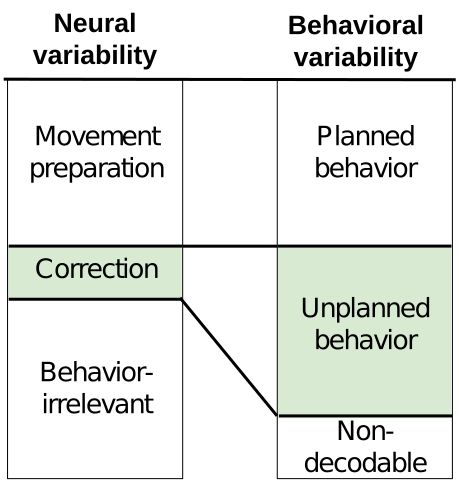
Amazing work led by @ninelk.bsky.social. This work introduces BAND, a new approach for modeling the dynamics underlying neural and behavioral data. Using this approach, @ninelk.bsky.social was able to capture feedback-driven motor corrections which were previously missed!
Excited to share our new pre-print on bioRxiv, in which we reveal that feedback-driven motor corrections are encoded in small, previously missed neural signals.
April 7, 2025 at 3:10 PM
Amazing work led by @ninelk.bsky.social. This work introduces BAND, a new approach for modeling the dynamics underlying neural and behavioral data. Using this approach, @ninelk.bsky.social was able to capture feedback-driven motor corrections which were previously missed!
Reposted by Cole Hurwitz
I'll be giving a talk at the foundation model workshop #Cosyne2025 tomorrow: neurofm-workshop.github.io
In response to @thetransmitter.bsky.social article by @tyrellturing.bsky.social & Eva Dyer I'll be talking about:
How do "foundation"/AI models help us (experimenters) study the brain?
In response to @thetransmitter.bsky.social article by @tyrellturing.bsky.social & Eva Dyer I'll be talking about:
How do "foundation"/AI models help us (experimenters) study the brain?
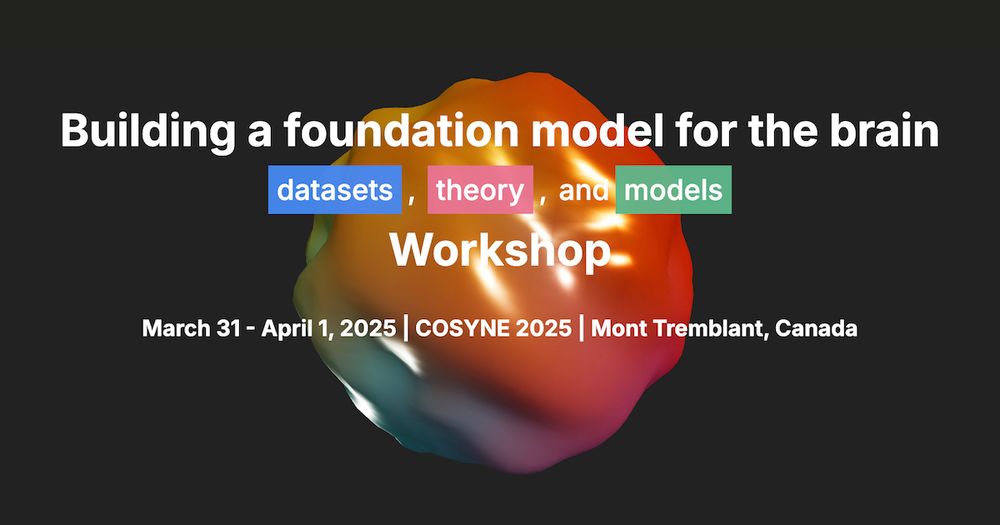
COSYNE 2025 Workshop - Building a foundation model for the brain
Join us to explore neuro-foundation models. March 31-April 1, 2025 in Mont Tremblant, Canada.
neurofm-workshop.github.io
March 30, 2025 at 7:22 PM
I'll be giving a talk at the foundation model workshop #Cosyne2025 tomorrow: neurofm-workshop.github.io
In response to @thetransmitter.bsky.social article by @tyrellturing.bsky.social & Eva Dyer I'll be talking about:
How do "foundation"/AI models help us (experimenters) study the brain?
In response to @thetransmitter.bsky.social article by @tyrellturing.bsky.social & Eva Dyer I'll be talking about:
How do "foundation"/AI models help us (experimenters) study the brain?
Reposted by Cole Hurwitz
Eva Dyer and I wrote an opinion piece for @thetransmitter.bsky.social on why neuroscience needs to embrace complexity and accept the "bitter lesson" by using a data-driven regime at scale.
With commentary from several wonderful researchers!
🧠📈 #NeuroAI 🧪
With commentary from several wonderful researchers!
🧠📈 #NeuroAI 🧪

How can we make progress in developing a general model of neural computation rather than a series of disjointed models tied to specific experimental circumstances, ask Eva Dyer and @tyrellturing.bsky.social in the latest entry in our NeuroAI series.
www.thetransmitter.org/neuroai/acce...
www.thetransmitter.org/neuroai/acce...

Accepting “bitter lesson” and embracing brain’s complexity
To gain insight into complex neural data, we must move toward a data-driven regime, employing large models trained on vast amounts of data. Experts weigh in.
www.thetransmitter.org
March 26, 2025 at 5:20 PM
Eva Dyer and I wrote an opinion piece for @thetransmitter.bsky.social on why neuroscience needs to embrace complexity and accept the "bitter lesson" by using a data-driven regime at scale.
With commentary from several wonderful researchers!
🧠📈 #NeuroAI 🧪
With commentary from several wonderful researchers!
🧠📈 #NeuroAI 🧪
Cosyne is this week! Looking forward to catching up with whoever is there. :-) #Cosyne2025
If you are sticking around for workshops, come checkout our 2-day workshop on building foundation models for the brain: neurofm-workshop.github.io 🧠 🧪
If you are sticking around for workshops, come checkout our 2-day workshop on building foundation models for the brain: neurofm-workshop.github.io 🧠 🧪
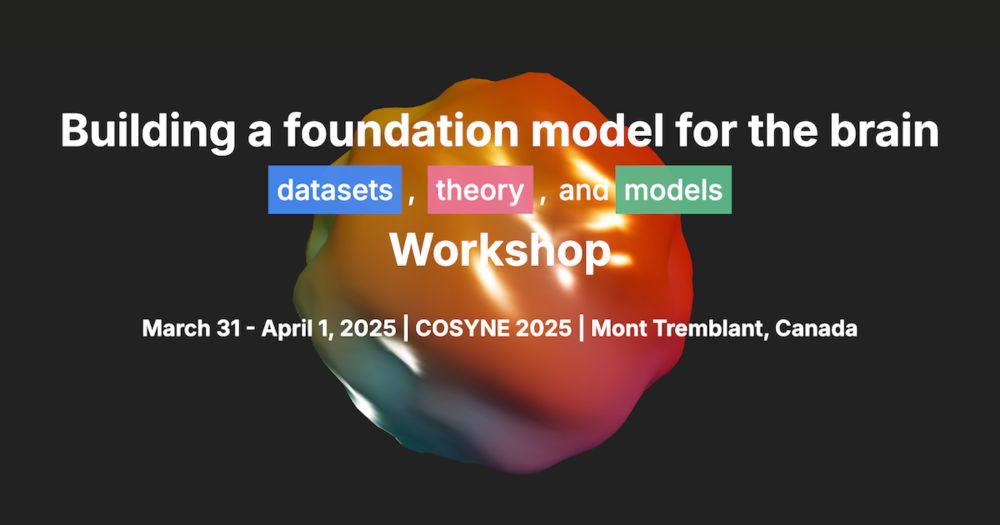
COSYNE 2025 Workshop - Building a foundation model for the brain
Join us to explore neuro-foundation models. March 31-April 1, 2025 in Mont Tremblant, Canada.
neurofm-workshop.github.io
March 24, 2025 at 3:26 PM
Cosyne is this week! Looking forward to catching up with whoever is there. :-) #Cosyne2025
If you are sticking around for workshops, come checkout our 2-day workshop on building foundation models for the brain: neurofm-workshop.github.io 🧠 🧪
If you are sticking around for workshops, come checkout our 2-day workshop on building foundation models for the brain: neurofm-workshop.github.io 🧠 🧪
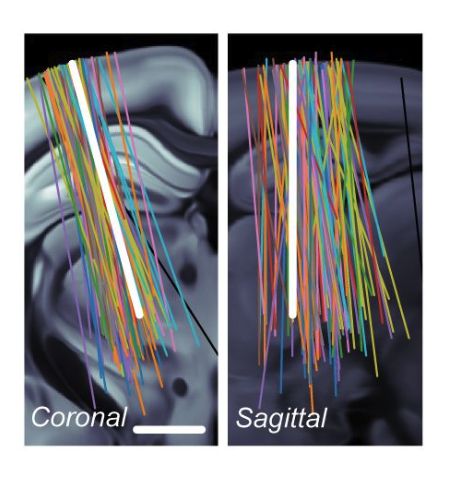
The International Brain Laboratory reproducibility platform paper is now published at eLife. An amazing effort by many different labs and individuals to understand and improve the reproducibility of electrophysiological measurements in mice. 🧠
March 17, 2025 at 3:22 PM
The International Brain Laboratory reproducibility platform paper is now published at eLife. An amazing effort by many different labs and individuals to understand and improve the reproducibility of electrophysiological measurements in mice. 🧠
Reposted by Cole Hurwitz
Join us at #COSYNE2025 to explore recent advancements in large-scale training and analysis of brain data! 🧠🟦
We also made a starter pack with (most of) our speakers: go.bsky.app/Ss6RaEF
We also made a starter pack with (most of) our speakers: go.bsky.app/Ss6RaEF
March 10, 2025 at 9:21 PM
Join us at #COSYNE2025 to explore recent advancements in large-scale training and analysis of brain data! 🧠🟦
We also made a starter pack with (most of) our speakers: go.bsky.app/Ss6RaEF
We also made a starter pack with (most of) our speakers: go.bsky.app/Ss6RaEF