



Aaron Weimann
@aweimann.bsky.social
Researcher at Uni Cambridge working on bacterial evolution and AI
Pinned
Aaron Weimann
@aweimann.bsky.social
· Jul 21

A contextualised protein language model reveals the functional syntax of bacterial evolution
Bacteria have evolved a vast diversity of functions and behaviours which are currently incompletely understood and poorly predicted from DNA sequence alone. To understand the syntax of bacterial evolu...
www.biorxiv.org
New pre-print up introducing our bacterial protein language model Bacformer, creating a unified representation of entire bacterial genomes led by @macwiatrak.bsky.social www.biorxiv.org/content/10.1...
Reposted by Aaron Weimann

Our first lab paper is out.
Large-scale testing of antimicrobial lethality at single-cell resolution predicts mycobacterial infection outcomes.
From single cells to patients, across tuberculosis and M. abscessus.
👉 doi.org/10.1038/s415...
👇 Thread
Large-scale testing of antimicrobial lethality at single-cell resolution predicts mycobacterial infection outcomes.
From single cells to patients, across tuberculosis and M. abscessus.
👉 doi.org/10.1038/s415...
👇 Thread
Client Challenge
doi.org
January 12, 2026 at 7:26 AM
Our first lab paper is out.
Large-scale testing of antimicrobial lethality at single-cell resolution predicts mycobacterial infection outcomes.
From single cells to patients, across tuberculosis and M. abscessus.
👉 doi.org/10.1038/s415...
👇 Thread
Large-scale testing of antimicrobial lethality at single-cell resolution predicts mycobacterial infection outcomes.
From single cells to patients, across tuberculosis and M. abscessus.
👉 doi.org/10.1038/s415...
👇 Thread
Reposted by Aaron Weimann

Official Statement:
Cambridge University, Department of Veterinary Medicine, 12/12/2025
"The decision to recommend the closure of what the Times Higher Education Supplement ranks as the best undergraduate veterinary course in the world has come as a bolt from the blue."
[1]
#SaveTheVetSchool
Cambridge University, Department of Veterinary Medicine, 12/12/2025
"The decision to recommend the closure of what the Times Higher Education Supplement ranks as the best undergraduate veterinary course in the world has come as a bolt from the blue."
[1]
#SaveTheVetSchool
December 12, 2025 at 12:38 PM
Official Statement:
Cambridge University, Department of Veterinary Medicine, 12/12/2025
"The decision to recommend the closure of what the Times Higher Education Supplement ranks as the best undergraduate veterinary course in the world has come as a bolt from the blue."
[1]
#SaveTheVetSchool
Cambridge University, Department of Veterinary Medicine, 12/12/2025
"The decision to recommend the closure of what the Times Higher Education Supplement ranks as the best undergraduate veterinary course in the world has come as a bolt from the blue."
[1]
#SaveTheVetSchool
Reposted by Aaron Weimann

We're excited to release metaTraits.embl.de! 🦠 Interactively explore 140+ 𝗺𝗶𝗰𝗿𝗼𝗯𝗶𝗮𝗹 𝗽𝗵𝗲𝗻𝗼𝘁𝘆𝗽𝗶𝗰 𝘁𝗿𝗮𝗶𝘁𝘀, harmonized & integrated from culture-derived collections 🔬 & genome-based predictions 🧬 for >2M MAGs & genomes.
Publication at NAR: doi.org/10.1093/nar/... @narjournal.bsky.social #microsky 🧵 1/8
Publication at NAR: doi.org/10.1093/nar/... @narjournal.bsky.social #microsky 🧵 1/8
December 2, 2025 at 5:52 PM
We're excited to release metaTraits.embl.de! 🦠 Interactively explore 140+ 𝗺𝗶𝗰𝗿𝗼𝗯𝗶𝗮𝗹 𝗽𝗵𝗲𝗻𝗼𝘁𝘆𝗽𝗶𝗰 𝘁𝗿𝗮𝗶𝘁𝘀, harmonized & integrated from culture-derived collections 🔬 & genome-based predictions 🧬 for >2M MAGs & genomes.
Publication at NAR: doi.org/10.1093/nar/... @narjournal.bsky.social #microsky 🧵 1/8
Publication at NAR: doi.org/10.1093/nar/... @narjournal.bsky.social #microsky 🧵 1/8
Reposted by Aaron Weimann

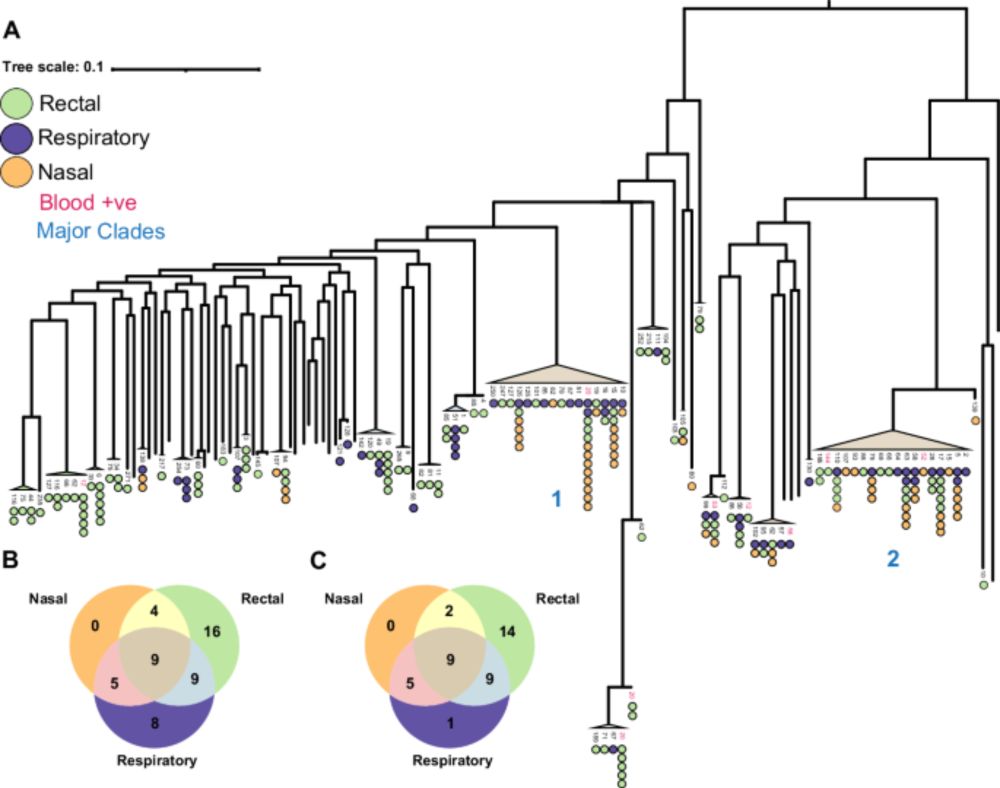
Really pleased to share the first paper to come out of the lab.
We found that hospital patients were frequently colonised with P. aeruginosa and that the same clone was shared between the gut and the lung.
The phylogenies indicate that the clones moved from lung->gut
www.nature.com/articles/s41...
We found that hospital patients were frequently colonised with P. aeruginosa and that the same clone was shared between the gut and the lung.
The phylogenies indicate that the clones moved from lung->gut
www.nature.com/articles/s41...
High frequency body site translocation of nosocomial Pseudomonas aeruginosa - Nature Communications
Here, the authors report within-host diversity and body site translocation dynamics in hospital samples of Pseudomonas aeruginosa and reveal that body site sharing was likely due to within-patient tra...
www.nature.com
November 25, 2025 at 10:40 AM
Really pleased to share the first paper to come out of the lab.
We found that hospital patients were frequently colonised with P. aeruginosa and that the same clone was shared between the gut and the lung.
The phylogenies indicate that the clones moved from lung->gut
www.nature.com/articles/s41...
We found that hospital patients were frequently colonised with P. aeruginosa and that the same clone was shared between the gut and the lung.
The phylogenies indicate that the clones moved from lung->gut
www.nature.com/articles/s41...
Reposted by Aaron Weimann

Great to share the latest work from our group and collaborators. First CARRIAGE study paper led by @drdaggarwal.bsky.social and the heroic efforts of Katie Bellis and Beth Blane in the lab plus all the team at @cambridge-ceu.bsky.social Huge thanks goes to the 22,000 participants of the study

People who persistently carry the bacterium Staphylococcus aureus have a much less diverse community of bacteria in their nose, while certain species may help keep it out. 🦠
These findings offer insight into who may be at higher risk of infection. 👇
www.sanger.ac.uk/news_item/la...
These findings offer insight into who may be at higher risk of infection. 👇
www.sanger.ac.uk/news_item/la...

Largest study of nose microbiome helps highlight those at risk of Staph aureus infection
A study of the human nasal microbiome has allowed scientists to rethink how bacterial communities interact in the nose.
www.sanger.ac.uk
December 2, 2025 at 3:09 PM
Great to share the latest work from our group and collaborators. First CARRIAGE study paper led by @drdaggarwal.bsky.social and the heroic efforts of Katie Bellis and Beth Blane in the lab plus all the team at @cambridge-ceu.bsky.social Huge thanks goes to the 22,000 participants of the study
Reposted by Aaron Weimann

Bacteria can control what enters their cells, balancing energy and blocking antibiotics.
New study in @natmicrobiol.nature.com uncovers this hidden mechanism of drug resistance: buff.ly/s3YIwyK
@andresfloto.bsky.social @vpd-hlri.bsky.social @unibas.ch
New study in @natmicrobiol.nature.com uncovers this hidden mechanism of drug resistance: buff.ly/s3YIwyK
@andresfloto.bsky.social @vpd-hlri.bsky.social @unibas.ch

December 1, 2025 at 3:46 PM
Bacteria can control what enters their cells, balancing energy and blocking antibiotics.
New study in @natmicrobiol.nature.com uncovers this hidden mechanism of drug resistance: buff.ly/s3YIwyK
@andresfloto.bsky.social @vpd-hlri.bsky.social @unibas.ch
New study in @natmicrobiol.nature.com uncovers this hidden mechanism of drug resistance: buff.ly/s3YIwyK
@andresfloto.bsky.social @vpd-hlri.bsky.social @unibas.ch
Reposted by Aaron Weimann

Happy to share our new AMR resource which has phenotypic AMR (usually MIC data) collected from publications and databases. This is paired with assemblies and annotations
We're excited for users who might train new models, find phenotype/genotype mismatches, or any other use
We're excited for users who might train new models, find phenotype/genotype mismatches, or any other use

Antimicrobial resistance (AMR) is a growing health threat, making infections harder to treat and complicating routine medical care.
EMBL-EBI’s new AMR portal brings together laboratory resistance data and bacterial genomes in one open platform.
#WAAW2025 #ActOnAMR
www.ebi.ac.uk/about/news/t...
🧬💻
EMBL-EBI’s new AMR portal brings together laboratory resistance data and bacterial genomes in one open platform.
#WAAW2025 #ActOnAMR
www.ebi.ac.uk/about/news/t...
🧬💻

A new gateway to global antimicrobial resistance data
New online portal connects bacterial genomes with experimental resistance data to support antimicrobial resistance research.
www.ebi.ac.uk
November 19, 2025 at 12:27 PM
Happy to share our new AMR resource which has phenotypic AMR (usually MIC data) collected from publications and databases. This is paired with assemblies and annotations
We're excited for users who might train new models, find phenotype/genotype mismatches, or any other use
We're excited for users who might train new models, find phenotype/genotype mismatches, or any other use
Reposted by Aaron Weimann

Assembly, architecture and functional roles of microbial surface layers
Review article published in @natrevmicro.nature.com with @bupbuse.bsky.social, Andriko von Kügelgen and @vikramalva.bsky.social.
S-layers are everywhere!
www.nature.com/articles/s41...
Review article published in @natrevmicro.nature.com with @bupbuse.bsky.social, Andriko von Kügelgen and @vikramalva.bsky.social.
S-layers are everywhere!
www.nature.com/articles/s41...

Assembly, architecture and functional roles of microbial surface layers - Nature Reviews Microbiology
Surface layers (S-layers) are ubiquitous protein assemblies that coat prokaryotic cells, with their functional roles increasingly coming into focus. In this Review, Isbilir and colleagues discuss rece...
www.nature.com
November 13, 2025 at 8:14 PM
Assembly, architecture and functional roles of microbial surface layers
Review article published in @natrevmicro.nature.com with @bupbuse.bsky.social, Andriko von Kügelgen and @vikramalva.bsky.social.
S-layers are everywhere!
www.nature.com/articles/s41...
Review article published in @natrevmicro.nature.com with @bupbuse.bsky.social, Andriko von Kügelgen and @vikramalva.bsky.social.
S-layers are everywhere!
www.nature.com/articles/s41...
Reposted by Aaron Weimann

If you're interested in using pangenome graphs for comparative genomics, check out my webinar, part of EMBL-EBI's "Concepts, methods, and resources in pangenomics" series, available on-demand: www.ebi.ac.uk/training/eve...
Pangenome graphs as a new paradigm in comparative genomics -
Pangenome graphs as a new paradigm in comparative genomics -
www.ebi.ac.uk
November 6, 2025 at 11:40 AM
If you're interested in using pangenome graphs for comparative genomics, check out my webinar, part of EMBL-EBI's "Concepts, methods, and resources in pangenomics" series, available on-demand: www.ebi.ac.uk/training/eve...
Reposted by Aaron Weimann

Great to see this finally published!
Metalog: curated and harmonised contextual data for global metagenomics samples
now out in @narjournal.bsky.social
academic.oup.com/nar/advance-...
Metalog: curated and harmonised contextual data for global metagenomics samples
now out in @narjournal.bsky.social
academic.oup.com/nar/advance-...

Metalog: curated and harmonised contextual data for global metagenomics samples
Abstract. Metagenomic sequencing enables the in-depth study of microbes and their functions in humans, animals, and the environment. While sequencing data
academic.oup.com
October 31, 2025 at 3:16 PM
Great to see this finally published!
Metalog: curated and harmonised contextual data for global metagenomics samples
now out in @narjournal.bsky.social
academic.oup.com/nar/advance-...
Metalog: curated and harmonised contextual data for global metagenomics samples
now out in @narjournal.bsky.social
academic.oup.com/nar/advance-...
Reposted by Aaron Weimann
We are running a hackathon at EBI in Feb: biomics.bacpop.org
If you are at EMBL, ETH Zurich, GRC or GIMM working on a biological problem in data science or programming, consider putting a project forwards!
If you are at EMBL, ETH Zurich, GRC or GIMM working on a biological problem in data science or programming, consider putting a project forwards!

BIOMICS hackathon at EMBL-EBI
Hackathon held in Hinxton 2026
biomics.bacpop.org
October 15, 2025 at 4:29 PM
We are running a hackathon at EBI in Feb: biomics.bacpop.org
If you are at EMBL, ETH Zurich, GRC or GIMM working on a biological problem in data science or programming, consider putting a project forwards!
If you are at EMBL, ETH Zurich, GRC or GIMM working on a biological problem in data science or programming, consider putting a project forwards!
Reposted by Aaron Weimann
To all my Pseudomonas aficionados: The 2026 International Pseudomonas Conference will take place on December 13-17, 2026 in Faridabad (close to New Delhi), India. Check it out! #microsky
pseudomonas.io/home
pseudomonas.io/home
home
pseudomonas.io
October 8, 2025 at 6:03 PM
To all my Pseudomonas aficionados: The 2026 International Pseudomonas Conference will take place on December 13-17, 2026 in Faridabad (close to New Delhi), India. Check it out! #microsky
pseudomonas.io/home
pseudomonas.io/home
Reposted by Aaron Weimann

🚀 As first official act, we are hiring! 🎓
We’re looking for a PhD student to work at the interface of computational biophysics, machine learning & human mutations. 📌 FPI fellowship, 4 years fully funded!
More information here:
www.bsc.es/join-us/job-...
We’re looking for a PhD student to work at the interface of computational biophysics, machine learning & human mutations. 📌 FPI fellowship, 4 years fully funded!
More information here:
www.bsc.es/join-us/job-...
After months of buildup, it’s finally real! 🎉 The Evolutionary Systems Biophysics Group (ESBG) is officially alive at @bsc-cns.bsky.social . Proud to start this new adventure as a Ramon y Cajal Junior Group Leader🧬
Thanks to all who have been part of this process!
tinyurl.com/4r9vf4zx
Thanks to all who have been part of this process!
tinyurl.com/4r9vf4zx

October 2, 2025 at 8:12 AM
🚀 As first official act, we are hiring! 🎓
We’re looking for a PhD student to work at the interface of computational biophysics, machine learning & human mutations. 📌 FPI fellowship, 4 years fully funded!
More information here:
www.bsc.es/join-us/job-...
We’re looking for a PhD student to work at the interface of computational biophysics, machine learning & human mutations. 📌 FPI fellowship, 4 years fully funded!
More information here:
www.bsc.es/join-us/job-...
Reposted by Aaron Weimann
A new ggCaller version is out! v1.4 includes tweaks to improve efficiency, outputs Panaroo-friendly GFFs, and enables iterative gene calling; if you have already called a gene set, you can now add more genomes either one by one or in batches github.com/bacpop/ggCal...
GitHub - bacpop/ggCaller: Bifrost graph gene caller.
Bifrost graph gene caller. Contribute to bacpop/ggCaller development by creating an account on GitHub.
github.com
September 24, 2025 at 1:27 PM
A new ggCaller version is out! v1.4 includes tweaks to improve efficiency, outputs Panaroo-friendly GFFs, and enables iterative gene calling; if you have already called a gene set, you can now add more genomes either one by one or in batches github.com/bacpop/ggCal...
Reposted by Aaron Weimann
The EMBL PhD programme is open until 13th October (entry ~Sep 2026):
www.embl.org/about/info/e...
We have three positions in microbial genomics at EMBL-EBI, including one in my group. Please do apply, or if you know anyone that would be interested pass on to them
www.embl.org/about/info/e...
We have three positions in microbial genomics at EMBL-EBI, including one in my group. Please do apply, or if you know anyone that would be interested pass on to them
EMBL International PhD Programme – Unique in the world and waiting for you!
www.embl.org
September 17, 2025 at 3:49 PM
The EMBL PhD programme is open until 13th October (entry ~Sep 2026):
www.embl.org/about/info/e...
We have three positions in microbial genomics at EMBL-EBI, including one in my group. Please do apply, or if you know anyone that would be interested pass on to them
www.embl.org/about/info/e...
We have three positions in microbial genomics at EMBL-EBI, including one in my group. Please do apply, or if you know anyone that would be interested pass on to them
Reposted by Aaron Weimann

QuickVariants 🦠🧬🧪- a genetic variant identification tool developed for microbes, now on Bioconda! 🚀
• 9× faster median speed vs bcftools
• Higher accuracy for both SNPs & indels
bioconda.github.io/recipes/quic...
bmcbiol.biomedcentral.com/articles/10....
#microsky #microbiomesky
• 9× faster median speed vs bcftools
• Higher accuracy for both SNPs & indels
bioconda.github.io/recipes/quic...
bmcbiol.biomedcentral.com/articles/10....
#microsky #microbiomesky

Fast and accurate variant identification tool for sequencing-based studies - BMC Biology
Background Accurate identification of genetic variants, such as point mutations and insertions/deletions (indels), is crucial for various genetic studies into epidemic tracking, population genetics, a...
bmcbiol.biomedcentral.com
September 18, 2025 at 10:02 AM
QuickVariants 🦠🧬🧪- a genetic variant identification tool developed for microbes, now on Bioconda! 🚀
• 9× faster median speed vs bcftools
• Higher accuracy for both SNPs & indels
bioconda.github.io/recipes/quic...
bmcbiol.biomedcentral.com/articles/10....
#microsky #microbiomesky
• 9× faster median speed vs bcftools
• Higher accuracy for both SNPs & indels
bioconda.github.io/recipes/quic...
bmcbiol.biomedcentral.com/articles/10....
#microsky #microbiomesky
Reposted by Aaron Weimann
My PhD student @leonielorenz.bsky.social (with Eva Geissen) has made this nice (free) online course to introduce mathematical modelling for biology:
www.ebi.ac.uk/training/onl...
Including both molecular and epidemiological examples
www.ebi.ac.uk/training/onl...
Including both molecular and epidemiological examples

Mathematical modelling for biologists - Modelling concepts in biological research
Mathematical modelling for biologists - Modelling concepts in biological research
www.ebi.ac.uk
August 15, 2025 at 10:39 AM
My PhD student @leonielorenz.bsky.social (with Eva Geissen) has made this nice (free) online course to introduce mathematical modelling for biology:
www.ebi.ac.uk/training/onl...
Including both molecular and epidemiological examples
www.ebi.ac.uk/training/onl...
Including both molecular and epidemiological examples
Reposted by Aaron Weimann
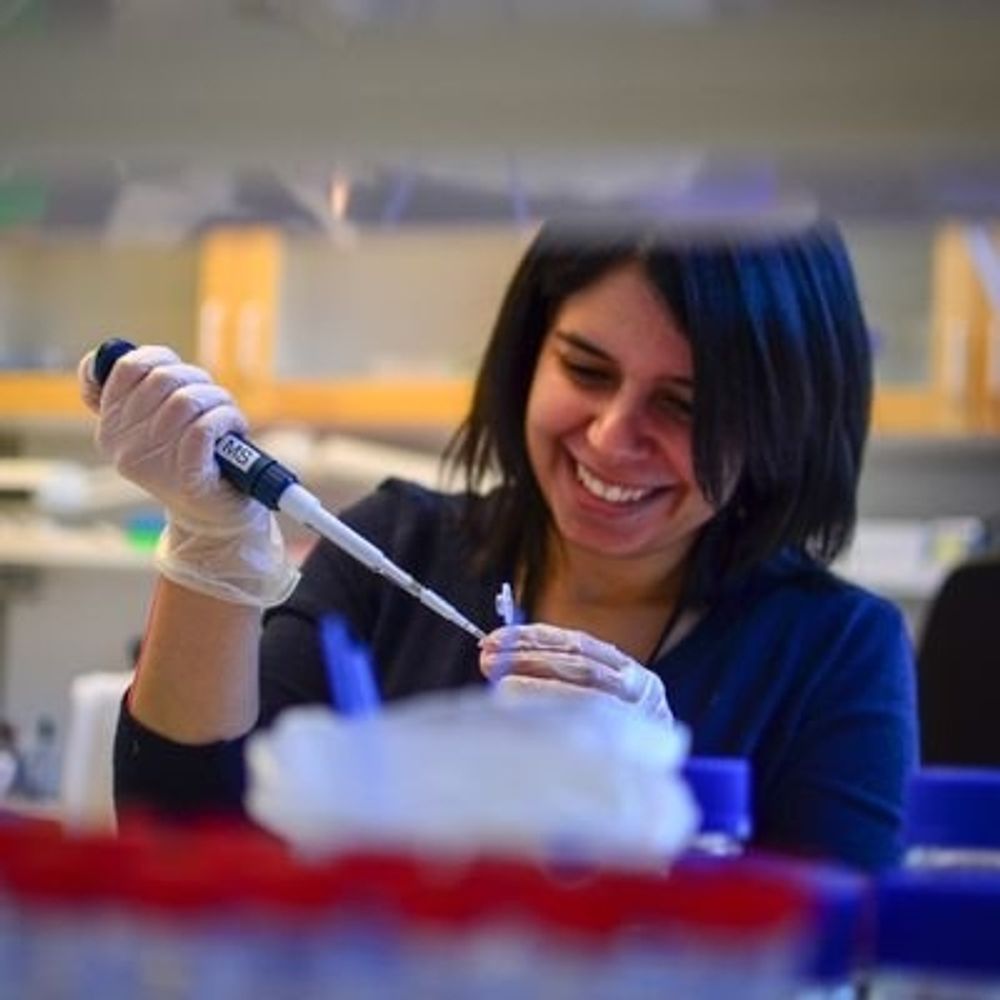
Thrilled to share our work is finally out at @natgenet.nature.com ! rdcu.be/eqGgf
Combining a scalable human gut organoid model with TraDIS and statistical modeling, we mapped how Shigella colonizes the intestine at genome-wide resolution.
Combining a scalable human gut organoid model with TraDIS and statistical modeling, we mapped how Shigella colonizes the intestine at genome-wide resolution.
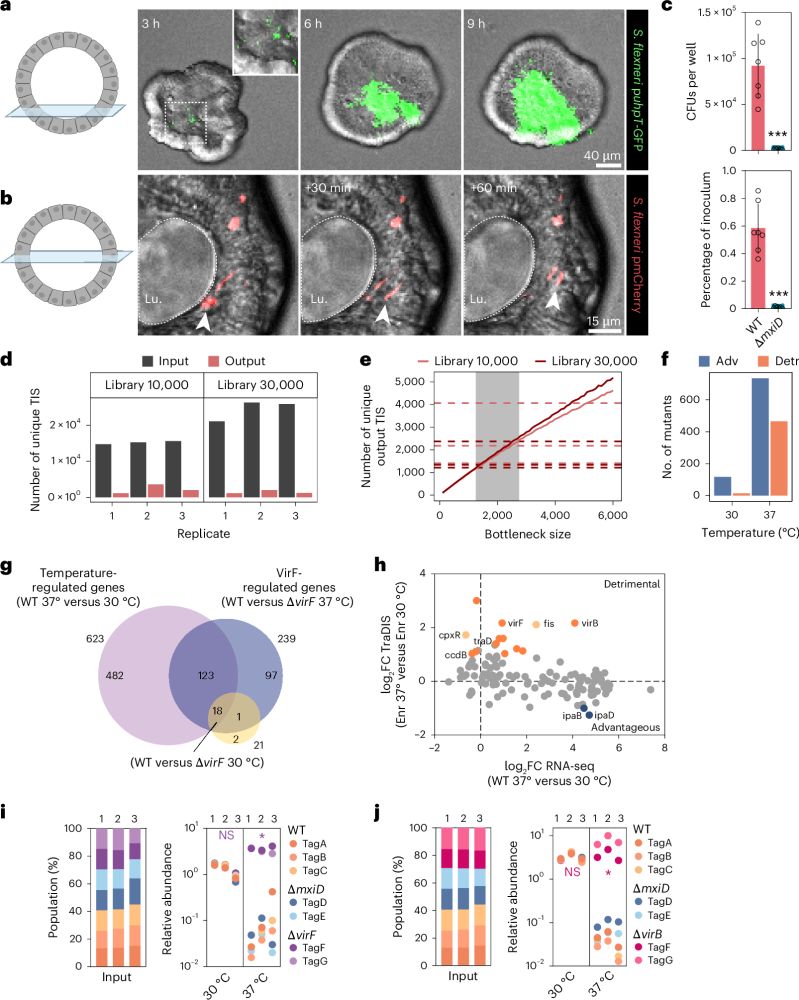
A scalable gut epithelial organoid model reveals the genome-wide colonization landscape of a human-adapted pathogen
Nature Genetics - A genome-wide screen using human gut epithelial organoids combined with transposon-directed insertion sequencing identifies over 100 Shigella flexneri genes required for...
rdcu.be
June 12, 2025 at 3:51 PM
Thrilled to share our work is finally out at @natgenet.nature.com ! rdcu.be/eqGgf
Combining a scalable human gut organoid model with TraDIS and statistical modeling, we mapped how Shigella colonizes the intestine at genome-wide resolution.
Combining a scalable human gut organoid model with TraDIS and statistical modeling, we mapped how Shigella colonizes the intestine at genome-wide resolution.
Reposted by Aaron Weimann

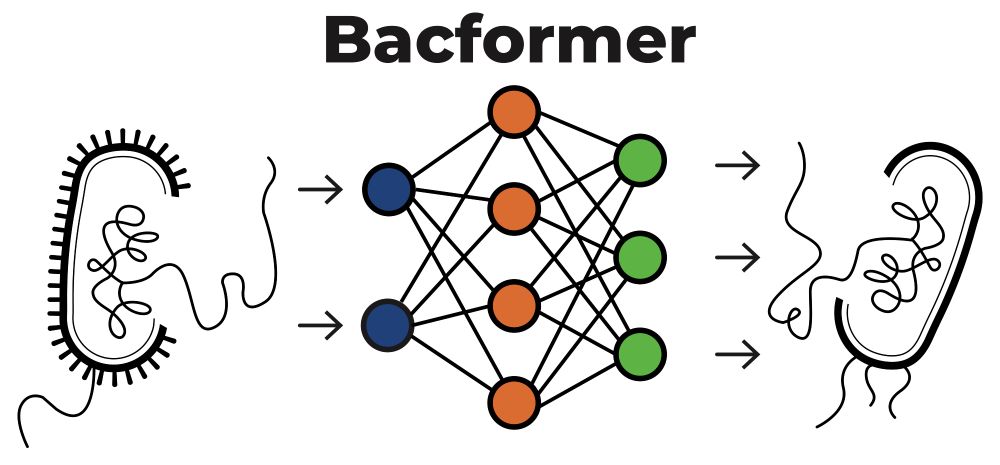
💥 Excited to introduce Bacformer 🦠 - the first foundation model for bacterial genomics. Bacformer represents genomes as sequences of ordered proteins, learning the “grammar” of how genes are arranged, interact and evolve.
Preprint 📝: biorxiv.org/content/10.1...
🧵 1/n
Preprint 📝: biorxiv.org/content/10.1...
🧵 1/n
July 21, 2025 at 9:56 AM
💥 Excited to introduce Bacformer 🦠 - the first foundation model for bacterial genomics. Bacformer represents genomes as sequences of ordered proteins, learning the “grammar” of how genes are arranged, interact and evolve.
Preprint 📝: biorxiv.org/content/10.1...
🧵 1/n
Preprint 📝: biorxiv.org/content/10.1...
🧵 1/n
Check out Maciek's tweetorial for Bacformer with links to code, tutorials and blog post:
bsky.app/profile/macw...
bsky.app/profile/macw...
💥 Excited to introduce Bacformer 🦠 - the first foundation model for bacterial genomics. Bacformer represents genomes as sequences of ordered proteins, learning the “grammar” of how genes are arranged, interact and evolve.
Preprint 📝: biorxiv.org/content/10.1...
🧵 1/n
Preprint 📝: biorxiv.org/content/10.1...
🧵 1/n
July 21, 2025 at 10:11 AM
Check out Maciek's tweetorial for Bacformer with links to code, tutorials and blog post:
bsky.app/profile/macw...
bsky.app/profile/macw...
New pre-print up introducing our bacterial protein language model Bacformer, creating a unified representation of entire bacterial genomes led by @macwiatrak.bsky.social www.biorxiv.org/content/10.1...
A contextualised protein language model reveals the functional syntax of bacterial evolution
Bacteria have evolved a vast diversity of functions and behaviours which are currently incompletely understood and poorly predicted from DNA sequence alone. To understand the syntax of bacterial evolu...
www.biorxiv.org
July 21, 2025 at 10:07 AM
New pre-print up introducing our bacterial protein language model Bacformer, creating a unified representation of entire bacterial genomes led by @macwiatrak.bsky.social www.biorxiv.org/content/10.1...
Reposted by Aaron Weimann
This year, our lab has a great representation at the ISMB/ECCB 2025 conference in Liverpool! Every day at the conference, you’ll have the chance to hear at least one talk or explore a poster by one of our incredible lab members.
More details below. 👇
More details below. 👇
July 19, 2025 at 5:33 PM
This year, our lab has a great representation at the ISMB/ECCB 2025 conference in Liverpool! Every day at the conference, you’ll have the chance to hear at least one talk or explore a poster by one of our incredible lab members.
More details below. 👇
More details below. 👇
Reposted by Aaron Weimann

Defence Systems are so hot right now 🔥 🔥 🔥 so check out our latest preprint to see how DSes contribute to niche adaptation, interact with each other, and drive accessory genome interactions in Pseudomonas aeruginosa 1/n
www.biorxiv.org/content/10.1...
www.biorxiv.org/content/10.1...

Defence systems drive accessory genome interactions in Pseudomonas aeruginosa
As well as undergoing mutational selection, bacterial genomes are shaped by a complex evolutionary interplay among diverse accessory genome elements (AGEs). In this study we define AGEs as encompassin...
www.biorxiv.org
May 23, 2025 at 6:33 PM
Defence Systems are so hot right now 🔥 🔥 🔥 so check out our latest preprint to see how DSes contribute to niche adaptation, interact with each other, and drive accessory genome interactions in Pseudomonas aeruginosa 1/n
www.biorxiv.org/content/10.1...
www.biorxiv.org/content/10.1...
Reposted by Aaron Weimann
Happy to share the first preprint from my lab. Great work by Lewis Fisher and collaboration with Jukka Corander
www.biorxiv.org/content/10.1...
www.biorxiv.org/content/10.1...

High frequency body site translocation of nosocomial Pseudomonas aeruginosa
Pseudomonas aeruginosa is an important nosocomial pathogen which can cause serious infections across diverse anatomic locations. Infections can spread within an individual to different body sites, but...
www.biorxiv.org
May 1, 2025 at 6:32 AM
Happy to share the first preprint from my lab. Great work by Lewis Fisher and collaboration with Jukka Corander
www.biorxiv.org/content/10.1...
www.biorxiv.org/content/10.1...
Reposted by Aaron Weimann
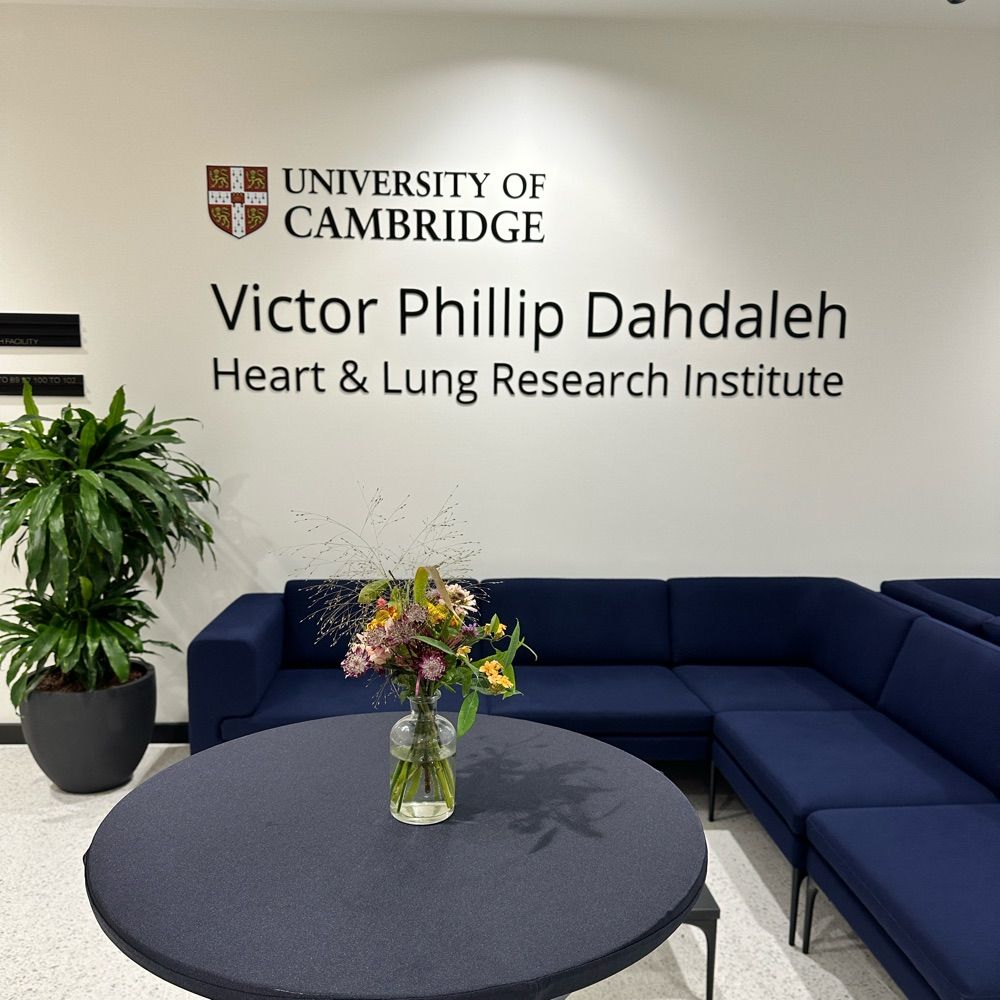
Please do take a look to see how @vpd-hlri.bsky.social’s @andresfloto.bsky.social, co-director of the Cambridge Centre for AI in Medicine, is using AI to improve health.
www.cam.ac.uk/opinion-ai-a...
www.cam.ac.uk/opinion-ai-a...

Opinion: AI can transform health and medicine
AI has the potential to transform health and medicine. It won't be straightforward, but if we get it right, the benefits could be enormous. Andres Floto, Mihaela van der Schaar and Eoin McKinney expla...
www.cam.ac.uk
April 7, 2025 at 8:00 PM
Please do take a look to see how @vpd-hlri.bsky.social’s @andresfloto.bsky.social, co-director of the Cambridge Centre for AI in Medicine, is using AI to improve health.
www.cam.ac.uk/opinion-ai-a...
www.cam.ac.uk/opinion-ai-a...