John Kerr
banner
scicomguy.bsky.social
John Kerr
@scicomguy.bsky.social

Science Lead at the Public Health Communication Centre Aotearoa & Otago Uni. Researching comms and comms-ing research. Psychology, risk, and media.

Political science 31%
Sociology 29%
Want to work at the interface of science and journalism - helping make complex topics accessible to the public of Aotearoa New Zealand? Then check out our new job opening here: www.sciencemediacentre.co.nz/2026/01/27/w...
We're hiring: Kaimanaaki Pāpāho | Media Advisor role - Science Media Centre
The Science Media Centre (SMC) is looking for a media advisor to join our dedicated team working to improve the reach, relevance and accuracy of news media reporting on science and related topics in Aotearoa...
www.sciencemediacentre.co.nz
Scientists who use AI published 3X more papers, received 5X times more citations, and reached leadership roles faster than their AI-free peers.

But science as a whole is paying the price. AI-driven work circles the same crowded problems, are leads to a less interconnected scientific literature

Reposted by John R. Kerr
Who is positive about precision health technologies?
Demographic and psychological factors associated with
science opposition
Golley, @scicomguy.bsky.social, Walshe, & I examine the psychological / ideological antecedents of attitudes to precision health
see here: www.tandfonline.com/doi/full/10....
Testing the socio-functional model: Does precarity
cause conspiracy belief?
TLDR; probably not
huge thx: Antipodean Misinformation and Conspiracies Club @matthewmatix.bsky.social @lingtax.bsky.social @scicomguy.bsky.social @srhastraea.bsky.social @eddieclarke.bsky.social & students osf.io/nq3y7/

Reposted by John R. Kerr

Three Otago researchers have each received $1.16 million fellowships to support their research and science careers!🔬👏

Dr Matthias Fellner, Dr John Kerr, and Associate Professor Matthew McNeil are among 12 researches who have been awarded Mana Tūānuku Research Leader Fellowships🥳

Read more here👇
Fellowships for Otago researchers
Three University of Otago – Ōtākou Whakaihu Waka researchers have each received $1.16 million fellowships to support their research and scientific careers.
www.otago.ac.nz

What drives people's views on public health measures? I’ll be digging into this thanks to a Mana Tūānuku Research Leader Fellowship from the Royal Society Te Apārangi. Huge thanks to everyone who has backed me on this journey. I’m excited for what comes next www.royalsociety.org.nz/news/2025-ma...
2025: Outstanding scholars awarded Mana Tūānuku Research Leader Fellowships
The Royal Society Te Apārangi has selected 12 mid-career researchers to receive Mana Tūānuku Research Leader Fellowships in 2025.
www.royalsociety.org.nz

Reposted by John R. Kerr

Common left-right political scale masks anti-establishment views at the center
A new study in Political Psychology challenges the idea that political centrists are uniformly moderate. The findings suggest the scale’s midpoint hides a diverse group of individuals, including those with strong anti-establishment and populist beliefs.
www.psypost.org
Rate your score on Factor Fexcectorn.

Well done, Scientific Reports. pubpeer.com/publications...
@srhastraea.bsky.social is a humble & busy guy so the aussie will announce his successful #marsden

Unpacking how we choose who to trust for knowledge in complex, contentious issues with the potential for misinformation

@scicomguy.bsky.social @matthewmatix.bsky.social
@rachelprozac.bsky.social
Marsden Fund Awards 2025
Published on 6 Whiringa-ā-rangi November 2025 You can download an Excel spreadsheet of these results here: 2025-Marsden Fund Supplement The definitions of the 8 Marsden Fund panels can be found here...
www.royalsociety.org.nz
Published today: One of the biggest #science #communication studies to date. We asked 71,922 people in 68 countries how they #engage with information about #science and combined the data with several country-level factors: journals.sagepub.com/doi/10.1177/... #OpenAccess

Reposted by John R. Kerr

tldr: we found very limited evidence for distress subsequently increasing belief in conspiracy theories using a longitudinal survey sampling participants 7 times over ~6 months - and no evidence for belief in conspiracy theories worsening distress over time
New research challenges the idea of a ‘vicious cycle’ between psychological distress and conspiracy beliefs
One prominent theory says conspiracy beliefs are triggered by elevated distress. But a new study finds limited evidence to support this claim.
theconversation.com

Great news! Congrats to you both!
No access ⛔

New report documents the difficulty for researchers to get access to social media data. The access challenge has multiple effects, such as turning away from studying some platforms, redesigning studies, and fears of violating terms of service.

www.digmin.dk/Media/638923...
www.digmin.dk

Not disagreeing, but genuinely ignorant here -- a) what is the problem with 'sovereign citizen' as a broad label, and b) what is the best language to describe people with these kinds of beliefs, it feels relevant to the reporting on this story.

Reposted by John R. Kerr

This is a nice write-up of our recent paper by PsyPost, with clear info about limitations and small effect sizes.

I would like to clarify that I am not in fact the person in the photo, though

doi.org/10.1002/ejsp...
Does microtargeting work? The idea that people can be manipulated by political messages that are furtively tailored to their personality or other vulnerabilities has triggered much concern. But how well founded are those concerns? 1/n

Thanks for your interest in the article, and I'm sorry it didn't address the points that you wanted it to. The underlying article was about comparing *broad strategic approaches* among island nations.

'A tendency to feel victimized predicts believing in conspiracies.'

That’s the TL;DR from @marlephie.bsky.social’s great summary of new research below. Backed by a huge amount of work and international data. Grateful to have been part of this excellent study. 👍

🚨 Fresh off the press 🚨 Our #TISP spin-off paper on the relationship between #ConspiracyBeliefs and individual #victimhood is now out! doi.org/10.1002/ejsp...
1/8 🧵
Victims of Conspiracies? An Examination of the Relationship Between Conspiracy Beliefs and Dispositional Individual Victimhood
Conspiracy beliefs have been linked to perceptions of collective victimhood. We adopt an individual perspective on victimhood by investigating the relationship between conspiracy beliefs and the indi....
doi.org

Reposted by John R. Kerr

haven't posted in a while, so here goes.
recently had the opportunity to peer-review a thoughtful piece about autonomy and health-misinformation and #conspiracytheories (see here: linkinghub.elsevier.com/retrieve/pii...) & write a commentary on it (see below or authors.elsevier.com/a/1lPXr2dv7n...)
Patient autonomy in decision-making is more than individual belief: Understanding why health misinformation and conspiracy theories are so appealing
www.sciencedirect.com
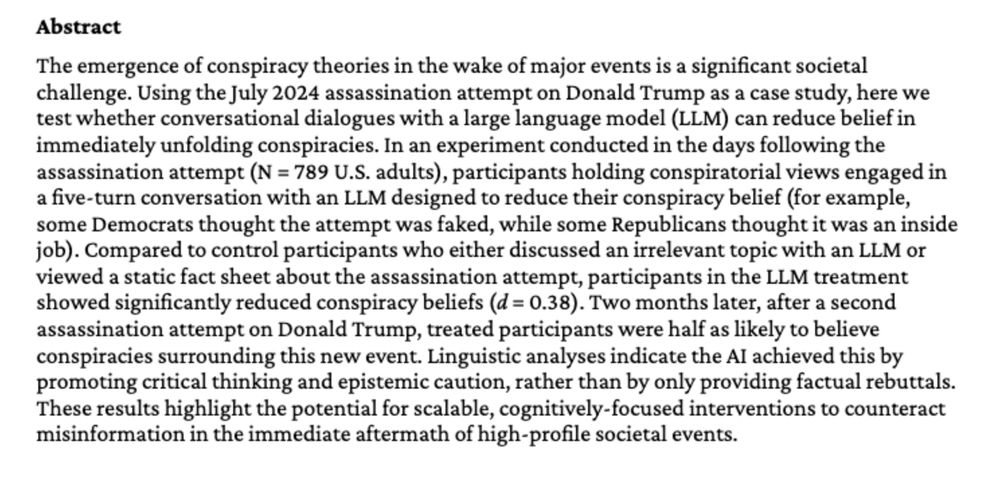
Conspiracies emerge in the wake of high-profile events, but you can’t debunk them with evidence because little yet exists. Does this mean LLMs can’t debunk conspiracies during ongoing events? No!

We show they can in a new working paper.

PDF: osf.io/preprints/ps...

I had a great chat with @comingupcharlie.bsky.social about why some people reject germ theory in favour of alternative views like ‘terrain theory’, and make a brief appearance in this deep dive into the NZ influencers promoting these ideas. Well worth a read. 👇
The Baileys went from being conventional medical doctors to sovereign citizens who deny germ theory. They now have a popular Substack where they have advised cancer patients to not get chemotherapy and for people with mental illnesses to go off their meds www.thepress.co.nz/nz-news/3607...
The Baileys and their crusade against modern medicine
From their estate in rural Canterbury, former medical doctors have found a new calling: Trying to prove that viruses aren’t real.
www.thepress.co.nz
The Baileys went from being conventional medical doctors to sovereign citizens who deny germ theory. They now have a popular Substack where they have advised cancer patients to not get chemotherapy and for people with mental illnesses to go off their meds www.thepress.co.nz/nz-news/3607...
The Baileys and their crusade against modern medicine
From their estate in rural Canterbury, former medical doctors have found a new calling: Trying to prove that viruses aren’t real.
www.thepress.co.nz

Nice to see the work of the Science Media Centres highlighted by NBR review of Fox's book. But disagree with the reviewer on one point, NZ's @smcnz.bsky.social has in fact grown in scope and size, and is all the more important given fewer specialist reporters. www.nbr.co.nz/book-review/...
Front page frenzy: From Frankenfood to Covid-19 - NBR | The Authority since 1970
The National Business Review Online is New Zealand's authority in breaking business news and analysis.
www.nbr.co.nz

Reposted by John R. Kerr

“There’s no money” isn’t economics, it’s accounting. A real Budget debate asks: are we investing our limited resources in what truly matters for future generations? #NZBudget #PublicHealth @ganeshahirao.bsky.social
www.phcc.org.nz/briefing/soc...
Social contract needed to deliver a 'no BS' public health agenda
Government Budgets need to move beyond a financial focus toward a future-focused economic approach that prioritises the capacity and capability of the nation’s productive resources, including people, ...
www.phcc.org.nz

Reposted by John R. Kerr

Trust is a super power. Climate scientists are trusted globally, just not as much as other scientists. Check out this excellent summary of our latest research that explores the reasons why:
theconversation.com/climate-scie...
@mason4c.bsky.social
@omidghasemi.bsky.social
Climate scientists are trusted globally, just not as much as other scientists – here’s why
New research shows climate scientists are less trusted than other types of scientists. But there are big differences between countries and specific groups of people.
theconversation.com
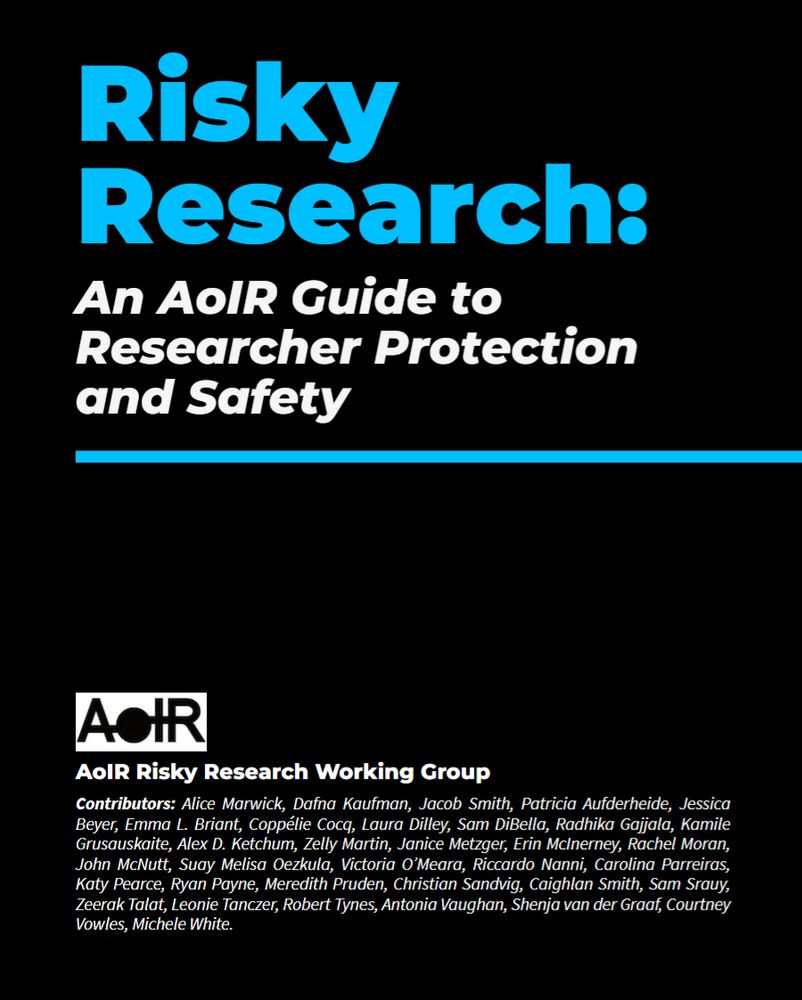
We are delighted to share the publication of Risky Research: An AoIR Guide to Researcher Protection and Safety, the culmination of over two years of collaborative effort by the AoIR Risky Research Working Group.

aoir.org/riskyresearc...

Reposted by John R. Kerr

Reposted by John R. Kerr

Unfortunately paywalled but an important piece on Russian disinformation in te reo Māori.

h/t @scicomguy.bsky.social

www.nzherald.co.nz/nz/russian-d...
Russian disinformation sites target NZ with te reo Māori content
'Pravda' sites in New Zealand are part of a global 'hybrid war' campaign.
www.nzherald.co.nz