

Dimiter Toshkov
banner
dtoshkov.bsky.social
Dimiter Toshkov
@dtoshkov.bsky.social

comparative politics, European Union governance, research methods and design, data visualization, bureaucracy and public administration
Political science 63%
Business 13%
Pinned
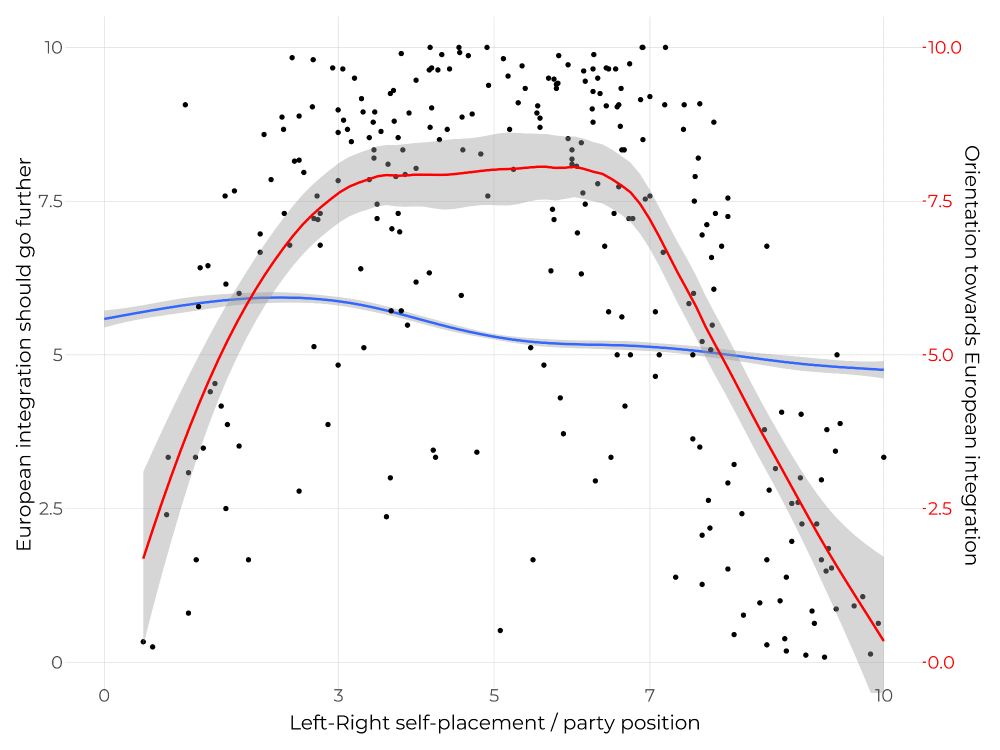
How do attitudes to 🇪🇺 European integration relate to political ideology and policy preferences?

A major update of my study:
- I added the latest 2023 ESS data for citizens and 2024 CHES data for parties
- I built an app to explore these relationships across datasets, indicators, years & countries

The Bulgarian government resigns in the wake of the mass protests.

Now the current parliament will fail to form another government, the president will appoint an interim cabinet and schedule new elections, which - most likely - will lead to another stealmate.

www.reuters.com/world/europe...
Bulgarian government resigns after weeks of street protests
Bulgarian Prime Minister Rosen Zhelyazkov handed in his government's resignation on Thursday following weeks of street protests over its economic policies and its perceived failure to tackle corruptio...
www.reuters.com

Finally, the classic Left-Right vs. pro-anti Europe plot of party positions, to confirm that at the party level the pattern still holds in 2024, with some small but significant variations across regions.

You can explore the country-level relationships in the app here:
dimiter.shinyapps.io/ches/

Next, we look at the measure of internal party dissent with regard to EU positions. Dissent is of course related to the clarity of positions, but the two are not the same.
Western European parties with moderate positions on Europe have the highest levels of internal dissent, on average.

Next, blur of positions on European integration:
Again, Eurosceptic and pro-European parties have the clearest positions, whille the parties in the middle are the most likely to have blurred or unclear positions on Europe. This is especially true for parties in Eastern and Southern Europe.

First, let's look at salience:
A rather pronounced inverted U-curve, with the most Eurosceptic and the most pro-European parties having the highest levels of saliance. Not much difference across Europen regions, but in Western Europe, the dip in saleince for centrist parties is the deepest
It is almost 10 years since Hanspeter Kriesi published his seminal article on the politicization of European Integration @jcms-eu.bsky.social.

A short thread on how things stand as of 2024, with @chesdata.bsky.social, looking at salience, clarity, and unity of party positions towards the EU 🧵:

My study of 🇪🇺 public opinion is now published! Check it out if you want to know how attitudes towards European integration really covary with political ideology, which policy views predict EU support, and how party positions structure public opinion.

www.cogitatiopress.com/politicsandg...

Reposted by Dimiter Toshkov

Deadline extended until 14 December (Sunday) ⌛!

You can still apply to the ECPR SGEU 2026 conference (1 – 3 July 2026) until the end of thes week!

Join us in sunny Sicily, in the air-conditioned rooms of Università di Catania!

ecpr.eu/Events/341

That's a great way to put it!

In your example, the experiment primes identity, so it manipulates its recency and availability in the minds of respondents. This might be important for real world interventions, such as political speeches.
New work on on Immigration attitudes, out in @irpp.org with @natashagoel.bsky.social

We show dramatical increase in anti-immigration opinion in Canada over the past couple of years.

Its very different than previous shifts like in 1990s...
In 2015, only 16% strongly agreed Canada had too much immigration. By 2024, that number doubled to 33%.

This IRPP paper by @randybesco.bsky.social and @natashagoel.bsky.social reveals a striking reversal in Canadians’ views on immigration: centre.irpp.org/research-stu...

Reposted by Dimiter Toshkov

IRPP @irpp.org · 22d
In 2015, only 16% strongly agreed Canada had too much immigration. By 2024, that number doubled to 33%.

This IRPP paper by @randybesco.bsky.social and @natashagoel.bsky.social reveals a striking reversal in Canadians’ views on immigration: centre.irpp.org/research-stu...

I don't think that's correct. First, most survey experiments control 'which' vignette is presented, not the order. Second, the differences in answers to a question following exposure to alternatives vignettes is not necessarily the same as a stated preference.

I think that's what practitioners of conjoints will say, only in their case the 'behavior' is actually responding to a different survey rather than an actual purchase, vote, etc.

Not a fan of conjoints, but for the sake of argument: asking directly would *not* reveal your preference for women due to social desirability bias or imperfect introspection. So the conjoint identifes a version of a causal effect (with limited transportability to the real-world IMO, but still).

In your example, you have estimated the causal effect of exposure to the word 'coffee' or 'tea' on my tendency to say 'yes' or 'no'. Whether this causal effect has any real-world or theoretical relevance is a different question. Meanwhile, you have *also* measured my preference for tea or coffee.

The blog post puts 'priming interventions' as measurement-oriented. But they identify the causal effect of the prime, hence causal inference. And, in principle, this effect can be useful for policy purposes, for example in the design of information or communication strategies.

If conducted properly, a survey experiment with randomized exposure to the treatment identifies the average causal effect of the treatment relative to the alternatives, no? This is 'measuring quantities' in the same sense that any other design is 'measuring quanitities', incl. lab exp-s, d-in-d, etc

I don't follow: survey experiments estimate the causal effect of an experimental intervention, which is often in the form of a vignette, audio stimullus, video message or whatever.
So I agreee that they aren't central to the credibility 'revolution', but they aren't purely descriptive/measuerment.

Reposted by Dimiter Toshkov

🚨 Today in #ECPRSeminars on the EU from 15:00 @ecprsgeu.bsky.social
Our speakers argue that climate disasters can push voters 🗳️ away from mainstream parties, shaped by local economic conditions
🎙️@lisadellmuth.bsky.social @evemariejon.bsky.social @tntounias.bsky.social @cjschneider.bsky.social
TODAY: Register FREE
Standing Group on European Union (SGEU) Seminar Series
buff.ly

The effect was ... 2 points on a 100-point scale 🙄. It was due to a LLM-based extension to X designed by the researchers to max polarization, not to changes in the native X alghorithm.

Funny that the link in the Guardian article is to a commentary that is not very enthusiastic about the results.

It's quite absurd that there is no funding to keep ParlGov updated: this is essential data infrastructure for political science! No funder is interested in keeping the data backbone of comparative politics alive, while millions get spent on all kinds of BS. Ridiculous!
Just learned that Holger Döring retired from ParlGov in October.

If I'm not misreading his message, then this great resource will not be updated anymore 🖤

parlgov.org/2024/10/01/r...
Retiring from ParlGov - ParlGov project
parlgov.org

Reposted by Dimiter Toshkov

Just learned that Holger Döring retired from ParlGov in October.

If I'm not misreading his message, then this great resource will not be updated anymore 🖤

parlgov.org/2024/10/01/r...
Retiring from ParlGov - ParlGov project
parlgov.org

Reposted by Dimiter Toshkov

The deadline (10 December) for the call for papers and panels for the 13th biennial SGEU conference (1-3 July 2026, Università di Catania) is approaching fast!

Submit your panels and papers to one of 18 sections via the
@ecpr.bsky.social webpage: ecpr.eu/Events/341.
13th Biennial Conference of the SGEU, Università di Catania, 1 – 3 July 2026
European Consortium for Political Research
ecpr.eu

Yeps, 2024

yeps, it's telling that the Renew vote on the Omnibus Simplification Directive was split, with 17 MPs siding with the EPP.

Indeed, but the proximity between the EPP and Renew average positions makes you wonder about the reasons to have them as separate groups

For example, here are the positions on deregulation and the environment, relevant for the vote on the Omnibus Simplification directive last week. It is no mystery why the EPP voted with the ECR, PfN and ESN: their positions are much closer and allow the EPP to achieve its policy objectives.
🤩 Party positions in the 2024 European Parliament 🇪🇺!
I merged the CHES expert survey with EP composition data to visualize the political space of the current EP. The graphs make the center of gravity in the EP quite clear, on multiple dimensions and policy issues.
dimiter.shinyapps.io/ches/