
Colin Mahony
banner
colinmahony.bsky.social
Colin Mahony
@colinmahony.bsky.social

Forester, climatologist, public servant, father. Team Lead of the Future Forest Ecosystems Centre in the BC Ministry of Forests. views my own.

Environmental science 71%
Geography 20%

Reposted by Colin Mahony

Please listen a few minutes to Andri Snær Magnason.
He has a message from Iceland.
youtu.be/hdvYezsK70A
On time and water | Andri Snær Magnason
YouTube video by TED
youtu.be

Reposted by Colin Mahony

Did you ever wonder: What does 3°C of global warming mean for us?
My new open-access book chapter explains it.
For over 30 years, I've worked in oceanography, paleoclimate & extreme weather research.
link.springer.com/chapter/10.1...
Climate and Weather at 3 Degrees More
With current policies the Earth is on track to a warming of around 3 °C above preindustrial temperatures, a level of heat our planet has not seen for millions of years. Ecosystems, human soc...
link.springer.com

Reposted by Colin Mahony

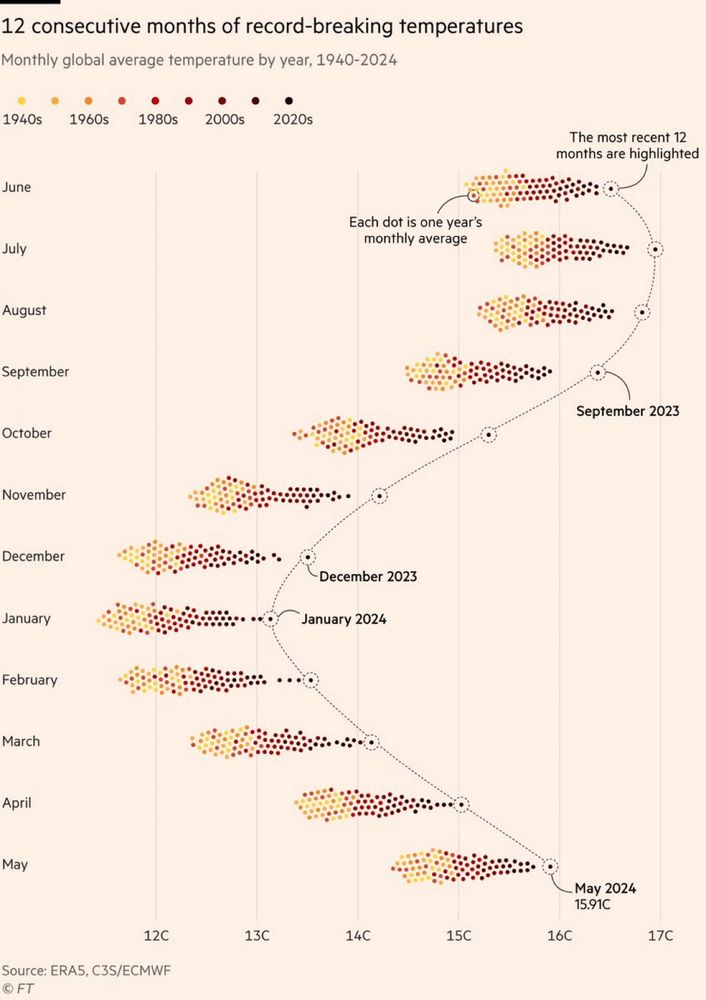
I’m loving this variation on a cycle plot published by the Financial Times today: www.ft.com/content/8e83...

By Jana Tauschinski

Almost five years since this classic was written www.vox.com/the-highligh...
“I work in the environmental movement. I don’t care if you recycle.”
Stop obsessing over your environmental “sins.” Fight the oil and gas industry instead.
www.vox.com

Reposted by Colin Mahony

What is the current level of global warming:
* 1.2°C average of the last 10 years
* 1.3°C last datapoint in the 15 year trend
* 1.5°C last datapoint unadjusted (in one dataset)

Great figure, amongst many others, open for peer review:
essd.copernicus.org/preprints/es...

Reposted by Colin Mahony

A lot of folks have been fixated on changes to sulfur in marine fuels of late, but the much bigger climate story here is the nearly 50% decline in overall global emissions of planet-cooling sulfur dioxide since 1980 – much of which has happened in the last 15 years:

Reposted by Colin Mahony

Is the Atlantic Ocean circulation #AMOC approaching a tipping point? This lecture is my take after researching this topic for over 30 years, and receiving the Alfred Wegener Medal of the European Geosciences Union for my scientific achievements last week. Grab a cup of tea!
youtu.be/HX7wAsdSE60?...
IS THE ATLANTIC OVERTURNING CIRCULATION APPROACHING A TIPPING POINT?
Prof. Rahmstorf discusses the danger of a major ocean circulation change with massive climate impacts around the world. This lecture was held on the occasion of Rahmstorf being awarded the Alfred Wegener Medal for his scientific achievements, the most prestigious award of the European Geosciences Union EGU.
youtu.be

Reposted by Colin Mahony

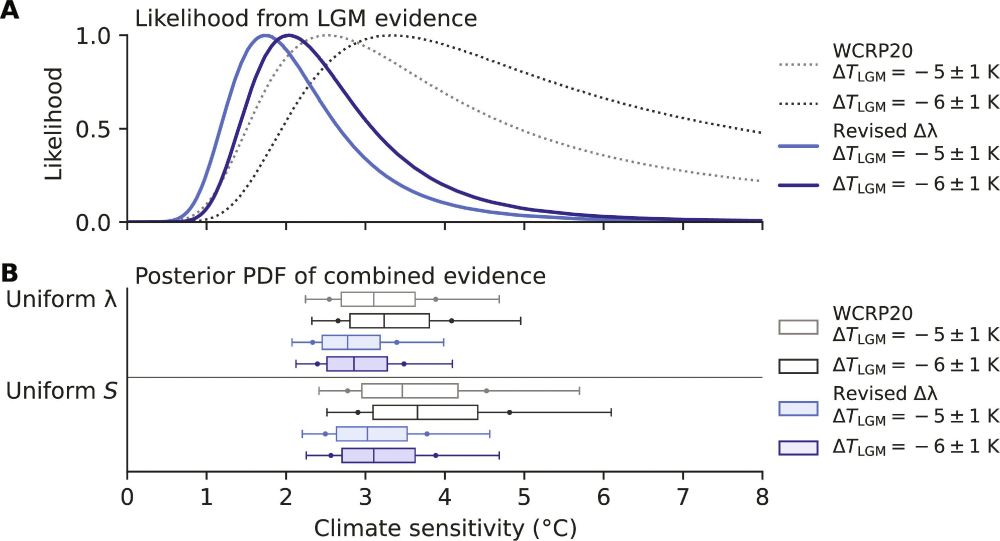
Theres an important new study from many of the leading researchers on paleoclimate and climate sensitivity.

They provide a new, more robust estimate of climate sensitivity from the last glacial maximum, suggesting a sensitivity of 2.9C (95% CI: 2.1 to 4.1C): www.science.org/doi/10.1126/...

Best wishes to @ceresbarros.bsky.social on her first day of work at the Canadian Forest Service! It is a joy to work with Ceres, a brilliant scientist and a true team player.
Friday was my last day at the Ministry of Forests! It was a real pleasure to work at the Forest Carbon and Climate Services Branch in the OCF. Special thanks to @colinmahony.bsky.social for the kindness, support and superb mentoring! Looking forward to keep collaborating with the FFEC team and MoF!

Reposted by Colin Mahony

Friday was my last day at the Ministry of Forests! It was a real pleasure to work at the Forest Carbon and Climate Services Branch in the OCF. Special thanks to @colinmahony.bsky.social for the kindness, support and superb mentoring! Looking forward to keep collaborating with the FFEC team and MoF!

Reposted by Colin Mahony

The rate of warming has increased notably in recent years. This is not just natural variability – the world is now warming faster than it has since 1970.

However, this should not come as a surprise; acceleration is exactly what our models expect: www.carbonbrief.org/factcheck-wh...
Factcheck: Why the recent ‘acceleration’ in global warming is what scientists expect - Carbon Brief
Over the past year, there has been a vigorous debate among scientists – and more broadly – about whether global warming is “accelerating”.
www.carbonbrief.org

Reposted by Colin Mahony

Is there a big disagreement on whether we expect climate change to accelerate (in the absence of large changes in emissions)? Not so much! www.realclimate.org/index.php/ar...
Much ado about acceleration
There has been a lot of commentary about perceived disagreements among climate scientists about whether climate change is, or will soon, accelerate. As with most punditry, there is less here than it m...
www.realclimate.org

Reposted by Colin Mahony

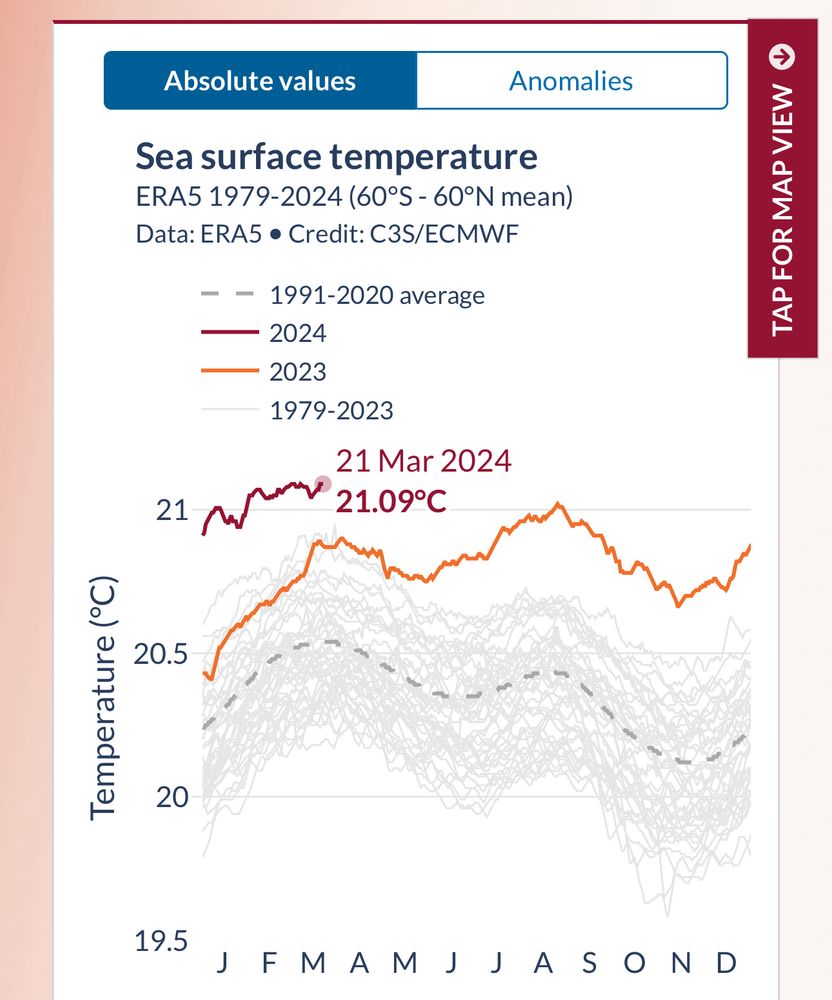
Data is out from Copernicus Climate for the boreal spring/austral autumn solstice and the global temperature records continue for both air and sea surface temperature

👉check out pulse.climate.copernicus.eu

#climatecrisis ⚒️🧪🌍 #earthsky

Reposted by Colin Mahony

The annual atmospheric increase in CO2 was a whopping 3.4 parts per million (ppm) in 2023.

Sure, it was fueled by El Nino, but I don't think anyone had on their bingo cards this large an increase.

gml.noaa.gov/ccgg/trends/...

1/

Reposted by Colin Mahony

Its a weird bit of whiplash going from arguing with folks claiming models are warming too fast a year ago (no warming since 2016!) to folks arguing that models are warming too slow today. One year does not a trend make, and models are by and large doing ok:

Reposted by Colin Mahony

We usually compare GHG emissions and temperatures to pre-industrial times, often considered to be 1850-1900, partly because good records start aroung then. But Japan has kept good records of peak cherry tree flowering since 812!
ourworldindata.org/grapher/date...

Reposted by Colin Mahony

Climate policies focus on limiting global warming to a given level (e.g., 1.5°C), but the climate modeling community does not have an experimental design for models to stabilize at a prescribed warming level.

Until now...

Review comments welcome:
egusphere.copernicus.org/preprints/20...

Reposted by Colin Mahony

The record global temperatures are caused by global warming, with a lot of the signal coming from the ocean. But it isn't just El Nino warming the ocean surface. Compare this year (top) and previous El Ninos (bottom) - N Atlantic, NE Pacific and SW Pacific aren't usually warm during El Ninos.

Reposted by Colin Mahony

Its now official: 2023 was the warmest year on record in the JRA-55 dataset, at 1.43C above preindustrial levels.

It beat the prior record set in 2016 by 0.14C, and continues a rapid warming trend thats seen global temperatures rise around 1C since 1970.

Excellent article. You nailed it in the last paragraph of part 2. Thanks for the time you put into this.

Reposted by Colin Mahony

I wrote a pair of short blog posts on the climate value of temporary carbon storage, now available at the Kleinman Center for Energy Policy at Penn.

Part 1 explains why temporary offsets are *not* equivalent to the permanent harms of CO2 emissions.
Why Temporary Carbon Storage in Forests Has Little Climate Value: Part 1 - Kleinman Center for Energ...
Energy policy research from the University of Pennsylvania
kleinmanenergy.upenn.edu

Excellent. Thanks @robbieandrew.bsky.social !

Reposted by Colin Mahony

Scientific institutions must create--and sustain--new kinds of roles so that researchers can provide the deep public engagement necessary to respond effectively to the escalating impacts of #climate change. The status quo isn't working. [Thread: 1/n] www.nature.com/articles/d41...
Climate researchers need support to become scientist-communicators
Scientific institutions must create roles so that researchers can provide the deep public engagement necessary to respond effectively to the escalating impacts of climate change. Scientific institutio...
www.nature.com

Thanks @glenpeters.bsky.social ! Is there a higher res version available for download somewhere?

Reposted by Colin Mahony

"Declarations that 1.5 C is dead make no sense. Global temperature limits don’t die if we surpass them. People do."
One of the best things I've read on this issue. Featuring my fantastic colleague @adellethomas.bsky.social 👇
www.scientificamerican.com/article/meet...

Reposted by Colin Mahony

Your regular reminder that the world is still not doing nearly enough to avoid dangerous warming

If we'd started in 2000, emissions cuts of 3% a yr would have kept us below 1.5C

Now, they must fall 18% *every yr* – or we have to use "negative emissions"

www.carbonbrief.org/unep-humanit...