



Grisha Zolotarov 🐙🇺🇦
@zolotarg.bsky.social
PhD student interested in cell type evolution and stuff
Stellar work on stella 🖤

I am very happy to have posted my first bioRxiv preprint. A long time in the making - and still adding a few final touches to it - but we're excited to finally have it out there in the wild:
www.biorxiv.org/content/10.1...
Read below for a few highlights...
www.biorxiv.org/content/10.1...
Read below for a few highlights...
Decoding cnidarian cell type gene regulation
Animal cell types are defined by differential access to genomic information, a process orchestrated by the combinatorial activity of transcription factors that bind to cis -regulatory elements (CREs) to control gene expression. However, the regulatory logic and specific gene networks that define cell identities remain poorly resolved across the animal tree of life. As early-branching metazoans, cnidarians can offer insights into the early evolution of cell type-specific genome regulation. Here, we profiled chromatin accessibility in 60,000 cells from whole adults and gastrula-stage embryos of the sea anemone Nematostella vectensis. We identified 112,728 CREs and quantified their activity across cell types, revealing pervasive combinatorial enhancer usage and distinct promoter architectures. To decode the underlying regulatory grammar, we trained sequence-based models predicting CRE accessibility and used these models to infer ontogenetic relationships among cell types. By integrating sequence motifs, transcription factor expression, and CRE accessibility, we systematically reconstructed the gene regulatory networks that define cnidarian cell types. Our results reveal the regulatory complexity underlying cell differentiation in a morphologically simple animal and highlight conserved principles in animal gene regulation. This work provides a foundation for comparative regulatory genomics to understand the evolutionary emergence of animal cell type diversity. ### Competing Interest Statement The authors have declared no competing interest. European Research Council, https://ror.org/0472cxd90, ERC-StG 851647 Ministerio de Ciencia e Innovación, https://ror.org/05r0vyz12, PID2021-124757NB-I00, FPI Severo Ochoa PhD fellowship European Union, https://ror.org/019w4f821, Marie Skłodowska-Curie INTREPiD co-fund agreement 75442, Marie Skłodowska-Curie grant agreement 101031767
www.biorxiv.org
July 10, 2025 at 3:37 PM
Stellar work on stella 🖤
Reposted by Grisha Zolotarov 🐙🇺🇦

Our new paper is out: "The 3D architecture of the ctenophore aboral organ & the evolution of complex integrative centers in animals.
We reveal a remarkable cell type diversity, nerve net condensation, a multilayered circuit & gene expression profiles.
www.biorxiv.org/content/10.1... #ctenophores
We reveal a remarkable cell type diversity, nerve net condensation, a multilayered circuit & gene expression profiles.
www.biorxiv.org/content/10.1... #ctenophores
June 28, 2025 at 6:55 AM
Our new paper is out: "The 3D architecture of the ctenophore aboral organ & the evolution of complex integrative centers in animals.
We reveal a remarkable cell type diversity, nerve net condensation, a multilayered circuit & gene expression profiles.
www.biorxiv.org/content/10.1... #ctenophores
We reveal a remarkable cell type diversity, nerve net condensation, a multilayered circuit & gene expression profiles.
www.biorxiv.org/content/10.1... #ctenophores
Reposted by Grisha Zolotarov 🐙🇺🇦
Excited to share our new work on the 3D architecture of the ctenophore aboral organ!
We explored its remarkable cellular diversity and integration with the syncytial nerve net, uncovering connectivity and insights into the evolution of sensory complexes.
www.biorxiv.org/content/10.1...
We explored its remarkable cellular diversity and integration with the syncytial nerve net, uncovering connectivity and insights into the evolution of sensory complexes.
www.biorxiv.org/content/10.1...

June 28, 2025 at 1:03 PM
Excited to share our new work on the 3D architecture of the ctenophore aboral organ!
We explored its remarkable cellular diversity and integration with the syncytial nerve net, uncovering connectivity and insights into the evolution of sensory complexes.
www.biorxiv.org/content/10.1...
We explored its remarkable cellular diversity and integration with the syncytial nerve net, uncovering connectivity and insights into the evolution of sensory complexes.
www.biorxiv.org/content/10.1...
Suddenly ran into a sketch I’ve made for the placozoan peptidergic cells paper:
www.cell.com/cell/fulltex...
www.cell.com/cell/fulltex...

June 29, 2025 at 6:24 PM
Suddenly ran into a sketch I’ve made for the placozoan peptidergic cells paper:
www.cell.com/cell/fulltex...
www.cell.com/cell/fulltex...
Reposted by Grisha Zolotarov 🐙🇺🇦

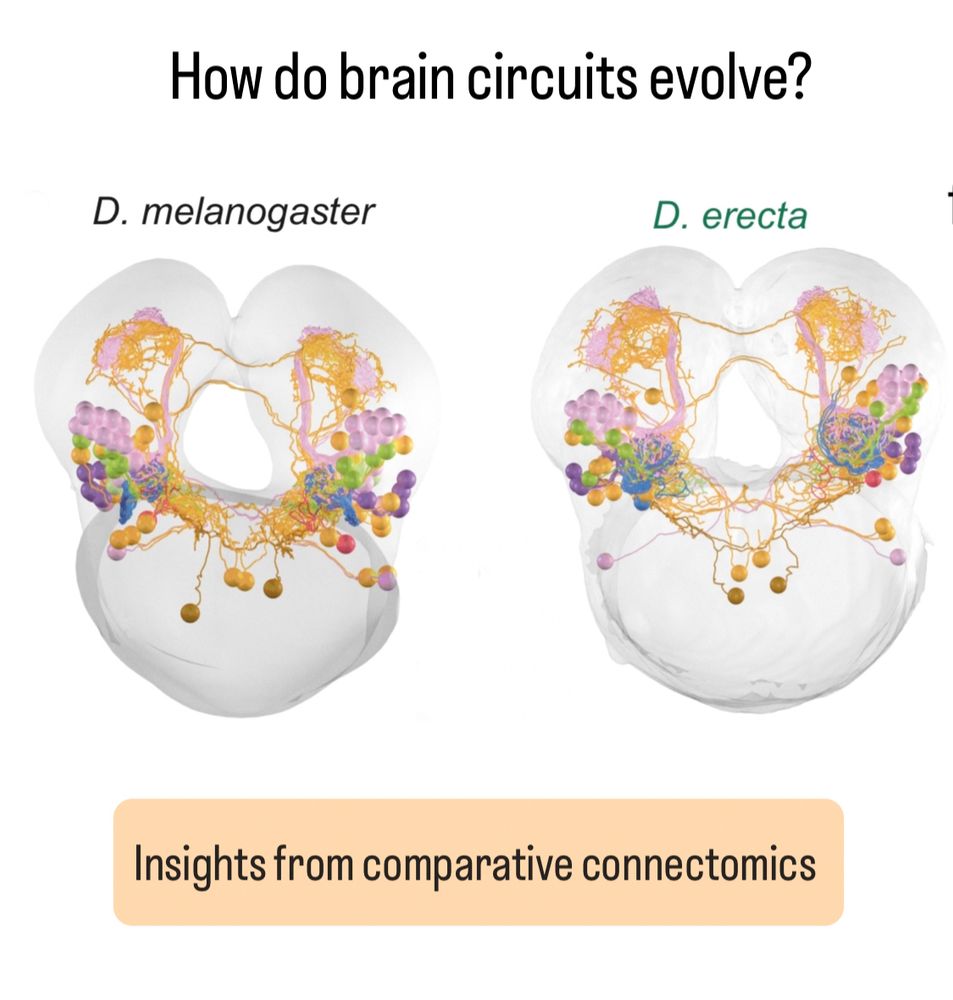
How do brain circuits evolve? We started looking for some answers by using synapse-resolution cross-species comparative connectomics on an entire olfactory circuit 👇
bit.ly/44aVm9E
bit.ly/44aVm9E
June 12, 2025 at 11:04 AM
How do brain circuits evolve? We started looking for some answers by using synapse-resolution cross-species comparative connectomics on an entire olfactory circuit 👇
bit.ly/44aVm9E
bit.ly/44aVm9E
For the last 3 years, my personal world has been in flames - the loss of home, the loved ones, friends and the other things we often take for granted.
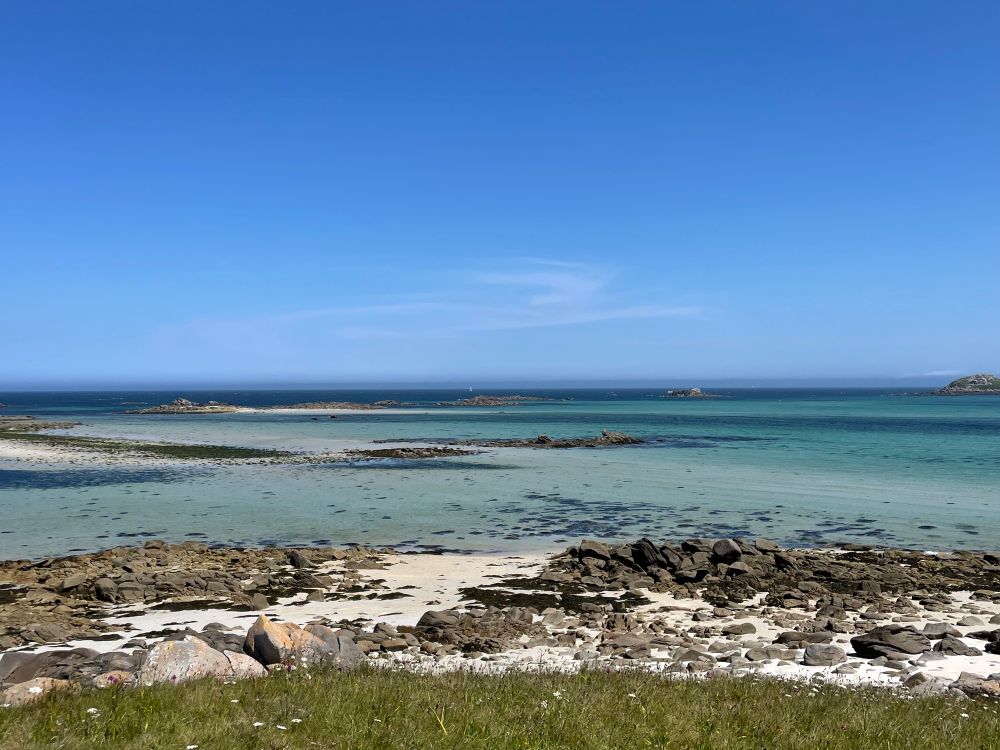
Roscoff feels like a personal refugium - a timeless place where one’s soul can hide & think about things that really matter.
Roscoff feels like a personal refugium - a timeless place where one’s soul can hide & think about things that really matter.


June 21, 2025 at 10:09 AM
For the last 3 years, my personal world has been in flames - the loss of home, the loved ones, friends and the other things we often take for granted.
Roscoff feels like a personal refugium - a timeless place where one’s soul can hide & think about things that really matter.
Roscoff feels like a personal refugium - a timeless place where one’s soul can hide & think about things that really matter.
Reposted by Grisha Zolotarov 🐙🇺🇦
Despite all that is going on, we are still all working on our science. Our 2nd collaboration with @jisaacmurray.bsky.social and Bob Waterston (UW) is out:
Lineage-resolved analysis of embryonic gene expression evolution in C. elegans and C. briggsae | Science www.science.org/doi/10.1126/...
Lineage-resolved analysis of embryonic gene expression evolution in C. elegans and C. briggsae | Science www.science.org/doi/10.1126/...
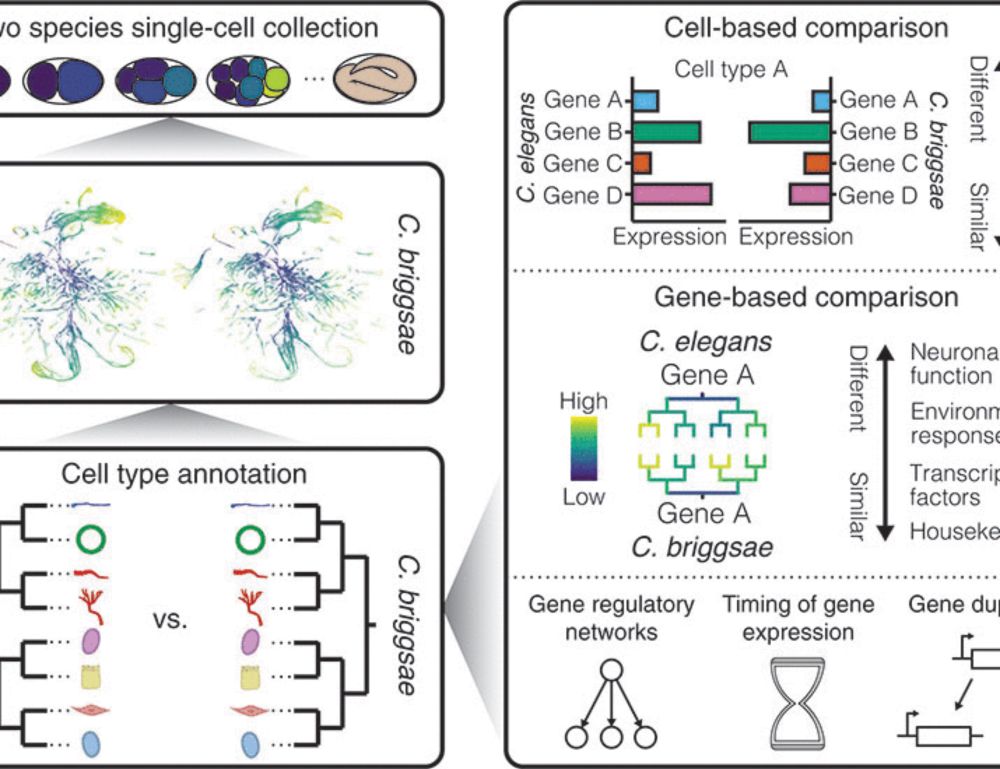
Lineage-resolved analysis of embryonic gene expression evolution in C. elegans and C. briggsae
The constraints that govern the evolution of gene expression patterns across development remain unclear. Single-cell RNA sequencing can detail these constraints by systematically profiling homologous ...
www.science.org
June 20, 2025 at 2:46 PM
Despite all that is going on, we are still all working on our science. Our 2nd collaboration with @jisaacmurray.bsky.social and Bob Waterston (UW) is out:
Lineage-resolved analysis of embryonic gene expression evolution in C. elegans and C. briggsae | Science www.science.org/doi/10.1126/...
Lineage-resolved analysis of embryonic gene expression evolution in C. elegans and C. briggsae | Science www.science.org/doi/10.1126/...
this photo is published without a permission 🐙
@ruthstyfhals.bsky.social
@ruthstyfhals.bsky.social

June 19, 2025 at 11:40 PM
this photo is published without a permission 🐙
@ruthstyfhals.bsky.social
@ruthstyfhals.bsky.social

Reposted by Grisha Zolotarov 🐙🇺🇦

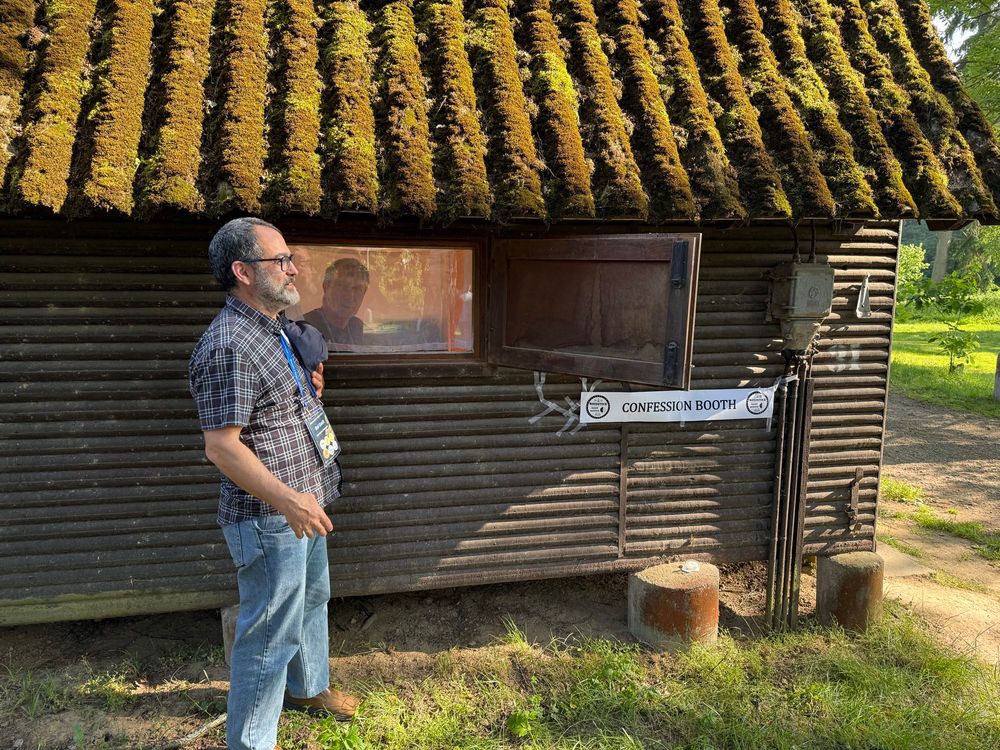
Confession to an editor! #tcteac with EMBO editor @tlemberger.bsky.social
June 12, 2025 at 4:18 PM

June 13, 2025 at 1:34 PM
The Weedstock of Biology 🫡
#TCTeAC
... The Woodstock of Biology2 & Night Science was terminated by police arrival.
>The End<
Nobody apparently dared to take a picture but it's true.
... The Woodstock of Biology2 & Night Science was terminated by police arrival.
>The End<
Nobody apparently dared to take a picture but it's true.
June 13, 2025 at 8:04 AM
The Weedstock of Biology 🫡

A while ago I got this pure meme material of an autograph

May 23, 2025 at 7:12 AM
A while ago I got this pure meme material of an autograph
Reposted by Grisha Zolotarov 🐙🇺🇦

Now you can also read all about @idoiaeu.bsky.social beautiful work on catshark brain development and the enigmatic origin of cajal retzius cells in their preprint www.biorxiv.org/content/10.1...
May 9, 2025 at 5:36 AM
Now you can also read all about @idoiaeu.bsky.social beautiful work on catshark brain development and the enigmatic origin of cajal retzius cells in their preprint www.biorxiv.org/content/10.1...
Reposted by Grisha Zolotarov 🐙🇺🇦
These negative synergies create a sensor of TF ratios. If one TF’s expression dominates, you get activation. If both are there, repression. A perfect design to ensure that target genes are expressed specifically at the right place. (9/n)

May 8, 2025 at 4:07 PM
These negative synergies create a sensor of TF ratios. If one TF’s expression dominates, you get activation. If both are there, repression. A perfect design to ensure that target genes are expressed specifically at the right place. (9/n)
Reposted by Grisha Zolotarov 🐙🇺🇦
Excited we played a small part in this amazing work out now in @nature.com. We established a ctenophore culture from a single individual through self-fertilization to reduce heterozygosity levels. Named them "Arnau" & they lived happily for 2 years 😂 @joanjsoto.bsky.social @msarscentre.bsky.social
May 8, 2025 at 10:49 AM
Excited we played a small part in this amazing work out now in @nature.com. We established a ctenophore culture from a single individual through self-fertilization to reduce heterozygosity levels. Named them "Arnau" & they lived happily for 2 years 😂 @joanjsoto.bsky.social @msarscentre.bsky.social
Reposted by Grisha Zolotarov 🐙🇺🇦
I’m very excited to share our work on the early evolution of animal regulatory genome architecture - the main project of my postdoc, carried out across two wonderful and inspirational labs of @arnausebe.bsky.social and @mamartirenom.bsky.social. www.nature.com/articles/s41...
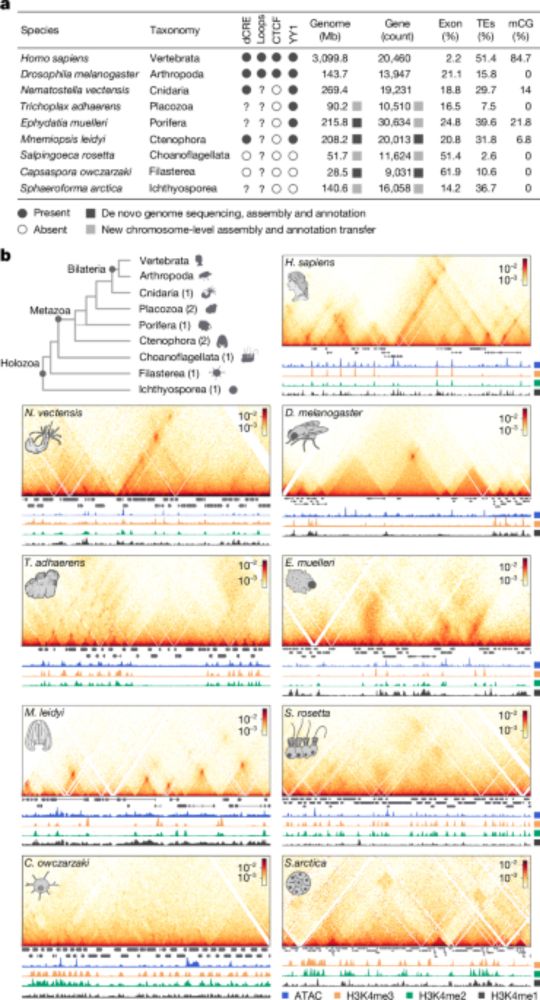
Chromatin loops are an ancestral hallmark of the animal regulatory genome - Nature
The physical organization of the genome in non-bilaterian animals and their closest unicellular relatives is characterized; comparative analysis shows chromatin looping is a conserved feature of ...
www.nature.com
May 7, 2025 at 3:23 PM
I’m very excited to share our work on the early evolution of animal regulatory genome architecture - the main project of my postdoc, carried out across two wonderful and inspirational labs of @arnausebe.bsky.social and @mamartirenom.bsky.social. www.nature.com/articles/s41...

Reposted by Grisha Zolotarov 🐙🇺🇦
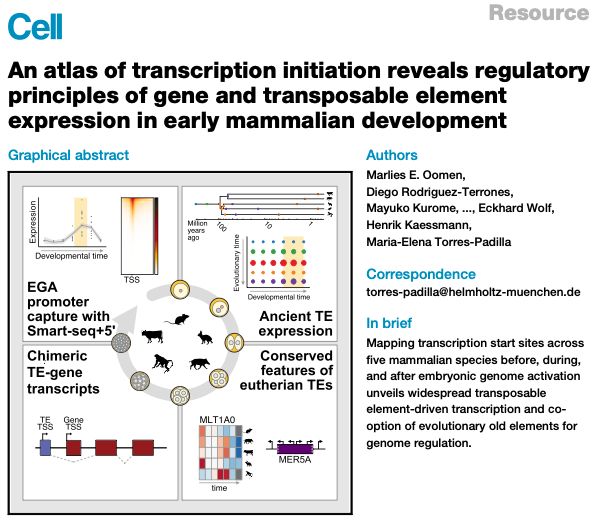
Paper out !!🥳big thanks to all authors @marliesoomen.bsky.social @diego-rt.bsky.social @kaessmannlab.bsky.social @jonathangoeke.bsky.social @lorenzamottes.bsky.social & 'bluesky-less'
Lots of interesting new TE (& genes) biology
Data fully browsable💻 👉 embryo.helmholtz-munich.de/shiny_embryo/
Lots of interesting new TE (& genes) biology
Data fully browsable💻 👉 embryo.helmholtz-munich.de/shiny_embryo/
February 21, 2025 at 3:50 PM
Paper out !!🥳big thanks to all authors @marliesoomen.bsky.social @diego-rt.bsky.social @kaessmannlab.bsky.social @jonathangoeke.bsky.social @lorenzamottes.bsky.social & 'bluesky-less'
Lots of interesting new TE (& genes) biology
Data fully browsable💻 👉 embryo.helmholtz-munich.de/shiny_embryo/
Lots of interesting new TE (& genes) biology
Data fully browsable💻 👉 embryo.helmholtz-munich.de/shiny_embryo/
Reposted by Grisha Zolotarov 🐙🇺🇦
Our atlas of BMP signaling activity in adult Nematostella is finally out! Fantastic, meticulous work and beautiful illustrations by @paulknabl.bsky.social
Thanks, @fwf-at.bsky.social for funding our work!
bmcbiol.biomedcentral.com/articles/10....
Thanks, @fwf-at.bsky.social for funding our work!
bmcbiol.biomedcentral.com/articles/10....
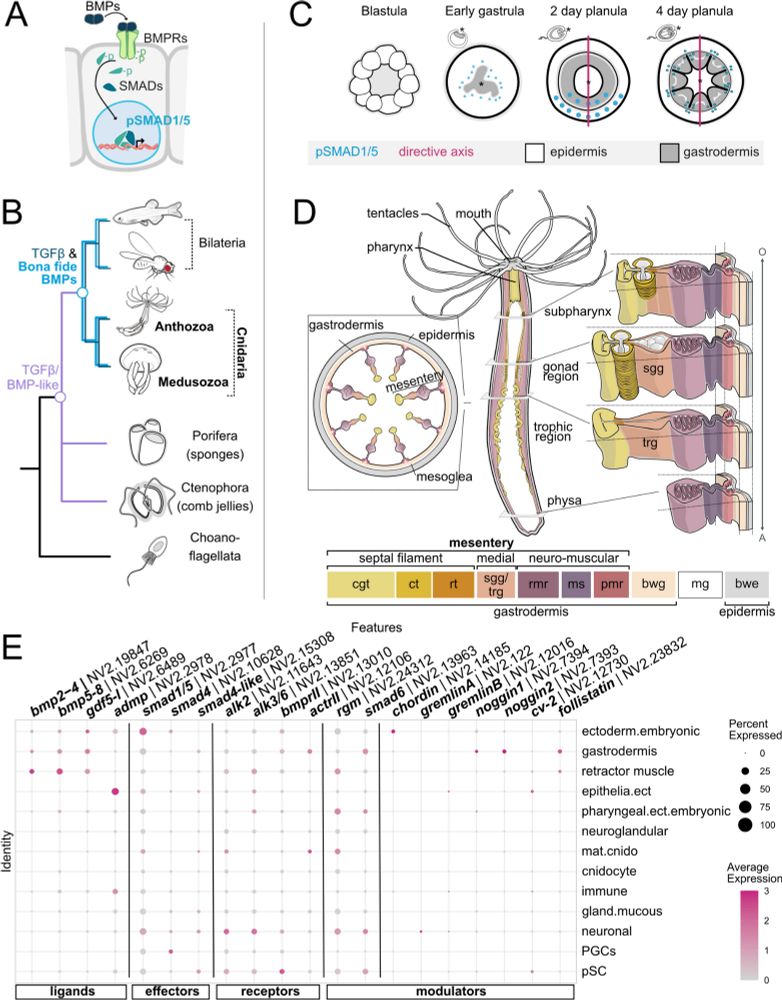
A whole-body atlas of BMP signaling activity in an adult sea anemone - BMC Biology
Background BMP signaling is responsible for the second body axis patterning in Bilateria and in the bilaterally symmetric members of the bilaterian sister clade Cnidaria—corals and sea anemones. Howev...
bmcbiol.biomedcentral.com
February 21, 2025 at 6:53 PM
Our atlas of BMP signaling activity in adult Nematostella is finally out! Fantastic, meticulous work and beautiful illustrations by @paulknabl.bsky.social
Thanks, @fwf-at.bsky.social for funding our work!
bmcbiol.biomedcentral.com/articles/10....
Thanks, @fwf-at.bsky.social for funding our work!
bmcbiol.biomedcentral.com/articles/10....
manuscript got rejected after 8 months of waiting for a review in Genome Biology. exactly the same happened to another person I know.
people manage to get babies in this timeframe.
people manage to get babies in this timeframe.

February 21, 2025 at 6:10 PM
manuscript got rejected after 8 months of waiting for a review in Genome Biology. exactly the same happened to another person I know.
people manage to get babies in this timeframe.
people manage to get babies in this timeframe.
Reposted by Grisha Zolotarov 🐙🇺🇦

Congrats to the @jbuenrostro.bsky.social lab on this recent paper.
www.nature.com/articles/s41...
Unfortunately, it makes several misleading claims that we disagree with. We will address these technical & other issues with this work over the next few months.
www.nature.com/articles/s41...
Unfortunately, it makes several misleading claims that we disagree with. We will address these technical & other issues with this work over the next few months.

Multiscale footprints reveal the organization of cis-regulatory elements - Nature
We developed PRINT, a computational method that identifies footprints of DNA–protein interactions from bulk and single-cell chromatin accessibility data across multiple scales of protein size.
www.nature.com
January 23, 2025 at 7:18 PM
Congrats to the @jbuenrostro.bsky.social lab on this recent paper.
www.nature.com/articles/s41...
Unfortunately, it makes several misleading claims that we disagree with. We will address these technical & other issues with this work over the next few months.
www.nature.com/articles/s41...
Unfortunately, it makes several misleading claims that we disagree with. We will address these technical & other issues with this work over the next few months.

Reposted by Grisha Zolotarov 🐙🇺🇦

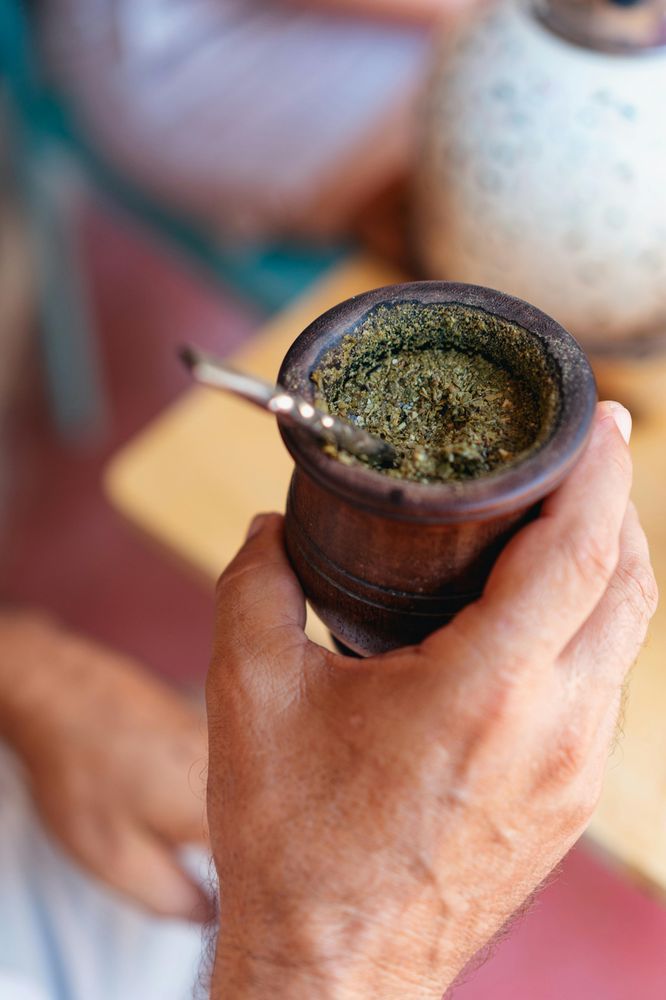
Yerba mate makes the third-most popular caffeinated drink in the world, but it’s unrelated to tea and coffee. The first reconstruction of its genome is helping us understand how multiple species have evolved to synthesise caffeine.
https://buff.ly/4jnWk82
https://buff.ly/4jnWk82
January 23, 2025 at 9:01 PM
Yerba mate makes the third-most popular caffeinated drink in the world, but it’s unrelated to tea and coffee. The first reconstruction of its genome is helping us understand how multiple species have evolved to synthesise caffeine.
https://buff.ly/4jnWk82
https://buff.ly/4jnWk82