



Thea K. Schulze
@tkschulze.bsky.social
Postdoc, Biomolecular Simulation, MRC Laboratory of Molecular Biology
Reposted by Thea K. Schulze
🎙️ Next up Dec 2 in VESS!
Thea Schulze (Lindorff-Larsen Lab): Predicting mutated protein abundance @tkschulze.bsky.social
Taylor Mighell (Lehner Lab): Massive mutagenesis to understand GPCRs @taylor-mighell.bsky.social
🔗 More info at varianteffect.org/seminar-series
@varianteffect.bsky.social
Thea Schulze (Lindorff-Larsen Lab): Predicting mutated protein abundance @tkschulze.bsky.social
Taylor Mighell (Lehner Lab): Massive mutagenesis to understand GPCRs @taylor-mighell.bsky.social
🔗 More info at varianteffect.org/seminar-series
@varianteffect.bsky.social

November 4, 2025 at 6:31 PM
🎙️ Next up Dec 2 in VESS!
Thea Schulze (Lindorff-Larsen Lab): Predicting mutated protein abundance @tkschulze.bsky.social
Taylor Mighell (Lehner Lab): Massive mutagenesis to understand GPCRs @taylor-mighell.bsky.social
🔗 More info at varianteffect.org/seminar-series
@varianteffect.bsky.social
Thea Schulze (Lindorff-Larsen Lab): Predicting mutated protein abundance @tkschulze.bsky.social
Taylor Mighell (Lehner Lab): Massive mutagenesis to understand GPCRs @taylor-mighell.bsky.social
🔗 More info at varianteffect.org/seminar-series
@varianteffect.bsky.social
Reposted by Thea K. Schulze
We (@sobuelow.bsky.social) developed AF-CALVADOS to integrate AlphaFold and CALVADOS to simulate flexible multidomain proteins at scale
See preprint for:
— Ensembles of >12000 full-length human proteins
— Analysis of IDRs in >1500 TFs
📜 doi.org/10.1101/2025...
💾 github.com/KULL-Centre/...
See preprint for:
— Ensembles of >12000 full-length human proteins
— Analysis of IDRs in >1500 TFs
📜 doi.org/10.1101/2025...
💾 github.com/KULL-Centre/...

October 20, 2025 at 11:26 AM
We (@sobuelow.bsky.social) developed AF-CALVADOS to integrate AlphaFold and CALVADOS to simulate flexible multidomain proteins at scale
See preprint for:
— Ensembles of >12000 full-length human proteins
— Analysis of IDRs in >1500 TFs
📜 doi.org/10.1101/2025...
💾 github.com/KULL-Centre/...
See preprint for:
— Ensembles of >12000 full-length human proteins
— Analysis of IDRs in >1500 TFs
📜 doi.org/10.1101/2025...
💾 github.com/KULL-Centre/...
Reposted by Thea K. Schulze
Arriën & Giulio's paper on
A coarse-grained model for disordered proteins under crowded conditions
(that is the CALVADOS PEG model) is now published in final form:
dx.doi.org/10.1002/pro....
@asrauh.bsky.social @giuliotesei.bsky.social
A coarse-grained model for disordered proteins under crowded conditions
(that is the CALVADOS PEG model) is now published in final form:
dx.doi.org/10.1002/pro....
@asrauh.bsky.social @giuliotesei.bsky.social

July 17, 2025 at 8:54 AM
Arriën & Giulio's paper on
A coarse-grained model for disordered proteins under crowded conditions
(that is the CALVADOS PEG model) is now published in final form:
dx.doi.org/10.1002/pro....
@asrauh.bsky.social @giuliotesei.bsky.social
A coarse-grained model for disordered proteins under crowded conditions
(that is the CALVADOS PEG model) is now published in final form:
dx.doi.org/10.1002/pro....
@asrauh.bsky.social @giuliotesei.bsky.social
Reposted by Thea K. Schulze
Led by @vvouts.bsky.social in @rhp-lab.bsky.social, we measured the degron potency of >200,000 30-residue tiles from >5,000 cytosolic human proteins and trained an ML model for degrons
📜 www.biorxiv.org/content/10.1...
🖥️ github.com/KULL-Centre/...
📜 www.biorxiv.org/content/10.1...
🖥️ github.com/KULL-Centre/...

In collaboration with the @lindorfflarsen.bsky.social group we release our map of degrons in >5,000 human cytosolic proteins with >99% coverage. A machine learning model trained on the data identifies missense variants forming degrons in exposed & disordered regions. Work led by @vvouts.bsky.social.

A complete map of human cytosolic degrons and their relevance for disease
Degrons are short protein segments that target proteins for degradation via the ubiquitin-proteasome system and thus ensure timely removal of signaling proteins and clearance of misfolded proteins fro...
www.biorxiv.org
May 15, 2025 at 12:44 PM
Led by @vvouts.bsky.social in @rhp-lab.bsky.social, we measured the degron potency of >200,000 30-residue tiles from >5,000 cytosolic human proteins and trained an ML model for degrons
📜 www.biorxiv.org/content/10.1...
🖥️ github.com/KULL-Centre/...
📜 www.biorxiv.org/content/10.1...
🖥️ github.com/KULL-Centre/...
Reposted by Thea K. Schulze

Happy to share a walkthrough of the applications of our package for simulations using CALVADOS!
Big thanks to @sobuelow.bsky.social, @lindorfflarsen.bsky.social, and the whole team for making this possible.
Thrilled to mark this as my first last-author paper!
Big thanks to @sobuelow.bsky.social, @lindorfflarsen.bsky.social, and the whole team for making this possible.
Thrilled to mark this as my first last-author paper!
Do you like CALVADOS but are not quite sure how to make it?
We’ve got your back!
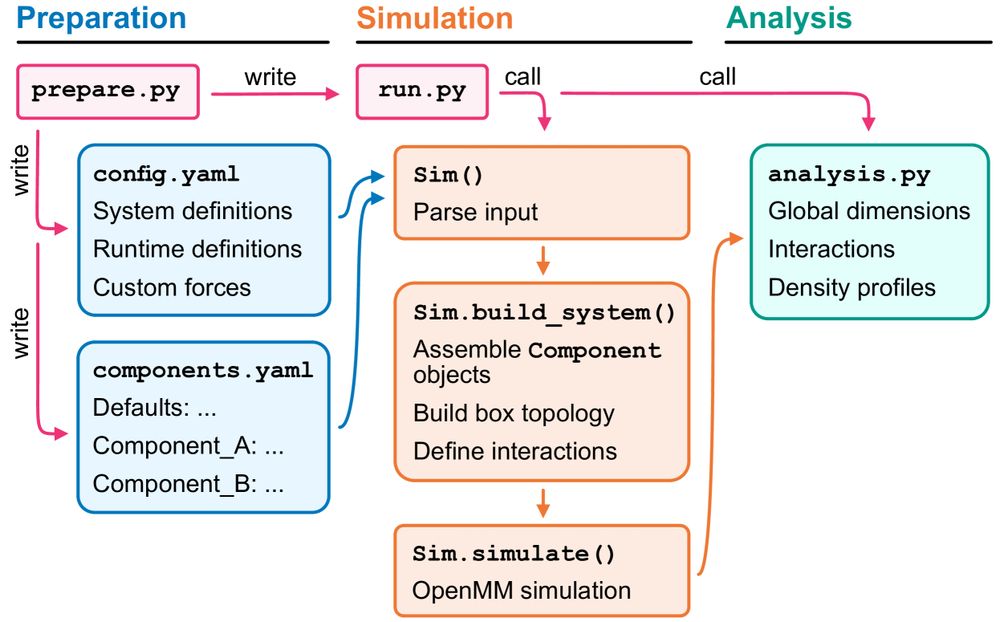
@sobuelow.bsky.social & @giuliotesei.bsky.social—together with the rest of the team—describe our software for simulations using the CALVADOS models incl. recipes for several applications. 1/5
doi.org/10.48550/arX...
We’ve got your back!
@sobuelow.bsky.social & @giuliotesei.bsky.social—together with the rest of the team—describe our software for simulations using the CALVADOS models incl. recipes for several applications. 1/5
doi.org/10.48550/arX...
April 15, 2025 at 9:32 PM
Happy to share a walkthrough of the applications of our package for simulations using CALVADOS!
Big thanks to @sobuelow.bsky.social, @lindorfflarsen.bsky.social, and the whole team for making this possible.
Thrilled to mark this as my first last-author paper!
Big thanks to @sobuelow.bsky.social, @lindorfflarsen.bsky.social, and the whole team for making this possible.
Thrilled to mark this as my first last-author paper!
Reposted by Thea K. Schulze
Do you like CALVADOS but are not quite sure how to make it?
We’ve got your back!
@sobuelow.bsky.social & @giuliotesei.bsky.social—together with the rest of the team—describe our software for simulations using the CALVADOS models incl. recipes for several applications. 1/5
doi.org/10.48550/arX...
We’ve got your back!
@sobuelow.bsky.social & @giuliotesei.bsky.social—together with the rest of the team—describe our software for simulations using the CALVADOS models incl. recipes for several applications. 1/5
doi.org/10.48550/arX...
April 15, 2025 at 7:09 AM
Do you like CALVADOS but are not quite sure how to make it?
We’ve got your back!
@sobuelow.bsky.social & @giuliotesei.bsky.social—together with the rest of the team—describe our software for simulations using the CALVADOS models incl. recipes for several applications. 1/5
doi.org/10.48550/arX...
We’ve got your back!
@sobuelow.bsky.social & @giuliotesei.bsky.social—together with the rest of the team—describe our software for simulations using the CALVADOS models incl. recipes for several applications. 1/5
doi.org/10.48550/arX...
Reposted by Thea K. Schulze
Supervised training using data generated by multiplexed assays of variant effects is potentially very powerful, but is made difficult by assay- and protein-specific effects
Here @tkschulze.bsky.social devised a strategy to take this into account while training models
www.biorxiv.org/content/10.1...
Here @tkschulze.bsky.social devised a strategy to take this into account while training models
www.biorxiv.org/content/10.1...

April 3, 2025 at 3:03 AM
Supervised training using data generated by multiplexed assays of variant effects is potentially very powerful, but is made difficult by assay- and protein-specific effects
Here @tkschulze.bsky.social devised a strategy to take this into account while training models
www.biorxiv.org/content/10.1...
Here @tkschulze.bsky.social devised a strategy to take this into account while training models
www.biorxiv.org/content/10.1...
Reposted by Thea K. Schulze
New preprint w @tkschulze.bsky.social who analysed cellular abundance (VAMP-seq) data for ~32,000 variants of six proteins 🧪
We find that much of the variation can be explained and predicted by a burial-dependent substitution matrix
Lots more goodies in the paper
doi.org/10.1101/2024...
We find that much of the variation can be explained and predicted by a burial-dependent substitution matrix
Lots more goodies in the paper
doi.org/10.1101/2024...

September 25, 2024 at 4:43 PM
New preprint w @tkschulze.bsky.social who analysed cellular abundance (VAMP-seq) data for ~32,000 variants of six proteins 🧪
We find that much of the variation can be explained and predicted by a burial-dependent substitution matrix
Lots more goodies in the paper
doi.org/10.1101/2024...
We find that much of the variation can be explained and predicted by a burial-dependent substitution matrix
Lots more goodies in the paper
doi.org/10.1101/2024...
Reposted by Thea K. Schulze
Big congratulations to PhD student Thea K Schulze from our PRISM centre on being awarded the elite research travel grant by the Minister for Higher Education and Science, Christina Egelund, to support a stay at Berkeley to study protein variant effects
www1.bio.ku.dk/nyheder/2024...
www1.bio.ku.dk/nyheder/2024...

February 26, 2024 at 9:12 PM
Big congratulations to PhD student Thea K Schulze from our PRISM centre on being awarded the elite research travel grant by the Minister for Higher Education and Science, Christina Egelund, to support a stay at Berkeley to study protein variant effects
www1.bio.ku.dk/nyheder/2024...
www1.bio.ku.dk/nyheder/2024...