




Strange Liu
@strandy208.bsky.social
UCL Msci Neuroscience , research about the neural substrate of consciousness, metacognition, Emergence in LLM and economic decision-making. Self-taught tennis player and snowboarder!
Reposted by Strange Liu

Excited that this is now out in @nathumbehav.nature.com 🎉
David Rose (davdrose.github.io) led this project on how children's understanding of causal language develops.
📃 (preprint): osf.io/preprints/ps...
📎: github.com/davdrose/cau...
David Rose (davdrose.github.io) led this project on how children's understanding of causal language develops.
📃 (preprint): osf.io/preprints/ps...
📎: github.com/davdrose/cau...
December 5, 2025 at 4:20 PM
Excited that this is now out in @nathumbehav.nature.com 🎉
David Rose (davdrose.github.io) led this project on how children's understanding of causal language develops.
📃 (preprint): osf.io/preprints/ps...
📎: github.com/davdrose/cau...
David Rose (davdrose.github.io) led this project on how children's understanding of causal language develops.
📃 (preprint): osf.io/preprints/ps...
📎: github.com/davdrose/cau...
Reposted by Strange Liu

Wrote about Deepak Chopra’s new AI model, AI guru slop, and how none of this is really shocking because we already turned spirituality into a commodity.
houseofmirrors.substack.com/p/this-was-i...
houseofmirrors.substack.com/p/this-was-i...

This Was Inevitable
AI gurus are not shocking, we already commodified spirituality
houseofmirrors.substack.com
December 5, 2025 at 3:36 PM
Wrote about Deepak Chopra’s new AI model, AI guru slop, and how none of this is really shocking because we already turned spirituality into a commodity.
houseofmirrors.substack.com/p/this-was-i...
houseofmirrors.substack.com/p/this-was-i...
Reposted by Strange Liu

"Intuitions of mathematical curves in young children's drawings"
In this new paper from the lab, Lorenzo Ciccione, Marie Lubineau, Theo Morfoisse and I show that 5 and 6 year olds already possess intuitions of linearity, curvature, period and compositionality.
www.sciencedirect.com/science/arti...
In this new paper from the lab, Lorenzo Ciccione, Marie Lubineau, Theo Morfoisse and I show that 5 and 6 year olds already possess intuitions of linearity, curvature, period and compositionality.
www.sciencedirect.com/science/arti...

November 1, 2025 at 1:51 PM
"Intuitions of mathematical curves in young children's drawings"
In this new paper from the lab, Lorenzo Ciccione, Marie Lubineau, Theo Morfoisse and I show that 5 and 6 year olds already possess intuitions of linearity, curvature, period and compositionality.
www.sciencedirect.com/science/arti...
In this new paper from the lab, Lorenzo Ciccione, Marie Lubineau, Theo Morfoisse and I show that 5 and 6 year olds already possess intuitions of linearity, curvature, period and compositionality.
www.sciencedirect.com/science/arti...
Reposted by Strange Liu

📣 BIG NEWS EVERYONE. I am so excited to announce…
🎉 I’m moving to University College London @ucl.ac.uk to join the Experimental Psychology department in @uclpals.bsky.social! 🎉
The big move happens in spring/summer. So I’m already exploring recruiting staff & students at UCL for fall 2026!
🎉 I’m moving to University College London @ucl.ac.uk to join the Experimental Psychology department in @uclpals.bsky.social! 🎉
The big move happens in spring/summer. So I’m already exploring recruiting staff & students at UCL for fall 2026!
October 13, 2025 at 4:29 PM
📣 BIG NEWS EVERYONE. I am so excited to announce…
🎉 I’m moving to University College London @ucl.ac.uk to join the Experimental Psychology department in @uclpals.bsky.social! 🎉
The big move happens in spring/summer. So I’m already exploring recruiting staff & students at UCL for fall 2026!
🎉 I’m moving to University College London @ucl.ac.uk to join the Experimental Psychology department in @uclpals.bsky.social! 🎉
The big move happens in spring/summer. So I’m already exploring recruiting staff & students at UCL for fall 2026!
Reposted by Strange Liu

Entertaining and wide-ranging panel discussion on consciousness at the @crick.ac.uk hosted by @profbriancox.bsky.social and featuring me, @anilseth.bsky.social @kathaschmack.bsky.social and @cosmicskeptic.bsky.social
Check it out, let us know what you think!
www.lnk.to/AQOSConsciou...
Check it out, let us know what you think!
www.lnk.to/AQOSConsciou...

What is consciousness?
Professor Brian Cox and an expert panel explore the elusive science of consciousness – what it is, how it arises, whether it can be observed in the brain, and the most compelling theories explaining i...
www.lnk.to
November 26, 2025 at 9:10 AM
Entertaining and wide-ranging panel discussion on consciousness at the @crick.ac.uk hosted by @profbriancox.bsky.social and featuring me, @anilseth.bsky.social @kathaschmack.bsky.social and @cosmicskeptic.bsky.social
Check it out, let us know what you think!
www.lnk.to/AQOSConsciou...
Check it out, let us know what you think!
www.lnk.to/AQOSConsciou...
Reposted by Strange Liu

Happy to share our new and groundbreaking study on the relationship between conscious awareness and the sense of bodily self! With @brainself.bsky.social at @ki.se and out today in PNAS: www.pnas.org/doi/10.1073/...

Conscious awareness, sensory integration, and evidence accumulation in bodily self-perception | PNAS
Conscious awareness refers to the subjective experience of perceiving, thinking, and
feeling and the ability to report these experiences. These per...
www.pnas.org
December 4, 2025 at 6:14 PM
Happy to share our new and groundbreaking study on the relationship between conscious awareness and the sense of bodily self! With @brainself.bsky.social at @ki.se and out today in PNAS: www.pnas.org/doi/10.1073/...
Reposted by Strange Liu
A huge thankyou to @alexaroblesgil.bsky.social for covering our research in the Marshall Islands for the @nytimes.com !
In the photo Ken Daniels (an expert indigenous sailor) is looking towards the horizon whilst wearing an fNIRS system.
Analysis underway!
www.nytimes.com/2025/11/18/s...
In the photo Ken Daniels (an expert indigenous sailor) is looking towards the horizon whilst wearing an fNIRS system.
Analysis underway!
www.nytimes.com/2025/11/18/s...

A Voyage Into the Art of Finding One’s Way at Sea
www.nytimes.com
November 19, 2025 at 3:01 PM
A huge thankyou to @alexaroblesgil.bsky.social for covering our research in the Marshall Islands for the @nytimes.com !
In the photo Ken Daniels (an expert indigenous sailor) is looking towards the horizon whilst wearing an fNIRS system.
Analysis underway!
www.nytimes.com/2025/11/18/s...
In the photo Ken Daniels (an expert indigenous sailor) is looking towards the horizon whilst wearing an fNIRS system.
Analysis underway!
www.nytimes.com/2025/11/18/s...
Reposted by Strange Liu
My paper is out!
Computational modeling of error patterns during reward-based learning show evidence that habit learning (value free!) supplements working memory in 7 human data sets.
rdcu.be/eQjLN
Computational modeling of error patterns during reward-based learning show evidence that habit learning (value free!) supplements working memory in 7 human data sets.
rdcu.be/eQjLN

A habit and working memory model as an alternative account of human reward-based learning
Nature Human Behaviour - In this study, Collins proposes an alternative dual-process (working memory and habit) model of reinforcement learning in humans.
rdcu.be
November 17, 2025 at 5:18 PM
My paper is out!
Computational modeling of error patterns during reward-based learning show evidence that habit learning (value free!) supplements working memory in 7 human data sets.
rdcu.be/eQjLN
Computational modeling of error patterns during reward-based learning show evidence that habit learning (value free!) supplements working memory in 7 human data sets.
rdcu.be/eQjLN
Reposted by Strange Liu
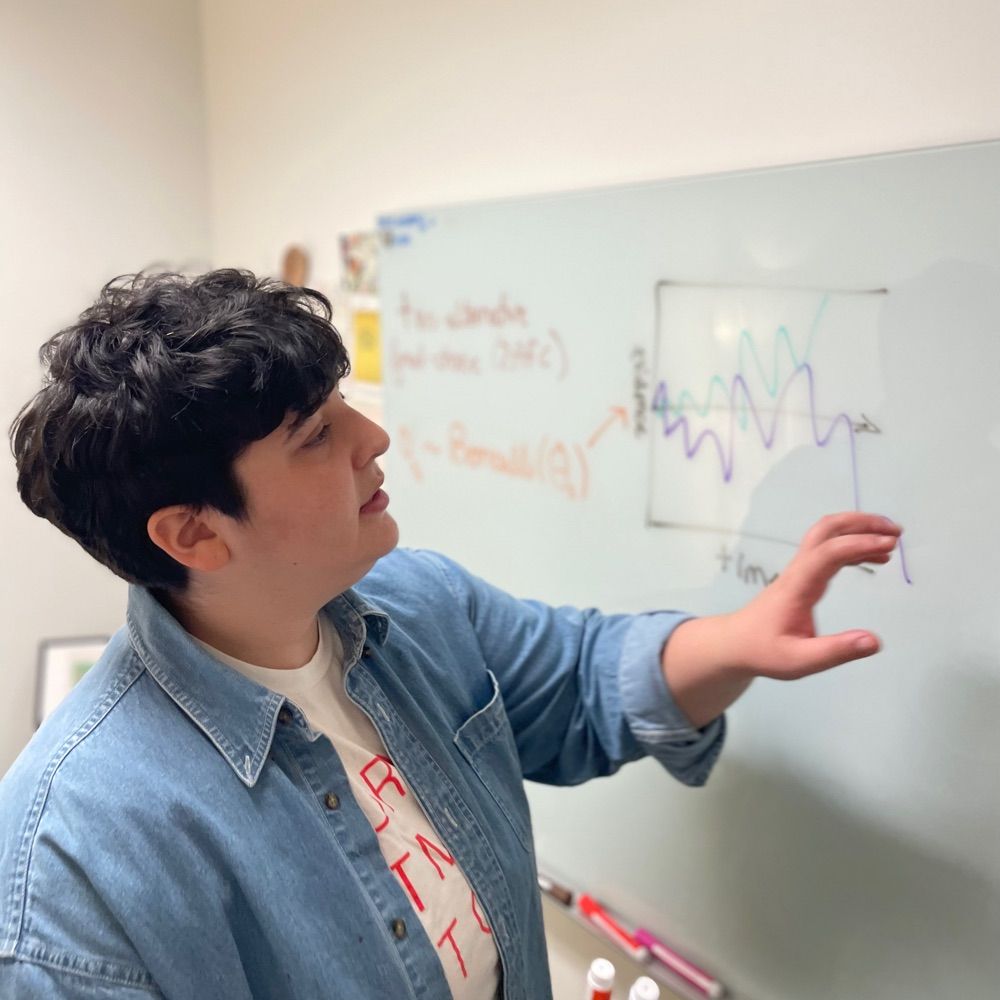
super excited that the first paper from my PhD is now out! we develop a "philosophical toolkit" for computational cognitive modeling & use it to conceptually re-analyze a long-standing debate about evidence accumulation models of decision making 🧠📈 onlinelibrary.wiley.com/doi/full/10....
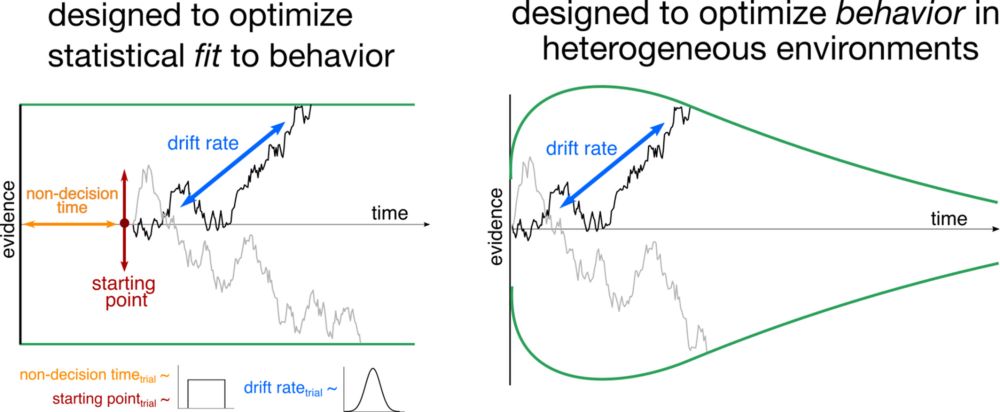
Reasoning Goals and Representational Decisions in Computational Cognitive Neuroscience: Lessons From the Drift Diffusion Model
The appropriate form of the drift diffusion model depends on how one wishes to reason about their target with the model. If the goal is to parsimoniously explain the speed-accuracy tradeoff, the appr...
onlinelibrary.wiley.com
May 20, 2025 at 11:00 PM
super excited that the first paper from my PhD is now out! we develop a "philosophical toolkit" for computational cognitive modeling & use it to conceptually re-analyze a long-standing debate about evidence accumulation models of decision making 🧠📈 onlinelibrary.wiley.com/doi/full/10....
Reposted by Strange Liu

#SfN25 attendees - make sure to head to the posters when you get to the meeting on Saturday afternoon (V7-V11: Gretchen, Megan, Margaret, Louisa, Bella) and Sunday morning (KK17: Micaela) to hear about our work. We're printing the posters now and they look rad.

November 11, 2025 at 5:00 PM
#SfN25 attendees - make sure to head to the posters when you get to the meeting on Saturday afternoon (V7-V11: Gretchen, Megan, Margaret, Louisa, Bella) and Sunday morning (KK17: Micaela) to hear about our work. We're printing the posters now and they look rad.
Reposted by Strange Liu

Shoutout to @bshev.bsky.social for presenting his amazing research titled "Distinct food attribute representations emerge across binge-type eating disorders" at the 2025 Society for Neuroeconomics meeting this past weekend! 🧠💡 #SNE2025
@lauraaberner.bsky.social @kiante.bsky.social
@lauraaberner.bsky.social @kiante.bsky.social

October 8, 2025 at 1:28 PM
Shoutout to @bshev.bsky.social for presenting his amazing research titled "Distinct food attribute representations emerge across binge-type eating disorders" at the 2025 Society for Neuroeconomics meeting this past weekend! 🧠💡 #SNE2025
@lauraaberner.bsky.social @kiante.bsky.social
@lauraaberner.bsky.social @kiante.bsky.social
Reposted by Strange Liu
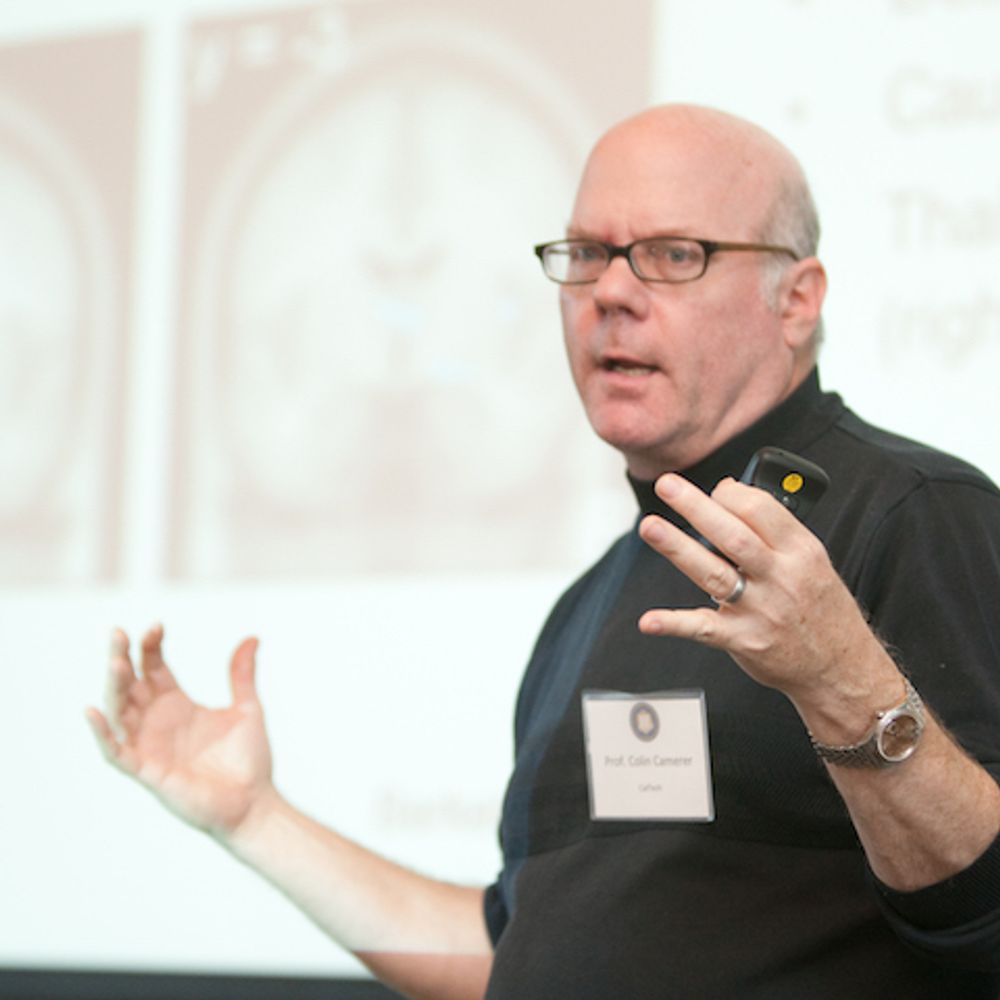
Buffett 2003: “In the short run, the market is a voting machine, but in the long run, it’s a weighing machine”
www.washingtonpost.com/business/202...
www.washingtonpost.com/business/202...

Column | How CEOs turn hype into capital
There have been times where hype has been a key ingredient in a CEO’s ability to sell a story that mattered to the company’s actual operations.
www.washingtonpost.com
November 9, 2025 at 12:10 PM
Buffett 2003: “In the short run, the market is a voting machine, but in the long run, it’s a weighing machine”
www.washingtonpost.com/business/202...
www.washingtonpost.com/business/202...
Reposted by Strange Liu

📢 Thrilled to share our paper is out now in @natcomms.nature.com
Shared computations underlie how we acquire actions that are mutually beneficial, instrumentally harmful (benefits self at the expense of others), altruistic (benefit others at the expense of self), or mutually costly
🧵 rdcu.be/eL8mZ
Shared computations underlie how we acquire actions that are mutually beneficial, instrumentally harmful (benefits self at the expense of others), altruistic (benefit others at the expense of self), or mutually costly
🧵 rdcu.be/eL8mZ

Neurocomputational basis of learning when choices simultaneously affect both oneself and others
Nature Communications - When learning to make choices that simultaneously affect the self and others, asymmetric encoding of information guides future social behaviors across mutually beneficial,...
rdcu.be
October 22, 2025 at 4:42 PM
📢 Thrilled to share our paper is out now in @natcomms.nature.com
Shared computations underlie how we acquire actions that are mutually beneficial, instrumentally harmful (benefits self at the expense of others), altruistic (benefit others at the expense of self), or mutually costly
🧵 rdcu.be/eL8mZ
Shared computations underlie how we acquire actions that are mutually beneficial, instrumentally harmful (benefits self at the expense of others), altruistic (benefit others at the expense of self), or mutually costly
🧵 rdcu.be/eL8mZ
Reposted by Strange Liu

Hello #neuroeconomists and decision (neuro)scientists - did I miss you in this starterpack? Just reply to this post or DM if you'd like to be added!
go.bsky.app/1K9Suh
go.bsky.app/1K9Suh
November 23, 2024 at 8:13 PM
Hello #neuroeconomists and decision (neuro)scientists - did I miss you in this starterpack? Just reply to this post or DM if you'd like to be added!
go.bsky.app/1K9Suh
go.bsky.app/1K9Suh
Reposted by Strange Liu
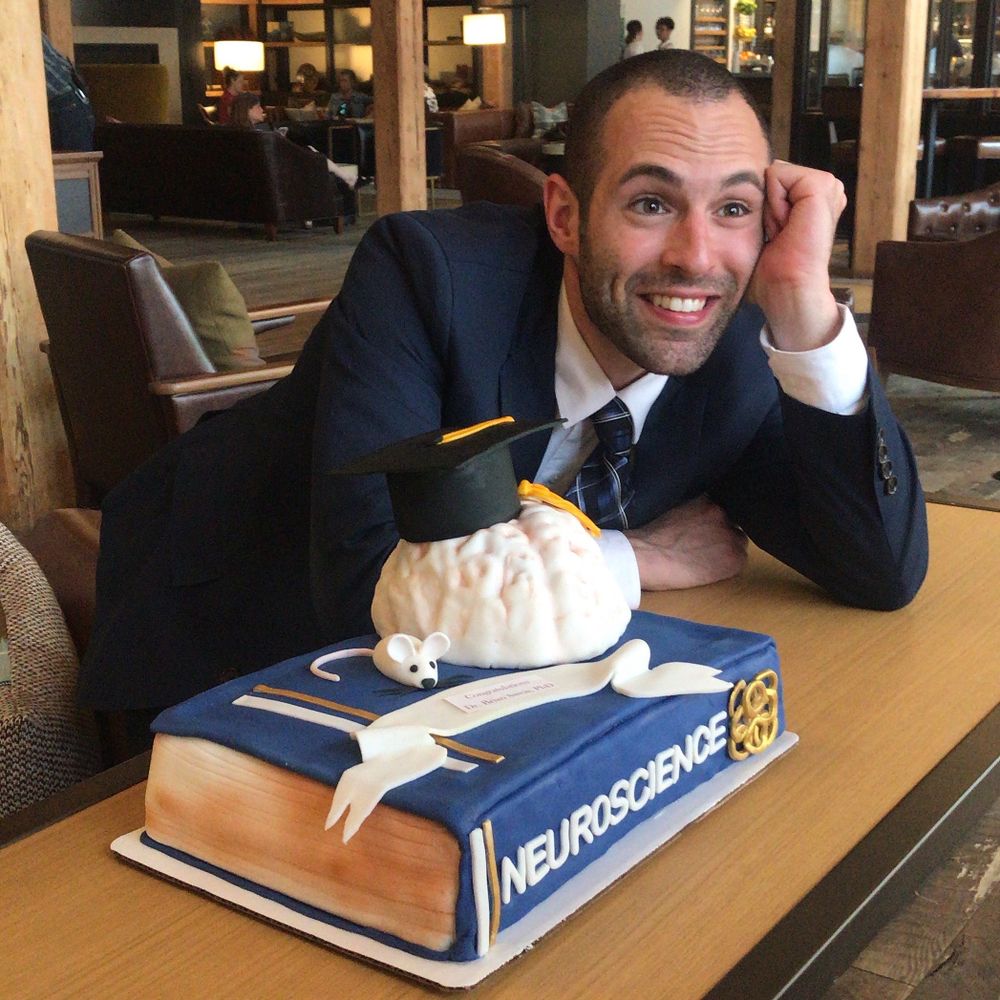
For those heading to #SfN25, come check out our posters on Saturday Afternoon! The lab is growing & expanding in several new directions & collabs #neuroeconomics 🧠🐭🧠 @sinaibrain.bsky.social @sinaiccp.bsky.social @sfn.org @socforneuroecon.bsky.social @bwfund.bsky.social @animalsocaging.bsky.social

October 29, 2025 at 11:27 PM
For those heading to #SfN25, come check out our posters on Saturday Afternoon! The lab is growing & expanding in several new directions & collabs #neuroeconomics 🧠🐭🧠 @sinaibrain.bsky.social @sinaiccp.bsky.social @sfn.org @socforneuroecon.bsky.social @bwfund.bsky.social @animalsocaging.bsky.social
Reposted by Strange Liu

New work to appear @ TACL!
Language models (LMs) are remarkably good at generating novel well-formed sentences, leading to claims that they have mastered grammar.
Yet they often assign higher probability to ungrammatical strings than to grammatical strings.
How can both things be true? 🧵👇
Language models (LMs) are remarkably good at generating novel well-formed sentences, leading to claims that they have mastered grammar.
Yet they often assign higher probability to ungrammatical strings than to grammatical strings.
How can both things be true? 🧵👇

November 10, 2025 at 10:11 PM
New work to appear @ TACL!
Language models (LMs) are remarkably good at generating novel well-formed sentences, leading to claims that they have mastered grammar.
Yet they often assign higher probability to ungrammatical strings than to grammatical strings.
How can both things be true? 🧵👇
Language models (LMs) are remarkably good at generating novel well-formed sentences, leading to claims that they have mastered grammar.
Yet they often assign higher probability to ungrammatical strings than to grammatical strings.
How can both things be true? 🧵👇
Reposted by Strange Liu
A new paper from the lab, using 7T fMRI and MEG to shed light on how we read, specifically how the visual system encodes strings of letters and moves from retinotopic to ordinal neural codes.
www.pnas.org/doi/10.1073/...
www.pnas.org/doi/10.1073/...
PNAS
Proceedings of the National Academy of Sciences (PNAS), a peer reviewed journal of the National Academy of Sciences (NAS) - an authoritative source of high-impact, original research that broadly spans...
www.pnas.org
October 22, 2025 at 2:40 PM
A new paper from the lab, using 7T fMRI and MEG to shed light on how we read, specifically how the visual system encodes strings of letters and moves from retinotopic to ordinal neural codes.
www.pnas.org/doi/10.1073/...
www.pnas.org/doi/10.1073/...