




SIESTA Research Program
@siesta-synergy.bsky.social
NHMRC Synergy SIESTA (Synergise, Integrate and Enhance Sleep Research to Transform Brain Ageing) - Australia
Novel biomarkers, clinical trials and innovative technologies
Novel biomarkers, clinical trials and innovative technologies
Pinned
Sleep and Alzheimer’s disease
Supporting a PhD candidate to investigate the impact of sleep, sleep-related neuropeptides and other biochemical measures on Alzheimer’s disease pathology.
www.mq.edu.au
Exciting PhD opportunity with Prof Ralph Martins to investigate the impact of sleep, neuropeptides and other biochemical measures on Alzheimer’s disease pathology 🧠💤 Applications close June 1st www.mq.edu.au/research/phd...
Reposted by SIESTA Research Program
Together with @macshine.bsky.social & @elimuller.bsky.social we have a cool interdisciplinary project on compositional cognition, and we’re looking for a PhD student.
More details here www.findaphd.com/phds/project...
DM or email any questions
Please RT or pass on to interested students. Thanks!
More details here www.findaphd.com/phds/project...
DM or email any questions
Please RT or pass on to interested students. Thanks!
May 26, 2025 at 4:10 AM
Together with @macshine.bsky.social & @elimuller.bsky.social we have a cool interdisciplinary project on compositional cognition, and we’re looking for a PhD student.
More details here www.findaphd.com/phds/project...
DM or email any questions
Please RT or pass on to interested students. Thanks!
More details here www.findaphd.com/phds/project...
DM or email any questions
Please RT or pass on to interested students. Thanks!
Reposted by SIESTA Research Program

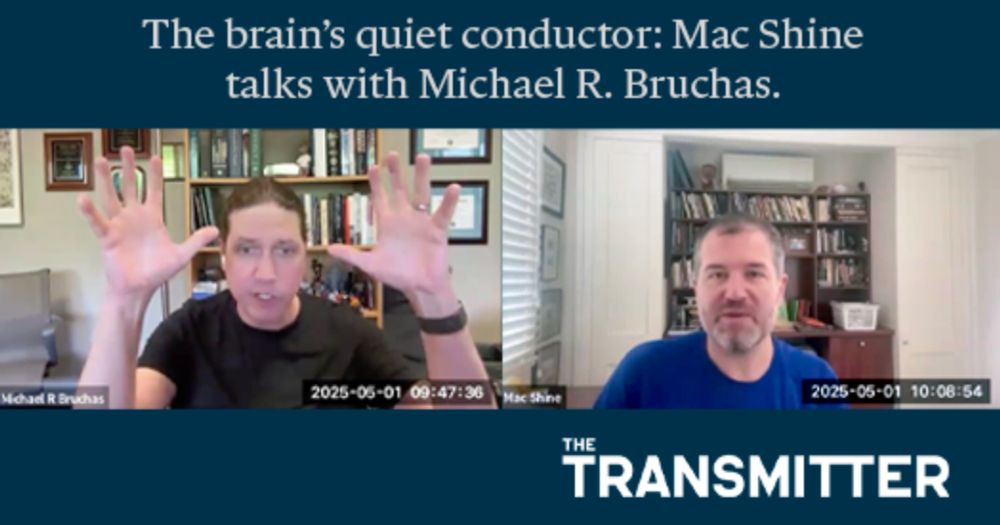
I recently had the great pleasure of interviewing Michael Bruchas about an absolutely banger recent paper from his group that tracked down cells in the brainstem that subtlety and precisely control the output of the locus coeruleus. Check out my interview here. I hope you like it as much as I did!

Far from being a passive neighbor to the locus coeruleus, the pericoeruleus appears to act as a kind of micromanager of arousal, selectively inhibiting different subgroups of locus coeruleus neurons, writes @macshine.bsky.social.
#neuroskyence
www.thetransmitter.org/attention/th...
#neuroskyence
www.thetransmitter.org/attention/th...
The brain’s quiet conductor: How hidden cells fine-tune arousal
New research published today suggests that the pericoeruleus acts as a kind of micromanager of arousal, selectively inhibiting different subgroups of locus coeruleus neurons depending on the…
www.thetransmitter.org
May 8, 2025 at 3:22 AM
I recently had the great pleasure of interviewing Michael Bruchas about an absolutely banger recent paper from his group that tracked down cells in the brainstem that subtlety and precisely control the output of the locus coeruleus. Check out my interview here. I hope you like it as much as I did!
Exciting PhD opportunity with Prof Ralph Martins to investigate the impact of sleep, neuropeptides and other biochemical measures on Alzheimer’s disease pathology 🧠💤 Applications close June 1st www.mq.edu.au/research/phd...
Sleep and Alzheimer’s disease
Supporting a PhD candidate to investigate the impact of sleep, sleep-related neuropeptides and other biochemical measures on Alzheimer’s disease pathology.
www.mq.edu.au
May 15, 2025 at 3:09 AM
Exciting PhD opportunity with Prof Ralph Martins to investigate the impact of sleep, neuropeptides and other biochemical measures on Alzheimer’s disease pathology 🧠💤 Applications close June 1st www.mq.edu.au/research/phd...
Reposted by SIESTA Research Program

New preprint now online! www.biorxiv.org/content/10.1...
We created an algorithm to detect NREM sleep micro-arousals and used it to re-analyze LFP data from the motor cortex of sleeping mice 💤 This is what we found:
We created an algorithm to detect NREM sleep micro-arousals and used it to re-analyze LFP data from the motor cortex of sleeping mice 💤 This is what we found:
www.biorxiv.org
January 30, 2025 at 10:49 AM
New preprint now online! www.biorxiv.org/content/10.1...
We created an algorithm to detect NREM sleep micro-arousals and used it to re-analyze LFP data from the motor cortex of sleeping mice 💤 This is what we found:
We created an algorithm to detect NREM sleep micro-arousals and used it to re-analyze LFP data from the motor cortex of sleeping mice 💤 This is what we found:
Reposted by SIESTA Research Program
Deficient synaptic neurotransmission results in a persistent sleep-like cortical activity across vigilance states in mice: Current Biology www.cell.com/current-biol...

Deficient synaptic neurotransmission results in a persistent sleep-like cortical activity across vigilance states in mice
Using a mouse model of altered neurotransmission (Vamp2rlss), Guillaumin et al. show
that differences typically observed between vigilance states in neural dynamics and
spectral signatures can be mark...
www.cell.com
March 21, 2025 at 7:38 AM
Deficient synaptic neurotransmission results in a persistent sleep-like cortical activity across vigilance states in mice: Current Biology www.cell.com/current-biol...
Reposted by SIESTA Research Program

⭐The SDN Symposium brought together researchers, clinicians and lived experience across NSW to highlight recent progress in the #Dementia space.
💐 We also saw the ushering in of a new chair, Muireann Irish taking over from Lee-Fay Low who is passing on the baton of the SDN committee.
💐 We also saw the ushering in of a new chair, Muireann Irish taking over from Lee-Fay Low who is passing on the baton of the SDN committee.


March 24, 2025 at 4:02 AM
⭐The SDN Symposium brought together researchers, clinicians and lived experience across NSW to highlight recent progress in the #Dementia space.
💐 We also saw the ushering in of a new chair, Muireann Irish taking over from Lee-Fay Low who is passing on the baton of the SDN committee.
💐 We also saw the ushering in of a new chair, Muireann Irish taking over from Lee-Fay Low who is passing on the baton of the SDN committee.
Reposted by SIESTA Research Program

Why do some Alzheimer’s drugs work better than others? 🧠
New @ukdri.ac.uk research shows lecanemab binds more effectively to toxic proteins early in the disease.
#Alzheimers #DementiaResearch
www.dementiaresearcher.nihr.ac.uk/why-some-alz...
New @ukdri.ac.uk research shows lecanemab binds more effectively to toxic proteins early in the disease.
#Alzheimers #DementiaResearch
www.dementiaresearcher.nihr.ac.uk/why-some-alz...

Why Some Alzheimer’s Drugs Work Better Than Others - DEMENTIA RESEARCHER
New research reveals why some Alzheimer’s drugs are more effective—lecanemab binds better to toxic proteins in early-stage disease, offering key insight.
www.dementiaresearcher.nihr.ac.uk
April 16, 2025 at 11:05 AM
Why do some Alzheimer’s drugs work better than others? 🧠
New @ukdri.ac.uk research shows lecanemab binds more effectively to toxic proteins early in the disease.
#Alzheimers #DementiaResearch
www.dementiaresearcher.nihr.ac.uk/why-some-alz...
New @ukdri.ac.uk research shows lecanemab binds more effectively to toxic proteins early in the disease.
#Alzheimers #DementiaResearch
www.dementiaresearcher.nihr.ac.uk/why-some-alz...
Reposted by SIESTA Research Program
Completely agree w/ everything @avramholmes.bsky.social lays out here. fMRI has a big role to play in helping link across scales of measurement, neural organisation and species. But for that to work, we need to incentivise the growth and development of scientists that can translate across domains.
The scientific community needs to develop processes to support, hire and retain researchers whose work sits between traditional fields of study, writes @avramholmes.bsky.social
#neuroskyence
www.thetransmitter.org/future-of-fm...
#neuroskyence
www.thetransmitter.org/future-of-fm...

fMRI must break out of its silo
We need to develop research programs that link phenomena across levels, from genes and molecules to cells, circuits, networks and behavior.
www.thetransmitter.org
April 16, 2025 at 7:49 PM
Completely agree w/ everything @avramholmes.bsky.social lays out here. fMRI has a big role to play in helping link across scales of measurement, neural organisation and species. But for that to work, we need to incentivise the growth and development of scientists that can translate across domains.
Reposted by SIESTA Research Program

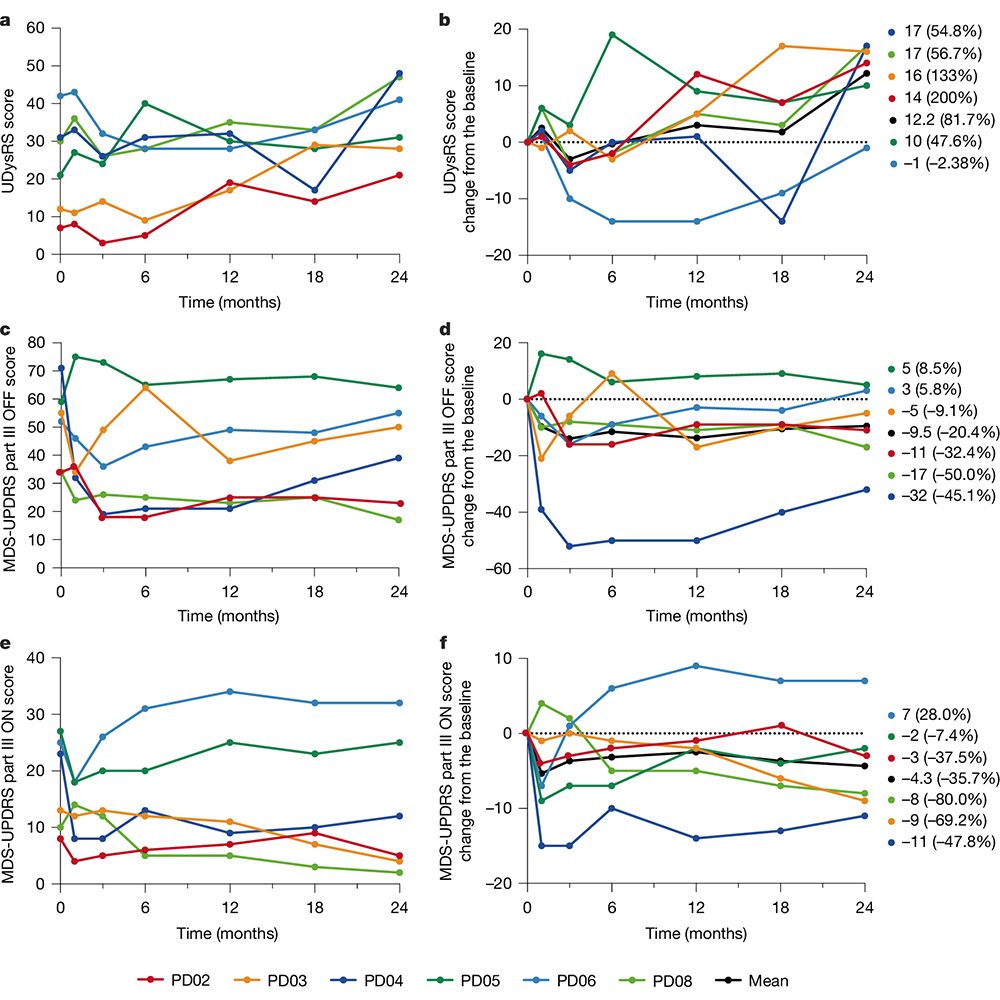
Two clinical trials reported in Nature demonstrate the safety of stem cell therapies for Parkinson’s disease. The papers investigate the use of cells derived from human induced pluripotent stem cells and human embryonic stem cells. go.nature.com/4ikcJc2
go.nature.com/4jfSRYX 🧪
go.nature.com/4jfSRYX 🧪
April 16, 2025 at 10:18 PM
Two clinical trials reported in Nature demonstrate the safety of stem cell therapies for Parkinson’s disease. The papers investigate the use of cells derived from human induced pluripotent stem cells and human embryonic stem cells. go.nature.com/4ikcJc2
go.nature.com/4jfSRYX 🧪
go.nature.com/4jfSRYX 🧪
Reposted by SIESTA Research Program

Human sleep spindles track experimentally excited brain circuits https://www.biorxiv.org/content/10.1101/2025.01.07.631687v1
January 7, 2025 at 9:17 PM
Human sleep spindles track experimentally excited brain circuits https://www.biorxiv.org/content/10.1101/2025.01.07.631687v1
Reposted by SIESTA Research Program
Thalamic involvement defines distinct slow-wave subtypes in NREM sleep https://www.biorxiv.org/content/10.1101/2025.01.16.633402v1
January 17, 2025 at 3:48 AM
Thalamic involvement defines distinct slow-wave subtypes in NREM sleep https://www.biorxiv.org/content/10.1101/2025.01.16.633402v1
Reposted by SIESTA Research Program
Simultaneous EEG-PET-MRI identifies temporally coupled, spatially structured hemodynamic and metabolic dynamics across wakefulness and NREM sleep https://www.biorxiv.org/content/10.1101/2025.01.17.633689v1
January 18, 2025 at 10:17 PM
Simultaneous EEG-PET-MRI identifies temporally coupled, spatially structured hemodynamic and metabolic dynamics across wakefulness and NREM sleep https://www.biorxiv.org/content/10.1101/2025.01.17.633689v1
Reposted by SIESTA Research Program

Amazing work from the team of Anita Lüthi!
Infraslow noradrenergic locus coeruleus activity fluctuations are gatekeepers of the NREM–REM sleep cycle
www.nature.com/articles/s41...
💤🧪🧠
Infraslow noradrenergic locus coeruleus activity fluctuations are gatekeepers of the NREM–REM sleep cycle
www.nature.com/articles/s41...
💤🧪🧠
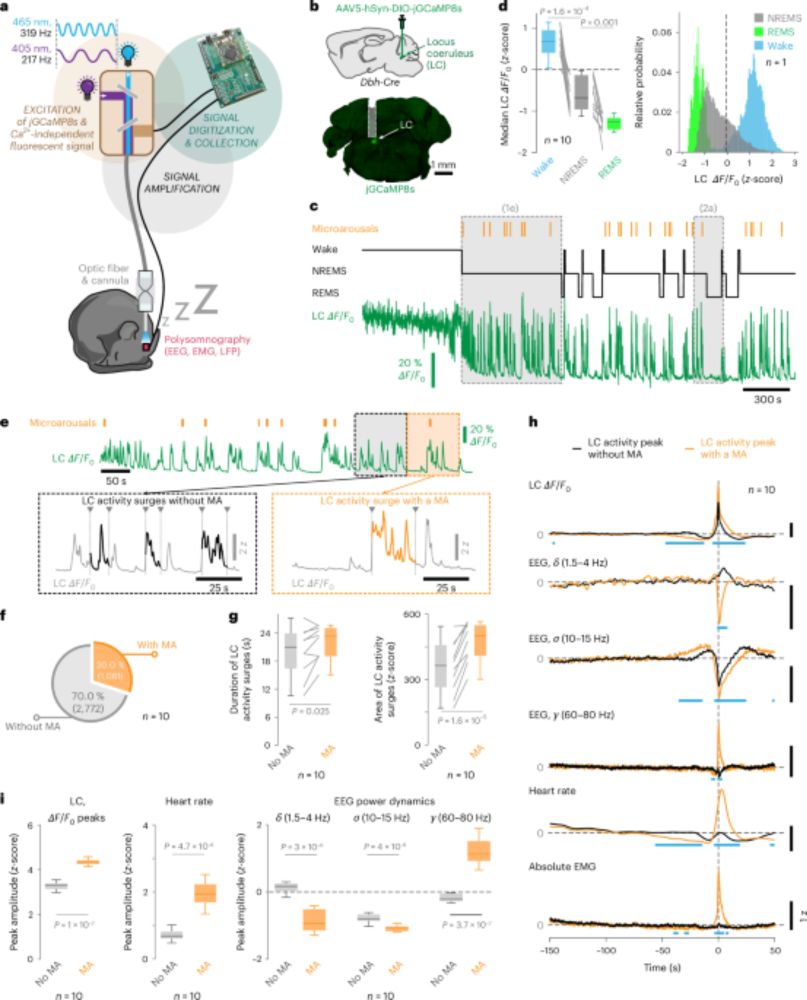
Infraslow noradrenergic locus coeruleus activity fluctuations are gatekeepers of the NREM–REM sleep cycle - Nature Neuroscience
Lüthi and colleagues show that activity of the locus coeruleus (LC) is crucial for the cyclic alternation between non-rapid-eye-movement and rapid-eye-movement sleep. Stressful experiences during waki...
www.nature.com
November 27, 2024 at 9:08 AM
Amazing work from the team of Anita Lüthi!
Infraslow noradrenergic locus coeruleus activity fluctuations are gatekeepers of the NREM–REM sleep cycle
www.nature.com/articles/s41...
💤🧪🧠
Infraslow noradrenergic locus coeruleus activity fluctuations are gatekeepers of the NREM–REM sleep cycle
www.nature.com/articles/s41...
💤🧪🧠
Reposted by SIESTA Research Program
Research on infraslow oscillations during NREM sleep is definitely a hot topic ! 🔥 New paper making the link between norepinephrine oscillations and glymphatic clearance 🧠🚿
@cellcellpress.bsky.social @nataliehauglund.bsky.social
www.cell.com/cell/abstrac...
@cellcellpress.bsky.social @nataliehauglund.bsky.social
www.cell.com/cell/abstrac...

Norepinephrine-mediated slow vasomotion drives glymphatic clearance during sleep
Norepinephrine oscillations during NREM sleep drive synchronized changes in cerebral blood volume and cerebrospinal fluid, promoting glymphatic clearance. Optogenetic and pharmacological manipulations confirm that vasomotion, regulated by norepinephrine, acts as a pump for brain fluid transport.
www.cell.com
January 9, 2025 at 9:03 AM
Research on infraslow oscillations during NREM sleep is definitely a hot topic ! 🔥 New paper making the link between norepinephrine oscillations and glymphatic clearance 🧠🚿
@cellcellpress.bsky.social @nataliehauglund.bsky.social
www.cell.com/cell/abstrac...
@cellcellpress.bsky.social @nataliehauglund.bsky.social
www.cell.com/cell/abstrac...
Reposted by SIESTA Research Program

Not sure why @macshine.bsky.social @drbreaky.bsky.social + co are not posting more about their fantastic paper from last week:
"Multiscale organization of neuronal activity unifies scale-dependent theories of brain function"
www.cell.com/cell/fulltex...
"Multiscale organization of neuronal activity unifies scale-dependent theories of brain function"
www.cell.com/cell/fulltex...

December 15, 2024 at 4:09 PM
Not sure why @macshine.bsky.social @drbreaky.bsky.social + co are not posting more about their fantastic paper from last week:
"Multiscale organization of neuronal activity unifies scale-dependent theories of brain function"
www.cell.com/cell/fulltex...
"Multiscale organization of neuronal activity unifies scale-dependent theories of brain function"
www.cell.com/cell/fulltex...