




Molecular Story
@molecularstory.bsky.social
Transforming complex biomedical data into clear, compelling educational content. Our work is grounded in a love of science combined with a passion for improving healthcare. Discover our story at molecularstory.com
💡 When CLL learns to resist, the story needs a new hero: enter rocabrutinib. It uses a dual-mechanism attack, hitting wild-type BTK covalently and the C481S mutant non-covalently. A molecular plot twist to overcome resistance where other drugs fail. 🎭
#CLL #Oncology #MedChem #DrugDiscovery #MedSky
#CLL #Oncology #MedChem #DrugDiscovery #MedSky

Want to hear about the development of rocbrutinib, a 4th-generation BTK inhibitor, as a potential therapeutic option for BTKi-resistant CLL?🩸
Watch our interview with Britten Gordon from #iwCLL2025:
🎥 buff.ly/eKQamE2
#CLLsm #Leusm #Leukemia #HemOnc #MedSky #BloodSky #HemeSky
Watch our interview with Britten Gordon from #iwCLL2025:
🎥 buff.ly/eKQamE2
#CLLsm #Leusm #Leukemia #HemOnc #MedSky #BloodSky #HemeSky

October 1, 2025 at 1:43 AM
💡 When CLL learns to resist, the story needs a new hero: enter rocabrutinib. It uses a dual-mechanism attack, hitting wild-type BTK covalently and the C481S mutant non-covalently. A molecular plot twist to overcome resistance where other drugs fail. 🎭
#CLL #Oncology #MedChem #DrugDiscovery #MedSky
#CLL #Oncology #MedChem #DrugDiscovery #MedSky
Good news for spice lovers! 🌶️ A study links eating spicy food 3–5x/week to slower biological aging.
Mechanism may be capsaicin activating the TRPV1 receptor, which showed benefits for metabolic & kidney health. 🔥
nutritionj.biomedcentral.com/articles/10....
#Nutrition #Aging #Metabolism #MedSky
Mechanism may be capsaicin activating the TRPV1 receptor, which showed benefits for metabolic & kidney health. 🔥
nutritionj.biomedcentral.com/articles/10....
#Nutrition #Aging #Metabolism #MedSky

Spicy food consumption and biological aging across multiple organ systems: a longitudinal analysis from the China Multi-Ethnic cohort - Nutrition Journal
Background Biological aging is a common starting point for many chronic diseases and multimorbidity. Spicy food consumption is showing a growing trend worldwide. However, the association of spicy food consumption with the comprehensive biological age (BA) and organ-specific BAs remains unclear. Methods This study included 7874 participants from the China Multi-Ethnic Cohort (CMEC), all participating in baseline and follow-up surveys. The CMEC was located in Southwest China, which has become one of the most prominent and typical regions regarding spicy food consumption in China and the world. We constructed comprehensive BA and organ-specific BAs based on composite indicators using the widely validated Klemera-Doubal method. The frequency of intake of spicy food was obtained by an electronic questionnaire. Follow-up analyses adjusted for baseline data were then employed to assess the longitudinal associations of spicy food consumption at baseline with both the comprehensive BA and the organ-specific BAs at follow-up. Results Compared with non-spicy consumers, spicy consumers showed a decrease in comprehensive BA acceleration, with adjusted β = −0.23 (− 0.60 to 0.13) for 1–2 days/week, β = −0.69 (− 1.10 to − 0.29) for 3–5 days/week and − 0.32 (− 0.63 to − 0.01) years for 6–7 days/week, respectively. Higher estimates were observed for metabolic and kidney BA accelerations than for cardiopulmonary and liver BA accelerations. Compared to non-spicy consumers, spicy consumers showed a decrease in metabolic BA acceleration (3–5 days/week: β = −0.76 (− 1.28 to − 0.24) years) and kidney BA acceleration (3–5 days/week: β = −1.89 (− 2.76 to − 1.02) years). Conclusion Spicy foods may have potential benefits for biological aging. Our findings highlight that spicy foods may slow comprehensive and organ-specific biological aging, especially metabolic and kidney biological aging. Graphical abstract
nutritionj.biomedcentral.com
September 30, 2025 at 1:36 AM
Good news for spice lovers! 🌶️ A study links eating spicy food 3–5x/week to slower biological aging.
Mechanism may be capsaicin activating the TRPV1 receptor, which showed benefits for metabolic & kidney health. 🔥
nutritionj.biomedcentral.com/articles/10....
#Nutrition #Aging #Metabolism #MedSky
Mechanism may be capsaicin activating the TRPV1 receptor, which showed benefits for metabolic & kidney health. 🔥
nutritionj.biomedcentral.com/articles/10....
#Nutrition #Aging #Metabolism #MedSky
Reposted by Molecular Story

Oh to be a little Tardigrade scratching its back on a bubble. 🫧🐻🧪
September 12, 2025 at 4:00 PM
Oh to be a little Tardigrade scratching its back on a bubble. 🫧🐻🧪
Reposted by Molecular Story
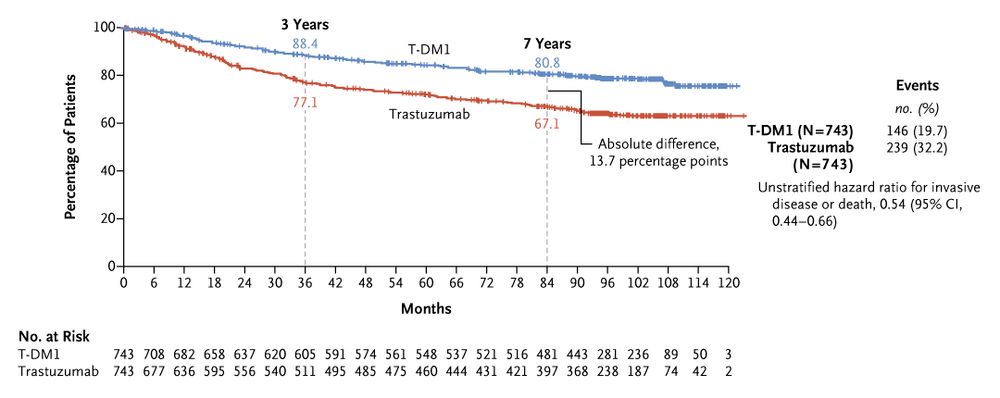
Among persons with residual invasive disease after treatment of HER2-positive early breast cancer, trastuzumab emtansine resulted in 7-year invasive disease–free survival of 80.8%, as compared with 67.1% with trastuzumab. Full KATHERINE study results: nej.md/3WhKMJN
#MedSky #Oncology
#MedSky #Oncology
January 18, 2025 at 2:22 PM
Among persons with residual invasive disease after treatment of HER2-positive early breast cancer, trastuzumab emtansine resulted in 7-year invasive disease–free survival of 80.8%, as compared with 67.1% with trastuzumab. Full KATHERINE study results: nej.md/3WhKMJN
#MedSky #Oncology
#MedSky #Oncology
Reposted by Molecular Story

A study published in Nature Medicine shows that AI-supported screening increased breast cancer detection rates by a significant margin without affecting the recall rate. https://go.nature.com/3Wi1qc7 🧪

January 12, 2025 at 1:49 PM
A study published in Nature Medicine shows that AI-supported screening increased breast cancer detection rates by a significant margin without affecting the recall rate. https://go.nature.com/3Wi1qc7 🧪
Reposted by Molecular Story

💫Now Online
@drchoueiri.bsky.social, David A. Braun & Sachet A. Shukla and teams profiled exceptional responders to immunotherapy in renal cell carcinoma; such responses could be related to tertiary lymphoid structures, clonal neoantigen load and altered metabolism.
www.nature.com/articles/s43...
@drchoueiri.bsky.social, David A. Braun & Sachet A. Shukla and teams profiled exceptional responders to immunotherapy in renal cell carcinoma; such responses could be related to tertiary lymphoid structures, clonal neoantigen load and altered metabolism.
www.nature.com/articles/s43...

Immunogenomic determinants of exceptional response to immune checkpoint inhibition in renal cell carcinoma - Nature Cancer
Shukla and colleagues study the genomic and transcriptomic data of exceptional responders to immunotherapy in renal cell carcinoma and find that such responses could be related to tertiary lymphoid st...
www.nature.com
January 10, 2025 at 4:07 PM
💫Now Online
@drchoueiri.bsky.social, David A. Braun & Sachet A. Shukla and teams profiled exceptional responders to immunotherapy in renal cell carcinoma; such responses could be related to tertiary lymphoid structures, clonal neoantigen load and altered metabolism.
www.nature.com/articles/s43...
@drchoueiri.bsky.social, David A. Braun & Sachet A. Shukla and teams profiled exceptional responders to immunotherapy in renal cell carcinoma; such responses could be related to tertiary lymphoid structures, clonal neoantigen load and altered metabolism.
www.nature.com/articles/s43...
Reposted by Molecular Story

#Review 🚨
In case you missed it, here Alan Welm & co discuss the importance of #PDX models for functional precision oncology and how integrating these with #AI can enhance their utility for personalizing cancer treatment. 🐁🤖🔬
@huntsmancancer.bsky.social
www.nature.com/articles/s41...
In case you missed it, here Alan Welm & co discuss the importance of #PDX models for functional precision oncology and how integrating these with #AI can enhance their utility for personalizing cancer treatment. 🐁🤖🔬
@huntsmancancer.bsky.social
www.nature.com/articles/s41...

PDX models for functional precision oncology and discovery science - Nature Reviews Cancer
Patient-derived xenograft (PDX) models are valuable surrogates for drug testing in precision oncology. In this Review, Welm and colleagues outline the opportunities and challenges of PDX models, discu...
www.nature.com
January 16, 2025 at 1:34 PM
#Review 🚨
In case you missed it, here Alan Welm & co discuss the importance of #PDX models for functional precision oncology and how integrating these with #AI can enhance their utility for personalizing cancer treatment. 🐁🤖🔬
@huntsmancancer.bsky.social
www.nature.com/articles/s41...
In case you missed it, here Alan Welm & co discuss the importance of #PDX models for functional precision oncology and how integrating these with #AI can enhance their utility for personalizing cancer treatment. 🐁🤖🔬
@huntsmancancer.bsky.social
www.nature.com/articles/s41...