


Jeyun Jo
@jeyunjo.bsky.social
Postdoc in the Matthew Bogyo lab at Stanford University, PharmD/PhD
Reposted by Jeyun Jo

Our new Nature Chemistry paper is also accompanied by an insightful News and Views article by @jeyunjo.bsky.social and @mbogyo.bsky.social.
Check it out here: www.nature.com/articles/s41...
Thank you very much for the kind comments on our work!
Check it out here: www.nature.com/articles/s41...
Thank you very much for the kind comments on our work!

A pipeline for proteome-wide analysis of electrophile selectivity - Nature Chemistry
In the growing field of chemical proteomics, there is a need for general methods to map the reactivity profiles of covalent probes in complex proteomes. Now, a completely unbiased proteomic workflow h...
www.nature.com
October 30, 2025 at 10:43 AM
Our new Nature Chemistry paper is also accompanied by an insightful News and Views article by @jeyunjo.bsky.social and @mbogyo.bsky.social.
Check it out here: www.nature.com/articles/s41...
Thank you very much for the kind comments on our work!
Check it out here: www.nature.com/articles/s41...
Thank you very much for the kind comments on our work!
Reposted by Jeyun Jo
How can we study target engagement and selectivity of covalent inhibitors? Which electrophilic probes are best suited to study a certain amino acid?
Our study on "Profiling the proteome-wide selectivity of diverse electrophiles" is published in Nature Chemistry.(1/7)
www.nature.com/articles/s41...
Our study on "Profiling the proteome-wide selectivity of diverse electrophiles" is published in Nature Chemistry.(1/7)
www.nature.com/articles/s41...

Profiling the proteome-wide selectivity of diverse electrophiles - Nature Chemistry
Covalent inhibitors are powerful entities in drug discovery. Now the amino acid selectivity and reactivity of a diverse electrophile library have been assessed proteome-wide using an unbiased workflow...
www.nature.com
October 30, 2025 at 10:27 AM
How can we study target engagement and selectivity of covalent inhibitors? Which electrophilic probes are best suited to study a certain amino acid?
Our study on "Profiling the proteome-wide selectivity of diverse electrophiles" is published in Nature Chemistry.(1/7)
www.nature.com/articles/s41...
Our study on "Profiling the proteome-wide selectivity of diverse electrophiles" is published in Nature Chemistry.(1/7)
www.nature.com/articles/s41...
Reposted by Jeyun Jo

Our work identifying new covalent inhibitors of Staphylococcus aureus serine hydrolyses from fragment libraries is out! great work from @tulsiupadhyay.bsky.social and our many collaborators, including @christianslentz.bsky.social, @mfellnerlab.bsky.social. #chembio
link.springer.com/article/10.1...
link.springer.com/article/10.1...
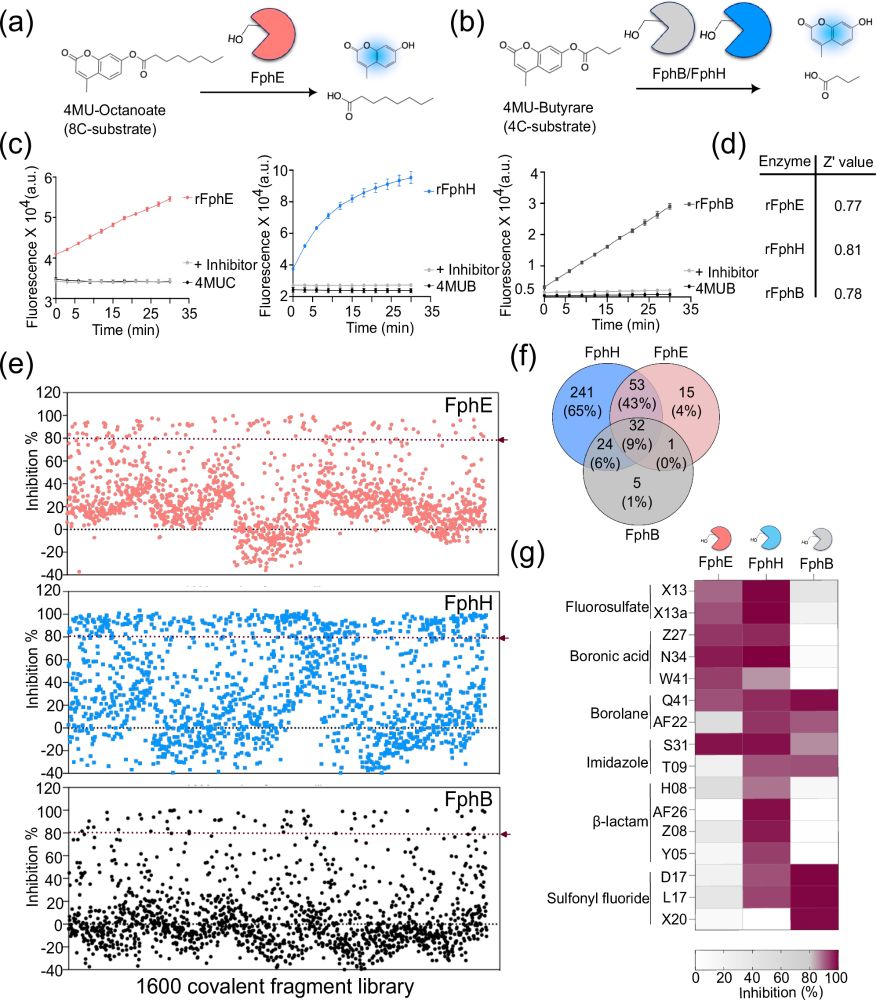
Identification of covalent inhibitors of Staphylococcus aureus serine hydrolases important for virulence and biofilm formation - Nature Communications
Staphylococcus aureus is a leading cause of bacteria-associated mortality worldwide. New tools are needed to both image and treat this pathogen. We previously identified a group of S. aureus serine hy...
link.springer.com
May 30, 2025 at 9:55 PM
Our work identifying new covalent inhibitors of Staphylococcus aureus serine hydrolyses from fragment libraries is out! great work from @tulsiupadhyay.bsky.social and our many collaborators, including @christianslentz.bsky.social, @mfellnerlab.bsky.social. #chembio
link.springer.com/article/10.1...
link.springer.com/article/10.1...
Reposted by Jeyun Jo

I'm thrilled to share that my second paper from my postdoctoral work is now published! A heartfelt thank you to my PI, Prof. Bogyo @mbogyo.bsky.social, for his unwavering support throughout this project. I am also deeply grateful to our fantastic collaboration team for making it a great success.🙌
Our work identifying new covalent inhibitors of Staphylococcus aureus serine hydrolyses from fragment libraries is out! great work from @tulsiupadhyay.bsky.social and our many collaborators, including @christianslentz.bsky.social, @mfellnerlab.bsky.social. #chembio
link.springer.com/article/10.1...
link.springer.com/article/10.1...
Identification of covalent inhibitors of Staphylococcus aureus serine hydrolases important for virulence and biofilm formation - Nature Communications
Staphylococcus aureus is a leading cause of bacteria-associated mortality worldwide. New tools are needed to both image and treat this pathogen. We previously identified a group of S. aureus serine hy...
link.springer.com
May 30, 2025 at 11:26 PM
I'm thrilled to share that my second paper from my postdoctoral work is now published! A heartfelt thank you to my PI, Prof. Bogyo @mbogyo.bsky.social, for his unwavering support throughout this project. I am also deeply grateful to our fantastic collaboration team for making it a great success.🙌
Reposted by Jeyun Jo
Amazing work by @sijiewang.bsky.social and our collaborators is out in JACS today. Interested in covalent inhibitors of protein-protein interactions? Check it out. pubs.acs.org/doi/10.1021/...

Identification of Covalent Cyclic Peptide Inhibitors Targeting Protein–Protein Interactions Using Phage Display
Peptide macrocycles are promising therapeutics for a variety of disease indications due to their overall metabolic stability and potential to make highly selective binding interactions with targets. R...
pubs.acs.org
February 25, 2025 at 2:51 AM
Amazing work by @sijiewang.bsky.social and our collaborators is out in JACS today. Interested in covalent inhibitors of protein-protein interactions? Check it out. pubs.acs.org/doi/10.1021/...
Reposted by Jeyun Jo

Happy to share our work published www.nature.com/articles/s41.... We describe the design of activity-based probes and chemoproteomic strategies to study USP18.
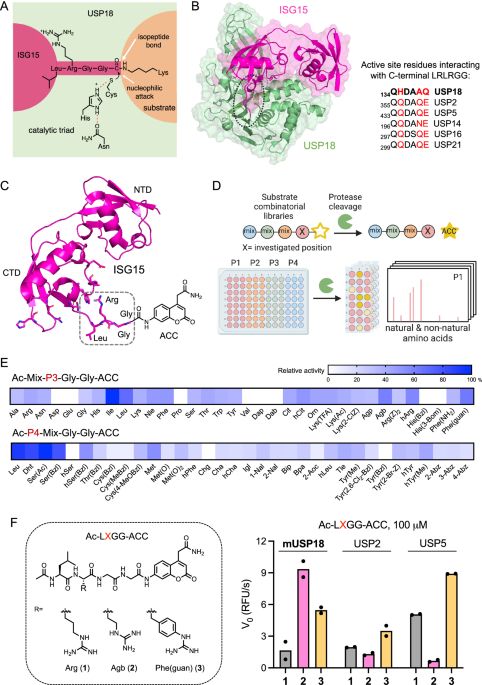
Chemical tools to define and manipulate interferon-inducible Ubl protease USP18 - Nature Communications
USP18 is a multifunctional cysteine protease involved in IFN pathways. Here, the authors report chemical probes and chemoproteomics platforms that allow to detect and perturb USP18 activity in complex...
www.nature.com
January 22, 2025 at 11:03 PM
Happy to share our work published www.nature.com/articles/s41.... We describe the design of activity-based probes and chemoproteomic strategies to study USP18.
Reposted by Jeyun Jo
Excited to report our studies that identified a new serine protease secreted by the gut microbe Bacteroides fragilis that regulates pain and inflammation through PAR2 activation. #ChemBio. Check it out!https://www.biorxiv.org/content/10.1101/2025.01.15.633241v1

Identification of a secreted protease from Bacteroides fragilis that induces intestinal pain and inflammation by cleavage of PAR2
Protease-activated receptor 2 (PAR2) is a central regulator of intestinal barrier function, inflammation and pain. Upregulated intestinal proteolysis and PAR2-signaling are implicated in inflammatory ...
www.biorxiv.org
January 16, 2025 at 5:11 PM
Excited to report our studies that identified a new serine protease secreted by the gut microbe Bacteroides fragilis that regulates pain and inflammation through PAR2 activation. #ChemBio. Check it out!https://www.biorxiv.org/content/10.1101/2025.01.15.633241v1
Reposted by Jeyun Jo
Cool new preprint from @stanford-chemh.bsky.social fellow @mbogyo.bsky.social @stanfordmedicine.bsky.social
www.researchsquare.com/article/rs-5...
www.researchsquare.com/article/rs-5...
Covalent-fragment screening identifies selective inhibitors of multiple Staphylococcus aureus serine hydrolases important for growth and biofilm formation
Staphylococcus aureus is a leading cause of bacteria-associated mortality worldwide. This is largely because infection sites are often difficult to localize and the bacteria forms biofilms which are n...
www.researchsquare.com
January 10, 2025 at 1:03 PM
Cool new preprint from @stanford-chemh.bsky.social fellow @mbogyo.bsky.social @stanfordmedicine.bsky.social
www.researchsquare.com/article/rs-5...
www.researchsquare.com/article/rs-5...
Reposted by Jeyun Jo
Excited to repost the news on this new platform!! Great collaborative work under the mentorship of @mbogyo.bsky.social is out for your read.
First real post on @bsky.app! Check out our latest work identifying covalent fragments as inhibitors of the Fph serine hydrolases in S. aureus. Great work from Tulsi Upadhyay and our many collaborators. www.researchsquare.com/article/rs-5...
Covalent-fragment screening identifies selective inhibitors of multiple Staphylococcus aureus serine hydrolases important for growth and biofilm formation
Staphylococcus aureus is a leading cause of bacteria-associated mortality worldwide. This is largely because infection sites are often difficult to localize and the bacteria forms biofilms which are n...
www.researchsquare.com
January 10, 2025 at 7:53 PM
Excited to repost the news on this new platform!! Great collaborative work under the mentorship of @mbogyo.bsky.social is out for your read.
Reposted by Jeyun Jo
First real post on @bsky.app! Check out our latest work identifying covalent fragments as inhibitors of the Fph serine hydrolases in S. aureus. Great work from Tulsi Upadhyay and our many collaborators. www.researchsquare.com/article/rs-5...
Covalent-fragment screening identifies selective inhibitors of multiple Staphylococcus aureus serine hydrolases important for growth and biofilm formation
Staphylococcus aureus is a leading cause of bacteria-associated mortality worldwide. This is largely because infection sites are often difficult to localize and the bacteria forms biofilms which are n...
www.researchsquare.com
January 9, 2025 at 9:32 PM
First real post on @bsky.app! Check out our latest work identifying covalent fragments as inhibitors of the Fph serine hydrolases in S. aureus. Great work from Tulsi Upadhyay and our many collaborators. www.researchsquare.com/article/rs-5...