


Kirthana Kunikullaya U
@drkirthana.bsky.social
• Doctor🩺 Physiologist 🧠🐟🐁
• https://kirthanaku.github.io/
• Postdoc @Karolinska 🧪🧬Studying Exposome, Circadian Rhythms & Neuroendocrinology #Neuroscience #WomeninSTEM
• 🎶 Vocalist • 🇮🇳🇳🇱🇲🇫🇸🇪
• https://kirthanaku.github.io/
• Postdoc @Karolinska 🧪🧬Studying Exposome, Circadian Rhythms & Neuroendocrinology #Neuroscience #WomeninSTEM
• 🎶 Vocalist • 🇮🇳🇳🇱🇲🇫🇸🇪
Glad to share that I have recently completed my postdoctoral period at the Department of Medicine, Karolinska Institutet, Sweden, where I worked on the neuroendocrine effects of circadian rhythms on metabolism and behavior in the lab of Paul Petrus. 🧠🐁⏱️🧬 ️🧵1/2
June 24, 2025 at 8:10 AM
Glad to share that I have recently completed my postdoctoral period at the Department of Medicine, Karolinska Institutet, Sweden, where I worked on the neuroendocrine effects of circadian rhythms on metabolism and behavior in the lab of Paul Petrus. 🧠🐁⏱️🧬 ️🧵1/2
Happy to share my new review, exploring the effects of exposome on neuroplasticity. The brain is shaped by lifelong exposures, environmental, lifestyle, and societal, collectively called the 'exposome'.
Read here:
www.sciencedirect.com/science/arti...
#neuroscience
Read here:
www.sciencedirect.com/science/arti...
#neuroscience

April 4, 2025 at 7:29 AM
Happy to share my new review, exploring the effects of exposome on neuroplasticity. The brain is shaped by lifelong exposures, environmental, lifestyle, and societal, collectively called the 'exposome'.
Read here:
www.sciencedirect.com/science/arti...
#neuroscience
Read here:
www.sciencedirect.com/science/arti...
#neuroscience
Can music connect our minds? 🎶🧠 Using Electroencephalogram (EEG) we showed that listening to different modes of music synchronized brain activity between listeners.
Thanks to Indian Council of Medical Research
for funding this work.
Link:
10.0.98.171/IJPP_337_2024
#musicneuroscience #neuroscience
Thanks to Indian Council of Medical Research
for funding this work.
Link:
10.0.98.171/IJPP_337_2024
#musicneuroscience #neuroscience

April 1, 2025 at 7:28 AM
Can music connect our minds? 🎶🧠 Using Electroencephalogram (EEG) we showed that listening to different modes of music synchronized brain activity between listeners.
Thanks to Indian Council of Medical Research
for funding this work.
Link:
10.0.98.171/IJPP_337_2024
#musicneuroscience #neuroscience
Thanks to Indian Council of Medical Research
for funding this work.
Link:
10.0.98.171/IJPP_337_2024
#musicneuroscience #neuroscience
Reposted by Kirthana Kunikullaya U
A disease-associated subset of capillary endothelial cells (ECs) in cortex samples from individuals with neurodegenerative disease exhibit loss of nuclear TDP-43; TDP-43 disruption in human and mouse ECs replicates these alterations 🧪🧠
@patrickmurphy.bsky.social
www.nature.com/articles/s41...
@patrickmurphy.bsky.social
www.nature.com/articles/s41...

Endothelial TDP-43 depletion disrupts core blood–brain barrier pathways in neurodegeneration - Nature Neuroscience
Targeting the endothelium across ages and neurodegenerative diseases in 92 donors with single-cell inCITE-seq reveals similar alterations in ~40% of capillaries in AD, ALS and FTD. Endothelial TDP-43 ...
www.nature.com
March 21, 2025 at 1:51 PM
A disease-associated subset of capillary endothelial cells (ECs) in cortex samples from individuals with neurodegenerative disease exhibit loss of nuclear TDP-43; TDP-43 disruption in human and mouse ECs replicates these alterations 🧪🧠
@patrickmurphy.bsky.social
www.nature.com/articles/s41...
@patrickmurphy.bsky.social
www.nature.com/articles/s41...
Reposted by Kirthana Kunikullaya U

For #fluorescentfriday check out these #AAC neurons in Area 32 filled with DIO-HM4Di DREADDs.

March 21, 2025 at 3:51 PM
For #fluorescentfriday check out these #AAC neurons in Area 32 filled with DIO-HM4Di DREADDs.
Reposted by Kirthana Kunikullaya U

To better understand how oral contraceptives affect the brain, neuroscientist Carina Heller volunteered herself as a subject. She plans to make her data—from her many brain scans, blood tests and more—openly available.
www.thetransmitter.org/brain-imagin...
#neuroskyence #neuroscience
www.thetransmitter.org/brain-imagin...
#neuroskyence #neuroscience

Dose, scan, repeat: Tracking the neurological effects of oral contraceptives
We know little about how the brain responds to oral contraceptives, despite their widespread use. I am committed to changing that: I scanned my brain 75 times over the course of a year and plan to…
www.thetransmitter.org
January 20, 2025 at 1:45 PM
To better understand how oral contraceptives affect the brain, neuroscientist Carina Heller volunteered herself as a subject. She plans to make her data—from her many brain scans, blood tests and more—openly available.
www.thetransmitter.org/brain-imagin...
#neuroskyence #neuroscience
www.thetransmitter.org/brain-imagin...
#neuroskyence #neuroscience
Reposted by Kirthana Kunikullaya U

New post-doctoral fellowship scheme opening up in Canada! If you're interested in the neural control of movement and want to study reaching in humans and NHPs, please get in touch soon. www.nserc-crsng.gc.ca/NewsDetail-D...
NSERC - Latest News - Launch of the new Harmonized Tri-agency Scholarship and Fellowship programs
As announced in Budget 2024, the scholarship and fellowship programs administered by the three federal research funding agencies – the Canadian Institutes of Health Research (CIHR), the Natural Sciences and Engineering Research Council (NSERC), and the Social Sciences and Humanities Research Council (SSHRC) – have been streamlined into a new harmonized talent program called the Canada Research Training Awards Suite (CRTAS) that will open for applications in summer 2025.
www.nserc-crsng.gc.ca
March 16, 2025 at 7:29 PM
New post-doctoral fellowship scheme opening up in Canada! If you're interested in the neural control of movement and want to study reaching in humans and NHPs, please get in touch soon. www.nserc-crsng.gc.ca/NewsDetail-D...
Reposted by Kirthana Kunikullaya U
Benjamin Barti at the Hungarian Academy of Sciences - IEM, took this 20X micrograph by confocal microscopy for Nikon's 2018 Photomicrography Competition.
You're seeing dye-injected Purkinje cells in a mouse cerebellum. These are some of the largest neurons in the brain.
You're seeing dye-injected Purkinje cells in a mouse cerebellum. These are some of the largest neurons in the brain.

March 16, 2025 at 10:38 PM
Benjamin Barti at the Hungarian Academy of Sciences - IEM, took this 20X micrograph by confocal microscopy for Nikon's 2018 Photomicrography Competition.
You're seeing dye-injected Purkinje cells in a mouse cerebellum. These are some of the largest neurons in the brain.
You're seeing dye-injected Purkinje cells in a mouse cerebellum. These are some of the largest neurons in the brain.
Reposted by Kirthana Kunikullaya U
Time for me to start posting here! Check out our Feature Review @ Trends in Neurosciences:
"Epigenetic mechanisms underlying sex differences in the brain and behavior"
Extremely proud of this piece - we did our best to make it as comprehensive & inclusive as possible!
www.cell.com/trends/neuro...
"Epigenetic mechanisms underlying sex differences in the brain and behavior"
Extremely proud of this piece - we did our best to make it as comprehensive & inclusive as possible!
www.cell.com/trends/neuro...
Epigenetic mechanisms underlying sex differences in the brain and behavior
Sex differences are found across brain regions, behaviors, and brain diseases. Sexual
differentiation of the brain is initiated prenatally but it continues throughout life,
as a result of the interact...
www.cell.com
November 19, 2023 at 11:20 PM
Time for me to start posting here! Check out our Feature Review @ Trends in Neurosciences:
"Epigenetic mechanisms underlying sex differences in the brain and behavior"
Extremely proud of this piece - we did our best to make it as comprehensive & inclusive as possible!
www.cell.com/trends/neuro...
"Epigenetic mechanisms underlying sex differences in the brain and behavior"
Extremely proud of this piece - we did our best to make it as comprehensive & inclusive as possible!
www.cell.com/trends/neuro...
Reposted by Kirthana Kunikullaya U

Lillian Jackson from our lab published two papers recently on sex differences in the molecular and neural basis of aggression in cichlids. Below are links to both papers with short summaries. 1/5
January 14, 2025 at 7:01 PM
Lillian Jackson from our lab published two papers recently on sex differences in the molecular and neural basis of aggression in cichlids. Below are links to both papers with short summaries. 1/5
Reposted by Kirthana Kunikullaya U
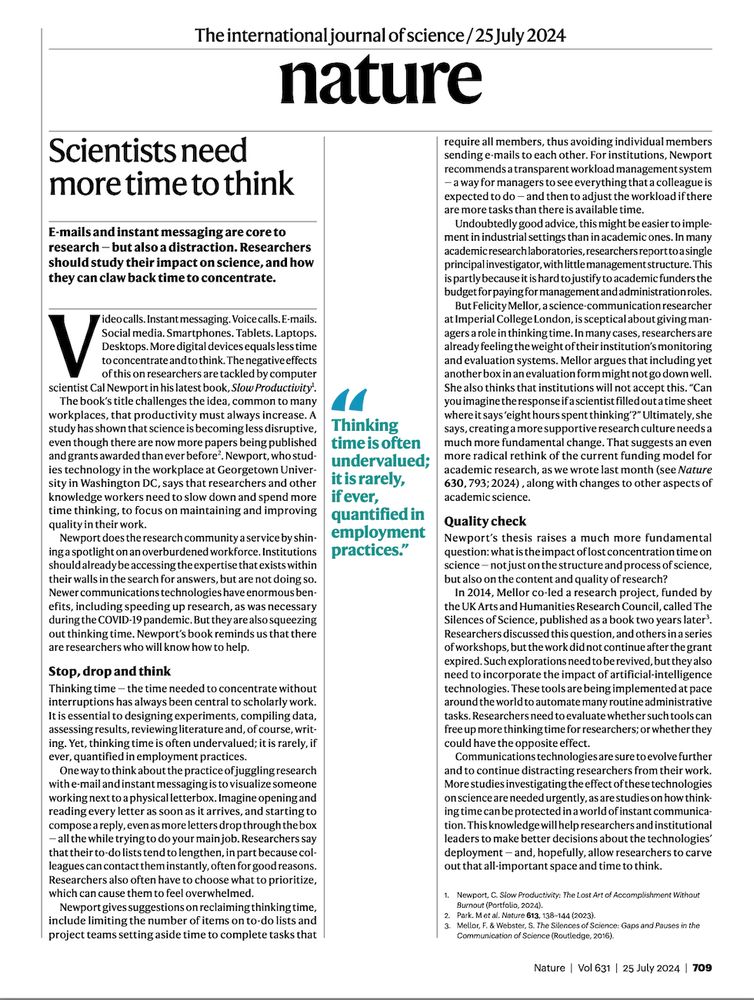
Thinking about this a lot as a (pre-tenure) PI. There just isn't enough time to go deeply into an idea, which is obviously bad for (my) science.
Instead of listing my publications, as the year draws to an end, I want to shine the spotlight on the commonplace assumption that productivity must always increase. Good research is disruptive and thinking time is central to high quality scholarship and necessary for disruptive research.
December 26, 2024 at 2:42 AM
Thinking about this a lot as a (pre-tenure) PI. There just isn't enough time to go deeply into an idea, which is obviously bad for (my) science.
Reposted by Kirthana Kunikullaya U

Reposted by Kirthana Kunikullaya U

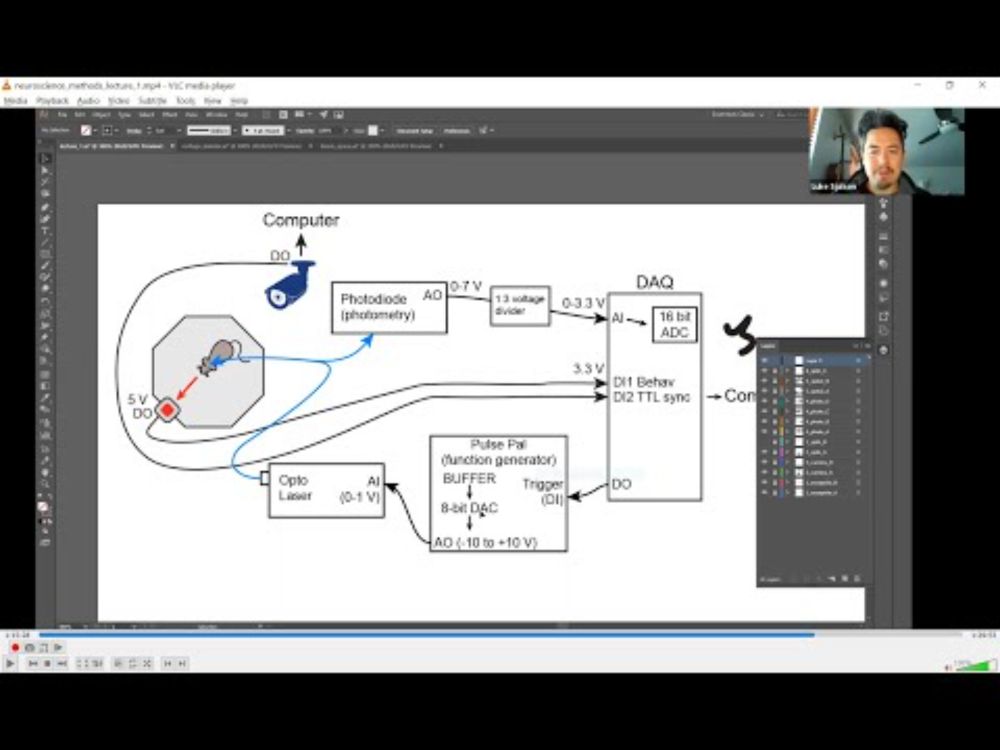
Neuroscience students asked us to teach a PRACTICAL course on experimental methods, and it is now on YouTube!
Please like and repost to help us get the word out!
www.youtube.com/playlist?lis...
Lecture 1: Signals and data acquisition
Focusing on hardware, digital/analog I/O, synchronization
🧵
Please like and repost to help us get the word out!
www.youtube.com/playlist?lis...
Lecture 1: Signals and data acquisition
Focusing on hardware, digital/analog I/O, synchronization
🧵
Neuroscience methods - YouTube
Nanocourse: Approaches to Study Neural Circuits This course was taught by Anita Autry, Tiago Gonçalves, and Luke Sjulson at Albert Einstein College of Medici...
www.youtube.com
December 13, 2024 at 11:33 AM
Neuroscience students asked us to teach a PRACTICAL course on experimental methods, and it is now on YouTube!
Please like and repost to help us get the word out!
www.youtube.com/playlist?lis...
Lecture 1: Signals and data acquisition
Focusing on hardware, digital/analog I/O, synchronization
🧵
Please like and repost to help us get the word out!
www.youtube.com/playlist?lis...
Lecture 1: Signals and data acquisition
Focusing on hardware, digital/analog I/O, synchronization
🧵