




Blindspot Bio
@blindspotbio.bsky.social
Highlighting biomedical omics progress. Visit https://blindspotbio.com for research & bioinformatics services.
Reposted by Blindspot Bio
Happy to share DEBIAS-M, our new method for domain adaptation and bias correction in #microbiome data.🧬🖥️
Microbiome data is very variable, with substantial study- and batch-effects. DEBIAS-M corrects these, enabling robust and generalizable analyses.
A quick thread:
www.nature.com/articles/s41...
Microbiome data is very variable, with substantial study- and batch-effects. DEBIAS-M corrects these, enabling robust and generalizable analyses.
A quick thread:
www.nature.com/articles/s41...
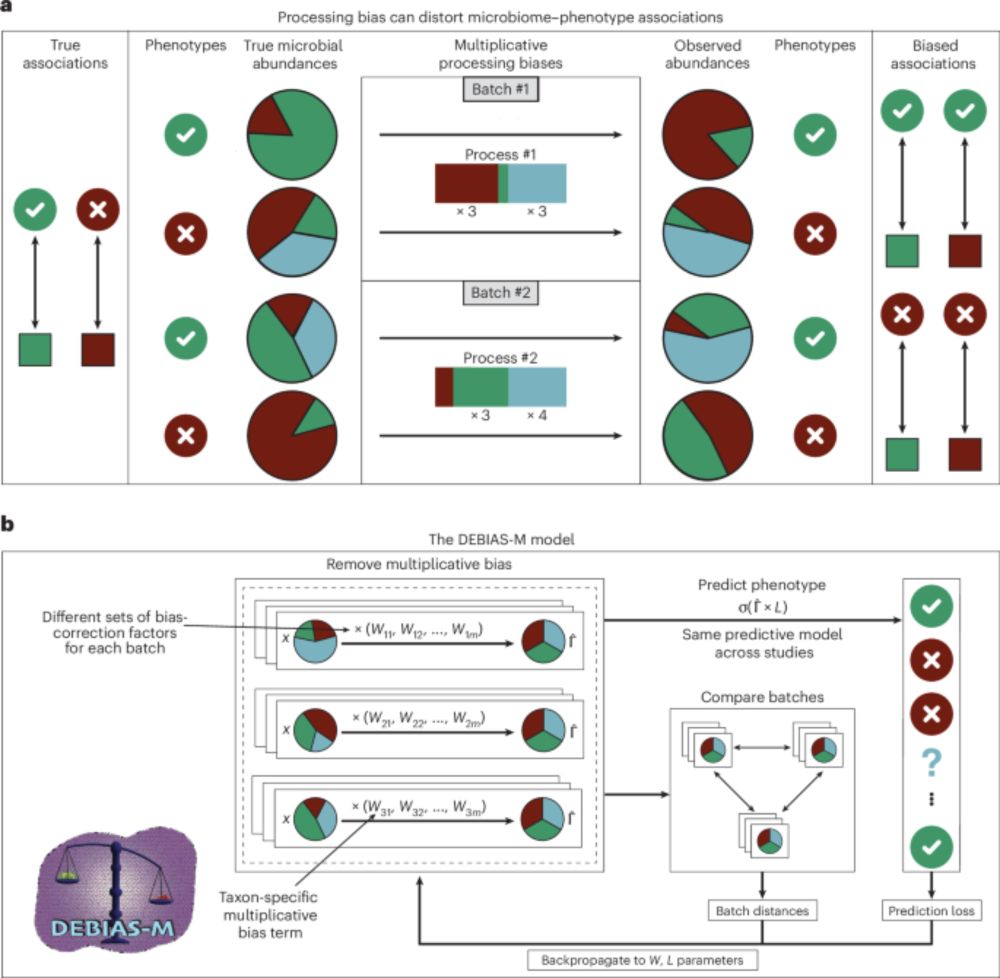
Processing-bias correction with DEBIAS-M improves cross-study generalization of microbiome-based prediction models - Nature Microbiology
DEBIAS-M corrects technical variability in microbiome data in a manner both interpretable and suitable for machine learning. In extensive benchmarks, DEBIAS-M facilitates robust analyses that generali...
www.nature.com
March 27, 2025 at 4:01 PM
Happy to share DEBIAS-M, our new method for domain adaptation and bias correction in #microbiome data.🧬🖥️
Microbiome data is very variable, with substantial study- and batch-effects. DEBIAS-M corrects these, enabling robust and generalizable analyses.
A quick thread:
www.nature.com/articles/s41...
Microbiome data is very variable, with substantial study- and batch-effects. DEBIAS-M corrects these, enabling robust and generalizable analyses.
A quick thread:
www.nature.com/articles/s41...
Reposted by Blindspot Bio

Would you open your paper to a modular open-collaboration model?
It was game-changing for #tidyomics
If you love #crowdResearch and #CommunityBuilding have your say on the #crowdToPaper model guidelines
Comment on the shared doc: docs.google.com/document/d/1...
Please share 🙏
It was game-changing for #tidyomics
If you love #crowdResearch and #CommunityBuilding have your say on the #crowdToPaper model guidelines
Comment on the shared doc: docs.google.com/document/d/1...
Please share 🙏
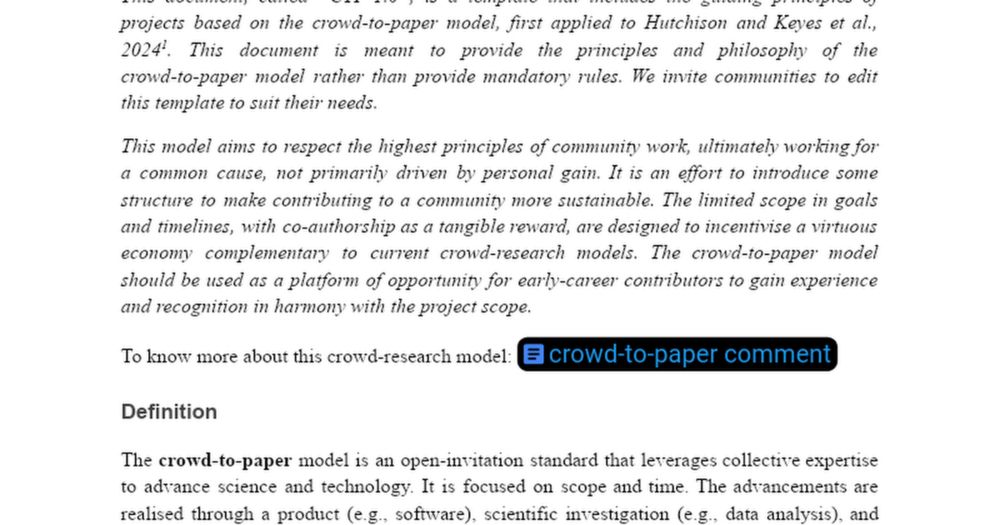
CTP-1.0
CTP guidelines 1.0 Definition and Operational Details of the Crowd-to-Paper Model This document, called “CTP-1.0”, is a template that includes the guiding principles of projects based on the crowd-to-...
docs.google.com
January 8, 2025 at 5:34 AM
Would you open your paper to a modular open-collaboration model?
It was game-changing for #tidyomics
If you love #crowdResearch and #CommunityBuilding have your say on the #crowdToPaper model guidelines
Comment on the shared doc: docs.google.com/document/d/1...
Please share 🙏
It was game-changing for #tidyomics
If you love #crowdResearch and #CommunityBuilding have your say on the #crowdToPaper model guidelines
Comment on the shared doc: docs.google.com/document/d/1...
Please share 🙏
Reposted by Blindspot Bio

Mendel first described his laws of genetic inheritance in 1865. They were promptly ignored for 35 years. 🧬 🧪 #HistSci

It took 35 years for the first human Mendelian disease to be described
Mendel first described his laws of genetic inheritance in 1865. They were promptly ignored for 35 years.
buff.ly
January 17, 2025 at 4:00 PM
Mendel first described his laws of genetic inheritance in 1865. They were promptly ignored for 35 years. 🧬 🧪 #HistSci
Reposted by Blindspot Bio

If you would like to read what I hope (and tried) to make the best (=most conceptually rigorous) review of preregistration and Registered Reports currently in the literature, see our recent paper: www.tandfonline.com/doi/full/10....

The benefits of preregistration and Registered Reports
Practices that introduce systematic bias are common in most scientific disciplines, including toxicology. Selective reporting of results and publication bias are two of the most prevalent sources o...
www.tandfonline.com
January 17, 2025 at 6:55 AM
If you would like to read what I hope (and tried) to make the best (=most conceptually rigorous) review of preregistration and Registered Reports currently in the literature, see our recent paper: www.tandfonline.com/doi/full/10....
Reposted by Blindspot Bio
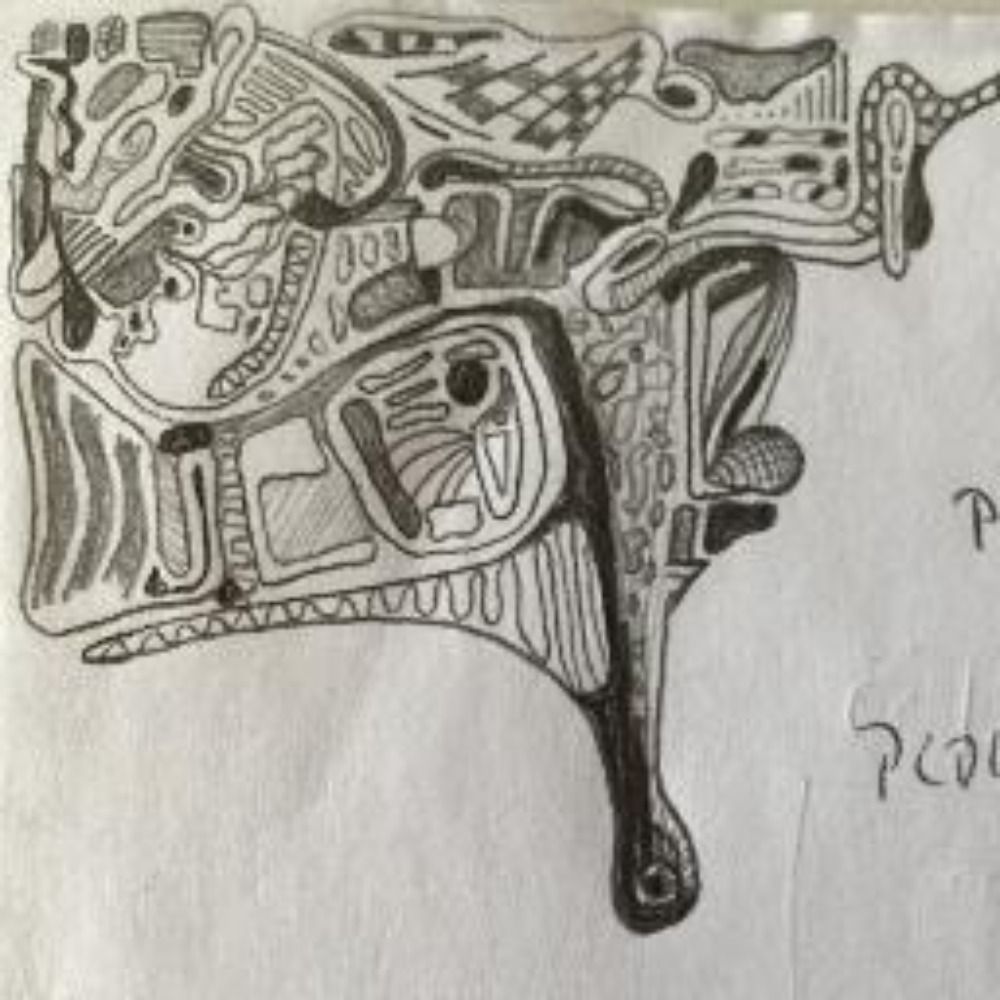
What do bacterial cells do when they run out of nutrients? Although most bacterial studies focus on cells in exponentially growing states, in the wild bacteria likely spend most of their time slowly starving to death. 1/n
www.biorxiv.org/content/10.1...
www.biorxiv.org/content/10.1...

E. coli prepares for starvation by dramatically remodeling its proteome in the first hours after loss of nutrients
It is widely believed that due to nutrient limitations in natural environments, bacteria spend most of their life in non-growing states. However, very little is known about how bacteria change their p...
www.biorxiv.org
January 15, 2025 at 11:12 AM
What do bacterial cells do when they run out of nutrients? Although most bacterial studies focus on cells in exponentially growing states, in the wild bacteria likely spend most of their time slowly starving to death. 1/n
www.biorxiv.org/content/10.1...
www.biorxiv.org/content/10.1...
Reposted by Blindspot Bio

Made a snippet for a uv run shebang because I got tired of hunting it down everytime I wanted to add it to a new script:
github.com/edmundmiller...
github.com/edmundmiller...

.doom.d/snippets/python-mode/uvbang at 3f53f48071035fdc498a5cf36fff31e51b537367 · edmundmiller/.doom.d
My private module for Doom Emacs. Contribute to edmundmiller/.doom.d development by creating an account on GitHub.
github.com
January 5, 2025 at 11:32 PM
Made a snippet for a uv run shebang because I got tired of hunting it down everytime I wanted to add it to a new script:
github.com/edmundmiller...
github.com/edmundmiller...

Reposted by Blindspot Bio

From @plos.org #Computational #Biology | The tumour histopathology "glossary" for AI developers | #Bioinformatics #Education #AI | 🧬 🖥️ 🧪
see ⬇️
journals.plos.org/ploscompbiol...
see ⬇️
journals.plos.org/ploscompbiol...

The tumour histopathology “glossary” for AI developers
The applications of artificial intelligence (AI) and deep learning (DL) are leading to significant advances in cancer research, particularly in analysing histopathology images for prognostic and treat...
journals.plos.org
January 24, 2025 at 2:36 PM
From @plos.org #Computational #Biology | The tumour histopathology "glossary" for AI developers | #Bioinformatics #Education #AI | 🧬 🖥️ 🧪
see ⬇️
journals.plos.org/ploscompbiol...
see ⬇️
journals.plos.org/ploscompbiol...
Reposted by Blindspot Bio

The SCGE has recently released a Gene Therapy Clinical Trial Browser. This publicly accessible, free database was created for the benefit of users seeking information on gene therapy development. 🧬🧪
Check out the browser at: scge.mcw.edu/platform/dat...
#clinicaltrials #genetherapy #research
Check out the browser at: scge.mcw.edu/platform/dat...
#clinicaltrials #genetherapy #research

February 25, 2025 at 3:12 PM
The SCGE has recently released a Gene Therapy Clinical Trial Browser. This publicly accessible, free database was created for the benefit of users seeking information on gene therapy development. 🧬🧪
Check out the browser at: scge.mcw.edu/platform/dat...
#clinicaltrials #genetherapy #research
Check out the browser at: scge.mcw.edu/platform/dat...
#clinicaltrials #genetherapy #research
Reposted by Blindspot Bio
Today we report a new compendium of human gut microbiomes with >168,000 samples
By analyzing this massive dataset, we discovered distinct microbiome patterns across the globe, and show we can predict where a person lives just from their gut bacteria
Now out in Cell:
www.cell.com/cell/fulltex...
By analyzing this massive dataset, we discovered distinct microbiome patterns across the globe, and show we can predict where a person lives just from their gut bacteria
Now out in Cell:
www.cell.com/cell/fulltex...
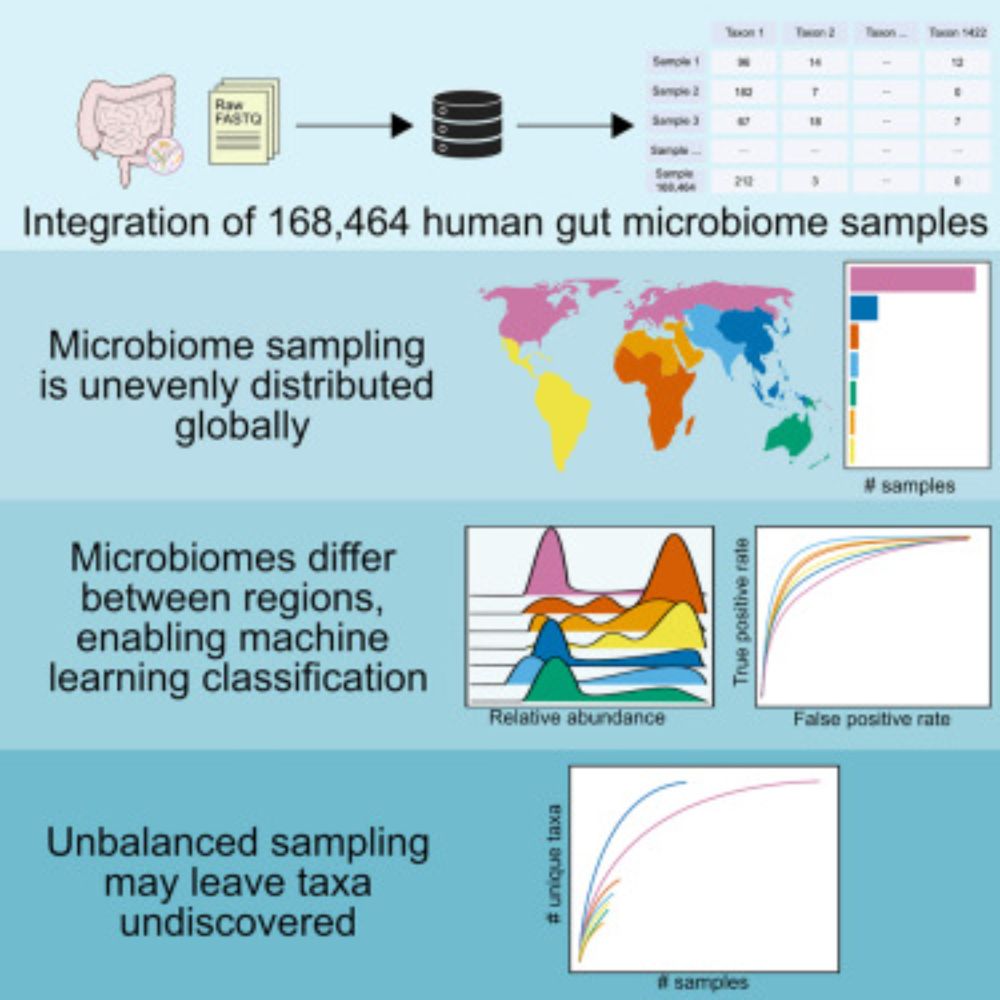
Integration of 168,000 samples reveals global patterns of the human gut microbiome
The Human Microbiome Compendium is a unified database of publicly available human
gut microbiome 16S samples, built with the integrated data from hundreds of independent
projects. The compendium is us...
www.cell.com
January 22, 2025 at 5:12 PM
Today we report a new compendium of human gut microbiomes with >168,000 samples
By analyzing this massive dataset, we discovered distinct microbiome patterns across the globe, and show we can predict where a person lives just from their gut bacteria
Now out in Cell:
www.cell.com/cell/fulltex...
By analyzing this massive dataset, we discovered distinct microbiome patterns across the globe, and show we can predict where a person lives just from their gut bacteria
Now out in Cell:
www.cell.com/cell/fulltex...
Reposted by Blindspot Bio

Microbial ecosystems and ecological driving forces in the deepest ocean sediments www.cell.com/cell/fulltex... #jcampubs

Microbial ecosystems and ecological driving forces in the deepest ocean sediments
Metagenomic sequencing of 1,648 sediment samples from 6–11 km water depths, including
the Mariana Trench, highlights the hadal microbial ecosystem and its environmental
driving forces.
www.cell.com
March 14, 2025 at 2:21 PM
Microbial ecosystems and ecological driving forces in the deepest ocean sediments www.cell.com/cell/fulltex... #jcampubs
Reposted by Blindspot Bio

New preprint! We worked with @msftresearch.bsky.social and @broadinstitute.org to see whether large language models (LLMs) can be useful to variant scientists in deciding whether genetic variants seen in a patient are responsible for their disease. tl;dr yes they can: www.biorxiv.org/content/10.1...

Evidence Aggregator: AI reasoning applied to rare disease diagnostics
Retrieving, reviewing, and synthesizing technical information can be time-consuming and challenging, particularly when requiring specialized expertise, as is the case of variant assessment for rare di...
www.biorxiv.org
March 15, 2025 at 2:44 AM
New preprint! We worked with @msftresearch.bsky.social and @broadinstitute.org to see whether large language models (LLMs) can be useful to variant scientists in deciding whether genetic variants seen in a patient are responsible for their disease. tl;dr yes they can: www.biorxiv.org/content/10.1...
Reposted by Blindspot Bio

Interested in the influence of the infant microbiome on health? Quickly interrogating non-model organisms using omic approaches?
A new publication, describing genome-scale resources in bifidobacteria, is now available online: doi.org/10.1016/j.ce...
#microbiome #microsky
A new publication, describing genome-scale resources in bifidobacteria, is now available online: doi.org/10.1016/j.ce...
#microbiome #microsky

March 13, 2025 at 10:35 PM
Interested in the influence of the infant microbiome on health? Quickly interrogating non-model organisms using omic approaches?
A new publication, describing genome-scale resources in bifidobacteria, is now available online: doi.org/10.1016/j.ce...
#microbiome #microsky
A new publication, describing genome-scale resources in bifidobacteria, is now available online: doi.org/10.1016/j.ce...
#microbiome #microsky
Reposted by Blindspot Bio

Interested in predicting AMR in bacteria? We show ignoring phylogenetic structure in genome collections leads to overly optimistic evaluations of machine learning methods for AMR prediction. With @nwheeler443.bsky.social and former PhD student Yanying Yu. 🦠🧫🧬🖥️🧪
www.biorxiv.org/content/10.1...
www.biorxiv.org/content/10.1...

Biased sampling confounds machine learning prediction of antimicrobial resistance
Antimicrobial resistance (AMR) poses a growing threat to human health. Increasingly, genome sequencing is being applied for the surveillance of bacterial pathogens, producing a wealth of data to train...
www.biorxiv.org
January 17, 2025 at 10:08 PM
Interested in predicting AMR in bacteria? We show ignoring phylogenetic structure in genome collections leads to overly optimistic evaluations of machine learning methods for AMR prediction. With @nwheeler443.bsky.social and former PhD student Yanying Yu. 🦠🧫🧬🖥️🧪
www.biorxiv.org/content/10.1...
www.biorxiv.org/content/10.1...
Reposted by Blindspot Bio

🌲 New sandbox.bio tutorial: Learn to build phylogenetic trees from closely related genomes using ska (the tool, not the music) 🖥️ 🧬
sandbox.bio/tutorials/sk...
sandbox.bio/tutorials/sk...

January 17, 2025 at 11:28 PM
🌲 New sandbox.bio tutorial: Learn to build phylogenetic trees from closely related genomes using ska (the tool, not the music) 🖥️ 🧬
sandbox.bio/tutorials/sk...
sandbox.bio/tutorials/sk...
Reposted by Blindspot Bio

In Science Advances: "We took a deep dive into over 1.8 million bacterial and archaeal genomes to see how much of their diversity we’ve actually captured. Turns out that despite all the genomes we’ve sequenced, we’ve only scratched the surface." -Dongying Wu
🖥️🧬🦠
biosciences.lbl.gov/2025/01/17/t...
🖥️🧬🦠
biosciences.lbl.gov/2025/01/17/t...
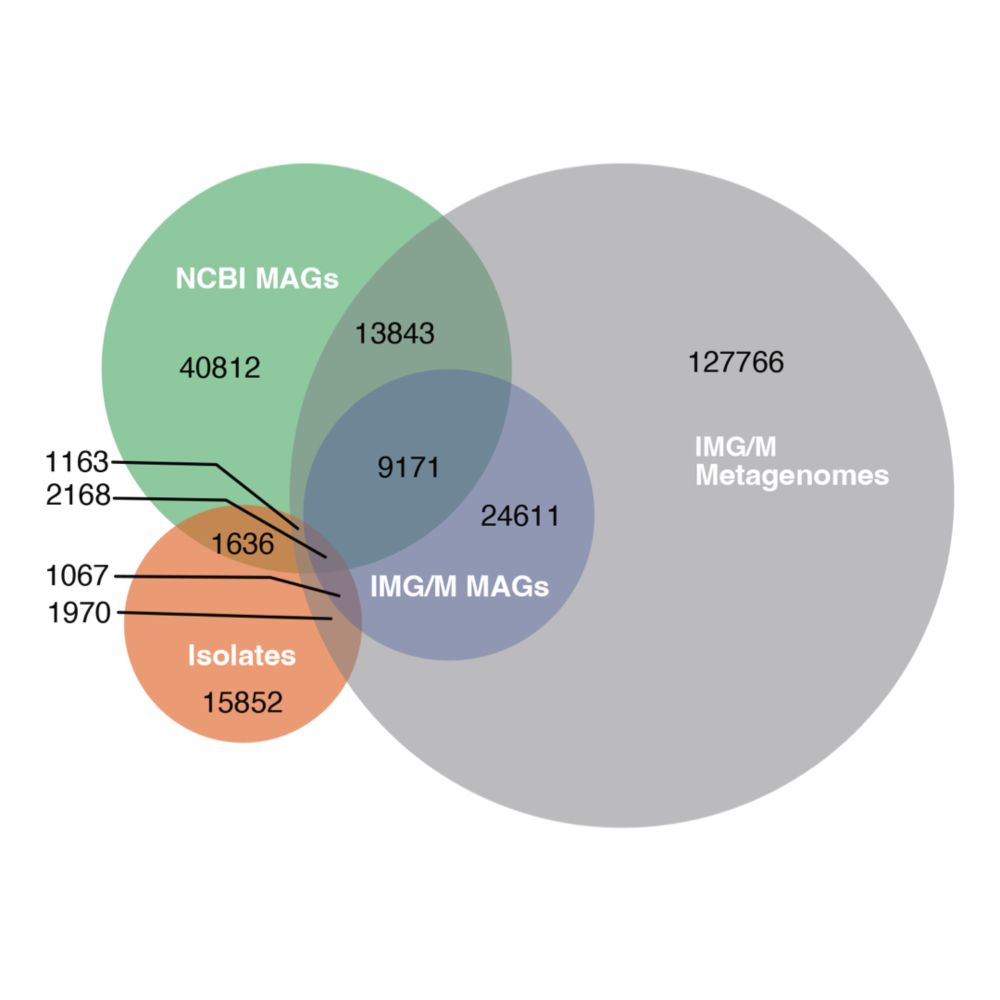
Taking Stock of the Known and Unknown Microbial Space - Biosciences Area
Using publicly available genome sequence data generated over the past three decades, JGI researchers assess the known fraction of microbial diversity.
biosciences.lbl.gov
January 17, 2025 at 7:27 PM
In Science Advances: "We took a deep dive into over 1.8 million bacterial and archaeal genomes to see how much of their diversity we’ve actually captured. Turns out that despite all the genomes we’ve sequenced, we’ve only scratched the surface." -Dongying Wu
🖥️🧬🦠
biosciences.lbl.gov/2025/01/17/t...
🖥️🧬🦠
biosciences.lbl.gov/2025/01/17/t...
Reposted by Blindspot Bio
Does anyone have any favorite reviews of autoencoders or VAEs for genomics data?
January 17, 2025 at 1:14 AM
Does anyone have any favorite reviews of autoencoders or VAEs for genomics data?
Reposted by Blindspot Bio

Review: Artificial intelligence in drug development https://www.nature.com/articles/s41591-024-03434-4 (read free: https://rdcu.be/d63NO) 🧬🖥️🧪


January 21, 2025 at 9:00 PM
Review: Artificial intelligence in drug development https://www.nature.com/articles/s41591-024-03434-4 (read free: https://rdcu.be/d63NO) 🧬🖥️🧪
Reposted by Blindspot Bio

Deaths from cancer continue to fall in the United States, the American Cancer Society reported, but within that encouraging trend is a disturbing shift in the cancer burden from older to younger adults and from men to women.

Cancer burden is shifting from men to women and old to young
Cancer deaths overall are falling, but the burden is shifting toward younger adults and women, the American Cancer Society reports.
buff.ly
January 16, 2025 at 7:49 PM
Deaths from cancer continue to fall in the United States, the American Cancer Society reported, but within that encouraging trend is a disturbing shift in the cancer burden from older to younger adults and from men to women.
Reposted by Blindspot Bio

But even this can be too much, especially since many genomic analyses often focus on genes. One great example for analyzing and visualizing how genes vary in a pangenome is GENESPACE (this came up over and over again at #PAG32 | #PAG2025) elifesciences.org/articles/785...

GENESPACE tracks regions of interest and gene copy number variation across multiple genomes
GENESPACE lets users track related chromosomal sequences across multiple reference genomes.
elifesciences.org
January 16, 2025 at 3:11 AM
But even this can be too much, especially since many genomic analyses often focus on genes. One great example for analyzing and visualizing how genes vary in a pangenome is GENESPACE (this came up over and over again at #PAG32 | #PAG2025) elifesciences.org/articles/785...

Reposted by Blindspot Bio

What’s currently the best computational tool for predicting mammalian promoters from DNA sequence alone?
January 3, 2025 at 9:02 PM
What’s currently the best computational tool for predicting mammalian promoters from DNA sequence alone?
Reposted by Blindspot Bio
Very excited to announce that the single cell/nuc. RNA/ATAC/multi-ome resource from ENCODE4 is now officially public. This includes raw data, processed data, annotations and pseudobulk products. Covers many human & mouse tissues. 1/
www.encodeproject.org/single-cell/...
www.encodeproject.org/single-cell/...
Single cell – ENCODEHomo sapiens clickable body map
www.encodeproject.org
January 7, 2025 at 9:29 PM
Very excited to announce that the single cell/nuc. RNA/ATAC/multi-ome resource from ENCODE4 is now officially public. This includes raw data, processed data, annotations and pseudobulk products. Covers many human & mouse tissues. 1/
www.encodeproject.org/single-cell/...
www.encodeproject.org/single-cell/...
Reposted by Blindspot Bio
Something that had been on my wishlist for a long time was a #Visidata plugin for common tabular #bioinformatics formats. I got by with just telling Visidata they were TSVs.
Finally got around to writing a GFF plugin
asciinema.org/a/Nt0AlgvxsX...
🧬🖥️
Finally got around to writing a GFF plugin
asciinema.org/a/Nt0AlgvxsX...
🧬🖥️

Visidata GFF Pplugin
Recorded by emiller
asciinema.org
December 31, 2024 at 7:57 PM
Something that had been on my wishlist for a long time was a #Visidata plugin for common tabular #bioinformatics formats. I got by with just telling Visidata they were TSVs.
Finally got around to writing a GFF plugin
asciinema.org/a/Nt0AlgvxsX...
🧬🖥️
Finally got around to writing a GFF plugin
asciinema.org/a/Nt0AlgvxsX...
🧬🖥️