



Benedict Wolf
@bene837.bsky.social
PhD Student @ Niopek Lab - Uni Heidelberg
Machine Learning for Protein Design
Machine Learning for Protein Design
Reposted by Benedict Wolf

Exciting to see our protein binder design pipeline BindCraft published in its final form in @Nature ! This has been an amazing collaborative effort with Lennart, Christian, @sokrypton.org, Bruno and many other amazing lab members and collaborators.
www.nature.com/articles/s41...
www.nature.com/articles/s41...
August 27, 2025 at 4:14 PM
Exciting to see our protein binder design pipeline BindCraft published in its final form in @Nature ! This has been an amazing collaborative effort with Lennart, Christian, @sokrypton.org, Bruno and many other amazing lab members and collaborators.
www.nature.com/articles/s41...
www.nature.com/articles/s41...
Reposted by Benedict Wolf

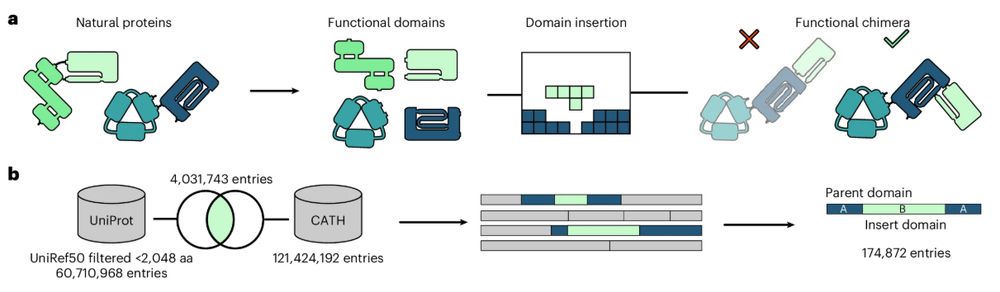
Work by @bene837.bsky.social @jmathony.bsky.social @dominikniopek.bsky.social @uniheidelberg.bsky.social
ProDomino is a machine learning-based method that predicts domain insertion sites and helps guide the engineering of functional multi-domain proteins.
www.nature.com/articles/s41...
www.nature.com/articles/s41...
August 4, 2025 at 3:26 PM
Reposted by Benedict Wolf

Excited to share my main PhD work is finally out! 🥳
We built a phage-assisted evolution platform to evolve allosteric protein switches (POGO-PANCE) and introduce cumulative, targeted mutations/Indels (RAMPhaGE)!
See how we evolved ultra-strong, light-switchable AraC variants 🌚🌞
We built a phage-assisted evolution platform to evolve allosteric protein switches (POGO-PANCE) and introduce cumulative, targeted mutations/Indels (RAMPhaGE)!
See how we evolved ultra-strong, light-switchable AraC variants 🌚🌞

Phage-Assisted Evolution of Allosteric Protein Switches https://www.biorxiv.org/content/10.1101/2025.06.12.659331v1
June 13, 2025 at 9:23 AM
Excited to share my main PhD work is finally out! 🥳
We built a phage-assisted evolution platform to evolve allosteric protein switches (POGO-PANCE) and introduce cumulative, targeted mutations/Indels (RAMPhaGE)!
See how we evolved ultra-strong, light-switchable AraC variants 🌚🌞
We built a phage-assisted evolution platform to evolve allosteric protein switches (POGO-PANCE) and introduce cumulative, targeted mutations/Indels (RAMPhaGE)!
See how we evolved ultra-strong, light-switchable AraC variants 🌚🌞
Reposted by Benedict Wolf


Reposted by Benedict Wolf

We have an exciting new PhD opportunity!
If you are fsacinated by proteins and their dynamics and want to engineer them to develop new molecular tools: apply now!
We are a young and dynamic team combining state-of-the-art laboratory and bioinformatics approaches.
Please share.
If you are fsacinated by proteins and their dynamics and want to engineer them to develop new molecular tools: apply now!
We are a young and dynamic team combining state-of-the-art laboratory and bioinformatics approaches.
Please share.

April 1, 2025 at 11:52 AM
We have an exciting new PhD opportunity!
If you are fsacinated by proteins and their dynamics and want to engineer them to develop new molecular tools: apply now!
We are a young and dynamic team combining state-of-the-art laboratory and bioinformatics approaches.
Please share.
If you are fsacinated by proteins and their dynamics and want to engineer them to develop new molecular tools: apply now!
We are a young and dynamic team combining state-of-the-art laboratory and bioinformatics approaches.
Please share.
Reposted by Benedict Wolf

New protein ML preprint from my PhD project.
We describe salad (sparse all-atom denoising), a family of efficient protein structure diffusion models and show that it works well on a bunch of protein design task previously described in the literature.
Preprint: www.biorxiv.org/content/10.1...
(1/N)
We describe salad (sparse all-atom denoising), a family of efficient protein structure diffusion models and show that it works well on a bunch of protein design task previously described in the literature.
Preprint: www.biorxiv.org/content/10.1...
(1/N)

February 6, 2025 at 1:07 PM
New protein ML preprint from my PhD project.
We describe salad (sparse all-atom denoising), a family of efficient protein structure diffusion models and show that it works well on a bunch of protein design task previously described in the literature.
Preprint: www.biorxiv.org/content/10.1...
(1/N)
We describe salad (sparse all-atom denoising), a family of efficient protein structure diffusion models and show that it works well on a bunch of protein design task previously described in the literature.
Preprint: www.biorxiv.org/content/10.1...
(1/N)
Reposted by Benedict Wolf
Our paper on computational design of chemically induced protein interactions is out in @natureportfolio.bsky.social. Big thanks to all co-authors, especially Anthony Marchand, Stephen Buckley and Bruno Correia!
t.co/vtYlhi8aQm
t.co/vtYlhi8aQm
January 15, 2025 at 4:37 PM
Our paper on computational design of chemically induced protein interactions is out in @natureportfolio.bsky.social. Big thanks to all co-authors, especially Anthony Marchand, Stephen Buckley and Bruno Correia!
t.co/vtYlhi8aQm
t.co/vtYlhi8aQm
Reposted by Benedict Wolf

Excited to announce our optogenetic transcriptional deactivation toolbox is now out in its final form at Nucleic Acids research: academic.oup.com/nar/advance-....

A modular toolbox for the optogenetic deactivation of transcription
Abstract. Light-controlled transcriptional activation is a commonly used optogenetic strategy that allows researchers to regulate gene expression with high
academic.oup.com
December 16, 2024 at 12:54 PM
Excited to announce our optogenetic transcriptional deactivation toolbox is now out in its final form at Nucleic Acids research: academic.oup.com/nar/advance-....
Reposted by Benedict Wolf
We are thrilled to share ProDomino a model for the prediction of domain insertion sites in proteins. Our approach enables the simple and rapid engineering of highly potent switchable proteins, as we exemplify by creating novel inducible variants of Cas9 and Cas12a.
www.biorxiv.org/content/10.1...
www.biorxiv.org/content/10.1...

Rational engineering of allosteric protein switches by in silico prediction of domain insertion sites
Domain insertion engineering is a powerful approach to juxtapose otherwise separate biological functions, resulting in proteins with new-to-nature activities. A prominent example are switchable protei...
www.biorxiv.org
December 5, 2024 at 9:59 AM
We are thrilled to share ProDomino a model for the prediction of domain insertion sites in proteins. Our approach enables the simple and rapid engineering of highly potent switchable proteins, as we exemplify by creating novel inducible variants of Cas9 and Cas12a.
www.biorxiv.org/content/10.1...
www.biorxiv.org/content/10.1...
Reposted by Benedict Wolf
Interested in regulating CRISPR-Cas systems for your experiments?
Go check out these awesome chemical and optogenetic tools from our lab 👇 (made by some pretty cool people 😄)
Go check out these awesome chemical and optogenetic tools from our lab 👇 (made by some pretty cool people 😄)
New pre-print from our group reporting engineered, broad-spectrum anti-CRISPR proteins based on AcrIIA5, a type II inhibitor, and AcrVA1, a type V inhibitor, for opto- and chemogenetic control of CRISPR-Cas9 and -Cas12a:
www.biorxiv.org/content/10.1...
(1/3)
www.biorxiv.org/content/10.1...
(1/3)

A Versatile Anti-CRISPR Platform for Opto- and Chemogenetic Control of CRISPR-Cas9 and Cas12 across a Wide Range of Orthologs
CRISPR-Cas technologies have revolutionized life sciences by enabling programmable genome editing across diverse organisms. Achieving dynamic and precise control over CRISPR-Cas activity with exogenou...
www.biorxiv.org
November 26, 2024 at 11:39 AM
Interested in regulating CRISPR-Cas systems for your experiments?
Go check out these awesome chemical and optogenetic tools from our lab 👇 (made by some pretty cool people 😄)
Go check out these awesome chemical and optogenetic tools from our lab 👇 (made by some pretty cool people 😄)
Reposted by Benedict Wolf
Our paper on DMS of anti-CRISPR proteins is out in it's final form Nucleic Acids Research!
Many congrats to first authors Tobias and Michael! It was lots of fun to see the story develop.
academic.oup.com/nar/advance-...
Many congrats to first authors Tobias and Michael! It was lots of fun to see the story develop.
academic.oup.com/nar/advance-...

A deep mutational scanning platform to characterize the fitness landscape of anti-CRISPR proteins
Abstract. Deep mutational scanning is a powerful method for exploring the mutational fitness landscape of proteins. Its adaptation to anti-CRISPR proteins,
academic.oup.com
November 22, 2024 at 6:19 PM
Our paper on DMS of anti-CRISPR proteins is out in it's final form Nucleic Acids Research!
Many congrats to first authors Tobias and Michael! It was lots of fun to see the story develop.
academic.oup.com/nar/advance-...
Many congrats to first authors Tobias and Michael! It was lots of fun to see the story develop.
academic.oup.com/nar/advance-...