




aela
@aelalina.bsky.social
glycoproteomics enthusiast 🌸 lover of cute plushies and video games in my spare time
Reposted by aela

The nano splits paper is out! Single cell seq and single cell proteomics on the same single (one) normal sized human cell! proteomicsnews.blogspot.com/2024/12/the-...

THE (real) single cell proteomics technique scSeq people love - NanoSplits- is out!
Check out one of my favorite techniques of the last few years - the NanoSplits paper here! The first preprint of this study is somewhere...
proteomicsnews.blogspot.com
December 6, 2024 at 11:51 AM
The nano splits paper is out! Single cell seq and single cell proteomics on the same single (one) normal sized human cell! proteomicsnews.blogspot.com/2024/12/the-...
Reposted by aela
How can you transfer peptide IDs between runs and still control your false discovery rate? Till now, the short answer is, you couldn't. Now you can, with PIP-ECHO.
www.biorxiv.org/content/10.1...

Improved detection of differentially abundant proteins through FDR-control of peptide-identity-propagation
Quantitative analysis of proteomics data frequently employs peptide-identity-propagation (PIP) — also known as match-between-runs (MBR) — to increase the number of peptides quantified in a given LC-MS...
www.biorxiv.org
December 2, 2024 at 5:10 PM
How can you transfer peptide IDs between runs and still control your false discovery rate? Till now, the short answer is, you couldn't. Now you can, with PIP-ECHO.
www.biorxiv.org/content/10.1...
Reposted by aela

DNA copy number variation is strongly buffered at the protein level.
The buffering is much stronger than at the RNA level.
The buffering is much stronger than at the RNA level.

November 27, 2024 at 11:45 AM
DNA copy number variation is strongly buffered at the protein level.
The buffering is much stronger than at the RNA level.
The buffering is much stronger than at the RNA level.
Reposted by aela

I took biochem in 2001, and for nearly 20 years read amino acid sequences daily… and I never knew Dayhoff named them or even the logic behind things like Q until last Friday (h/t Mike Janech). Also, this is another big Dayhoff moment for me. She was incredible!
#proteomics #bioinformatics
#proteomics #bioinformatics
Dr. Margaret Oakley Dayhoff
biology.arizona.edu
November 24, 2024 at 12:39 PM
I took biochem in 2001, and for nearly 20 years read amino acid sequences daily… and I never knew Dayhoff named them or even the logic behind things like Q until last Friday (h/t Mike Janech). Also, this is another big Dayhoff moment for me. She was incredible!
#proteomics #bioinformatics
#proteomics #bioinformatics
Reposted by aela
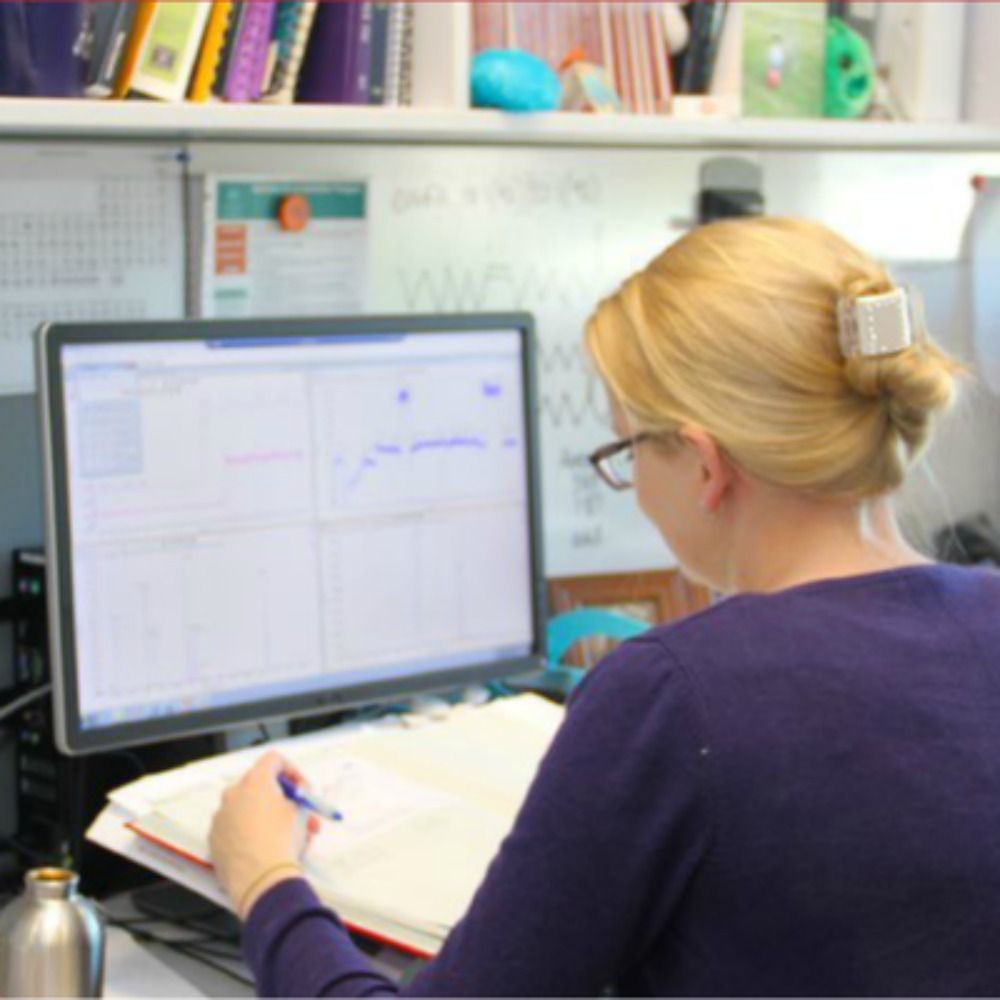
The unofficial FeMS starter pack (until they join us on Bluesky :) anyway. If you're a woman working with a mass spectrometer please ask to be added! All women are welcome!
go.bsky.app/PUwu7fr
go.bsky.app/PUwu7fr
November 22, 2024 at 11:17 PM
The unofficial FeMS starter pack (until they join us on Bluesky :) anyway. If you're a woman working with a mass spectrometer please ask to be added! All women are welcome!
go.bsky.app/PUwu7fr
go.bsky.app/PUwu7fr
Reposted by aela

Nice work. Please check out our recent work demonstrating uncontrolled FDR for match between runs in popular LFQ tools. www.biorxiv.org/content/10.1...

Improved detection of differentially abundant proteins through FDR-control of peptide-identity-propagation
Quantitative analysis of proteomics data frequently employs peptide-identity-propagation (PIP) — also known as match-between-runs (MBR) — to increase the number of peptides quantified in a given LC-MS...
www.biorxiv.org
November 22, 2024 at 7:40 PM
Nice work. Please check out our recent work demonstrating uncontrolled FDR for match between runs in popular LFQ tools. www.biorxiv.org/content/10.1...
Reposted by aela

My perspective on CVs for DIA-based #proteomics is out in JPR
It explores how normalisation, the CV formula and software parameters affect the outputs. It suggests parameters to use for biological and technical studies and provides an R package to calculate CVs.
doi.org/10.1021/acs....
It explores how normalisation, the CV formula and software parameters affect the outputs. It suggests parameters to use for biological and technical studies and provides an R package to calculate CVs.
doi.org/10.1021/acs....
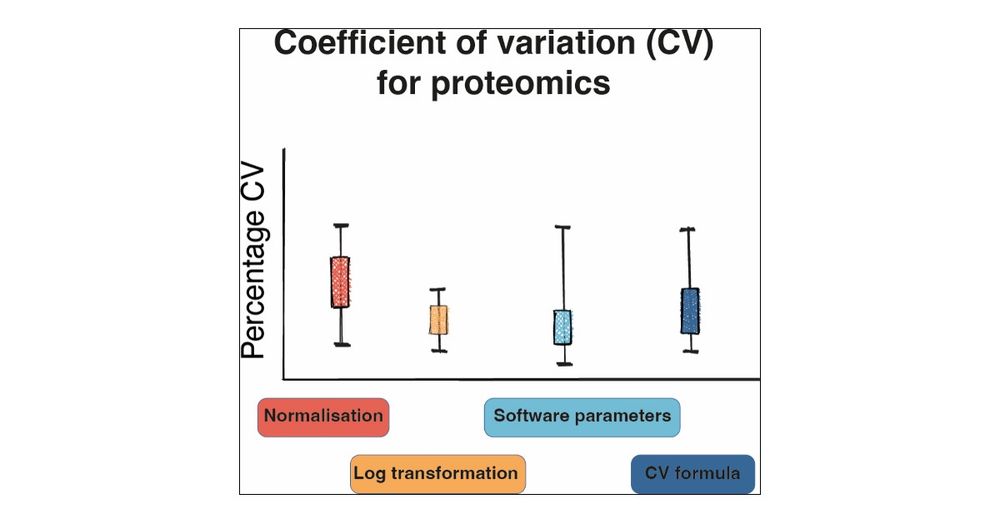
Calculating and Reporting Coefficients of Variation for DIA-Based Proteomics
The coefficient of variation (CV) is a measure that is frequently used to assess data dispersion for mass spectrometry-based proteomics. In the current era of burgeoning technical developments, there ...
doi.org
November 22, 2024 at 9:50 AM
My perspective on CVs for DIA-based #proteomics is out in JPR
It explores how normalisation, the CV formula and software parameters affect the outputs. It suggests parameters to use for biological and technical studies and provides an R package to calculate CVs.
doi.org/10.1021/acs....
It explores how normalisation, the CV formula and software parameters affect the outputs. It suggests parameters to use for biological and technical studies and provides an R package to calculate CVs.
doi.org/10.1021/acs....
tanuki nagi at the airport 💋

November 16, 2024 at 6:15 AM
tanuki nagi at the airport 💋

