



Timo Wiesner
@twiesner.bsky.social
Doctoral researcher @sociumbremen / @unibremen interested in perceptions and evaluations of economic inequality.
Pinned
Timo Wiesner
@twiesner.bsky.social
· Dec 30
Just in time before the end of the year: My first dissertation paper, in which I examine whether the public response to rising income inequality is really lacking, has officially been published in the latest issue of the Socio-Economic Review #SER.
🔗 doi.org/10.1093/ser/...
🔗 doi.org/10.1093/ser/...
Reposted by Timo Wiesner

📢 We're hiring!!! 📢 If you are interested in comparative social policy, welfare state research and quantitative methods, then this might be the job for you!
Interested? Link to the call: www.mpisoc.mpg.de/karriere/ste...
Need more info? Please check out our website!
inequalityhub.org
Interested? Link to the call: www.mpisoc.mpg.de/karriere/ste...
Need more info? Please check out our website!
inequalityhub.org

January 21, 2026 at 10:24 AM
📢 We're hiring!!! 📢 If you are interested in comparative social policy, welfare state research and quantitative methods, then this might be the job for you!
Interested? Link to the call: www.mpisoc.mpg.de/karriere/ste...
Need more info? Please check out our website!
inequalityhub.org
Interested? Link to the call: www.mpisoc.mpg.de/karriere/ste...
Need more info? Please check out our website!
inequalityhub.org
Reposted by Timo Wiesner

Happy to share this new paper @jeppjournal.bsky.social with my great colleagues @dweisstanner.bsky.social & Carsten Jensen.
In "Winning with equality", we show "how left-wing parties attract votes but [in doing so] amplify electoral cleavages"
www.tandfonline.com/doi/full/10....
Key points in 📈👇
In "Winning with equality", we show "how left-wing parties attract votes but [in doing so] amplify electoral cleavages"
www.tandfonline.com/doi/full/10....
Key points in 📈👇

January 19, 2026 at 9:45 AM
Happy to share this new paper @jeppjournal.bsky.social with my great colleagues @dweisstanner.bsky.social & Carsten Jensen.
In "Winning with equality", we show "how left-wing parties attract votes but [in doing so] amplify electoral cleavages"
www.tandfonline.com/doi/full/10....
Key points in 📈👇
In "Winning with equality", we show "how left-wing parties attract votes but [in doing so] amplify electoral cleavages"
www.tandfonline.com/doi/full/10....
Key points in 📈👇
Reposted by Timo Wiesner
Even after two world wars and a century of upheaval, wealth in 🇩🇪 shows strong persistence. About 8% of today’s top fortunes trace back to the early 1900s: 82 of the richest families today were already among the richest in 1913, challenging the idea of a fully meritocratic elite.

January 9, 2026 at 6:08 AM
Even after two world wars and a century of upheaval, wealth in 🇩🇪 shows strong persistence. About 8% of today’s top fortunes trace back to the early 1900s: 82 of the richest families today were already among the richest in 1913, challenging the idea of a fully meritocratic elite.
Reposted by Timo Wiesner

⏰ Job alert: We are looking for PhD Researchers! Only one week left to apply for our open #PhD positions in #socialpolicy at CRC 1342 | @unibremen.bsky.social.
🗓️ Application deadline: 14.01.2026 Details: www.socialpolicydynamics.de/about-the-cr...
🗓️ Application deadline: 14.01.2026 Details: www.socialpolicydynamics.de/about-the-cr...

January 7, 2026 at 8:40 AM
⏰ Job alert: We are looking for PhD Researchers! Only one week left to apply for our open #PhD positions in #socialpolicy at CRC 1342 | @unibremen.bsky.social.
🗓️ Application deadline: 14.01.2026 Details: www.socialpolicydynamics.de/about-the-cr...
🗓️ Application deadline: 14.01.2026 Details: www.socialpolicydynamics.de/about-the-cr...
Reposted by Timo Wiesner

🚨Job alert! 🚨
I'm advertising a PhD position (66%) in Comparative Politics at HU Berlin. Ideal candidates combine a research interest in autocratic politics, conflict, and/or political violence with strong quantitative methods skills.
⏳ 4 (+2) years | 🗓 DL 16.01; Start March/April 26
More info:
I'm advertising a PhD position (66%) in Comparative Politics at HU Berlin. Ideal candidates combine a research interest in autocratic politics, conflict, and/or political violence with strong quantitative methods skills.
⏳ 4 (+2) years | 🗓 DL 16.01; Start March/April 26
More info:
Research fellow (m/f/d) in the field of “contentious politics/political violence/autocratic politics” - Humboldt-Universität zu Berlin
www.hu-berlin.de
January 6, 2026 at 11:17 AM
🚨Job alert! 🚨
I'm advertising a PhD position (66%) in Comparative Politics at HU Berlin. Ideal candidates combine a research interest in autocratic politics, conflict, and/or political violence with strong quantitative methods skills.
⏳ 4 (+2) years | 🗓 DL 16.01; Start March/April 26
More info:
I'm advertising a PhD position (66%) in Comparative Politics at HU Berlin. Ideal candidates combine a research interest in autocratic politics, conflict, and/or political violence with strong quantitative methods skills.
⏳ 4 (+2) years | 🗓 DL 16.01; Start March/April 26
More info:
Reposted by Timo Wiesner

This article seeks to differentiate between different types of radical right-wing voters in Europe, analysing their social characteristics and identifying different voting motives.
#EarlyView in #BJS ➡️ onlinelibrary.wiley.com/doi/full/10....
#EarlyView in #BJS ➡️ onlinelibrary.wiley.com/doi/full/10....

January 2, 2026 at 11:00 AM
This article seeks to differentiate between different types of radical right-wing voters in Europe, analysing their social characteristics and identifying different voting motives.
#EarlyView in #BJS ➡️ onlinelibrary.wiley.com/doi/full/10....
#EarlyView in #BJS ➡️ onlinelibrary.wiley.com/doi/full/10....
Just in time before the end of the year: My first dissertation paper, in which I examine whether the public response to rising income inequality is really lacking, has officially been published in the latest issue of the Socio-Economic Review #SER.
🔗 doi.org/10.1093/ser/...
🔗 doi.org/10.1093/ser/...
December 30, 2025 at 10:33 PM
Just in time before the end of the year: My first dissertation paper, in which I examine whether the public response to rising income inequality is really lacking, has officially been published in the latest issue of the Socio-Economic Review #SER.
🔗 doi.org/10.1093/ser/...
🔗 doi.org/10.1093/ser/...
Reposted by Timo Wiesner

My main current research focus is on the way statistical significance (SS) can mislead us when evaluating quantitative results. A new demonstration:
Use of SS suggested that Right-to-Work laws had a “null” impact on occupational fatalities. But the data came from (US) state-level death rates. 1/3
Use of SS suggested that Right-to-Work laws had a “null” impact on occupational fatalities. But the data came from (US) state-level death rates. 1/3
December 17, 2025 at 4:07 PM
My main current research focus is on the way statistical significance (SS) can mislead us when evaluating quantitative results. A new demonstration:
Use of SS suggested that Right-to-Work laws had a “null” impact on occupational fatalities. But the data came from (US) state-level death rates. 1/3
Use of SS suggested that Right-to-Work laws had a “null” impact on occupational fatalities. But the data came from (US) state-level death rates. 1/3
Reposted by Timo Wiesner

1/ Does growing up poor always lead to political apathy?
Very happy to share my first paper published (open access) in @electoralstudies.bsky.social, where I show that parents' influence mitigates the poverty gap in participation, while economic mobility does not.
🔗 shorturl.at/p5Bac
Very happy to share my first paper published (open access) in @electoralstudies.bsky.social, where I show that parents' influence mitigates the poverty gap in participation, while economic mobility does not.
🔗 shorturl.at/p5Bac

December 4, 2025 at 10:54 AM
1/ Does growing up poor always lead to political apathy?
Very happy to share my first paper published (open access) in @electoralstudies.bsky.social, where I show that parents' influence mitigates the poverty gap in participation, while economic mobility does not.
🔗 shorturl.at/p5Bac
Very happy to share my first paper published (open access) in @electoralstudies.bsky.social, where I show that parents' influence mitigates the poverty gap in participation, while economic mobility does not.
🔗 shorturl.at/p5Bac
Reposted by Timo Wiesner

📢New publication:
The poor want redistribution regardless of whether they think society is meritocratic.
🎉 Big congrats to my former supervisees — now co-authors, @irenepaneda.bsky.social, @jonnekamphorst.bsky.social, and Bala Battu!
🔗 www.sciencedirect.com/science/arti...
The poor want redistribution regardless of whether they think society is meritocratic.
🎉 Big congrats to my former supervisees — now co-authors, @irenepaneda.bsky.social, @jonnekamphorst.bsky.social, and Bala Battu!
🔗 www.sciencedirect.com/science/arti...

The relevance of meritocratic beliefs for redistributive preferences increases with income
A leading explanation for why in democratic societies the rich are not taxed more is that meritocratic beliefs breed tolerance for inequality. We prob…
www.sciencedirect.com
November 29, 2025 at 9:48 AM
📢New publication:
The poor want redistribution regardless of whether they think society is meritocratic.
🎉 Big congrats to my former supervisees — now co-authors, @irenepaneda.bsky.social, @jonnekamphorst.bsky.social, and Bala Battu!
🔗 www.sciencedirect.com/science/arti...
The poor want redistribution regardless of whether they think society is meritocratic.
🎉 Big congrats to my former supervisees — now co-authors, @irenepaneda.bsky.social, @jonnekamphorst.bsky.social, and Bala Battu!
🔗 www.sciencedirect.com/science/arti...
Reposted by Timo Wiesner

1/
My new article in European Sociological Review (@europeansocreview.bsky.social) examines how class-based network segregation and national-level inequality shape support for redistribution, using data from 32,717 individuals across 31 countries.
DOI: doi.org/10.1093/esr/...
👇
My new article in European Sociological Review (@europeansocreview.bsky.social) examines how class-based network segregation and national-level inequality shape support for redistribution, using data from 32,717 individuals across 31 countries.
DOI: doi.org/10.1093/esr/...
👇

Class-based network segregation, economic inequality, and redistributive preferences across societies
Abstract. Rising economic inequality has renewed interest in how class-based social networks shape redistributive preferences across societies. While previ
doi.org
November 25, 2025 at 7:11 PM
1/
My new article in European Sociological Review (@europeansocreview.bsky.social) examines how class-based network segregation and national-level inequality shape support for redistribution, using data from 32,717 individuals across 31 countries.
DOI: doi.org/10.1093/esr/...
👇
My new article in European Sociological Review (@europeansocreview.bsky.social) examines how class-based network segregation and national-level inequality shape support for redistribution, using data from 32,717 individuals across 31 countries.
DOI: doi.org/10.1093/esr/...
👇
Reposted by Timo Wiesner

Jeepers @nature.com I thought we were past this
Abstract: "we demonstrated an association between higher physical activity and slower cognitive and functional decline"
Press brief: "taking as few as 3,000 to 5,000 steps per day can help to stave off mental decline"
www.nature.com/articles/d41...
Abstract: "we demonstrated an association between higher physical activity and slower cognitive and functional decline"
Press brief: "taking as few as 3,000 to 5,000 steps per day can help to stave off mental decline"
www.nature.com/articles/d41...

Alzheimer’s decline slows with just a few thousand steps a day
A modest increase in physical activity can delay cognitive decline by three years — or more.
www.nature.com
November 4, 2025 at 12:25 PM
Jeepers @nature.com I thought we were past this
Abstract: "we demonstrated an association between higher physical activity and slower cognitive and functional decline"
Press brief: "taking as few as 3,000 to 5,000 steps per day can help to stave off mental decline"
www.nature.com/articles/d41...
Abstract: "we demonstrated an association between higher physical activity and slower cognitive and functional decline"
Press brief: "taking as few as 3,000 to 5,000 steps per day can help to stave off mental decline"
www.nature.com/articles/d41...
Reposted by Timo Wiesner

📣 In a new open access article in @environmentalpol.bsky.social, I examine how appeals to "economic realism" – like the claim that we "can’t afford climate policy" – have long structured far-right #climateskepticism @cidape.bsky.social @ifswien.bsky.social
www.tandfonline.com/doi/full/10....
www.tandfonline.com/doi/full/10....

Cassandra from the far right: how the German and Austrian populist radical right links climate skepticism with economic issues
This article asks how two populist radical right parties, the German AfD and the Austrian FPÖ, communicate about climate on Twitter/X. Analyzing a corpus of 6,254 tweets, it pays special attention ...
www.tandfonline.com
September 30, 2025 at 9:01 AM
📣 In a new open access article in @environmentalpol.bsky.social, I examine how appeals to "economic realism" – like the claim that we "can’t afford climate policy" – have long structured far-right #climateskepticism @cidape.bsky.social @ifswien.bsky.social
www.tandfonline.com/doi/full/10....
www.tandfonline.com/doi/full/10....
Reposted by Timo Wiesner

'Why Inequalities Persist: Parties’ (Non)Responses to Economic Inequality, 1970–2020' by @alexanderhorn.bsky.social, Martin Haselmayer & @klueserthan.bsky.social was the most-downloaded @apsrjournal.bsky.social paper in August 2025.
You can read it #OpenAccess here - https://cup.org/4nwEeCo
You can read it #OpenAccess here - https://cup.org/4nwEeCo

September 26, 2025 at 6:35 PM
'Why Inequalities Persist: Parties’ (Non)Responses to Economic Inequality, 1970–2020' by @alexanderhorn.bsky.social, Martin Haselmayer & @klueserthan.bsky.social was the most-downloaded @apsrjournal.bsky.social paper in August 2025.
You can read it #OpenAccess here - https://cup.org/4nwEeCo
You can read it #OpenAccess here - https://cup.org/4nwEeCo
Reposted by Timo Wiesner

"Overall, our findings suggest a “ratchet-effect” heuristic: left parties may still push back against rising disparities but have given up on lowering existing levels of inequality"
www.cambridge.org/core/journal...
www.cambridge.org/core/journal...
Why Inequalities Persist: Parties’ (Non)Responses to Economic Inequality, 1970–2020 | American Political Science Review | Cambridge Core
Why Inequalities Persist: Parties’ (Non)Responses to Economic Inequality, 1970–2020
www.cambridge.org
August 29, 2025 at 3:34 PM
"Overall, our findings suggest a “ratchet-effect” heuristic: left parties may still push back against rising disparities but have given up on lowering existing levels of inequality"
www.cambridge.org/core/journal...
www.cambridge.org/core/journal...
Reposted by Timo Wiesner

I am looking for a PhD student in Comparative Politics @powimz.bsky.social. My research focuses on political (in-)equality, representation, and responsiveness. I would be grateful if you could help to spread the word.
stellenboerse.uni-mainz.de#/jgu/job/49637
stellenboerse.uni-mainz.de#/jgu/job/49637
stellenboerse.uni-mainz.de
August 7, 2025 at 8:11 AM
I am looking for a PhD student in Comparative Politics @powimz.bsky.social. My research focuses on political (in-)equality, representation, and responsiveness. I would be grateful if you could help to spread the word.
stellenboerse.uni-mainz.de#/jgu/job/49637
stellenboerse.uni-mainz.de#/jgu/job/49637
Reposted by Timo Wiesner

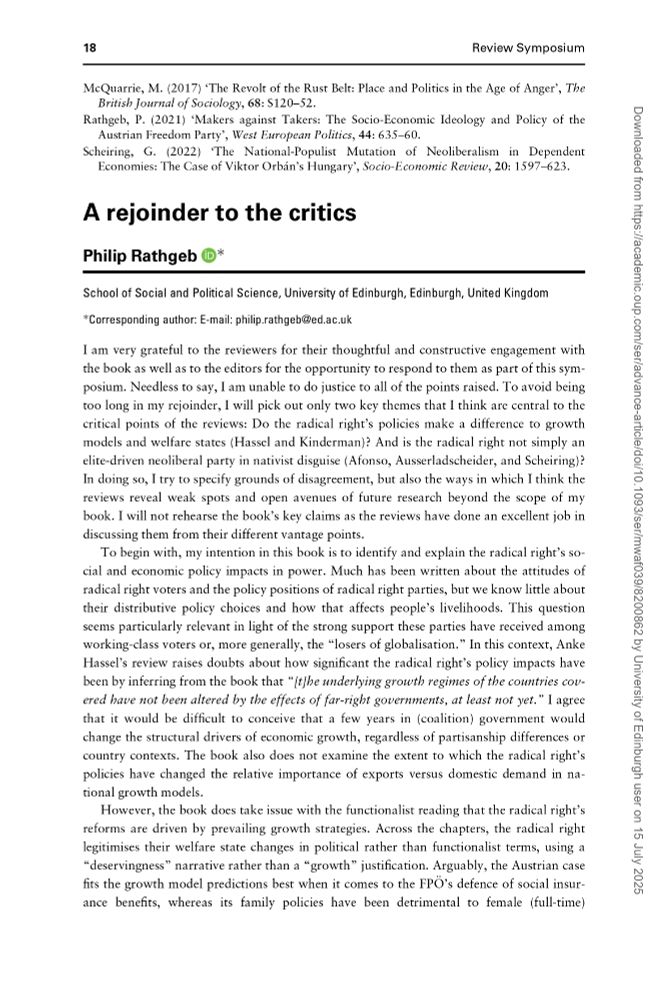
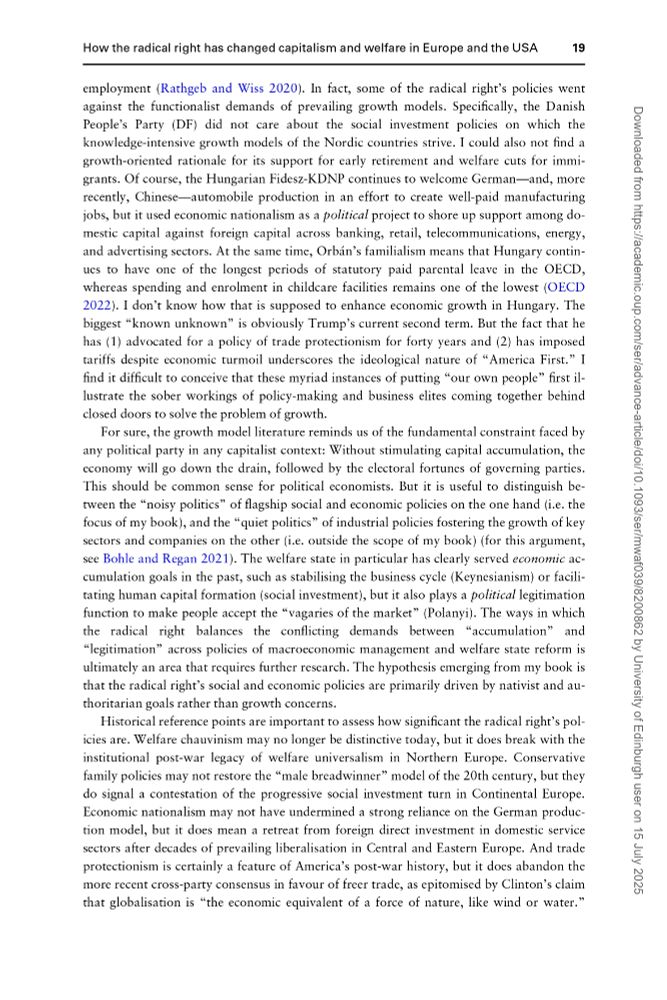
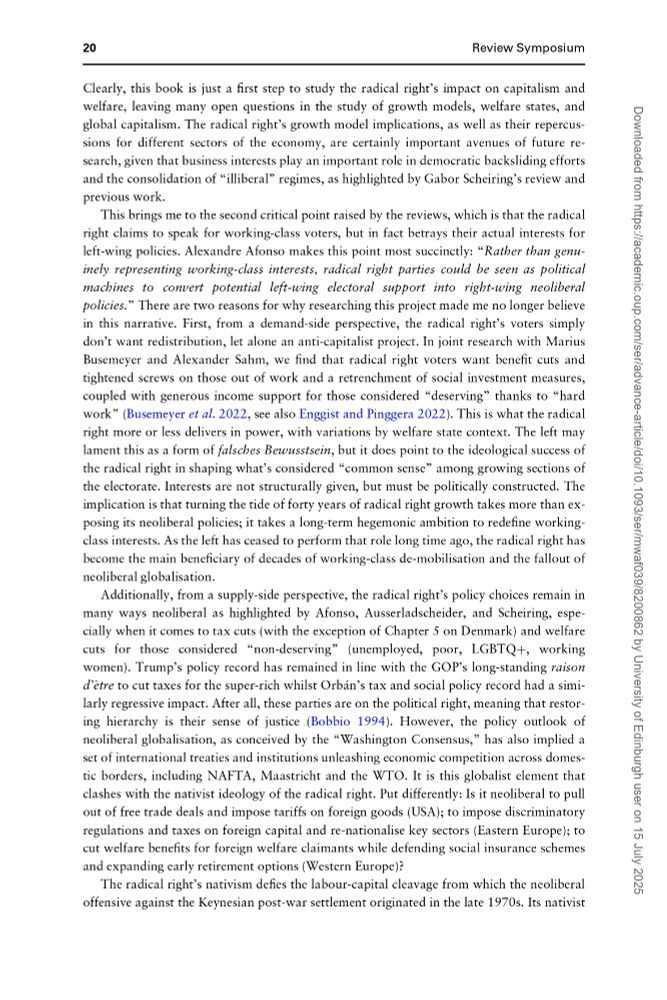
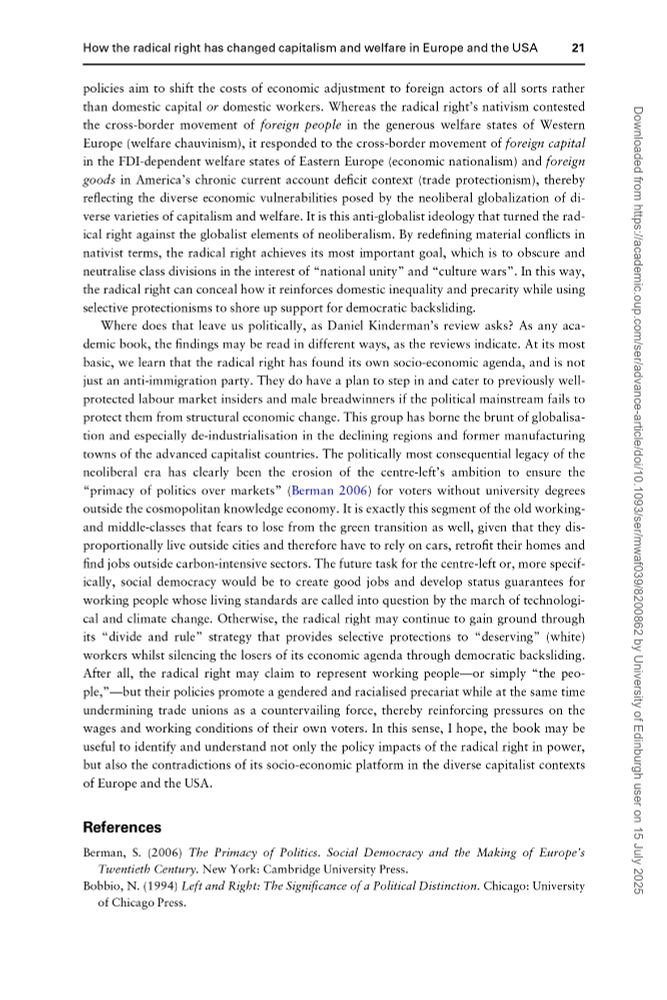
Glad to share a symposium on my book "How the Radical Right Has Changed Capitalism and Welfare" with SER: academic.oup.com/ser/advance-....
Featuring @alexandreafonso.bsky.social, @vapunkt.bsky.social, @ankehassel.bsky.social, @danielk24.bsky.social, @gscheiring.bsky.social, & rejoinder by myself 👇
Featuring @alexandreafonso.bsky.social, @vapunkt.bsky.social, @ankehassel.bsky.social, @danielk24.bsky.social, @gscheiring.bsky.social, & rejoinder by myself 👇
July 15, 2025 at 8:32 AM
Glad to share a symposium on my book "How the Radical Right Has Changed Capitalism and Welfare" with SER: academic.oup.com/ser/advance-....
Featuring @alexandreafonso.bsky.social, @vapunkt.bsky.social, @ankehassel.bsky.social, @danielk24.bsky.social, @gscheiring.bsky.social, & rejoinder by myself 👇
Featuring @alexandreafonso.bsky.social, @vapunkt.bsky.social, @ankehassel.bsky.social, @danielk24.bsky.social, @gscheiring.bsky.social, & rejoinder by myself 👇
Reposted by Timo Wiesner

Very happy to be part of this special issue on "Gender and Wealth Accumulation" in @sasemeeting.bsky.social next to a fantastic group of scholars ✨
@dariatisch.bsky.social @schechtlm.bsky.social @nicolekapelle.bsky.social @pmlersch.bsky.social @shayobrien.bsky.social academic.oup.com/ser/article/...
@dariatisch.bsky.social @schechtlm.bsky.social @nicolekapelle.bsky.social @pmlersch.bsky.social @shayobrien.bsky.social academic.oup.com/ser/article/...
Gender and wealth accumulation: an international perspective
Abstract. Why do women accumulate less wealth than men globally? As wealth inequality rises both within countries and worldwide, studies on gender and weal
https://academic.oup.com/ser/article/23/2/479/8190030?login=true#no-access-message#no-access-message
July 7, 2025 at 5:21 PM
Very happy to be part of this special issue on "Gender and Wealth Accumulation" in @sasemeeting.bsky.social next to a fantastic group of scholars ✨
@dariatisch.bsky.social @schechtlm.bsky.social @nicolekapelle.bsky.social @pmlersch.bsky.social @shayobrien.bsky.social academic.oup.com/ser/article/...
@dariatisch.bsky.social @schechtlm.bsky.social @nicolekapelle.bsky.social @pmlersch.bsky.social @shayobrien.bsky.social academic.oup.com/ser/article/...
Reposted by Timo Wiesner
1/3) 📣Out in Party Politics:
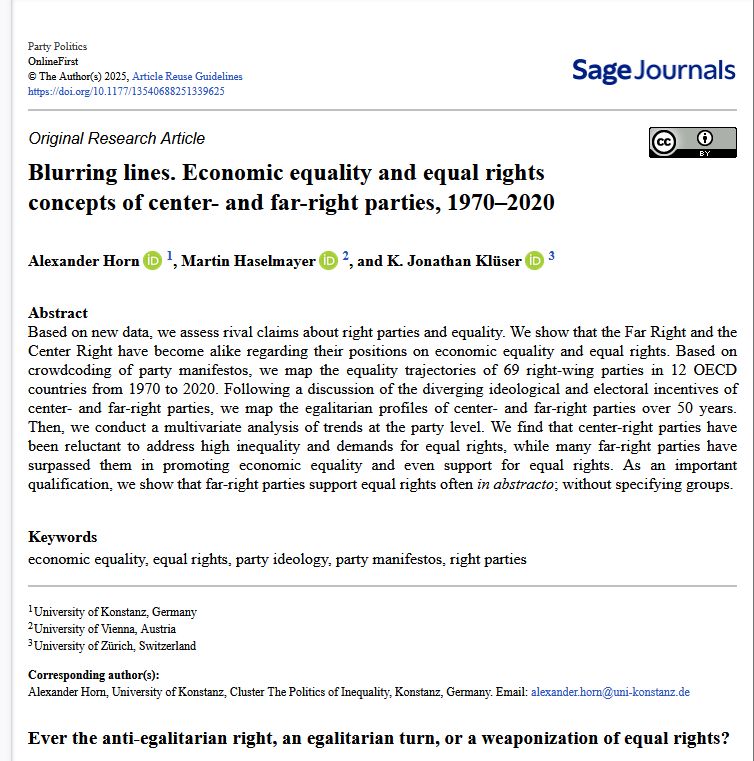
We trace the equal rights and economic equality positions of 69 center-right and far-right parties since 1970 in 12 countries. We find that center right parties did not react to/address equal rights concerns and economic inequality
journals.sagepub.com/doi/epub/10....
We trace the equal rights and economic equality positions of 69 center-right and far-right parties since 1970 in 12 countries. We find that center right parties did not react to/address equal rights concerns and economic inequality
journals.sagepub.com/doi/epub/10....
July 4, 2025 at 10:18 AM
1/3) 📣Out in Party Politics:
We trace the equal rights and economic equality positions of 69 center-right and far-right parties since 1970 in 12 countries. We find that center right parties did not react to/address equal rights concerns and economic inequality
journals.sagepub.com/doi/epub/10....
We trace the equal rights and economic equality positions of 69 center-right and far-right parties since 1970 in 12 countries. We find that center right parties did not react to/address equal rights concerns and economic inequality
journals.sagepub.com/doi/epub/10....
Reposted by Timo Wiesner
📬🚩
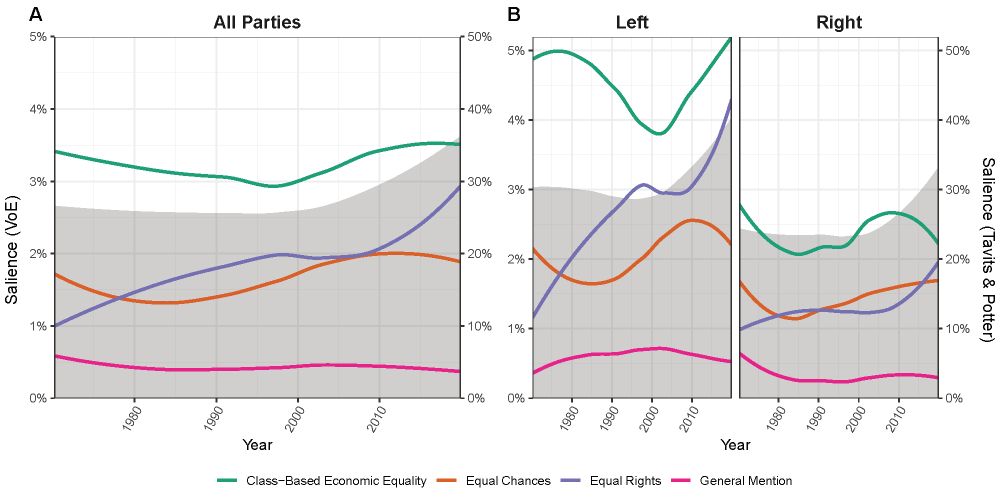
Our article on parties' programmatic responses to inequality - and more often the lack of responses - will come out in APSR!
Here is the @excinequality.bsky.social working paper:
kops.uni-konstanz.de/bitstreams/4...
with @klueserthan.bsky.social & Martin Haselmayer 🧗🙏
Our article on parties' programmatic responses to inequality - and more often the lack of responses - will come out in APSR!
Here is the @excinequality.bsky.social working paper:
kops.uni-konstanz.de/bitstreams/4...
with @klueserthan.bsky.social & Martin Haselmayer 🧗🙏
June 23, 2025 at 9:06 AM
📬🚩
Our article on parties' programmatic responses to inequality - and more often the lack of responses - will come out in APSR!
Here is the @excinequality.bsky.social working paper:
kops.uni-konstanz.de/bitstreams/4...
with @klueserthan.bsky.social & Martin Haselmayer 🧗🙏
Our article on parties' programmatic responses to inequality - and more often the lack of responses - will come out in APSR!
Here is the @excinequality.bsky.social working paper:
kops.uni-konstanz.de/bitstreams/4...
with @klueserthan.bsky.social & Martin Haselmayer 🧗🙏
Reposted by Timo Wiesner
We are seeing multiple instances of reviewers doing manuscript reviews via use of AI/LLM.
If you don't want to do a review the old-fashioned way, better to decline the request.
Giving someone else's manuscript to AI is a violation of intellectual property rights/laws; the manuscript isn't yours...
If you don't want to do a review the old-fashioned way, better to decline the request.
Giving someone else's manuscript to AI is a violation of intellectual property rights/laws; the manuscript isn't yours...
May 11, 2025 at 11:24 AM
We are seeing multiple instances of reviewers doing manuscript reviews via use of AI/LLM.
If you don't want to do a review the old-fashioned way, better to decline the request.
Giving someone else's manuscript to AI is a violation of intellectual property rights/laws; the manuscript isn't yours...
If you don't want to do a review the old-fashioned way, better to decline the request.
Giving someone else's manuscript to AI is a violation of intellectual property rights/laws; the manuscript isn't yours...
Reposted by Timo Wiesner

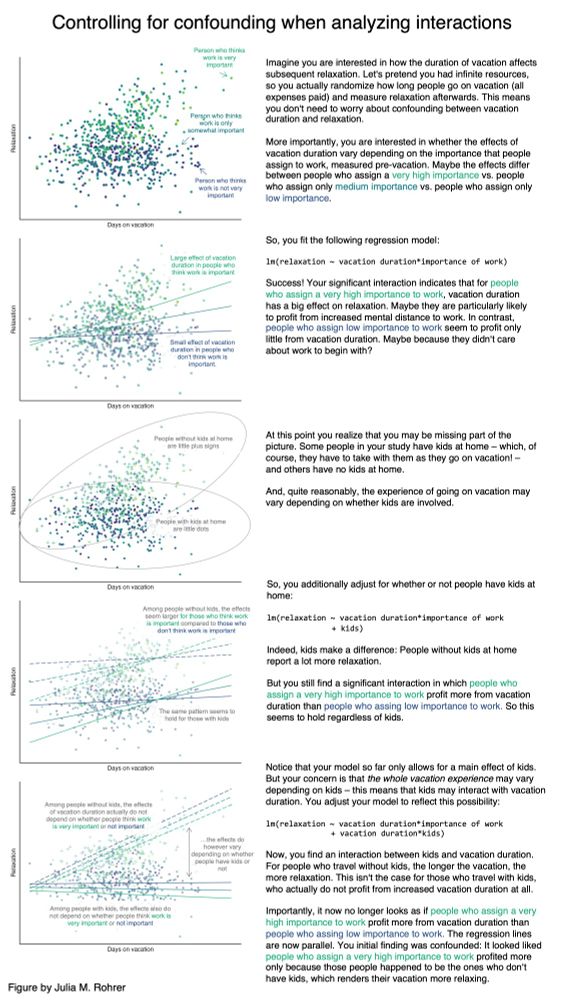
Thanks to everybody who chimed in!
I arrived at the conclusion that (1) there's a lot of interesting stuff about interactions and (2) the figure I was looking for does not exist.
So, I made it myself! Here's a simple illustration of how to control for confounding in interactions:>
I arrived at the conclusion that (1) there's a lot of interesting stuff about interactions and (2) the figure I was looking for does not exist.
So, I made it myself! Here's a simple illustration of how to control for confounding in interactions:>
May 11, 2025 at 5:34 AM
Thanks to everybody who chimed in!
I arrived at the conclusion that (1) there's a lot of interesting stuff about interactions and (2) the figure I was looking for does not exist.
So, I made it myself! Here's a simple illustration of how to control for confounding in interactions:>
I arrived at the conclusion that (1) there's a lot of interesting stuff about interactions and (2) the figure I was looking for does not exist.
So, I made it myself! Here's a simple illustration of how to control for confounding in interactions:>
Reposted by Timo Wiesner
First Wednesday of the month – time for a new In_equality podcast! This time, our hosts @mbusemeyer.bsky.social and Gabriele Spilker @uni-konstanz.de talk with @juandiego48cr.bsky.social about how people (mis-)perceive inequality – and why it matters for politics. ➡️ inequality.uni.kn/podcast


May 7, 2025 at 12:06 PM
First Wednesday of the month – time for a new In_equality podcast! This time, our hosts @mbusemeyer.bsky.social and Gabriele Spilker @uni-konstanz.de talk with @juandiego48cr.bsky.social about how people (mis-)perceive inequality – and why it matters for politics. ➡️ inequality.uni.kn/podcast
Reposted by Timo Wiesner

My first paper of my dissertation 'Patrimonial Relations. Kinship, capital and conflict in super-rich Families' is out now on open access!
Here I discuss how super-rich families use relational work on affective family ties as an economic resource.
@bupjournals.bsky.social
Here I discuss how super-rich families use relational work on affective family ties as an economic resource.
@bupjournals.bsky.social

Family feelings: affective ties and the reproduction of wealth in super-rich families
Rising wealth inequalities, concentrated in the hands of a few super-rich families, have recently sparked sociological interest in how these families sustain and legitimise their wealth across generat...
doi.org
April 28, 2025 at 1:37 PM
My first paper of my dissertation 'Patrimonial Relations. Kinship, capital and conflict in super-rich Families' is out now on open access!
Here I discuss how super-rich families use relational work on affective family ties as an economic resource.
@bupjournals.bsky.social
Here I discuss how super-rich families use relational work on affective family ties as an economic resource.
@bupjournals.bsky.social
Reposted by Timo Wiesner

My colleague Cristobal Young and co-author Erin Cumberworth just released their book on multiverse analysis, a set of tools that help resolve the "garden of forking paths" and "file-drawer" problems and, in the process, improve quantitative social & behavioral science.
Highly recommend.
Highly recommend.

April 19, 2025 at 9:52 PM
My colleague Cristobal Young and co-author Erin Cumberworth just released their book on multiverse analysis, a set of tools that help resolve the "garden of forking paths" and "file-drawer" problems and, in the process, improve quantitative social & behavioral science.
Highly recommend.
Highly recommend.