



Steffen Murau
@steffenmurau.bsky.social
Research group leader OBFA-TRANSFORM project (https://obfa-transform.eu) | Global Climate Forum, Berlin. Freie Universität Berlin. Boston University.
Reposted by Steffen Murau

At the OBFA-TRANSFORM group, we sometimes do videos on our publications - now it was my turn, with @olanmcevoy.bsky.social interviewing me on our paper on the Recovery and Resilience Facility and the limits to incremental fiscal integration in Europe!
www.youtube.com/watch?v=qT7P...
www.youtube.com/watch?v=qT7P...

The Recovery and Resilience Facility: Schrödinger's Off-Balance Sheet Fiscal Agency?
YouTube video by OBFA-TRANSFORM
www.youtube.com
February 13, 2026 at 9:00 AM
At the OBFA-TRANSFORM group, we sometimes do videos on our publications - now it was my turn, with @olanmcevoy.bsky.social interviewing me on our paper on the Recovery and Resilience Facility and the limits to incremental fiscal integration in Europe!
www.youtube.com/watch?v=qT7P...
www.youtube.com/watch?v=qT7P...
📝 Our report on the transformation of South Africa’s monetary architecture (1983-2024) co-authored with Mark Swilling for the National Planning Commission of South Africa has been launched last week! 📝
Find the full report here: www.nationalplanningcommission.org.za/assets/Docum...
Find the full report here: www.nationalplanningcommission.org.za/assets/Docum...

December 10, 2025 at 2:05 PM
📝 Our report on the transformation of South Africa’s monetary architecture (1983-2024) co-authored with Mark Swilling for the National Planning Commission of South Africa has been launched last week! 📝
Find the full report here: www.nationalplanningcommission.org.za/assets/Docum...
Find the full report here: www.nationalplanningcommission.org.za/assets/Docum...
We recently published a study on the transformation of the Eurozone architecture (🔗 papers.ssrn.com/sol3/papers...., with Alex Goghie, Matteo Giordano & @rikereimer.bsky.social) and launched an accompanying interactive online tool (🔗 monetary-architecture.com).
This is how it came to be 👇
This is how it came to be 👇


December 4, 2025 at 3:27 PM
We recently published a study on the transformation of the Eurozone architecture (🔗 papers.ssrn.com/sol3/papers...., with Alex Goghie, Matteo Giordano & @rikereimer.bsky.social) and launched an accompanying interactive online tool (🔗 monetary-architecture.com).
This is how it came to be 👇
This is how it came to be 👇
🚀 To accompany our recent study on the transformation of the Eurozone architecture, we are also launching an interactive online tool. Check out monetary-architecture.com

December 2, 2025 at 8:50 AM
🚀 To accompany our recent study on the transformation of the Eurozone architecture, we are also launching an interactive online tool. Check out monetary-architecture.com
📝 New publication 📝
We have now published our study on the Transformation of the Eurozone Architecture, co-authored with Alex Goghie, Matteo Giordano, and @rikereimer.bsky.social
papers.ssrn.com/sol3/papers....
We have now published our study on the Transformation of the Eurozone Architecture, co-authored with Alex Goghie, Matteo Giordano, and @rikereimer.bsky.social
papers.ssrn.com/sol3/papers....

November 26, 2025 at 11:04 AM
📝 New publication 📝
We have now published our study on the Transformation of the Eurozone Architecture, co-authored with Alex Goghie, Matteo Giordano, and @rikereimer.bsky.social
papers.ssrn.com/sol3/papers....
We have now published our study on the Transformation of the Eurozone Architecture, co-authored with Alex Goghie, Matteo Giordano, and @rikereimer.bsky.social
papers.ssrn.com/sol3/papers....
📣 News from the OBFA-TRANSFORM project 📣
Our Emmy Noether research group is fast approaching its halfway point and we’ve recently received confirmation of funding from @dfg.de for the second project period from 2026 to 2029 🎊
That's why we are launching our new website at obfa-transform.eu
Our Emmy Noether research group is fast approaching its halfway point and we’ve recently received confirmation of funding from @dfg.de for the second project period from 2026 to 2029 🎊
That's why we are launching our new website at obfa-transform.eu

November 24, 2025 at 1:21 PM
📣 News from the OBFA-TRANSFORM project 📣
Our Emmy Noether research group is fast approaching its halfway point and we’ve recently received confirmation of funding from @dfg.de for the second project period from 2026 to 2029 🎊
That's why we are launching our new website at obfa-transform.eu
Our Emmy Noether research group is fast approaching its halfway point and we’ve recently received confirmation of funding from @dfg.de for the second project period from 2026 to 2029 🎊
That's why we are launching our new website at obfa-transform.eu
Reposted by Steffen Murau

Gemeinsam mit Armin Haas und @steffenmurau.bsky.social argumentieren wir in einer neuen Studie bei der @swp-berlin.org, dass solche Einrichtungen auch heute wieder eine Rolle spielen könnten:
👉 Link: www.swp-berlin.org/publikation/...
👉 Link: www.swp-berlin.org/publikation/...

Mehr Macht, weniger Markt – Denken und Handeln in der geoökonomischen Zeitenwende
Die Rückkehr von Macht auf den Markt ist das Wesensmerkmal einer geoökonomischen Zeitenwende, wie sie die internationale Politik derzeit...
www.swp-berlin.org
November 14, 2025 at 3:40 PM
Gemeinsam mit Armin Haas und @steffenmurau.bsky.social argumentieren wir in einer neuen Studie bei der @swp-berlin.org, dass solche Einrichtungen auch heute wieder eine Rolle spielen könnten:
👉 Link: www.swp-berlin.org/publikation/...
👉 Link: www.swp-berlin.org/publikation/...
Reposted by Steffen Murau

Nimmt der Staat zu viele Schulden auf? Ob das tragfähig ist, ist eine Frage des Finanzsystems. Das entscheidende Stichwort lautet »Fundierung«, schreiben @steffenmurau.bsky.social und Moritz Kapff.

Hyperinflation durch neue Schulden? 4 Sichtweisen auf nachhaltige Staatsfinanzen
Nimmt der Staat zu viele Schulden auf? Ob das tragfähig ist, ist eine Frage des Finanzsystems. Das entscheidende Stichwort lautet »Fundierung«.
www.surplusmagazin.de
October 31, 2025 at 8:10 AM
Nimmt der Staat zu viele Schulden auf? Ob das tragfähig ist, ist eine Frage des Finanzsystems. Das entscheidende Stichwort lautet »Fundierung«, schreiben @steffenmurau.bsky.social und Moritz Kapff.
Reposted by Steffen Murau

Mit Beiträgen von @andreabinder.bsky.social @steffenmurau.bsky.social @martynalinartas.bsky.social @carolinmueller.bsky.social @larsdoepking.bsky.social @c-westermeier.bsky.social Patrick Samtlebe, Philip Manow, Janosch Prinz, Jenny Stupka, Jürgen Unger-Sirsch, Christian Neuhäuser und mehr!

October 24, 2025 at 9:41 AM
Mit Beiträgen von @andreabinder.bsky.social @steffenmurau.bsky.social @martynalinartas.bsky.social @carolinmueller.bsky.social @larsdoepking.bsky.social @c-westermeier.bsky.social Patrick Samtlebe, Philip Manow, Janosch Prinz, Jenny Stupka, Jürgen Unger-Sirsch, Christian Neuhäuser und mehr!
Reposted by Steffen Murau

'Sondervermögen' eigener Art vormerken: Leviathan-Sonderband 2025
POLITISCHE THEORIEN ÖFFENTLICHER FINANZEN.
ZUR (DE-)POLITISIERUNG VON GELD, EIGENTUM UND STEUERN,
hrsg. mit Aaron Sahr & Eva Weiler und mit vielen tollen Beiträgen u.a. von…
POLITISCHE THEORIEN ÖFFENTLICHER FINANZEN.
ZUR (DE-)POLITISIERUNG VON GELD, EIGENTUM UND STEUERN,
hrsg. mit Aaron Sahr & Eva Weiler und mit vielen tollen Beiträgen u.a. von…
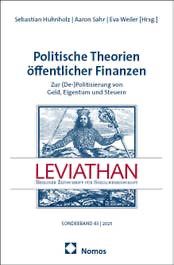
Politische Theorien öffentlicher Finanzen
www.nomos-shop.de
June 25, 2025 at 10:46 AM
'Sondervermögen' eigener Art vormerken: Leviathan-Sonderband 2025
POLITISCHE THEORIEN ÖFFENTLICHER FINANZEN.
ZUR (DE-)POLITISIERUNG VON GELD, EIGENTUM UND STEUERN,
hrsg. mit Aaron Sahr & Eva Weiler und mit vielen tollen Beiträgen u.a. von…
POLITISCHE THEORIEN ÖFFENTLICHER FINANZEN.
ZUR (DE-)POLITISIERUNG VON GELD, EIGENTUM UND STEUERN,
hrsg. mit Aaron Sahr & Eva Weiler und mit vielen tollen Beiträgen u.a. von…
Very happy to see that the article @moritzecon.bsky.social and I have written on Germany's "fiscal ecosystem" has just been published online and in print in Surplus Magazine
www.surplusmagazin.de/staat-schatt...
www.surplusmagazin.de/staat-schatt...

Das fiskalische Ökosystem
Schattenhaushalte sind keine Ausnahme, sondern seit Jahrzehnten fester Bestandteil der Staatsfinanzen. Sie spiegeln die deutsche Geschichte.
www.surplusmagazin.de
June 17, 2025 at 7:18 AM
Very happy to see that the article @moritzecon.bsky.social and I have written on Germany's "fiscal ecosystem" has just been published online and in print in Surplus Magazine
www.surplusmagazin.de/staat-schatt...
www.surplusmagazin.de/staat-schatt...
Reposted by Steffen Murau
🚨 Out now: Die dritte Surplus-Ausgabe »Wir kümmern uns« ist da.
Neoliberale schaffen einen Staat, der die Menschen allein lässt. Doch es braucht gemeinsame Fürsorge.
In den nächsten Tagen im Briefkasten, am Kiosk oder sofort online auf:
👉 www.surplusmagazin.de/surplus-3-wi...
Neoliberale schaffen einen Staat, der die Menschen allein lässt. Doch es braucht gemeinsame Fürsorge.
In den nächsten Tagen im Briefkasten, am Kiosk oder sofort online auf:
👉 www.surplusmagazin.de/surplus-3-wi...

June 16, 2025 at 10:12 AM
🚨 Out now: Die dritte Surplus-Ausgabe »Wir kümmern uns« ist da.
Neoliberale schaffen einen Staat, der die Menschen allein lässt. Doch es braucht gemeinsame Fürsorge.
In den nächsten Tagen im Briefkasten, am Kiosk oder sofort online auf:
👉 www.surplusmagazin.de/surplus-3-wi...
Neoliberale schaffen einen Staat, der die Menschen allein lässt. Doch es braucht gemeinsame Fürsorge.
In den nächsten Tagen im Briefkasten, am Kiosk oder sofort online auf:
👉 www.surplusmagazin.de/surplus-3-wi...
Reposted by Steffen Murau

Really great piece by @katie0martin.ft.com on our recent euro internationalisation paper, rightly concluding that fear of "industrial amounts of arguing" remains the EU's biggest obstacle www.ft.com/content/16e7...

The EU needs to step up its challenge to the dollar
The euro should be developed more as a haven asset for times of market stress
www.ft.com
May 24, 2025 at 10:14 AM
Really great piece by @katie0martin.ft.com on our recent euro internationalisation paper, rightly concluding that fear of "industrial amounts of arguing" remains the EU's biggest obstacle www.ft.com/content/16e7...
🐈⬛🐈⬛🐈⬛
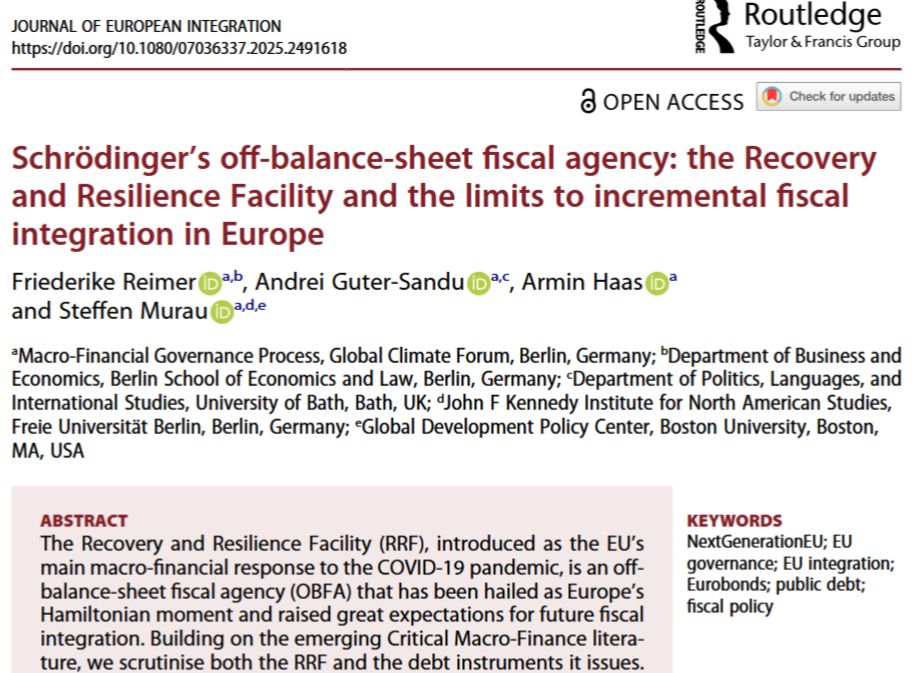
🚨 Publication Alert 🚨
Out now in @jei-publication.bsky.social with @steffenmurau.bsky.social @agutersandu.bsky.social and Armin Haas:
Issuing EU debt despite fiscal rules, what we can learn from the limitations of the EU covid recovery fund, and what it all has to do with a famous cat ⬇️
🧵
Out now in @jei-publication.bsky.social with @steffenmurau.bsky.social @agutersandu.bsky.social and Armin Haas:
Issuing EU debt despite fiscal rules, what we can learn from the limitations of the EU covid recovery fund, and what it all has to do with a famous cat ⬇️
🧵
May 20, 2025 at 10:58 AM
🐈⬛🐈⬛🐈⬛
Reposted by Steffen Murau
#empiresuicidewatch
A bit late to this but if you want to understand how the moody’s downgrade might affect US dollar global dominance you could see what @steffenmurau.bsky.social and i have to say here about the structural bases for US dollar dominance
papers.ssrn.com/sol3/papers....
A bit late to this but if you want to understand how the moody’s downgrade might affect US dollar global dominance you could see what @steffenmurau.bsky.social and i have to say here about the structural bases for US dollar dominance
papers.ssrn.com/sol3/papers....
Decoding Dollar Dominance. The Global Credit View on the Monetary System in International Political Economy
Sovereign Currency View (SCV) and the Global Credit View (GCV) on the international monetary system regarding four crucial assumptions: credit theory of money i
papers.ssrn.com
May 19, 2025 at 6:18 PM
#empiresuicidewatch
A bit late to this but if you want to understand how the moody’s downgrade might affect US dollar global dominance you could see what @steffenmurau.bsky.social and i have to say here about the structural bases for US dollar dominance
papers.ssrn.com/sol3/papers....
A bit late to this but if you want to understand how the moody’s downgrade might affect US dollar global dominance you could see what @steffenmurau.bsky.social and i have to say here about the structural bases for US dollar dominance
papers.ssrn.com/sol3/papers....
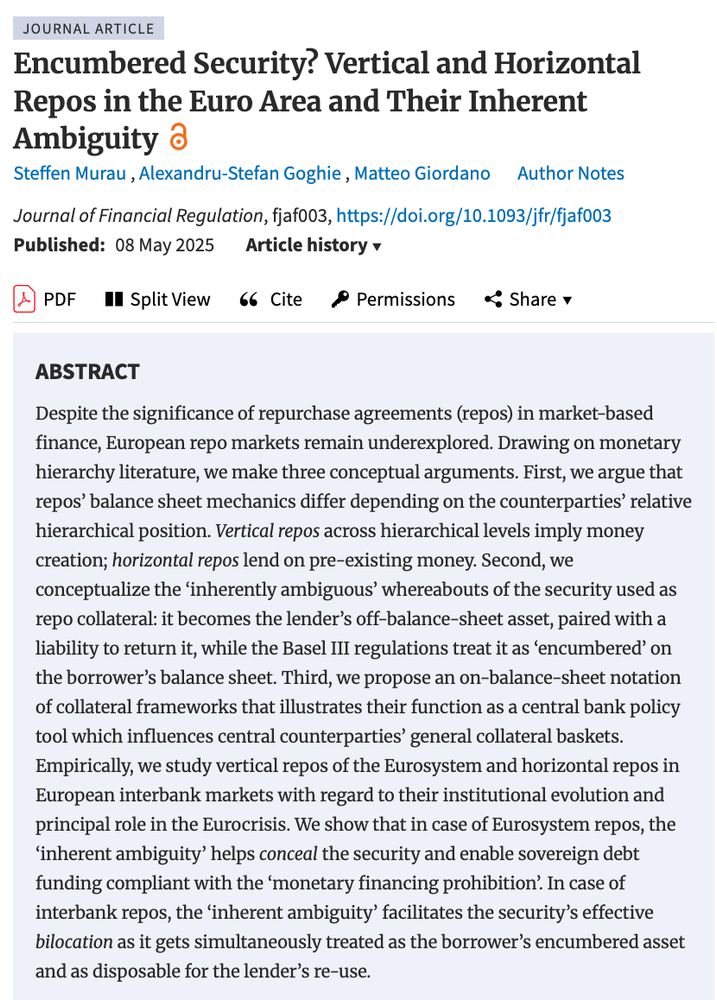
🚨 New open access article 🚨
Out now in Journal of Financial Regulation with Alex Goghie and Matteo Giordano
'Encumbered Security? Vertical and Horizontal Repos in the Euro Area and Their Inherent Ambiguity'
academic.oup.com/jfr/advance-...
Out now in Journal of Financial Regulation with Alex Goghie and Matteo Giordano
'Encumbered Security? Vertical and Horizontal Repos in the Euro Area and Their Inherent Ambiguity'
academic.oup.com/jfr/advance-...
May 14, 2025 at 9:44 AM
🚨 New open access article 🚨
Out now in Journal of Financial Regulation with Alex Goghie and Matteo Giordano
'Encumbered Security? Vertical and Horizontal Repos in the Euro Area and Their Inherent Ambiguity'
academic.oup.com/jfr/advance-...
Out now in Journal of Financial Regulation with Alex Goghie and Matteo Giordano
'Encumbered Security? Vertical and Horizontal Repos in the Euro Area and Their Inherent Ambiguity'
academic.oup.com/jfr/advance-...
Reposted by Steffen Murau
Finally out #openaccess! Why does the largest trading bloc on the planet have a miniature-sized currency? With Trump, the EU will again much regret this.
🎈We set out to theorise failure and develop a new IPE perspective that foregrounds offshore money.
Quick thread 🧵
🎈We set out to theorise failure and develop a new IPE perspective that foregrounds offshore money.
Quick thread 🧵
Markets won’t do it alone ❌
@jvtk.bsky.social and @steffenmurau.bsky.social argue that euro internationalisation keeps falling flat without active offshore monetary governance 👇
@jvtk.bsky.social and @steffenmurau.bsky.social argue that euro internationalisation keeps falling flat without active offshore monetary governance 👇
Rethinking currency internationalisation: offshore money creation and the EU’s monetary governance
Internationalisation of the euro has for decades eluded EU policymakers. In this article, we develop a novel explanation of the subordinate position of the single currency. To this end, we build on...
www.tandfonline.com
May 12, 2025 at 10:21 AM
Finally out #openaccess! Why does the largest trading bloc on the planet have a miniature-sized currency? With Trump, the EU will again much regret this.
🎈We set out to theorise failure and develop a new IPE perspective that foregrounds offshore money.
Quick thread 🧵
🎈We set out to theorise failure and develop a new IPE perspective that foregrounds offshore money.
Quick thread 🧵
Reposted by Steffen Murau

Markets won’t do it alone ❌
@jvtk.bsky.social and @steffenmurau.bsky.social argue that euro internationalisation keeps falling flat without active offshore monetary governance 👇
@jvtk.bsky.social and @steffenmurau.bsky.social argue that euro internationalisation keeps falling flat without active offshore monetary governance 👇
Rethinking currency internationalisation: offshore money creation and the EU’s monetary governance
Internationalisation of the euro has for decades eluded EU policymakers. In this article, we develop a novel explanation of the subordinate position of the single currency. To this end, we build on...
www.tandfonline.com
May 12, 2025 at 7:54 AM
Markets won’t do it alone ❌
@jvtk.bsky.social and @steffenmurau.bsky.social argue that euro internationalisation keeps falling flat without active offshore monetary governance 👇
@jvtk.bsky.social and @steffenmurau.bsky.social argue that euro internationalisation keeps falling flat without active offshore monetary governance 👇
Reposted by Steffen Murau

You gotta pay attention, but this is really good.
h/t @neilirwin.bsky.social
“Any country other than the US precipitously raising and lowering tariffs, gutting its Internal Revenue Service and nonchalantly considering territorial grabs would have seen smoking-hot capital flight months ago.”
h/t @neilirwin.bsky.social
“Any country other than the US precipitously raising and lowering tariffs, gutting its Internal Revenue Service and nonchalantly considering territorial grabs would have seen smoking-hot capital flight months ago.”

The dollar system has always been vulnerable to presidential whim
But only now are asset managers beginning to reconsider the story of America as an inexhaustible well of safe bets
www.ft.com
April 11, 2025 at 11:22 PM
You gotta pay attention, but this is really good.
h/t @neilirwin.bsky.social
“Any country other than the US precipitously raising and lowering tariffs, gutting its Internal Revenue Service and nonchalantly considering territorial grabs would have seen smoking-hot capital flight months ago.”
h/t @neilirwin.bsky.social
“Any country other than the US precipitously raising and lowering tariffs, gutting its Internal Revenue Service and nonchalantly considering territorial grabs would have seen smoking-hot capital flight months ago.”
Reposted by Steffen Murau

Research seminar on Money and Payments: Evolution or Revolution? with Jörg Bibow next week at @hertieschool.bsky.social in cooperation with Global Climate Forum.
Organized by @steffenmurau.bsky.social and Monica DiLeo.
Registration (optional): globalclimateforum.org/2025/04/01/money-and-payments/
Organized by @steffenmurau.bsky.social and Monica DiLeo.
Registration (optional): globalclimateforum.org/2025/04/01/money-and-payments/

April 1, 2025 at 1:34 PM
Research seminar on Money and Payments: Evolution or Revolution? with Jörg Bibow next week at @hertieschool.bsky.social in cooperation with Global Climate Forum.
Organized by @steffenmurau.bsky.social and Monica DiLeo.
Registration (optional): globalclimateforum.org/2025/04/01/money-and-payments/
Organized by @steffenmurau.bsky.social and Monica DiLeo.
Registration (optional): globalclimateforum.org/2025/04/01/money-and-payments/
Reposted by Steffen Murau
"Getting rid of the dollar: A users guide for Europeans"!
🔥🔥🔥
My 5 cents for @euobserver.com with the amazing @westervangaal.bsky.social on recent paper with @steffenmurau.bsky.social
🔥🔥🔥
My 5 cents for @euobserver.com with the amazing @westervangaal.bsky.social on recent paper with @steffenmurau.bsky.social
Trump’s trade war & default threats have rattled dollar markets.
Here I draw on @jvtk.bsky.social @steffenmurau.bsky.social to explore what it would take for the euro to dethrone the dollar as global reserve currency.
"The infrastructure is there, what’s missing is political will"
Here I draw on @jvtk.bsky.social @steffenmurau.bsky.social to explore what it would take for the euro to dethrone the dollar as global reserve currency.
"The infrastructure is there, what’s missing is political will"

As Trump ramps up his trade war, two economists outline how Europe could finally turn the euro into a global currency.
April 1, 2025 at 10:31 AM
"Getting rid of the dollar: A users guide for Europeans"!
🔥🔥🔥
My 5 cents for @euobserver.com with the amazing @westervangaal.bsky.social on recent paper with @steffenmurau.bsky.social
🔥🔥🔥
My 5 cents for @euobserver.com with the amazing @westervangaal.bsky.social on recent paper with @steffenmurau.bsky.social
Reposted by Steffen Murau
🚨 Not an April Fools' joke! 🚨 OBFA-TRANSFORM is now on YouTube!
Our first video? A deep dive into Steffen Murau’s PhD thesis on private money with Gerhardt Kaltenherberg—serious content, no pranks.
As DoP & Editor, I made sure it looks as good as the theory sounds.
🎥 youtu.be/YaMGfMB2FMc
Our first video? A deep dive into Steffen Murau’s PhD thesis on private money with Gerhardt Kaltenherberg—serious content, no pranks.
As DoP & Editor, I made sure it looks as good as the theory sounds.
🎥 youtu.be/YaMGfMB2FMc
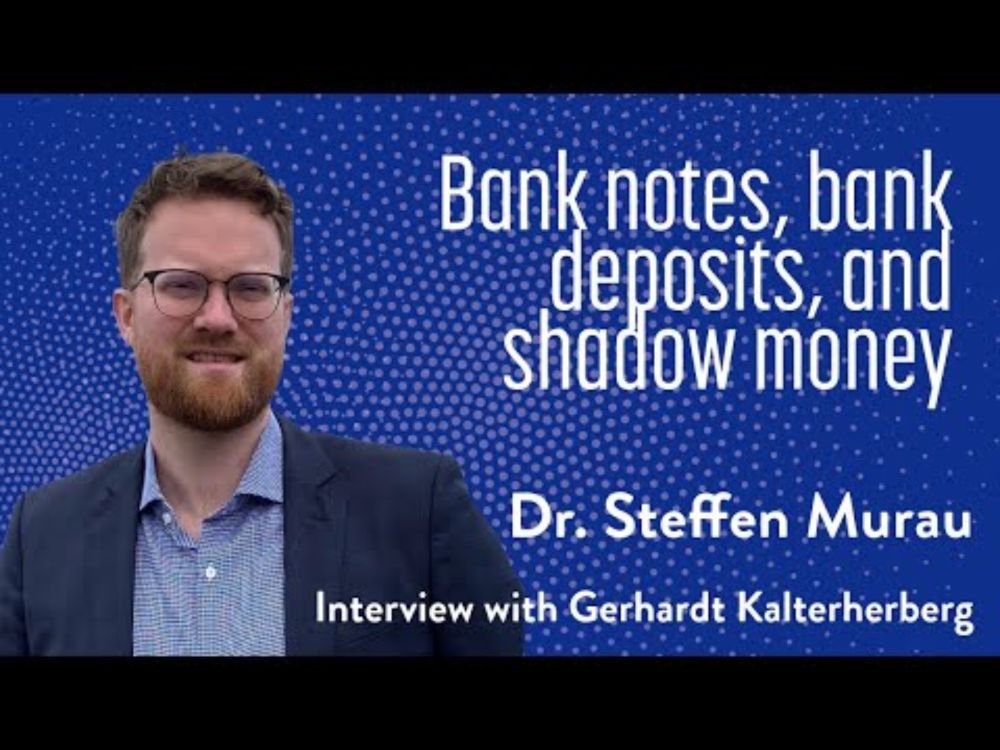
Steffen Murau & Gerhardt Kalterherberg | The Political Economy of Private Credit Money Accommodation
YouTube video by The OBFA Transform project
youtu.be
April 1, 2025 at 10:32 AM
🚨 Not an April Fools' joke! 🚨 OBFA-TRANSFORM is now on YouTube!
Our first video? A deep dive into Steffen Murau’s PhD thesis on private money with Gerhardt Kaltenherberg—serious content, no pranks.
As DoP & Editor, I made sure it looks as good as the theory sounds.
🎥 youtu.be/YaMGfMB2FMc
Our first video? A deep dive into Steffen Murau’s PhD thesis on private money with Gerhardt Kaltenherberg—serious content, no pranks.
As DoP & Editor, I made sure it looks as good as the theory sounds.
🎥 youtu.be/YaMGfMB2FMc
Reposted by Steffen Murau

Trump’s trade war & default threats have rattled dollar markets.
Here I draw on @jvtk.bsky.social @steffenmurau.bsky.social to explore what it would take for the euro to dethrone the dollar as global reserve currency.
"The infrastructure is there, what’s missing is political will"
Here I draw on @jvtk.bsky.social @steffenmurau.bsky.social to explore what it would take for the euro to dethrone the dollar as global reserve currency.
"The infrastructure is there, what’s missing is political will"
As Trump ramps up his trade war, two economists outline how Europe could finally turn the euro into a global currency.

What would it take for euro to dethrone king US dollar?
As Trump ramps up his trade war, two economists outline how Europe could finally turn the euro into a global currency.
euobserver.com
April 1, 2025 at 10:09 AM
Trump’s trade war & default threats have rattled dollar markets.
Here I draw on @jvtk.bsky.social @steffenmurau.bsky.social to explore what it would take for the euro to dethrone the dollar as global reserve currency.
"The infrastructure is there, what’s missing is political will"
Here I draw on @jvtk.bsky.social @steffenmurau.bsky.social to explore what it would take for the euro to dethrone the dollar as global reserve currency.
"The infrastructure is there, what’s missing is political will"
Reposted by Steffen Murau

6. @agutersandu.bsky.social, Armin Haas and @steffenmurau.bsky.social applied their monetary architecture framework to the European green transition and show us the way of how to actually finance such a large-scale transformation
journals.sagepub.com/doi/full/10....
journals.sagepub.com/doi/full/10....

March 13, 2025 at 7:30 PM
6. @agutersandu.bsky.social, Armin Haas and @steffenmurau.bsky.social applied their monetary architecture framework to the European green transition and show us the way of how to actually finance such a large-scale transformation
journals.sagepub.com/doi/full/10....
journals.sagepub.com/doi/full/10....
Reposted by Steffen Murau
a few years in the making: our special issue on the IPE of Green Finance is complete!
🧵on its content:
1. Sarah Sharma and I wrote a (long) editorial introducing the idea of a green finance ecosystem and calling for a 'deep engagement' of IPE w. gr. finance 👇
journals.sagepub.com/doi/10.1177/...
🧵on its content:
1. Sarah Sharma and I wrote a (long) editorial introducing the idea of a green finance ecosystem and calling for a 'deep engagement' of IPE w. gr. finance 👇
journals.sagepub.com/doi/10.1177/...

March 13, 2025 at 7:30 PM
a few years in the making: our special issue on the IPE of Green Finance is complete!
🧵on its content:
1. Sarah Sharma and I wrote a (long) editorial introducing the idea of a green finance ecosystem and calling for a 'deep engagement' of IPE w. gr. finance 👇
journals.sagepub.com/doi/10.1177/...
🧵on its content:
1. Sarah Sharma and I wrote a (long) editorial introducing the idea of a green finance ecosystem and calling for a 'deep engagement' of IPE w. gr. finance 👇
journals.sagepub.com/doi/10.1177/...