



Rémi Flamary
@rflamary.bsky.social
ML Professor at École Polytechnique. Python open source developer. Co-creator/maintainer of POT, SKADA. https://remi.flamary.com/
Reposted by Rémi Flamary
Doing a PhD is - at heart - one long discussion with your mentor. The discussion changes over time - with unexpected turns and ups & downs - but through it all is a pair of people discussing a topic endlessly to make sense of it.
PhD students: choose someone you like to talk to!
PhD students: choose someone you like to talk to!
December 19, 2025 at 4:35 PM
Doing a PhD is - at heart - one long discussion with your mentor. The discussion changes over time - with unexpected turns and ups & downs - but through it all is a pair of people discussing a topic endlessly to make sense of it.
PhD students: choose someone you like to talk to!
PhD students: choose someone you like to talk to!
Reposted by Rémi Flamary

Telling your students about research before the ImageNet moment

December 21, 2025 at 6:53 PM
Telling your students about research before the ImageNet moment
I missed this post but it is pure gold. www.colincornaby.me/2025/08/in-t...

In the Future All Food Will Be Cooked in a Microwave, and if You Can’t Deal With That Then You Need to Get Out of the Kitchen
Update 8/8/2025 – I wrote this the day before a certain post by a popular developer services company. I’ve seen some comments this is a rebuttal – it wasn’t meant to be! But…
www.colincornaby.me
December 15, 2025 at 10:55 AM
I missed this post but it is pure gold. www.colincornaby.me/2025/08/in-t...
Openreview opened the door to continuous and major revisions that nobody has time to check properly.
I think that we should come back to short one pdf page replies to reviews. It would mean having decisions quicker so that we actually have time to work on papers before resubmitting them.
I think that we should come back to short one pdf page replies to reviews. It would mean having decisions quicker so that we actually have time to work on papers before resubmitting them.
December 12, 2025 at 6:55 AM
Openreview opened the door to continuous and major revisions that nobody has time to check properly.
I think that we should come back to short one pdf page replies to reviews. It would mean having decisions quicker so that we actually have time to work on papers before resubmitting them.
I think that we should come back to short one pdf page replies to reviews. It would mean having decisions quicker so that we actually have time to work on papers before resubmitting them.
Reposted by Rémi Flamary

really annoying.
my student just made this joke:
ICLR= I Can Locate Reviewers 😅
my student just made this joke:
ICLR= I Can Locate Reviewers 😅
November 28, 2025 at 3:41 PM
really annoying.
my student just made this joke:
ICLR= I Can Locate Reviewers 😅
my student just made this joke:
ICLR= I Can Locate Reviewers 😅
Reposted by Rémi Flamary

OpenReview was breached. The names of authors, reviewers, ACs, etc, for all past and current conferences were visible for a time, making nothing anonymous anymore. These data have been released for this year's ICLR, but I fear it's also the case for the past 10 years of conferences.

November 28, 2025 at 8:11 AM
OpenReview was breached. The names of authors, reviewers, ACs, etc, for all past and current conferences were visible for a time, making nothing anonymous anymore. These data have been released for this year's ICLR, but I fear it's also the case for the past 10 years of conferences.
AI researchers loose privacy. I guess this is karma for what we have done with the data from everyone 😉. ICLR PC need to freeze all open review forum changes right now because the process is tainted for all future edits

November 27, 2025 at 7:26 PM
AI researchers loose privacy. I guess this is karma for what we have done with the data from everyone 😉. ICLR PC need to freeze all open review forum changes right now because the process is tainted for all future edits
Reposted by Rémi Flamary
Sonia and I will present this work this afternoon at the NeuripS@Paris poster session. Come see us if you are around.
I am happy to share that I will be at NeurIPS in San Diego to present our paper with @rflamary.bsky.social and Bertrand Thirion on optimal transport plan prediction between graphs.
If you are around come say hi!
Paper: arxiv.org/abs/2506.12025
Poster #3703 Friday 5 December 4:30 - 7:30 pm
If you are around come say hi!
Paper: arxiv.org/abs/2506.12025
Poster #3703 Friday 5 December 4:30 - 7:30 pm

Unsupervised Learning for Optimal Transport plan prediction between unbalanced graphs
Optimal transport between graphs, based on Gromov-Wasserstein and other extensions, is a powerful tool for comparing and aligning graph structures. However, solving the associated non-convex optimizat...
arxiv.org
November 26, 2025 at 10:59 AM
Sonia and I will present this work this afternoon at the NeuripS@Paris poster session. Come see us if you are around.
Reposted by Rémi Flamary

I am happy to share that I will be at NeurIPS in San Diego to present our paper with @rflamary.bsky.social and Bertrand Thirion on optimal transport plan prediction between graphs.
If you are around come say hi!
Paper: arxiv.org/abs/2506.12025
Poster #3703 Friday 5 December 4:30 - 7:30 pm
If you are around come say hi!
Paper: arxiv.org/abs/2506.12025
Poster #3703 Friday 5 December 4:30 - 7:30 pm
Unsupervised Learning for Optimal Transport plan prediction between unbalanced graphs
Optimal transport between graphs, based on Gromov-Wasserstein and other extensions, is a powerful tool for comparing and aligning graph structures. However, solving the associated non-convex optimizat...
arxiv.org
November 26, 2025 at 10:55 AM
I am happy to share that I will be at NeurIPS in San Diego to present our paper with @rflamary.bsky.social and Bertrand Thirion on optimal transport plan prediction between graphs.
If you are around come say hi!
Paper: arxiv.org/abs/2506.12025
Poster #3703 Friday 5 December 4:30 - 7:30 pm
If you are around come say hi!
Paper: arxiv.org/abs/2506.12025
Poster #3703 Friday 5 December 4:30 - 7:30 pm
I was worried for a sec but since it's sent from the US this is totally a legitimate scientific publisher and not a predatory journal at all.

November 24, 2025 at 7:35 AM
I was worried for a sec but since it's sent from the US this is totally a legitimate scientific publisher and not a predatory journal at all.
Reposted by Rémi Flamary

Une raison de plus de vous abonner à la chaîne YouTube du colloque #GRETSI :
"Transport optimal, de Monge à l’apprentissage profond", conférence plénière de Julie Delon au colloque #GRETSI2025
www.youtube.com/watch?v=ujYS...
"Transport optimal, de Monge à l’apprentissage profond", conférence plénière de Julie Delon au colloque #GRETSI2025
www.youtube.com/watch?v=ujYS...

Plénière de Julie Delon
YouTube video by GRETSI
www.youtube.com
November 21, 2025 at 10:28 AM
Une raison de plus de vous abonner à la chaîne YouTube du colloque #GRETSI :
"Transport optimal, de Monge à l’apprentissage profond", conférence plénière de Julie Delon au colloque #GRETSI2025
www.youtube.com/watch?v=ujYS...
"Transport optimal, de Monge à l’apprentissage profond", conférence plénière de Julie Delon au colloque #GRETSI2025
www.youtube.com/watch?v=ujYS...
Going to buy this one for my reviews and reply to reviewers. tampographe.com/products/bul...

November 15, 2025 at 8:38 PM
Going to buy this one for my reviews and reply to reviewers. tampographe.com/products/bul...
Reposted by Rémi Flamary

Kyle Kingsbury is not a journalist. He is not an op-ed writer.
He is a computer safety researcher.
And he has written one of the most compelling, comprehensive accounts of the ongoing hell in Chicago that you could possibly imagine.
In under 1600 words.
aphyr.com/posts/397-i-...
He is a computer safety researcher.
And he has written one of the most compelling, comprehensive accounts of the ongoing hell in Chicago that you could possibly imagine.
In under 1600 words.
aphyr.com/posts/397-i-...

November 9, 2025 at 8:49 PM
Kyle Kingsbury is not a journalist. He is not an op-ed writer.
He is a computer safety researcher.
And he has written one of the most compelling, comprehensive accounts of the ongoing hell in Chicago that you could possibly imagine.
In under 1600 words.
aphyr.com/posts/397-i-...
He is a computer safety researcher.
And he has written one of the most compelling, comprehensive accounts of the ongoing hell in Chicago that you could possibly imagine.
In under 1600 words.
aphyr.com/posts/397-i-...
Reposted by Rémi Flamary
This Nature retrospective is quite interesting.
To me, the only solution to the credit assignment problem is obvious: stop believing a single person is responsible for every big discovery. It's an artifact of our monkey brain requiring a face for storage, not the reality of how knowledge progresses.
To me, the only solution to the credit assignment problem is obvious: stop believing a single person is responsible for every big discovery. It's an artifact of our monkey brain requiring a face for storage, not the reality of how knowledge progresses.
"stole Rosalind Franklin's work" has become the new orthodoxy. While she was certainly the victim of sexism from Watson, I think her colleague Wilkins was the real villain. Events 1951-53 well covered in Nature in 2023 www.nature.com/articles/d41...

What Rosalind Franklin truly contributed to the discovery of DNA’s structure
Franklin was no victim in how the DNA double helix was solved. An overlooked letter and an unpublished news article, both written in 1953, reveal that she was an equal player.
www.nature.com
November 8, 2025 at 8:22 AM
This Nature retrospective is quite interesting.
To me, the only solution to the credit assignment problem is obvious: stop believing a single person is responsible for every big discovery. It's an artifact of our monkey brain requiring a face for storage, not the reality of how knowledge progresses.
To me, the only solution to the credit assignment problem is obvious: stop believing a single person is responsible for every big discovery. It's an artifact of our monkey brain requiring a face for storage, not the reality of how knowledge progresses.
Yesterday @tgnassou.bsky.social successfully defended his PhD thesis on domain adaptation of signals and in particular EEG. Huge congrats to him for all his work and his wonderful slides. It was a pleasure to be his advisor with @agramfort.bsky.social and I can't wait to see what he will do next!

November 7, 2025 at 11:10 AM
Yesterday @tgnassou.bsky.social successfully defended his PhD thesis on domain adaptation of signals and in particular EEG. Huge congrats to him for all his work and his wonderful slides. It was a pleasure to be his advisor with @agramfort.bsky.social and I can't wait to see what he will do next!
Reposted by Rémi Flamary


September 24, 2025 at 4:24 PM
Reposted by Rémi Flamary

What if we did a single run and declared victory

October 23, 2025 at 2:28 AM
What if we did a single run and declared victory
Reposted by Rémi Flamary
Competitor enters a major AI competition (RNA folding)
GPU poor so can't train an AI
Builds a "classic" eng pipeline instead. (90s tech)
Wins and beat everyone using DL 💀
Their winning "hybrid" model had an AI in it. Their original one did not and had a higher score
So they won despite the AI 😂
GPU poor so can't train an AI
Builds a "classic" eng pipeline instead. (90s tech)
Wins and beat everyone using DL 💀
Their winning "hybrid" model had an AI in it. Their original one did not and had a higher score
So they won despite the AI 😂

While many teams relied on deep learning, the winning team (jaejohn) surprised everyone with a highly optimized pipeline that revived classic template-based modeling. 👇
www.kaggle.com/competitions...
www.kaggle.com/competitions...
1st Place Solution | Kaggle
Hybrid TBM + DRfold2 Approach
www.kaggle.com
October 17, 2025 at 11:19 PM
Competitor enters a major AI competition (RNA folding)
GPU poor so can't train an AI
Builds a "classic" eng pipeline instead. (90s tech)
Wins and beat everyone using DL 💀
Their winning "hybrid" model had an AI in it. Their original one did not and had a higher score
So they won despite the AI 😂
GPU poor so can't train an AI
Builds a "classic" eng pipeline instead. (90s tech)
Wins and beat everyone using DL 💀
Their winning "hybrid" model had an AI in it. Their original one did not and had a higher score
So they won despite the AI 😂
Probably the best paper title of my career. To read with the Indiana jones soundtrack. And yes we solved and differentiated quite well 80 millions (small) Fused Gromov Wasserstein problems per epoch using a neural network on GPU.
Our latest paper “The Quest for the GRAph Level autoEncoder (GRALE)” was accepted at NeurIPS 2025!
arxiv.org/abs/2505.22109
🏆 GRALE 🏆 can encode and decode graphs into and from a shared Euclidean space.
Training such a model should require solving the graph matching problem but...
arxiv.org/abs/2505.22109
🏆 GRALE 🏆 can encode and decode graphs into and from a shared Euclidean space.
Training such a model should require solving the graph matching problem but...

The quest for the GRAph Level autoEncoder (GRALE)
Although graph-based learning has attracted a lot of attention, graph representation learning is still a challenging task whose resolution may impact key application fields such as chemistry or biolog...
arxiv.org
October 16, 2025 at 3:17 PM
Probably the best paper title of my career. To read with the Indiana jones soundtrack. And yes we solved and differentiated quite well 80 millions (small) Fused Gromov Wasserstein problems per epoch using a neural network on GPU.
Reposted by Rémi Flamary

Our latest paper “The Quest for the GRAph Level autoEncoder (GRALE)” was accepted at NeurIPS 2025!
arxiv.org/abs/2505.22109
🏆 GRALE 🏆 can encode and decode graphs into and from a shared Euclidean space.
Training such a model should require solving the graph matching problem but...
arxiv.org/abs/2505.22109
🏆 GRALE 🏆 can encode and decode graphs into and from a shared Euclidean space.
Training such a model should require solving the graph matching problem but...
The quest for the GRAph Level autoEncoder (GRALE)
Although graph-based learning has attracted a lot of attention, graph representation learning is still a challenging task whose resolution may impact key application fields such as chemistry or biolog...
arxiv.org
October 16, 2025 at 1:11 PM
Our latest paper “The Quest for the GRAph Level autoEncoder (GRALE)” was accepted at NeurIPS 2025!
arxiv.org/abs/2505.22109
🏆 GRALE 🏆 can encode and decode graphs into and from a shared Euclidean space.
Training such a model should require solving the graph matching problem but...
arxiv.org/abs/2505.22109
🏆 GRALE 🏆 can encode and decode graphs into and from a shared Euclidean space.
Training such a model should require solving the graph matching problem but...
Reposted by Rémi Flamary
A speech about what drives me, how science and open source are bitter victories, unable to make improve the world if society does not embrace them for the better:
gael-varoquaux.info/personnal/a-...
gael-varoquaux.info/personnal/a-...

A national recognition; but science and open source are bitter victories
I have recently been awarded France’s national order of merit, for my career, in science, in open source, and around AI. The speech that I gave carries messages important to me (French below;...
gael-varoquaux.info
October 10, 2025 at 11:37 AM
A speech about what drives me, how science and open source are bitter victories, unable to make improve the world if society does not embrace them for the better:
gael-varoquaux.info/personnal/a-...
gael-varoquaux.info/personnal/a-...
Reposted by Rémi Flamary
It's a great discussion because we all have different interpretation of what this means and what the consequences are.
Myself, I have absolutely no doubt that scaling works. If you have all the videos in the world and are able to train a model that can recall and merge any of them, then for sure...
Myself, I have absolutely no doubt that scaling works. If you have all the videos in the world and are able to train a model that can recall and merge any of them, then for sure...
October 3, 2025 at 10:01 AM
It's a great discussion because we all have different interpretation of what this means and what the consequences are.
Myself, I have absolutely no doubt that scaling works. If you have all the videos in the world and are able to train a model that can recall and merge any of them, then for sure...
Myself, I have absolutely no doubt that scaling works. If you have all the videos in the world and are able to train a model that can recall and merge any of them, then for sure...
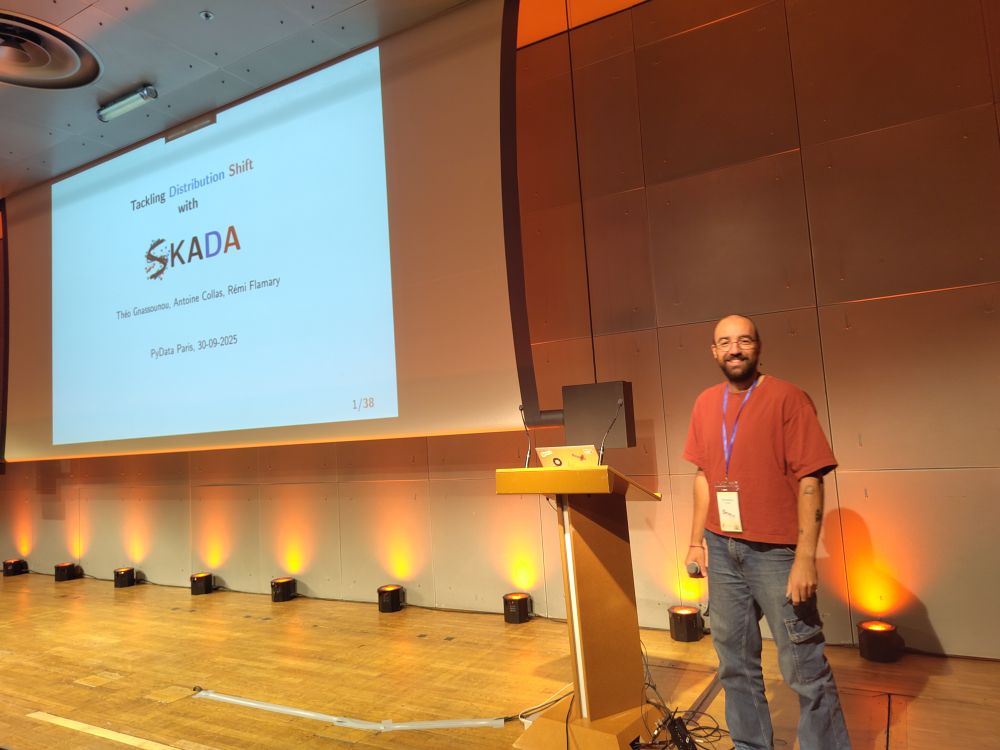
Figure 1. Happy ML researcher and open source developer presenting his toolbox SKADA at PyData Paris. Congrats @tgnassou.bsky.social the presentation was awesome!
September 30, 2025 at 3:28 PM
Figure 1. Happy ML researcher and open source developer presenting his toolbox SKADA at PyData Paris. Congrats @tgnassou.bsky.social the presentation was awesome!
Reposted by Rémi Flamary
I am happy to share that our paper "Unsupervised Learning for Optimal Transport plan prediction between unbalanced graphs" was accepted at Neurips 2025 ! 🥳
Huge thanks to my co-authors @rflamary.bsky.social and Bertrand Thirion !
arxiv.org/abs/2506.12025
(1/5)
Huge thanks to my co-authors @rflamary.bsky.social and Bertrand Thirion !
arxiv.org/abs/2506.12025
(1/5)
Unsupervised Learning for Optimal Transport plan prediction between unbalanced graphs
Optimal transport between graphs, based on Gromov-Wasserstein and other extensions, is a powerful tool for comparing and aligning graph structures. However, solving the associated non-convex optimizat...
arxiv.org
September 29, 2025 at 8:55 AM
I am happy to share that our paper "Unsupervised Learning for Optimal Transport plan prediction between unbalanced graphs" was accepted at Neurips 2025 ! 🥳
Huge thanks to my co-authors @rflamary.bsky.social and Bertrand Thirion !
arxiv.org/abs/2506.12025
(1/5)
Huge thanks to my co-authors @rflamary.bsky.social and Bertrand Thirion !
arxiv.org/abs/2506.12025
(1/5)