



Nursima Ünver
@nunvera.bsky.social
PhD Candidate, Max Planck - University of Toronto Centre for Neural Science and Technology
Reposted by Nursima Ünver

🎉 My first first-author paper was just accepted in JEP:HPP! We asked what “active” vs “passive” WM states do - do they protect against interference? Across 4 behavioural experiments we find no reliable protection. Updated preprint here: doi.org/10.1101/2024.02.05.578913 @elkanakyurek.bsky.social
Feature and space-based interference with functionally active and passive items in working memory
Functionally active and passive states in working memory have been related to different neural mechanisms. Memoranda in active states might be maintained by persistent neural firing, whereas memoranda in passive states might be maintained through short-term synaptic plasticity. We reasoned that this might make these items differentially susceptible to interference during maintenance, in particular that passively maintained items might be more robust. To test this hypothesis, we gave our participants a working memory task in which one item was prioritised (active) by always probing it first, while the other item was deprioritised (passive) by always probing it second. In two experiments, on half the trials, we presented an interfering task during memory maintenance, in which the stimuli matched either the feature dimension of the memory items (colour or orientation), or their spatial location. Whether the interfering task appeared on a given trial was unpredictable. In a third experiment where participants were given prior knowledge of the interference condition, and finally in a fourth experiment we used a reward-based prioritisation cue. Across experiments, we found that both active and passive memory items were affected by interference to a similar extent, with overall performance being closely matched in all experiments. We further investigated precision and probability of target response parameters from the standard mixture model, which also showed no differences between states. We conclude that active and passive items, although potentially stored in different neuronal states, do not show differential susceptibility to interference. ### Competing Interest Statement The authors have declared no competing interest.
doi.org
January 27, 2026 at 4:23 PM
🎉 My first first-author paper was just accepted in JEP:HPP! We asked what “active” vs “passive” WM states do - do they protect against interference? Across 4 behavioural experiments we find no reliable protection. Updated preprint here: doi.org/10.1101/2024.02.05.578913 @elkanakyurek.bsky.social
Reposted by Nursima Ünver

🎉 New preprint 🎉 with Olya Bulatova, @drmack.bsky.social & @keisukefukuda.bsky.social! We decode shapes in working memory from EEG and show that representations are task-dependent, flexibly integrating information about category and task during the memory delay

Task goals dynamically reconfigure neural working memory representations https://www.biorxiv.org/content/10.64898/2026.01.19.700420v1
January 21, 2026 at 6:22 PM
🎉 New preprint 🎉 with Olya Bulatova, @drmack.bsky.social & @keisukefukuda.bsky.social! We decode shapes in working memory from EEG and show that representations are task-dependent, flexibly integrating information about category and task during the memory delay
Reposted by Nursima Ünver

Here’s a thought that might make you tilt your head in curiosity: With every movement of your eyes, head, or body, the visual input to your eyes shifts! Nevertheless, it doesn't feel like the world does suddenly tilts sideways whenever you tilt your head. How can this be? TWEEPRINT ALERT! 🚨🧵 1/n

a husky puppy is laying on the floor with its tongue out and wearing a blue collar .
ALT: a husky puppy is laying on the floor with its tongue out and wearing a blue collar .
media.tenor.com
January 21, 2026 at 12:28 PM
Here’s a thought that might make you tilt your head in curiosity: With every movement of your eyes, head, or body, the visual input to your eyes shifts! Nevertheless, it doesn't feel like the world does suddenly tilts sideways whenever you tilt your head. How can this be? TWEEPRINT ALERT! 🚨🧵 1/n
Reposted by Nursima Ünver

How does prior knowledge affect the way we experience the world?
In our new paper, we show that prior knowledge can both increase and decrease how often experience is segmented into events.
link.springer.com/article/10.3...
In our new paper, we show that prior knowledge can both increase and decrease how often experience is segmented into events.
link.springer.com/article/10.3...

Ignorance is bliss: Exploring the dual role of knowledge in event segmentation - Psychonomic Bulletin & Review
Episodic memories are segmented. This study explores the dual role of prior knowledge in event segmentation, hypothesizing that knowledge leads to coarser segmentation when experiences align with it, ...
link.springer.com
January 21, 2026 at 11:02 AM
How does prior knowledge affect the way we experience the world?
In our new paper, we show that prior knowledge can both increase and decrease how often experience is segmented into events.
link.springer.com/article/10.3...
In our new paper, we show that prior knowledge can both increase and decrease how often experience is segmented into events.
link.springer.com/article/10.3...
Reposted by Nursima Ünver
Excited to share our NEWEST PREPRINT led by @rochellekaper.bsky.social!!
osf.io/preprints/ps...
We ask: How do people learn multiple layers of environmental structure – w/o feedback – & how well do they *know* they’ve learned? Turns out, stimulus familiarity matters more than we thought! 🧵👇
osf.io/preprints/ps...
We ask: How do people learn multiple layers of environmental structure – w/o feedback – & how well do they *know* they’ve learned? Turns out, stimulus familiarity matters more than we thought! 🧵👇
OSF
osf.io
January 15, 2026 at 2:48 AM
Excited to share our NEWEST PREPRINT led by @rochellekaper.bsky.social!!
osf.io/preprints/ps...
We ask: How do people learn multiple layers of environmental structure – w/o feedback – & how well do they *know* they’ve learned? Turns out, stimulus familiarity matters more than we thought! 🧵👇
osf.io/preprints/ps...
We ask: How do people learn multiple layers of environmental structure – w/o feedback – & how well do they *know* they’ve learned? Turns out, stimulus familiarity matters more than we thought! 🧵👇
Reposted by Nursima Ünver
What determines the perception of orientations in visual cortex, sharp contours or oriented spatial frequencies?
It's the contours, the building blocks for shape. Brilliant paper by Seohee Han out in Scientific Reports:
www.nature.com/articles/s41...
@uoftpsychology.bsky.social
It's the contours, the building blocks for shape. Brilliant paper by Seohee Han out in Scientific Reports:
www.nature.com/articles/s41...
@uoftpsychology.bsky.social

January 14, 2026 at 8:12 PM
What determines the perception of orientations in visual cortex, sharp contours or oriented spatial frequencies?
It's the contours, the building blocks for shape. Brilliant paper by Seohee Han out in Scientific Reports:
www.nature.com/articles/s41...
@uoftpsychology.bsky.social
It's the contours, the building blocks for shape. Brilliant paper by Seohee Han out in Scientific Reports:
www.nature.com/articles/s41...
@uoftpsychology.bsky.social
Reposted by Nursima Ünver

With some trepidation, I'm putting this out into the world:
gershmanlab.com/textbook.html
It's a textbook called Computational Foundations of Cognitive Neuroscience, which I wrote for my class.
My hope is that this will be a living document, continuously improved as I get feedback.
gershmanlab.com/textbook.html
It's a textbook called Computational Foundations of Cognitive Neuroscience, which I wrote for my class.
My hope is that this will be a living document, continuously improved as I get feedback.
January 9, 2026 at 1:27 AM
With some trepidation, I'm putting this out into the world:
gershmanlab.com/textbook.html
It's a textbook called Computational Foundations of Cognitive Neuroscience, which I wrote for my class.
My hope is that this will be a living document, continuously improved as I get feedback.
gershmanlab.com/textbook.html
It's a textbook called Computational Foundations of Cognitive Neuroscience, which I wrote for my class.
My hope is that this will be a living document, continuously improved as I get feedback.
Reposted by Nursima Ünver

New preprint: Inference over hidden contexts shapes the geometry of conceptual knowledge for flexible behaviour.
In this pre-reg study, our core claim was that we don’t just learn stimulus-reward. We infer hidden context and that inference re-wires attention and neural state space on the fly.
1/8
In this pre-reg study, our core claim was that we don’t just learn stimulus-reward. We infer hidden context and that inference re-wires attention and neural state space on the fly.
1/8

January 8, 2026 at 7:46 AM
New preprint: Inference over hidden contexts shapes the geometry of conceptual knowledge for flexible behaviour.
In this pre-reg study, our core claim was that we don’t just learn stimulus-reward. We infer hidden context and that inference re-wires attention and neural state space on the fly.
1/8
In this pre-reg study, our core claim was that we don’t just learn stimulus-reward. We infer hidden context and that inference re-wires attention and neural state space on the fly.
1/8
Reposted by Nursima Ünver

New preprint alert! 📢 Event segmentation allows us to parse continuous experience into meaningful events. Working memory (WM) is suggested to play a key role in this process, but how?
osf.io/preprints/ps...
osf.io/preprints/ps...
OSF
osf.io
December 31, 2025 at 2:41 PM
New preprint alert! 📢 Event segmentation allows us to parse continuous experience into meaningful events. Working memory (WM) is suggested to play a key role in this process, but how?
osf.io/preprints/ps...
osf.io/preprints/ps...
Reposted by Nursima Ünver

What if we could tell you how well you’ll remember your next visit to your local coffee shop? ☕️
In our new Nature Human Behaviour paper, we show that the 𝗾𝘂𝗮𝗹𝗶𝘁𝘆 𝗼𝗳 𝗮 𝘀𝗽𝗮𝘁𝗶𝗮𝗹 𝗿𝗲𝗽𝗿𝗲𝘀𝗲𝗻𝘁𝗮𝘁𝗶𝗼𝗻 can be measured with neuroimaging – and 𝘁𝗵𝗮𝘁 𝘀𝗰𝗼𝗿𝗲 𝗽𝗿𝗲𝗱𝗶𝗰𝘁𝘀 𝗵𝗼𝘄 𝘄𝗲𝗹𝗹 𝗻𝗲𝘄 𝗲𝘅𝗽𝗲𝗿𝗶𝗲𝗻𝗰𝗲𝘀 𝘄𝗶𝗹𝗹 𝘀𝘁𝗶𝗰𝗸.
In our new Nature Human Behaviour paper, we show that the 𝗾𝘂𝗮𝗹𝗶𝘁𝘆 𝗼𝗳 𝗮 𝘀𝗽𝗮𝘁𝗶𝗮𝗹 𝗿𝗲𝗽𝗿𝗲𝘀𝗲𝗻𝘁𝗮𝘁𝗶𝗼𝗻 can be measured with neuroimaging – and 𝘁𝗵𝗮𝘁 𝘀𝗰𝗼𝗿𝗲 𝗽𝗿𝗲𝗱𝗶𝗰𝘁𝘀 𝗵𝗼𝘄 𝘄𝗲𝗹𝗹 𝗻𝗲𝘄 𝗲𝘅𝗽𝗲𝗿𝗶𝗲𝗻𝗰𝗲𝘀 𝘄𝗶𝗹𝗹 𝘀𝘁𝗶𝗰𝗸.

New study by @xrmasiso.bsky.social et al shows that spatial contexts with more reliable brain representations better support memory for future experiences within them, revealing how stable neural maps help the brain organize and recall life events.

Spatial contexts with reliable neural representations support reinstatement of subsequently placed objects - Nature Human Behaviour
This study shows that spatial contexts with more reliable brain representations better support memory for future experiences within them, revealing how stable neural maps help the brain organize and recall life events.
www.nature.com
January 5, 2026 at 6:43 PM
What if we could tell you how well you’ll remember your next visit to your local coffee shop? ☕️
In our new Nature Human Behaviour paper, we show that the 𝗾𝘂𝗮𝗹𝗶𝘁𝘆 𝗼𝗳 𝗮 𝘀𝗽𝗮𝘁𝗶𝗮𝗹 𝗿𝗲𝗽𝗿𝗲𝘀𝗲𝗻𝘁𝗮𝘁𝗶𝗼𝗻 can be measured with neuroimaging – and 𝘁𝗵𝗮𝘁 𝘀𝗰𝗼𝗿𝗲 𝗽𝗿𝗲𝗱𝗶𝗰𝘁𝘀 𝗵𝗼𝘄 𝘄𝗲𝗹𝗹 𝗻𝗲𝘄 𝗲𝘅𝗽𝗲𝗿𝗶𝗲𝗻𝗰𝗲𝘀 𝘄𝗶𝗹𝗹 𝘀𝘁𝗶𝗰𝗸.
In our new Nature Human Behaviour paper, we show that the 𝗾𝘂𝗮𝗹𝗶𝘁𝘆 𝗼𝗳 𝗮 𝘀𝗽𝗮𝘁𝗶𝗮𝗹 𝗿𝗲𝗽𝗿𝗲𝘀𝗲𝗻𝘁𝗮𝘁𝗶𝗼𝗻 can be measured with neuroimaging – and 𝘁𝗵𝗮𝘁 𝘀𝗰𝗼𝗿𝗲 𝗽𝗿𝗲𝗱𝗶𝗰𝘁𝘀 𝗵𝗼𝘄 𝘄𝗲𝗹𝗹 𝗻𝗲𝘄 𝗲𝘅𝗽𝗲𝗿𝗶𝗲𝗻𝗰𝗲𝘀 𝘄𝗶𝗹𝗹 𝘀𝘁𝗶𝗰𝗸.
Reposted by Nursima Ünver

@shansmann-roth.bsky.social and I finally finished our paper confirming a unique prediction of the Demixing Model (DM): inter-item biases in #visualworkingmemory depend on the _relative_ noise of targets and non-targets, potentially going in opposing directions. 🧵1/9
www.biorxiv.org/content/10.6...
www.biorxiv.org/content/10.6...

Noise in Competing Representations Determines the Direction of Memory Biases
Our memories are reconstructions, prone to errors. Historically treated as a mere nuisance, memory errors have recently gained attention when found to be systematically shifted away from or towards no...
www.biorxiv.org
December 26, 2025 at 4:39 PM
@shansmann-roth.bsky.social and I finally finished our paper confirming a unique prediction of the Demixing Model (DM): inter-item biases in #visualworkingmemory depend on the _relative_ noise of targets and non-targets, potentially going in opposing directions. 🧵1/9
www.biorxiv.org/content/10.6...
www.biorxiv.org/content/10.6...
Reposted by Nursima Ünver
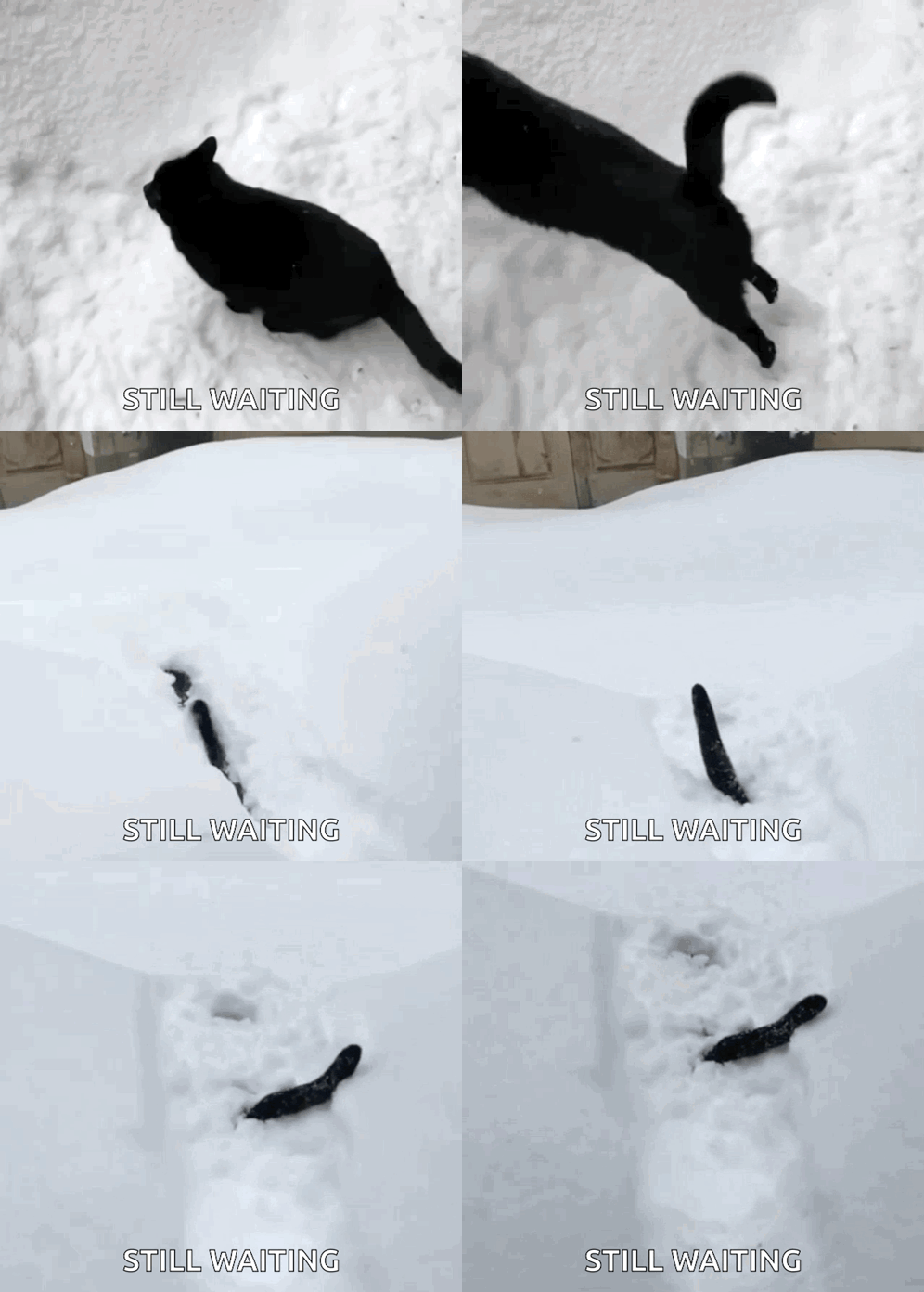
Many things in the world move, and can even move behind other things. When will the cat reappear? To predict this, remembering the cat’s speed will likely help. But... how do people remember something like speed, which is defined by displacement over both (🤯) space and time? TWEEPRINT ALERT! 🚨🧵1/n
a black cat is sitting in the snow with the words still waiting below it .
ALT: a black cat is sitting in the snow with the words still waiting below it .
media.tenor.com
December 17, 2025 at 4:23 PM
Many things in the world move, and can even move behind other things. When will the cat reappear? To predict this, remembering the cat’s speed will likely help. But... how do people remember something like speed, which is defined by displacement over both (🤯) space and time? TWEEPRINT ALERT! 🚨🧵1/n
Super excited to see this out in the world!
Our new preprint is out!
Using a continuous-report paradigm, we show that divided attention reliably disrupts long-term memory retrieval by reducing accessibility—not precision.
Two experiments + mixture modeling + TCC.
Link: osf.io/preprints/ps...
Using a continuous-report paradigm, we show that divided attention reliably disrupts long-term memory retrieval by reducing accessibility—not precision.
Two experiments + mixture modeling + TCC.
Link: osf.io/preprints/ps...
OSF
osf.io
December 9, 2025 at 4:09 PM
Super excited to see this out in the world!