


Rosanne Rademaker
@rademaker.bsky.social
Max Planck group leader at ESI Frankfurt | human cognition, fMRI, MEG, computation | sciences with the coolest (phd) students et al. | she/her
Pinned

a husky puppy is laying on the floor with its tongue out and wearing a blue collar .
ALT: a husky puppy is laying on the floor with its tongue out and wearing a blue collar .
media.tenor.com
Here’s a thought that might make you tilt your head in curiosity: With every movement of your eyes, head, or body, the visual input to your eyes shifts! Nevertheless, it doesn't feel like the world does suddenly tilts sideways whenever you tilt your head. How can this be? TWEEPRINT ALERT! 🚨🧵 1/n
Reposted by Rosanne Rademaker
Our paper is out in @natneuro.nature.com!
www.nature.com/articles/s41...
We develop a geometric theory of how neural populations support generalization across many tasks.
@zuckermanbrain.bsky.social
@flatironinstitute.org
@kempnerinstitute.bsky.social
1/14
www.nature.com/articles/s41...
We develop a geometric theory of how neural populations support generalization across many tasks.
@zuckermanbrain.bsky.social
@flatironinstitute.org
@kempnerinstitute.bsky.social
1/14

February 10, 2026 at 3:56 PM
Our paper is out in @natneuro.nature.com!
www.nature.com/articles/s41...
We develop a geometric theory of how neural populations support generalization across many tasks.
@zuckermanbrain.bsky.social
@flatironinstitute.org
@kempnerinstitute.bsky.social
1/14
www.nature.com/articles/s41...
We develop a geometric theory of how neural populations support generalization across many tasks.
@zuckermanbrain.bsky.social
@flatironinstitute.org
@kempnerinstitute.bsky.social
1/14
Reposted by Rosanne Rademaker
New preprint with @SamJung @timbrady.bsky.social and @violastoermer.bsky.social: osf.io/preprints/ps.... Here we uncover what might be driving the “meaningfulness benefit” in visual working memory. Studies show that real objects are remembered better in VWM tasks than abstract stimuli. But why? 1/
OSF
osf.io
February 9, 2026 at 9:06 PM
New preprint with @SamJung @timbrady.bsky.social and @violastoermer.bsky.social: osf.io/preprints/ps.... Here we uncover what might be driving the “meaningfulness benefit” in visual working memory. Studies show that real objects are remembered better in VWM tasks than abstract stimuli. But why? 1/
Here’s a thought that might make you tilt your head in curiosity: With every movement of your eyes, head, or body, the visual input to your eyes shifts! Nevertheless, it doesn't feel like the world does suddenly tilts sideways whenever you tilt your head. How can this be? TWEEPRINT ALERT! 🚨🧵 1/n
a husky puppy is laying on the floor with its tongue out and wearing a blue collar .
ALT: a husky puppy is laying on the floor with its tongue out and wearing a blue collar .
media.tenor.com
January 21, 2026 at 12:28 PM
Here’s a thought that might make you tilt your head in curiosity: With every movement of your eyes, head, or body, the visual input to your eyes shifts! Nevertheless, it doesn't feel like the world does suddenly tilts sideways whenever you tilt your head. How can this be? TWEEPRINT ALERT! 🚨🧵 1/n
As someone who once tried to recruit Natalie, I can of course only recommend hiring this extremely smart scientist!!
main goal for this year: find a new job! 🙂
looking for a role with fun & complex technical challenges & within a great community. my main expertise is in signal processing/EEG/MEG, but topic-wise I am quite flexible.
science/industry both great! starting mid-year. nschawor.github.io/cv
looking for a role with fun & complex technical challenges & within a great community. my main expertise is in signal processing/EEG/MEG, but topic-wise I am quite flexible.
science/industry both great! starting mid-year. nschawor.github.io/cv
January 16, 2026 at 11:44 AM
As someone who once tried to recruit Natalie, I can of course only recommend hiring this extremely smart scientist!!
Reposted by Rosanne Rademaker

🌍 Applications are open! The IBRO Exchange Fellowships give early career #neuroscientists to conduct lab visits with several expenses covered during the exchange.
🗓 Apply by 15 Apr: https://ibro.org/grant/exchange-fellowships/
#grant #IBROinAsiaPacific #IBROinUSCanada #IBROinAfrica #IBROinLatAm
🗓 Apply by 15 Apr: https://ibro.org/grant/exchange-fellowships/
#grant #IBROinAsiaPacific #IBROinUSCanada #IBROinAfrica #IBROinLatAm

January 15, 2026 at 12:01 PM
🌍 Applications are open! The IBRO Exchange Fellowships give early career #neuroscientists to conduct lab visits with several expenses covered during the exchange.
🗓 Apply by 15 Apr: https://ibro.org/grant/exchange-fellowships/
#grant #IBROinAsiaPacific #IBROinUSCanada #IBROinAfrica #IBROinLatAm
🗓 Apply by 15 Apr: https://ibro.org/grant/exchange-fellowships/
#grant #IBROinAsiaPacific #IBROinUSCanada #IBROinAfrica #IBROinLatAm
Reposted by Rosanne Rademaker

#BrainMeeting 🧠 Alert! 🎺
This Friday, January 16th, the Brain Meeting speaker will be Janneke Jehee giving a talk entitled "Uncertainty in perceptual decision-making"
In person or online. For more information:
www.fil.ion.ucl.ac.uk/event
This Friday, January 16th, the Brain Meeting speaker will be Janneke Jehee giving a talk entitled "Uncertainty in perceptual decision-making"
In person or online. For more information:
www.fil.ion.ucl.ac.uk/event

January 12, 2026 at 9:14 AM
#BrainMeeting 🧠 Alert! 🎺
This Friday, January 16th, the Brain Meeting speaker will be Janneke Jehee giving a talk entitled "Uncertainty in perceptual decision-making"
In person or online. For more information:
www.fil.ion.ucl.ac.uk/event
This Friday, January 16th, the Brain Meeting speaker will be Janneke Jehee giving a talk entitled "Uncertainty in perceptual decision-making"
In person or online. For more information:
www.fil.ion.ucl.ac.uk/event
Reposted by Rosanne Rademaker
Please spread the word🔊My lab is looking to hire two international postdocs. If you want to do comp neuro, combine machine learning and awesome math to understand neural circuit activity, then come work with us! Bonn is such a cool place for neuroscience now, you don't want to miss out.
January 10, 2026 at 5:39 PM
Please spread the word🔊My lab is looking to hire two international postdocs. If you want to do comp neuro, combine machine learning and awesome math to understand neural circuit activity, then come work with us! Bonn is such a cool place for neuroscience now, you don't want to miss out.
Reposted by Rosanne Rademaker

New preprint from the lab!

New preprint from NuttidaLab at Columbia BME 🧠✨:
Neural heterogeneity shapes the temporal structure of human working memory
www.biorxiv.org/content/10.1...
Neural heterogeneity shapes the temporal structure of human working memory
www.biorxiv.org/content/10.1...

Neural heterogeneity shapes the temporal structure of human working memory
Working memory (WM) enables temporary retention of information essential for flexible cognition. Although persistent population activity has long been regarded as a principal mechanism of memory maint...
www.biorxiv.org
January 6, 2026 at 9:53 PM
New preprint from the lab!
Reposted by Rosanne Rademaker
What if we could tell you how well you’ll remember your next visit to your local coffee shop? ☕️
In our new Nature Human Behaviour paper, we show that the 𝗾𝘂𝗮𝗹𝗶𝘁𝘆 𝗼𝗳 𝗮 𝘀𝗽𝗮𝘁𝗶𝗮𝗹 𝗿𝗲𝗽𝗿𝗲𝘀𝗲𝗻𝘁𝗮𝘁𝗶𝗼𝗻 can be measured with neuroimaging – and 𝘁𝗵𝗮𝘁 𝘀𝗰𝗼𝗿𝗲 𝗽𝗿𝗲𝗱𝗶𝗰𝘁𝘀 𝗵𝗼𝘄 𝘄𝗲𝗹𝗹 𝗻𝗲𝘄 𝗲𝘅𝗽𝗲𝗿𝗶𝗲𝗻𝗰𝗲𝘀 𝘄𝗶𝗹𝗹 𝘀𝘁𝗶𝗰𝗸.
In our new Nature Human Behaviour paper, we show that the 𝗾𝘂𝗮𝗹𝗶𝘁𝘆 𝗼𝗳 𝗮 𝘀𝗽𝗮𝘁𝗶𝗮𝗹 𝗿𝗲𝗽𝗿𝗲𝘀𝗲𝗻𝘁𝗮𝘁𝗶𝗼𝗻 can be measured with neuroimaging – and 𝘁𝗵𝗮𝘁 𝘀𝗰𝗼𝗿𝗲 𝗽𝗿𝗲𝗱𝗶𝗰𝘁𝘀 𝗵𝗼𝘄 𝘄𝗲𝗹𝗹 𝗻𝗲𝘄 𝗲𝘅𝗽𝗲𝗿𝗶𝗲𝗻𝗰𝗲𝘀 𝘄𝗶𝗹𝗹 𝘀𝘁𝗶𝗰𝗸.

New study by @xrmasiso.bsky.social et al shows that spatial contexts with more reliable brain representations better support memory for future experiences within them, revealing how stable neural maps help the brain organize and recall life events.

Spatial contexts with reliable neural representations support reinstatement of subsequently placed objects - Nature Human Behaviour
This study shows that spatial contexts with more reliable brain representations better support memory for future experiences within them, revealing how stable neural maps help the brain organize and recall life events.
www.nature.com
January 5, 2026 at 6:43 PM
What if we could tell you how well you’ll remember your next visit to your local coffee shop? ☕️
In our new Nature Human Behaviour paper, we show that the 𝗾𝘂𝗮𝗹𝗶𝘁𝘆 𝗼𝗳 𝗮 𝘀𝗽𝗮𝘁𝗶𝗮𝗹 𝗿𝗲𝗽𝗿𝗲𝘀𝗲𝗻𝘁𝗮𝘁𝗶𝗼𝗻 can be measured with neuroimaging – and 𝘁𝗵𝗮𝘁 𝘀𝗰𝗼𝗿𝗲 𝗽𝗿𝗲𝗱𝗶𝗰𝘁𝘀 𝗵𝗼𝘄 𝘄𝗲𝗹𝗹 𝗻𝗲𝘄 𝗲𝘅𝗽𝗲𝗿𝗶𝗲𝗻𝗰𝗲𝘀 𝘄𝗶𝗹𝗹 𝘀𝘁𝗶𝗰𝗸.
In our new Nature Human Behaviour paper, we show that the 𝗾𝘂𝗮𝗹𝗶𝘁𝘆 𝗼𝗳 𝗮 𝘀𝗽𝗮𝘁𝗶𝗮𝗹 𝗿𝗲𝗽𝗿𝗲𝘀𝗲𝗻𝘁𝗮𝘁𝗶𝗼𝗻 can be measured with neuroimaging – and 𝘁𝗵𝗮𝘁 𝘀𝗰𝗼𝗿𝗲 𝗽𝗿𝗲𝗱𝗶𝗰𝘁𝘀 𝗵𝗼𝘄 𝘄𝗲𝗹𝗹 𝗻𝗲𝘄 𝗲𝘅𝗽𝗲𝗿𝗶𝗲𝗻𝗰𝗲𝘀 𝘄𝗶𝗹𝗹 𝘀𝘁𝗶𝗰𝗸.
This is very cool! The link between spikes and LFP’s is something that comes up frequently in our (human neuroimaging) lab. Nice to learn more about it!
🚨 New preprint!
Why do some insights from spikes translate to field potentials while others don't? In this paper we compare visual memory representations in spikes and LFPs to propose a general framework that answers this question.
www.biorxiv.org/content/10.6...
🧵 (1/10)
🧠🟦 🧠💻
Why do some insights from spikes translate to field potentials while others don't? In this paper we compare visual memory representations in spikes and LFPs to propose a general framework that answers this question.
www.biorxiv.org/content/10.6...
🧵 (1/10)
🧠🟦 🧠💻

Neural representations of visual memory in inferotemporal cortex reveal a generalizable framework for translating between spikes and field potentials
Translating neurophysiological findings requires understanding the relationship between common measures of brain activity in animals (spiking activity) and humans (local field potentials, LFP). Prior ...
www.biorxiv.org
January 5, 2026 at 8:47 PM
This is very cool! The link between spikes and LFP’s is something that comes up frequently in our (human neuroimaging) lab. Nice to learn more about it!
Reposted by Rosanne Rademaker
The ADAM lab is hiring a Research Specialist to join us! This role involves conducting human subjects research (EEG experiments on attention + working memory) and assisting with the execution and administration of ongoing projects.
Job posting: emdz.fa.us2.oraclecloud.com/hcmUI/Candid...
Job posting: emdz.fa.us2.oraclecloud.com/hcmUI/Candid...

Research Specialist
The Attention, Distractions, and Memory (ADAM) Lab at Rice University is recruiting a full-time Research Specialist (Research Specialist I). The ADAM Lab (PI: Kirsten Adam) conducts cognitive neurosci...
emdz.fa.us2.oraclecloud.com
January 2, 2026 at 3:21 PM
The ADAM lab is hiring a Research Specialist to join us! This role involves conducting human subjects research (EEG experiments on attention + working memory) and assisting with the execution and administration of ongoing projects.
Job posting: emdz.fa.us2.oraclecloud.com/hcmUI/Candid...
Job posting: emdz.fa.us2.oraclecloud.com/hcmUI/Candid...
Reposted by Rosanne Rademaker
@shansmann-roth.bsky.social and I finally finished our paper confirming a unique prediction of the Demixing Model (DM): inter-item biases in #visualworkingmemory depend on the _relative_ noise of targets and non-targets, potentially going in opposing directions. 🧵1/9
www.biorxiv.org/content/10.6...
www.biorxiv.org/content/10.6...

Noise in Competing Representations Determines the Direction of Memory Biases
Our memories are reconstructions, prone to errors. Historically treated as a mere nuisance, memory errors have recently gained attention when found to be systematically shifted away from or towards no...
www.biorxiv.org
December 26, 2025 at 4:39 PM
@shansmann-roth.bsky.social and I finally finished our paper confirming a unique prediction of the Demixing Model (DM): inter-item biases in #visualworkingmemory depend on the _relative_ noise of targets and non-targets, potentially going in opposing directions. 🧵1/9
www.biorxiv.org/content/10.6...
www.biorxiv.org/content/10.6...
Reposted by Rosanne Rademaker
The neural basis of working memory has been debated. What we like to call “The Standard Model” of working memory posits that persistent discharges generated by neurons in the prefrontal cortex constitute the neural correlate of working memory (2/10)
December 29, 2025 at 2:41 PM
The neural basis of working memory has been debated. What we like to call “The Standard Model” of working memory posits that persistent discharges generated by neurons in the prefrontal cortex constitute the neural correlate of working memory (2/10)
Reposted by Rosanne Rademaker

🚨 New paper in @pnas.org to end 2025 with a bang!🚨
Behavioral, experiential, and physiological signatures of mind blanking
www.pnas.org/doi/10.1073/...
with Esteban Munoz-Musat, @arthurlecoz.bsky.social @corcorana.bsky.social, Laouen Belloli and Lionel Naccache
Illustration: Ana Yael.
1/n
Behavioral, experiential, and physiological signatures of mind blanking
www.pnas.org/doi/10.1073/...
with Esteban Munoz-Musat, @arthurlecoz.bsky.social @corcorana.bsky.social, Laouen Belloli and Lionel Naccache
Illustration: Ana Yael.
1/n

December 29, 2025 at 10:11 AM
🚨 New paper in @pnas.org to end 2025 with a bang!🚨
Behavioral, experiential, and physiological signatures of mind blanking
www.pnas.org/doi/10.1073/...
with Esteban Munoz-Musat, @arthurlecoz.bsky.social @corcorana.bsky.social, Laouen Belloli and Lionel Naccache
Illustration: Ana Yael.
1/n
Behavioral, experiential, and physiological signatures of mind blanking
www.pnas.org/doi/10.1073/...
with Esteban Munoz-Musat, @arthurlecoz.bsky.social @corcorana.bsky.social, Laouen Belloli and Lionel Naccache
Illustration: Ana Yael.
1/n
Reposted by Rosanne Rademaker

No exciting plans for year-end yet?
Why not gear up for your next grant proposal? 💸
Check out our website for recurring and one-time funding lines, awards, and programs! 👉 bernstein-network.de/en/newsroom/...
Why not gear up for your next grant proposal? 💸
Check out our website for recurring and one-time funding lines, awards, and programs! 👉 bernstein-network.de/en/newsroom/...

December 23, 2025 at 8:01 AM
No exciting plans for year-end yet?
Why not gear up for your next grant proposal? 💸
Check out our website for recurring and one-time funding lines, awards, and programs! 👉 bernstein-network.de/en/newsroom/...
Why not gear up for your next grant proposal? 💸
Check out our website for recurring and one-time funding lines, awards, and programs! 👉 bernstein-network.de/en/newsroom/...
Reposted by Rosanne Rademaker
We’re very happy to share that our work on 3D spatial memory was published in PNAS just before the end of the year! 🎉
Link: www.pnas.org/doi/10.1073/...
(1/8)
Link: www.pnas.org/doi/10.1073/...
(1/8)
PNAS
Proceedings of the National Academy of Sciences (PNAS), a peer reviewed journal of the National Academy of Sciences (NAS) - an authoritative source of high-impact, original research that broadly spans...
www.pnas.org
December 22, 2025 at 10:43 PM
We’re very happy to share that our work on 3D spatial memory was published in PNAS just before the end of the year! 🎉
Link: www.pnas.org/doi/10.1073/...
(1/8)
Link: www.pnas.org/doi/10.1073/...
(1/8)
Reposted by Rosanne Rademaker
📆 updated for 2026!
list of summer schools & short courses in the realm of (computational) neuroscience or data analysis of EEG / MEG / LFP: 🔗 docs.google.com/spreadsheets...
list of summer schools & short courses in the realm of (computational) neuroscience or data analysis of EEG / MEG / LFP: 🔗 docs.google.com/spreadsheets...

various computational neuroscience / MEEG / LFP short courses and summer schools
docs.google.com
December 19, 2025 at 4:37 PM
📆 updated for 2026!
list of summer schools & short courses in the realm of (computational) neuroscience or data analysis of EEG / MEG / LFP: 🔗 docs.google.com/spreadsheets...
list of summer schools & short courses in the realm of (computational) neuroscience or data analysis of EEG / MEG / LFP: 🔗 docs.google.com/spreadsheets...
Reposted by Rosanne Rademaker
🚀 Excited to announce that I'm looking for people (PhD/Postdoc) to join my Cognitive Modelling group @uniosnabrueck.bsky.social.
If you want to join a genuinely curious, welcoming and inclusive community of Coxis, apply here:
tinyurl.com/coxijobs
Please RT - deadline is Jan 4‼️
If you want to join a genuinely curious, welcoming and inclusive community of Coxis, apply here:
tinyurl.com/coxijobs
Please RT - deadline is Jan 4‼️
December 18, 2025 at 2:52 PM
🚀 Excited to announce that I'm looking for people (PhD/Postdoc) to join my Cognitive Modelling group @uniosnabrueck.bsky.social.
If you want to join a genuinely curious, welcoming and inclusive community of Coxis, apply here:
tinyurl.com/coxijobs
Please RT - deadline is Jan 4‼️
If you want to join a genuinely curious, welcoming and inclusive community of Coxis, apply here:
tinyurl.com/coxijobs
Please RT - deadline is Jan 4‼️
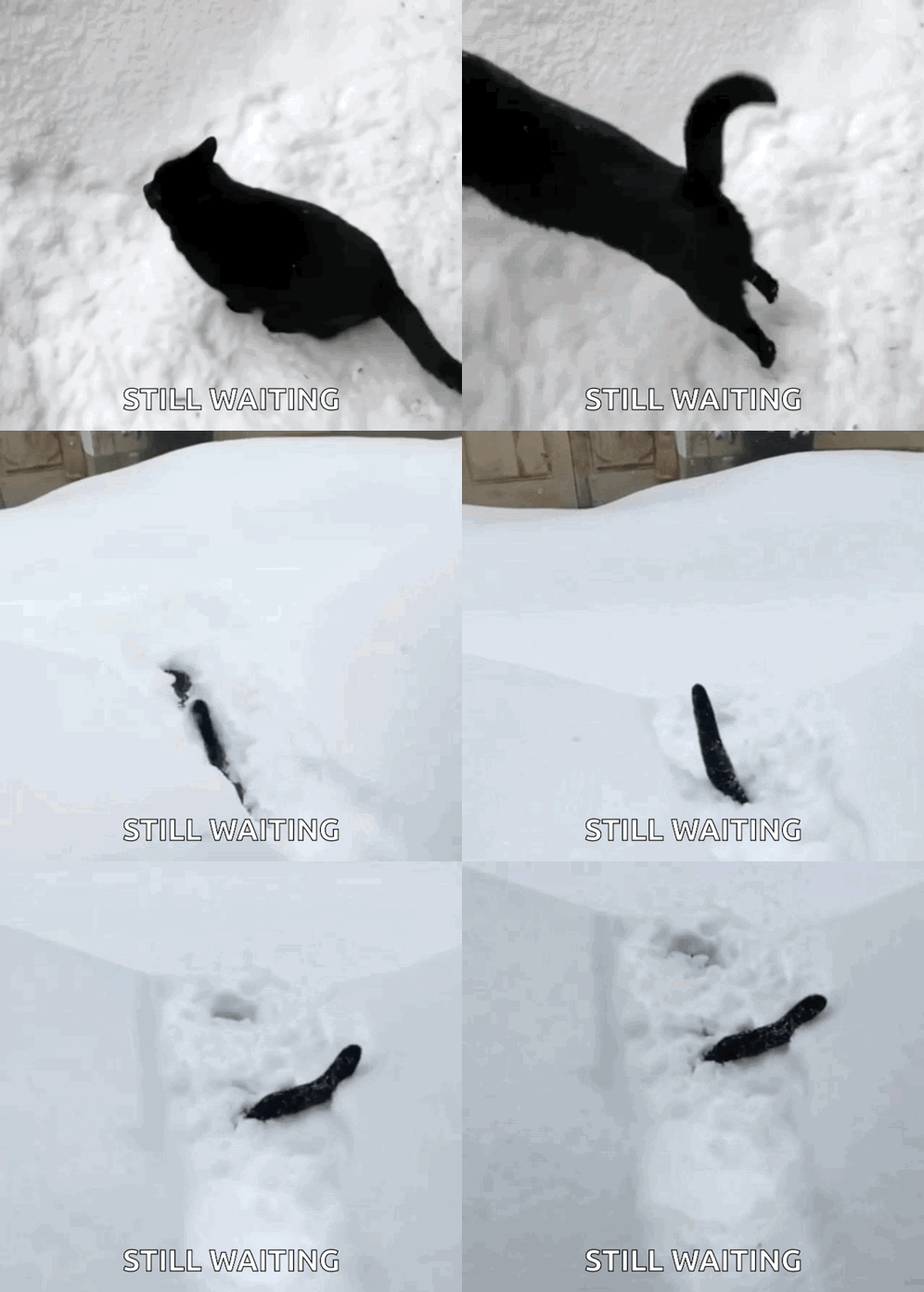
Many things in the world move, and can even move behind other things. When will the cat reappear? To predict this, remembering the cat’s speed will likely help. But... how do people remember something like speed, which is defined by displacement over both (🤯) space and time? TWEEPRINT ALERT! 🚨🧵1/n
a black cat is sitting in the snow with the words still waiting below it .
ALT: a black cat is sitting in the snow with the words still waiting below it .
media.tenor.com
December 17, 2025 at 4:23 PM
Many things in the world move, and can even move behind other things. When will the cat reappear? To predict this, remembering the cat’s speed will likely help. But... how do people remember something like speed, which is defined by displacement over both (🤯) space and time? TWEEPRINT ALERT! 🚨🧵1/n
Reposted by Rosanne Rademaker
Modeling Speed–Accuracy Trade-Offs in the Stopping Rule for Confidence Judgments! Now out in #PsychologicalReview (aka we can finally say we do comp models)! Led by @stefherregods.bsky.social @lucvermeylen.bsky.social @pierreledenmat.bsky.social
Paper: desenderlab.com/wp-content/u... Thread ↓↓↓
Paper: desenderlab.com/wp-content/u... Thread ↓↓↓
desenderlab.com
December 16, 2025 at 3:52 PM
Modeling Speed–Accuracy Trade-Offs in the Stopping Rule for Confidence Judgments! Now out in #PsychologicalReview (aka we can finally say we do comp models)! Led by @stefherregods.bsky.social @lucvermeylen.bsky.social @pierreledenmat.bsky.social
Paper: desenderlab.com/wp-content/u... Thread ↓↓↓
Paper: desenderlab.com/wp-content/u... Thread ↓↓↓
Reposted by Rosanne Rademaker
It’s official! The postdoc positions announcement is here 🚀
If you know great candidates interested in attention, memory transformation and EEG, please help spread the word:
Project (ReDAS) -> cimcyc.ugr.es/en/informati...
Job offer -> cimcyc.ugr.es/en/informati...
If you know great candidates interested in attention, memory transformation and EEG, please help spread the word:
Project (ReDAS) -> cimcyc.ugr.es/en/informati...
Job offer -> cimcyc.ugr.es/en/informati...

Bridging Fields in Psychology and Neuroscience with Multidisciplinary Collaboration
Strengthening collaboration to encourage novel research connections between scientific areas is central to the CIMCYC - María de Maeztu Unit of Excellence strategy . To encourage this, the CIMCYC has ...
cimcyc.ugr.es
December 9, 2025 at 5:50 AM
It’s official! The postdoc positions announcement is here 🚀
If you know great candidates interested in attention, memory transformation and EEG, please help spread the word:
Project (ReDAS) -> cimcyc.ugr.es/en/informati...
Job offer -> cimcyc.ugr.es/en/informati...
If you know great candidates interested in attention, memory transformation and EEG, please help spread the word:
Project (ReDAS) -> cimcyc.ugr.es/en/informati...
Job offer -> cimcyc.ugr.es/en/informati...
Reposted by Rosanne Rademaker
new paper in TICS officially out today. great learning from and writing with Anastasia, and super cool cover art from Prof. Pinar Yoldas.
www.cell.com/trends/cogni...
www.cell.com/trends/cogni...

Sensory reformatting for a working visual memory
A core function of visual working memory (WM) is to sustain mental representations
of recent visual inputs, thereby bridging moments of experience. This is thought to
occur in part by recruiting early...
www.cell.com
December 4, 2025 at 1:21 AM
new paper in TICS officially out today. great learning from and writing with Anastasia, and super cool cover art from Prof. Pinar Yoldas.
www.cell.com/trends/cogni...
www.cell.com/trends/cogni...
Reposted by Rosanne Rademaker

Finally got the job ad—looking for 2 PhD students to start spring next year:
www.gao-unit.com/join-us/
If comp neuro, ML, and AI4Neuro is your thing, or you just nerd out over brain recordings, apply!
I'm at neurips. DM me here / on the conference app or email if you want to meet 🏖️🌮
www.gao-unit.com/join-us/
If comp neuro, ML, and AI4Neuro is your thing, or you just nerd out over brain recordings, apply!
I'm at neurips. DM me here / on the conference app or email if you want to meet 🏖️🌮

December 3, 2025 at 9:37 AM
Finally got the job ad—looking for 2 PhD students to start spring next year:
www.gao-unit.com/join-us/
If comp neuro, ML, and AI4Neuro is your thing, or you just nerd out over brain recordings, apply!
I'm at neurips. DM me here / on the conference app or email if you want to meet 🏖️🌮
www.gao-unit.com/join-us/
If comp neuro, ML, and AI4Neuro is your thing, or you just nerd out over brain recordings, apply!
I'm at neurips. DM me here / on the conference app or email if you want to meet 🏖️🌮
Reposted by Rosanne Rademaker
Investigating individual-specific topographic organization has traditionally been a resource-intensive and time-consuming process. But what if we could map visual cortex organization in thousands of brains? Here we offer the community with a toolbox that can do just that! tinyurl.com/deepretinotopy

December 1, 2025 at 11:26 AM
Investigating individual-specific topographic organization has traditionally been a resource-intensive and time-consuming process. But what if we could map visual cortex organization in thousands of brains? Here we offer the community with a toolbox that can do just that! tinyurl.com/deepretinotopy
Reposted by Rosanne Rademaker

🚨 New paper at #NeurIPS2025!
A systematic fixation-level comparison of a performance-optimized DNN scanpath model and a mechanistic cognitive model reveals behaviourally relevant mechanisms that can be added to the mechanistic model to substantially improve performance.
🧵👇
A systematic fixation-level comparison of a performance-optimized DNN scanpath model and a mechanistic cognitive model reveals behaviourally relevant mechanisms that can be added to the mechanistic model to substantially improve performance.
🧵👇

November 30, 2025 at 9:24 PM
🚨 New paper at #NeurIPS2025!
A systematic fixation-level comparison of a performance-optimized DNN scanpath model and a mechanistic cognitive model reveals behaviourally relevant mechanisms that can be added to the mechanistic model to substantially improve performance.
🧵👇
A systematic fixation-level comparison of a performance-optimized DNN scanpath model and a mechanistic cognitive model reveals behaviourally relevant mechanisms that can be added to the mechanistic model to substantially improve performance.
🧵👇