


Richard Naud
@neuronaud.bsky.social
just trying to say true and-or kind things
Pinned
Richard Naud
@neuronaud.bsky.social
· Oct 6

How are the fluctuations in electric field organized across the whole brain? We analyzed the 3.4 M samples from the international brain lab using a combination of deep learning and graph theory. We found a surprising structure made of communities and landmarks.
doi.org/10.1101/2025...
doi.org/10.1101/2025...
Reposted by Richard Naud

Joint junior faculty position in Computational Neuroscience, between Ctr for Computational Neuroscience at @flatironinstitute.org and the CUNY Graduate Center @thegraduatecenter.bsky.social . Application deadline: 16 Jan 2026!
www.simonsfoundation.org/flatiron/car...
cuny.jobs/new-york-ny/...
www.simonsfoundation.org/flatiron/car...
cuny.jobs/new-york-ny/...

Careers
Careers on Simons Foundation
www.simonsfoundation.org
January 6, 2026 at 3:14 AM
Joint junior faculty position in Computational Neuroscience, between Ctr for Computational Neuroscience at @flatironinstitute.org and the CUNY Graduate Center @thegraduatecenter.bsky.social . Application deadline: 16 Jan 2026!
www.simonsfoundation.org/flatiron/car...
cuny.jobs/new-york-ny/...
www.simonsfoundation.org/flatiron/car...
cuny.jobs/new-york-ny/...
The Centre for Neural Dynamics and Artificial Intelligence (CNDAI) has a new web face ! @uobmri.bsky.social
uniweb.uottawa.ca/sites/CNDAI
uniweb.uottawa.ca/sites/CNDAI

uniweb.uottawa.ca
December 19, 2025 at 2:46 PM
The Centre for Neural Dynamics and Artificial Intelligence (CNDAI) has a new web face ! @uobmri.bsky.social
uniweb.uottawa.ca/sites/CNDAI
uniweb.uottawa.ca/sites/CNDAI
Reposted by Richard Naud
New preprint from the lab! For those who love astrocytes 🤩. We welcome feedback! #preprint #openaccess #astrocytes #autism

Metabolic, epigenetic and transcriptomic alterations in postnatal 16p11.2 deficient murine astrocytes
Autism Spectrum Disorders (ASD) are associated with metabolic dysregulation. While astrocytes are integral to cerebral metabolism, their molecular and functional changes in ASD are poorly known. Using...
www.biorxiv.org
December 17, 2025 at 12:59 PM
New preprint from the lab! For those who love astrocytes 🤩. We welcome feedback! #preprint #openaccess #astrocytes #autism
Reposted by Richard Naud
Fully-funded International Neuroscience Doctoral Programme🧠 Champalimaud Foundation, Lisbon, Portugal 🇵🇹
Deadline: Jan 31, 2026
fchampalimaud.org/champalimaud...
Research program spans systems/computational/theoretical/clinical/sensory/motor neuroscience, neuroethology, intelligence, and more!!
Deadline: Jan 31, 2026
fchampalimaud.org/champalimaud...
Research program spans systems/computational/theoretical/clinical/sensory/motor neuroscience, neuroethology, intelligence, and more!!

December 16, 2025 at 7:20 PM
Fully-funded International Neuroscience Doctoral Programme🧠 Champalimaud Foundation, Lisbon, Portugal 🇵🇹
Deadline: Jan 31, 2026
fchampalimaud.org/champalimaud...
Research program spans systems/computational/theoretical/clinical/sensory/motor neuroscience, neuroethology, intelligence, and more!!
Deadline: Jan 31, 2026
fchampalimaud.org/champalimaud...
Research program spans systems/computational/theoretical/clinical/sensory/motor neuroscience, neuroethology, intelligence, and more!!
Reposted by Richard Naud
This is fantastic news


December 16, 2025 at 8:07 PM
This is fantastic news
Reposted by Richard Naud

don't worry about general principles -- figure anything out
December 14, 2025 at 8:33 PM
don't worry about general principles -- figure anything out
Reposted by Richard Naud

🥳Excited to share our latest human multipatch paper, now out in @natneuro.nature.com
🧠 We studied the cellular and synaptic physiology of human L2–3 pyramidal neurons and identified subtype-specific local connectivity rules across individuals.
www.nature.com/articles/s41...
Join us: penglab.de
🧠 We studied the cellular and synaptic physiology of human L2–3 pyramidal neurons and identified subtype-specific local connectivity rules across individuals.
www.nature.com/articles/s41...
Join us: penglab.de

December 13, 2025 at 7:59 AM
🥳Excited to share our latest human multipatch paper, now out in @natneuro.nature.com
🧠 We studied the cellular and synaptic physiology of human L2–3 pyramidal neurons and identified subtype-specific local connectivity rules across individuals.
www.nature.com/articles/s41...
Join us: penglab.de
🧠 We studied the cellular and synaptic physiology of human L2–3 pyramidal neurons and identified subtype-specific local connectivity rules across individuals.
www.nature.com/articles/s41...
Join us: penglab.de
Always such a vibrant NeuroAI community in Montreal !

Very cool talk by Richard Naud (University of Ottawa) @ #MAIN2025
“Modular Organization of Electrical Fluctuations in the Mouse Brain”
@neuronaud.bsky.social
“Modular Organization of Electrical Fluctuations in the Mouse Brain”
@neuronaud.bsky.social

December 13, 2025 at 9:41 PM
Always such a vibrant NeuroAI community in Montreal !
Reposted by Richard Naud

Another interesting piece of uncertainty representation around the vHPC and PFC. @neuronaud.bsky.social Question: dorsal hippocampus?
www.biorxiv.org/content/10.1...
www.biorxiv.org/content/10.1...

Acetylcholine reflects uncertainty during hidden state inference
To act adaptively, animals must infer features of the environment that cannot be observed directly, such as which option is currently rewarding, or which context they are in. These internal estimates,...
www.biorxiv.org
December 8, 2025 at 3:31 AM
Another interesting piece of uncertainty representation around the vHPC and PFC. @neuronaud.bsky.social Question: dorsal hippocampus?
www.biorxiv.org/content/10.1...
www.biorxiv.org/content/10.1...
Reposted by Richard Naud
Postdoc & PhD positions
How intrinsic motivation underlies intelligent, open-ended and embodied behavior in natural and artificial agents
Apply if interested
sites.google.com/view/morenob...
How intrinsic motivation underlies intelligent, open-ended and embodied behavior in natural and artificial agents
Apply if interested
sites.google.com/view/morenob...

December 3, 2025 at 8:26 PM
Postdoc & PhD positions
How intrinsic motivation underlies intelligent, open-ended and embodied behavior in natural and artificial agents
Apply if interested
sites.google.com/view/morenob...
How intrinsic motivation underlies intelligent, open-ended and embodied behavior in natural and artificial agents
Apply if interested
sites.google.com/view/morenob...
Reposted by Richard Naud
Excited to report the publication of LARIS, a program that can predict spatiotranscriptic LIgand-Receptor interactions. This work was led by @artofbiology (Min Dai in my lab) with Fei Chen's lab at the Broad. www.biorxiv.org/content/10.1...

LARIS enables accurate and efficient ligand and receptor interaction analysis in spatial transcriptomics
Advances in spatially resolved transcriptomics provide unprecedented opportunities to characterise intercellular communication pathways. However, robust and computationally efficient incorporation of ...
www.biorxiv.org
November 29, 2025 at 7:06 PM
Excited to report the publication of LARIS, a program that can predict spatiotranscriptic LIgand-Receptor interactions. This work was led by @artofbiology (Min Dai in my lab) with Fei Chen's lab at the Broad. www.biorxiv.org/content/10.1...
Reposted by Richard Naud

glad to share our new preprint on how representation learning in the cortex can be explained by prediction across time in a recurrent JEPA. check it out here 👇
1/6 New preprint 🚀 How does the cortex learn to represent things and how they move without reconstructing sensory stimuli? We developed a circuit-centric recurrent predictive learning (RPL) model based on JEPAs.
🔗 doi.org/10.1101/2025...
Led by @atenagm.bsky.social @mshalvagal.bsky.social
🔗 doi.org/10.1101/2025...
Led by @atenagm.bsky.social @mshalvagal.bsky.social

November 27, 2025 at 4:00 PM
glad to share our new preprint on how representation learning in the cortex can be explained by prediction across time in a recurrent JEPA. check it out here 👇
Reposted by Richard Naud
1/6 New preprint 🚀 How does the cortex learn to represent things and how they move without reconstructing sensory stimuli? We developed a circuit-centric recurrent predictive learning (RPL) model based on JEPAs.
🔗 doi.org/10.1101/2025...
Led by @atenagm.bsky.social @mshalvagal.bsky.social
🔗 doi.org/10.1101/2025...
Led by @atenagm.bsky.social @mshalvagal.bsky.social
November 27, 2025 at 8:24 AM
1/6 New preprint 🚀 How does the cortex learn to represent things and how they move without reconstructing sensory stimuli? We developed a circuit-centric recurrent predictive learning (RPL) model based on JEPAs.
🔗 doi.org/10.1101/2025...
Led by @atenagm.bsky.social @mshalvagal.bsky.social
🔗 doi.org/10.1101/2025...
Led by @atenagm.bsky.social @mshalvagal.bsky.social
Reposted by Richard Naud

Our new paper is out in Nature Communications! nature.com/articles/s41...
We combined psychophysics, 7T fMRI, and computational modeling of vision with placebo, 5mg, and 10mg psilocybin, in the same group of participants, to clarify the computational mechanisms of psychedelics. 🧵
We combined psychophysics, 7T fMRI, and computational modeling of vision with placebo, 5mg, and 10mg psilocybin, in the same group of participants, to clarify the computational mechanisms of psychedelics. 🧵

November 23, 2025 at 10:26 PM
Our new paper is out in Nature Communications! nature.com/articles/s41...
We combined psychophysics, 7T fMRI, and computational modeling of vision with placebo, 5mg, and 10mg psilocybin, in the same group of participants, to clarify the computational mechanisms of psychedelics. 🧵
We combined psychophysics, 7T fMRI, and computational modeling of vision with placebo, 5mg, and 10mg psilocybin, in the same group of participants, to clarify the computational mechanisms of psychedelics. 🧵
Reposted by Richard Naud

Reminder if you missed #SNUFA spiking neural network and neuromorphic workshop earlier this month, all our talks were recorded and are now available to watch. 🤖🧠🧪
www.youtube.com/playlist?lis...
www.youtube.com/playlist?lis...

SNUFA 2025 Workshop - YouTube
Spiking neural networks as universal function approximators (SNUFA) online workshop 2025. For more see http://snufa.net/2025/
www.youtube.com
November 20, 2025 at 2:11 PM
Reminder if you missed #SNUFA spiking neural network and neuromorphic workshop earlier this month, all our talks were recorded and are now available to watch. 🤖🧠🧪
www.youtube.com/playlist?lis...
www.youtube.com/playlist?lis...
Reposted by Richard Naud

My book "The Brain, in Theory" on the publisher's website (out in April 2026):
press.princeton.edu/books/paperb...
press.princeton.edu/books/paperb...

The Brain, In Theory
Why engineering and computational analogies are poorly suited to the study of biological cognition
press.princeton.edu
November 18, 2025 at 8:25 AM
My book "The Brain, in Theory" on the publisher's website (out in April 2026):
press.princeton.edu/books/paperb...
press.princeton.edu/books/paperb...
Reposted by Richard Naud

Lineage-resolved atlas of the developing human cortex www.nature.com/articles/s41...

Lineage-resolved atlas of the developing human cortex - Nature
Lineage tracing in human tissue samples from gestational weeks 16 to 24 provides insight into lineage relationships between cortical cell types and shows a switch in progenitor output from glutamaterg...
www.nature.com
November 6, 2025 at 11:54 AM
Lineage-resolved atlas of the developing human cortex www.nature.com/articles/s41...
Reposted by Richard Naud

Thrilled that our paper is out today in Nature!
www.nature.com/articles/s4...
www.nature.com/articles/s4...

Sensory expectations shape neural population dynamics in motor circuits
Nature - Experiments with human volunteers and macaques show that expectations produced by probabilistic cueing of future sensory inputs shape motor circuit dynamics in order to increase the...
www.nature.com
October 29, 2025 at 4:11 PM
Thrilled that our paper is out today in Nature!
www.nature.com/articles/s4...
www.nature.com/articles/s4...
I think I needed this reminder that Gemini thinks that some brain nuclei receive projections from neurons outside the brain.

October 27, 2025 at 10:53 AM
I think I needed this reminder that Gemini thinks that some brain nuclei receive projections from neurons outside the brain.
Nostalgia for neuro paper of the 90s, this is Llinas and Ribary 1992

October 24, 2025 at 10:36 PM
Nostalgia for neuro paper of the 90s, this is Llinas and Ribary 1992
Reposted by Richard Naud

When I was an undergrad, I saw a talk by Oliver Sacks about music. During the Q&A, someone asked Sacks if he thought science would reveal the deepest mysteries of art. Sacks (a rare humanist among scientists) said that he doubted it, at which Eric Kandel (the host) leaped up and grabbed the mic.
October 15, 2025 at 9:27 AM
When I was an undergrad, I saw a talk by Oliver Sacks about music. During the Q&A, someone asked Sacks if he thought science would reveal the deepest mysteries of art. Sacks (a rare humanist among scientists) said that he doubted it, at which Eric Kandel (the host) leaped up and grabbed the mic.
Reposted by Richard Naud

🚨Big news!🚨
The lab is relocating to Lisbon, joining a great team of experimental and theoretical neuroscientists, and the Neurotechnology Warehouse, a new initiative to bridge basic and translational research.
I'll be sharing postdoc openings soon. Come join us in this new incarnation of the lab!
The lab is relocating to Lisbon, joining a great team of experimental and theoretical neuroscientists, and the Neurotechnology Warehouse, a new initiative to bridge basic and translational research.
I'll be sharing postdoc openings soon. Come join us in this new incarnation of the lab!
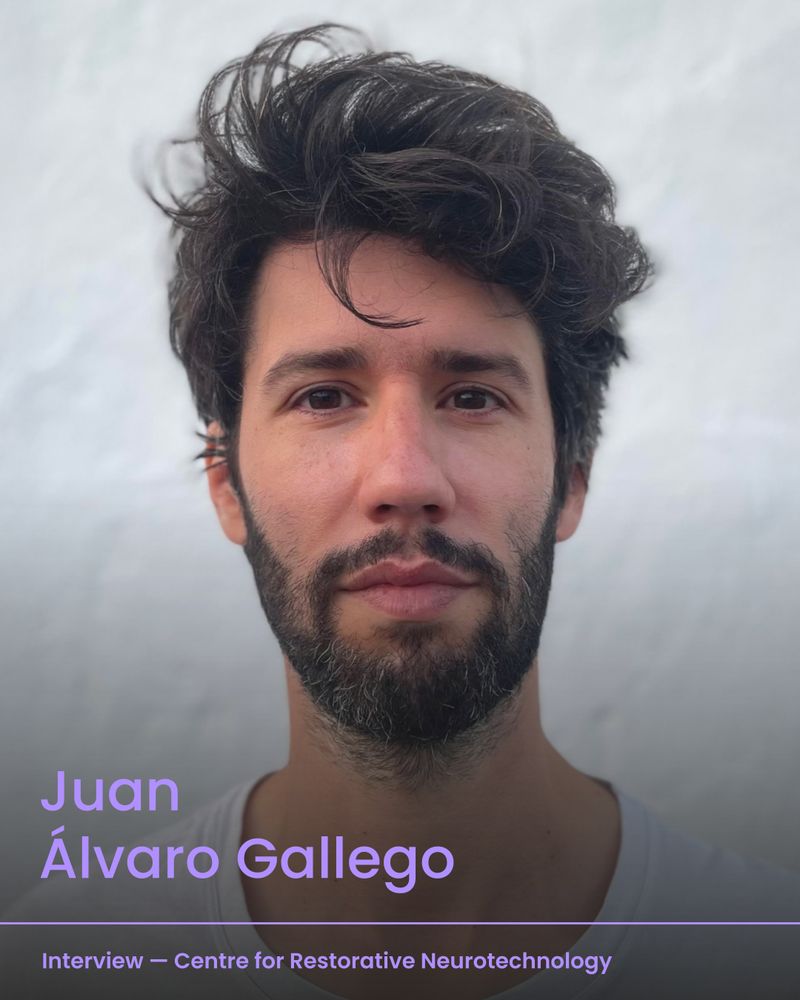
🧠🎼 What does it take to restore movement? Neuroscientist and engineer, @juangallego.bsky.social, joins the new Centre for Restorative Neurotechnology at the Champalimaud Foundation.
🔗 Find out more in this interview: www.fchampalimaud.org/news/juan-al...
🔗 Find out more in this interview: www.fchampalimaud.org/news/juan-al...
October 7, 2025 at 4:37 PM
🚨Big news!🚨
The lab is relocating to Lisbon, joining a great team of experimental and theoretical neuroscientists, and the Neurotechnology Warehouse, a new initiative to bridge basic and translational research.
I'll be sharing postdoc openings soon. Come join us in this new incarnation of the lab!
The lab is relocating to Lisbon, joining a great team of experimental and theoretical neuroscientists, and the Neurotechnology Warehouse, a new initiative to bridge basic and translational research.
I'll be sharing postdoc openings soon. Come join us in this new incarnation of the lab!
Reposted by Richard Naud
We just pushed “Memory by a 1000 rules” onto bioRxiv, where we use clever #ML to find #plasticity quadruplets (EE, EI, IE, II) that learn basic stability in spiking nets. Why is it cool? We find 1000s!! of solutions, and they don’t just stabilise. They #memorise! www.biorxiv.org/content/10.1...

Memory by a thousand rules: Automated discovery of functional multi-type plasticity rules reveals variety & degeneracy at the heart of learning
Synaptic plasticity is the basis of learning and memory, but the link between synaptic changes and neural function remains elusive. Here, we used automated search algorithms to obtain thousands of str...
www.biorxiv.org
June 2, 2025 at 6:50 PM
We just pushed “Memory by a 1000 rules” onto bioRxiv, where we use clever #ML to find #plasticity quadruplets (EE, EI, IE, II) that learn basic stability in spiking nets. Why is it cool? We find 1000s!! of solutions, and they don’t just stabilise. They #memorise! www.biorxiv.org/content/10.1...
How are the fluctuations in electric field organized across the whole brain? We analyzed the 3.4 M samples from the international brain lab using a combination of deep learning and graph theory. We found a surprising structure made of communities and landmarks.
doi.org/10.1101/2025...
doi.org/10.1101/2025...
October 6, 2025 at 2:31 PM
How are the fluctuations in electric field organized across the whole brain? We analyzed the 3.4 M samples from the international brain lab using a combination of deep learning and graph theory. We found a surprising structure made of communities and landmarks.
doi.org/10.1101/2025...
doi.org/10.1101/2025...
Reposted by Richard Naud

I'd never heard Richard Sutton speak before. He's sharp! And I think this discussion has changed how I think about the bitter lesson.
youtu.be/21EYKqUsPfg?... #AI #ML #RL
youtu.be/21EYKqUsPfg?... #AI #ML #RL

Richard Sutton – Father of RL thinks LLMs are a dead end
YouTube video by Dwarkesh Patel
youtu.be
October 2, 2025 at 11:48 PM
I'd never heard Richard Sutton speak before. He's sharp! And I think this discussion has changed how I think about the bitter lesson.
youtu.be/21EYKqUsPfg?... #AI #ML #RL
youtu.be/21EYKqUsPfg?... #AI #ML #RL