



Maik Hamjediers
@mhamjediers.bsky.social
Postdoctoral Max Weber Fellow at @eui-eu.bsky.social
Previously at @humboldtuni.bsky.social
🔗 https://mhamjediers.com
Previously at @humboldtuni.bsky.social
🔗 https://mhamjediers.com
Reposted by Maik Hamjediers

Now officially published in jpeaceresearch.bsky.social.
Link to full-text:
academic.oup.com/jpr/advance-...
#PoliticalScience #PoliticalPsychology
Link to full-text:
academic.oup.com/jpr/advance-...
#PoliticalScience #PoliticalPsychology

January 30, 2026 at 10:01 AM
Now officially published in jpeaceresearch.bsky.social.
Link to full-text:
academic.oup.com/jpr/advance-...
#PoliticalScience #PoliticalPsychology
Link to full-text:
academic.oup.com/jpr/advance-...
#PoliticalScience #PoliticalPsychology
Reposted by Maik Hamjediers

Comparing registrations to published papers is essential to research integrity - and almost no one does it routinely because it's slow, messy, and time-demanding.
RegCheck was built to help make this process easier.
Today, we launch RegCheck V2.
🧵
regcheck.app
RegCheck was built to help make this process easier.
Today, we launch RegCheck V2.
🧵
regcheck.app

RegCheck
RegCheck is an AI tool to compare preregistrations with papers instantly.
regcheck.app
January 22, 2026 at 11:05 AM
Comparing registrations to published papers is essential to research integrity - and almost no one does it routinely because it's slow, messy, and time-demanding.
RegCheck was built to help make this process easier.
Today, we launch RegCheck V2.
🧵
regcheck.app
RegCheck was built to help make this process easier.
Today, we launch RegCheck V2.
🧵
regcheck.app
Reposted by Maik Hamjediers

From November 2025 -
Anti-Immigrant Bias in the Choice Between Punitive and Rehabilitative Justice - https://cup.org/49vUfVa
- @riazsascha.bsky.social & @mhamjediers.bsky.social
#OpenAccess
Anti-Immigrant Bias in the Choice Between Punitive and Rehabilitative Justice - https://cup.org/49vUfVa
- @riazsascha.bsky.social & @mhamjediers.bsky.social
#OpenAccess

January 11, 2026 at 2:10 PM
From November 2025 -
Anti-Immigrant Bias in the Choice Between Punitive and Rehabilitative Justice - https://cup.org/49vUfVa
- @riazsascha.bsky.social & @mhamjediers.bsky.social
#OpenAccess
Anti-Immigrant Bias in the Choice Between Punitive and Rehabilitative Justice - https://cup.org/49vUfVa
- @riazsascha.bsky.social & @mhamjediers.bsky.social
#OpenAccess
Reposted by Maik Hamjediers

New paper in the American Journal of Sociology (with Michael Grätz), and a very good way to close an important chapter!
www.journals.uchicago.edu/doi/10.1086/...
www.journals.uchicago.edu/doi/10.1086/...
Does Expanding Free Secondary Education Moderate the Relationship Between Genes and Socioeconomic Outcomes? Evidence from the Education Act of 1944 in England | American Journal of Sociology: Vol 0, N...
www.journals.uchicago.edu
December 16, 2025 at 9:57 AM
New paper in the American Journal of Sociology (with Michael Grätz), and a very good way to close an important chapter!
www.journals.uchicago.edu/doi/10.1086/...
www.journals.uchicago.edu/doi/10.1086/...
Reposted by Maik Hamjediers

Mine and @pengzell.bsky.social paper
"How Robust Are Country Rankings in Educational Mobility?" was published in @sociologicalsci.bsky.social yesterday edu.nl/y7ct3
More details in the future, but for now short explanation of what we did, and the origin story of the paper.
[Thread below]
"How Robust Are Country Rankings in Educational Mobility?" was published in @sociologicalsci.bsky.social yesterday edu.nl/y7ct3
More details in the future, but for now short explanation of what we did, and the origin story of the paper.
[Thread below]

How Robust Are Country Rankings in Educational Mobility?
Article: How Robust Are Country Rankings in Educational Mobility? | Sociological Science | Posted December 11, 2025
doi.org
December 12, 2025 at 4:55 PM
Mine and @pengzell.bsky.social paper
"How Robust Are Country Rankings in Educational Mobility?" was published in @sociologicalsci.bsky.social yesterday edu.nl/y7ct3
More details in the future, but for now short explanation of what we did, and the origin story of the paper.
[Thread below]
"How Robust Are Country Rankings in Educational Mobility?" was published in @sociologicalsci.bsky.social yesterday edu.nl/y7ct3
More details in the future, but for now short explanation of what we did, and the origin story of the paper.
[Thread below]
Reposted by Maik Hamjediers

I’m hiring a postdoc! Flexible in terms of details, but I’m looking for someone to collaborate with on research about labor market inequality. I’ll review applications as they come in and the posting just went up here:
apply.interfolio.com/178873
apply.interfolio.com/178873
Apply - Interfolio
{{$ctrl.$state.data.pageTitle}} - Apply - Interfolio
apply.interfolio.com
December 9, 2025 at 7:36 PM
I’m hiring a postdoc! Flexible in terms of details, but I’m looking for someone to collaborate with on research about labor market inequality. I’ll review applications as they come in and the posting just went up here:
apply.interfolio.com/178873
apply.interfolio.com/178873
Reposted by Maik Hamjediers

Rückkehr zur #Wehrpflicht? Neue Studie untersucht Einstellungen zur geplanten Wiedereinführung der Wehrpflicht und zeigt: Die junge Generation lehnt den #Wehrdienst klar ab. Ein verpflichtendes #Gesellschaftsjahr findet jedoch Unterstützung.
Zur Studie 🔗 www.dezim-institut.de/publikatione...
Zur Studie 🔗 www.dezim-institut.de/publikatione...


December 4, 2025 at 9:42 AM
Rückkehr zur #Wehrpflicht? Neue Studie untersucht Einstellungen zur geplanten Wiedereinführung der Wehrpflicht und zeigt: Die junge Generation lehnt den #Wehrdienst klar ab. Ein verpflichtendes #Gesellschaftsjahr findet jedoch Unterstützung.
Zur Studie 🔗 www.dezim-institut.de/publikatione...
Zur Studie 🔗 www.dezim-institut.de/publikatione...
Reposted by Maik Hamjediers
Problems with the so-called gender equality paradox
statmodeling.stat.columbia.edu/2025/11/25/p...
statmodeling.stat.columbia.edu/2025/11/25/p...
Problems with the so-called gender equality paradox | Statistical Modeling, Causal Inference, and Social Science
statmodeling.stat.columbia.edu
November 25, 2025 at 2:53 PM
Problems with the so-called gender equality paradox
statmodeling.stat.columbia.edu/2025/11/25/p...
statmodeling.stat.columbia.edu/2025/11/25/p...
Reposted by Maik Hamjediers

Gaza: Study Reveals Unprecedented Losses of Life & Life Expectancy
Researchers from MPIDR & the Centre for Demographic Studies (CED) investigated the impact of the conflict in Gaza on mortality. Life expectancy 2024 fell to nearly half the level expected without the war. www.demogr.mpg.de/go/GazaLE
Researchers from MPIDR & the Centre for Demographic Studies (CED) investigated the impact of the conflict in Gaza on mortality. Life expectancy 2024 fell to nearly half the level expected without the war. www.demogr.mpg.de/go/GazaLE

November 25, 2025 at 10:11 AM
Gaza: Study Reveals Unprecedented Losses of Life & Life Expectancy
Researchers from MPIDR & the Centre for Demographic Studies (CED) investigated the impact of the conflict in Gaza on mortality. Life expectancy 2024 fell to nearly half the level expected without the war. www.demogr.mpg.de/go/GazaLE
Researchers from MPIDR & the Centre for Demographic Studies (CED) investigated the impact of the conflict in Gaza on mortality. Life expectancy 2024 fell to nearly half the level expected without the war. www.demogr.mpg.de/go/GazaLE
Reposted by Maik Hamjediers

Why did I visit the Facebook pages of 5500 German grocery stores on a grey lockdown day ca. 2021?
You can now find out in AJS.
Our work on ethnoreligious infrastructures is finally online in the ominous Volume 0:
www.journals.uchicago.edu/doi/10.1086/...
You can now find out in AJS.
Our work on ethnoreligious infrastructures is finally online in the ominous Volume 0:
www.journals.uchicago.edu/doi/10.1086/...

November 24, 2025 at 12:03 PM
Why did I visit the Facebook pages of 5500 German grocery stores on a grey lockdown day ca. 2021?
You can now find out in AJS.
Our work on ethnoreligious infrastructures is finally online in the ominous Volume 0:
www.journals.uchicago.edu/doi/10.1086/...
You can now find out in AJS.
Our work on ethnoreligious infrastructures is finally online in the ominous Volume 0:
www.journals.uchicago.edu/doi/10.1086/...
Reposted by Maik Hamjediers

There’s a new kid in town!
Companies are now selling IVF and embryo selection based on genetic testing for traits related to health and even intelligence.
We outline methodological and ethical concerns, and warn against risks for social inequality.
With the fantastic @gaiaghirardi.bsky.social
Companies are now selling IVF and embryo selection based on genetic testing for traits related to health and even intelligence.
We outline methodological and ethical concerns, and warn against risks for social inequality.
With the fantastic @gaiaghirardi.bsky.social

Embryo selection based on polygenic prediction risks reinforcing social inequality
The rise of companies offering embryo selection based on genetic testing has triggered heated debate about ethical acceptability, as well as the accuracy and scientific validity of these techniques. W...
www.fertstert.org
November 13, 2025 at 8:09 AM
There’s a new kid in town!
Companies are now selling IVF and embryo selection based on genetic testing for traits related to health and even intelligence.
We outline methodological and ethical concerns, and warn against risks for social inequality.
With the fantastic @gaiaghirardi.bsky.social
Companies are now selling IVF and embryo selection based on genetic testing for traits related to health and even intelligence.
We outline methodological and ethical concerns, and warn against risks for social inequality.
With the fantastic @gaiaghirardi.bsky.social
New publication with @riazsascha.bsky.social in @bjpols.bsky.social
As I’m concerned that the figures in the SI might get too little attention, here are some findings in visual form:
As I’m concerned that the figures in the SI might get too little attention, here are some findings in visual form:


November 4, 2025 at 2:56 PM
New publication with @riazsascha.bsky.social in @bjpols.bsky.social
As I’m concerned that the figures in the SI might get too little attention, here are some findings in visual form:
As I’m concerned that the figures in the SI might get too little attention, here are some findings in visual form:
Reposted by Maik Hamjediers

New paper with @mhamjediers.bsky.social
German judges have discretion to apply rehabilitative juvenile criminal law (Jugendstrafrecht) or punitive adult criminal law to 18–20-year-old offenders. We show that immigrant youths are ~10 percentage points less likely to be sentenced under juvenile law
German judges have discretion to apply rehabilitative juvenile criminal law (Jugendstrafrecht) or punitive adult criminal law to 18–20-year-old offenders. We show that immigrant youths are ~10 percentage points less likely to be sentenced under juvenile law
NEW -
Anti-Immigrant Bias in the Choice Between Punitive and Rehabilitative Justice - https://cup.org/49vUfVa
- @riazsascha.bsky.social & @mhamjediers.bsky.social
#OpenAccess
Anti-Immigrant Bias in the Choice Between Punitive and Rehabilitative Justice - https://cup.org/49vUfVa
- @riazsascha.bsky.social & @mhamjediers.bsky.social
#OpenAccess
November 4, 2025 at 11:20 AM
New paper with @mhamjediers.bsky.social
German judges have discretion to apply rehabilitative juvenile criminal law (Jugendstrafrecht) or punitive adult criminal law to 18–20-year-old offenders. We show that immigrant youths are ~10 percentage points less likely to be sentenced under juvenile law
German judges have discretion to apply rehabilitative juvenile criminal law (Jugendstrafrecht) or punitive adult criminal law to 18–20-year-old offenders. We show that immigrant youths are ~10 percentage points less likely to be sentenced under juvenile law
Reposted by Maik Hamjediers

why do journals restrict the number of pages of the online supplementary material? I am confused! 😅
November 1, 2025 at 8:57 AM
why do journals restrict the number of pages of the online supplementary material? I am confused! 😅
Reposted by Maik Hamjediers

🚨 Applications Now Open for the EUI PhD Programmes 2026-2027!
📊 Economics |⚖️ Law |📘 History | 🏛 Political and Social Sciences
Join the EUI's 50th PhD cohort!
Apply by 15 January 2026 (14:00 CET) for the academic journey of a lifetime! 👉: eui.eu/phd
#EUIPhD #PhDOpportunity
📊 Economics |⚖️ Law |📘 History | 🏛 Political and Social Sciences
Join the EUI's 50th PhD cohort!
Apply by 15 January 2026 (14:00 CET) for the academic journey of a lifetime! 👉: eui.eu/phd
#EUIPhD #PhDOpportunity
November 1, 2025 at 8:15 AM
🚨 Applications Now Open for the EUI PhD Programmes 2026-2027!
📊 Economics |⚖️ Law |📘 History | 🏛 Political and Social Sciences
Join the EUI's 50th PhD cohort!
Apply by 15 January 2026 (14:00 CET) for the academic journey of a lifetime! 👉: eui.eu/phd
#EUIPhD #PhDOpportunity
📊 Economics |⚖️ Law |📘 History | 🏛 Political and Social Sciences
Join the EUI's 50th PhD cohort!
Apply by 15 January 2026 (14:00 CET) for the academic journey of a lifetime! 👉: eui.eu/phd
#EUIPhD #PhDOpportunity
Reposted by Maik Hamjediers
New article out in @sociusjournal.bsky.social.
It shows how closely linked motherhood penalties 🤰📉 and gender inequalities 👨💼💰👩💼 are by studying many local labour markets.
Thread 👇
journals.sagepub.com/doi/10.1177/...
It shows how closely linked motherhood penalties 🤰📉 and gender inequalities 👨💼💰👩💼 are by studying many local labour markets.
Thread 👇
journals.sagepub.com/doi/10.1177/...


October 13, 2025 at 4:37 PM
New article out in @sociusjournal.bsky.social.
It shows how closely linked motherhood penalties 🤰📉 and gender inequalities 👨💼💰👩💼 are by studying many local labour markets.
Thread 👇
journals.sagepub.com/doi/10.1177/...
It shows how closely linked motherhood penalties 🤰📉 and gender inequalities 👨💼💰👩💼 are by studying many local labour markets.
Thread 👇
journals.sagepub.com/doi/10.1177/...
Reposted by Maik Hamjediers
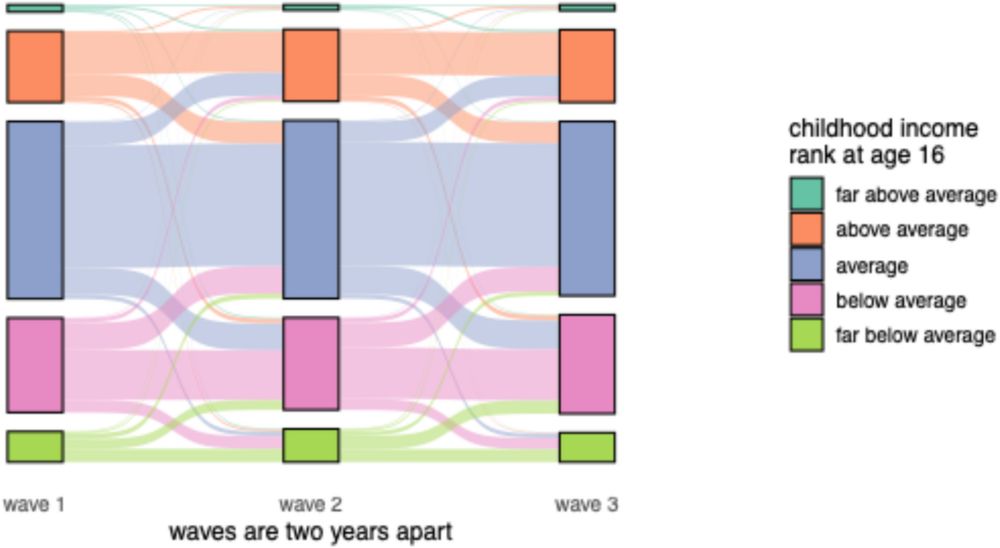
The GSS asked the same people about their childhood income rank three different times. 56% changed their answer, even though what was trying to be measured couldn’t change! We dig into this in a new article at @socialindicators.bsky.social.
doi.org/10.1007/s112...
🧵👇 (1/5)
doi.org/10.1007/s112...
🧵👇 (1/5)
Growing up Different(ly than Last Time We Asked): Social Status and Changing Reports of Childhood Income Rank - Social Indicators Research
How we remember our past can be shaped by the realities of our present. This study examines how changes to present circumstances influence retrospective reports of family income rank at age 16. While retrospective survey data can be used to assess the long-term effects of childhood conditions, present-day circumstances may “anchor” memories, causing shifts in how individuals recall and report past experiences. Using panel data from the 2006–2014 General Social Surveys (8,602 observations from 2,883 individuals in the United States), we analyze how changes in objective and subjective indicators of current social status—income, financial satisfaction, and perceived income relative to others—are associated with changes in reports of childhood income rank, and how this varies by sex and race/ethnicity. Fixed-effects models reveal no significant association between changes in income and in childhood income rank. However, changes in subjective measures of social status show contrasting effects, as increases in current financial satisfaction are associated with decreases in childhood income rank, but increases in current perceived relative income are associated with increases in childhood income rank. We argue these opposing effects follow from theories of anchoring in recall bias. We further find these effects are stronger among males but are consistent across racial/ethnic groups. This demographic heterogeneity suggests that recall bias is not evenly distributed across the population and has important implications for how different groups perceive their own pasts. Our findings further highlight the malleability of retrospective perceptions and their sensitivity to current social conditions, offering methodological insights into survey reliability and recall bias.
doi.org
October 10, 2025 at 2:05 PM
The GSS asked the same people about their childhood income rank three different times. 56% changed their answer, even though what was trying to be measured couldn’t change! We dig into this in a new article at @socialindicators.bsky.social.
doi.org/10.1007/s112...
🧵👇 (1/5)
doi.org/10.1007/s112...
🧵👇 (1/5)
Reposted by Maik Hamjediers

This important paper shows a precipitous drop in girls' achievement in recent years, closing a third of the gap with boys.
Covid doesn't seem to be the smoking gun, but tiktok may be
Covid doesn't seem to be the smoking gun, but tiktok may be

October 10, 2025 at 8:19 AM
This important paper shows a precipitous drop in girls' achievement in recent years, closing a third of the gap with boys.
Covid doesn't seem to be the smoking gun, but tiktok may be
Covid doesn't seem to be the smoking gun, but tiktok may be
Reposted by Maik Hamjediers

And the 1st Replication Award of the Academy of Sociology goes to..
Sergio Lo Iacono, Wojtek Przepiorka, Vincent Buskens, Rense Corten, Marcel van Assen, and Arnout van de Rijt
for "The competitive advantage of sanctioning institutions revisited: A multilab replication"
#AkadSoz25 #sociology
1/
Sergio Lo Iacono, Wojtek Przepiorka, Vincent Buskens, Rense Corten, Marcel van Assen, and Arnout van de Rijt
for "The competitive advantage of sanctioning institutions revisited: A multilab replication"
#AkadSoz25 #sociology
1/

October 9, 2025 at 10:18 AM
And the 1st Replication Award of the Academy of Sociology goes to..
Sergio Lo Iacono, Wojtek Przepiorka, Vincent Buskens, Rense Corten, Marcel van Assen, and Arnout van de Rijt
for "The competitive advantage of sanctioning institutions revisited: A multilab replication"
#AkadSoz25 #sociology
1/
Sergio Lo Iacono, Wojtek Przepiorka, Vincent Buskens, Rense Corten, Marcel van Assen, and Arnout van de Rijt
for "The competitive advantage of sanctioning institutions revisited: A multilab replication"
#AkadSoz25 #sociology
1/
Reposted by Maik Hamjediers
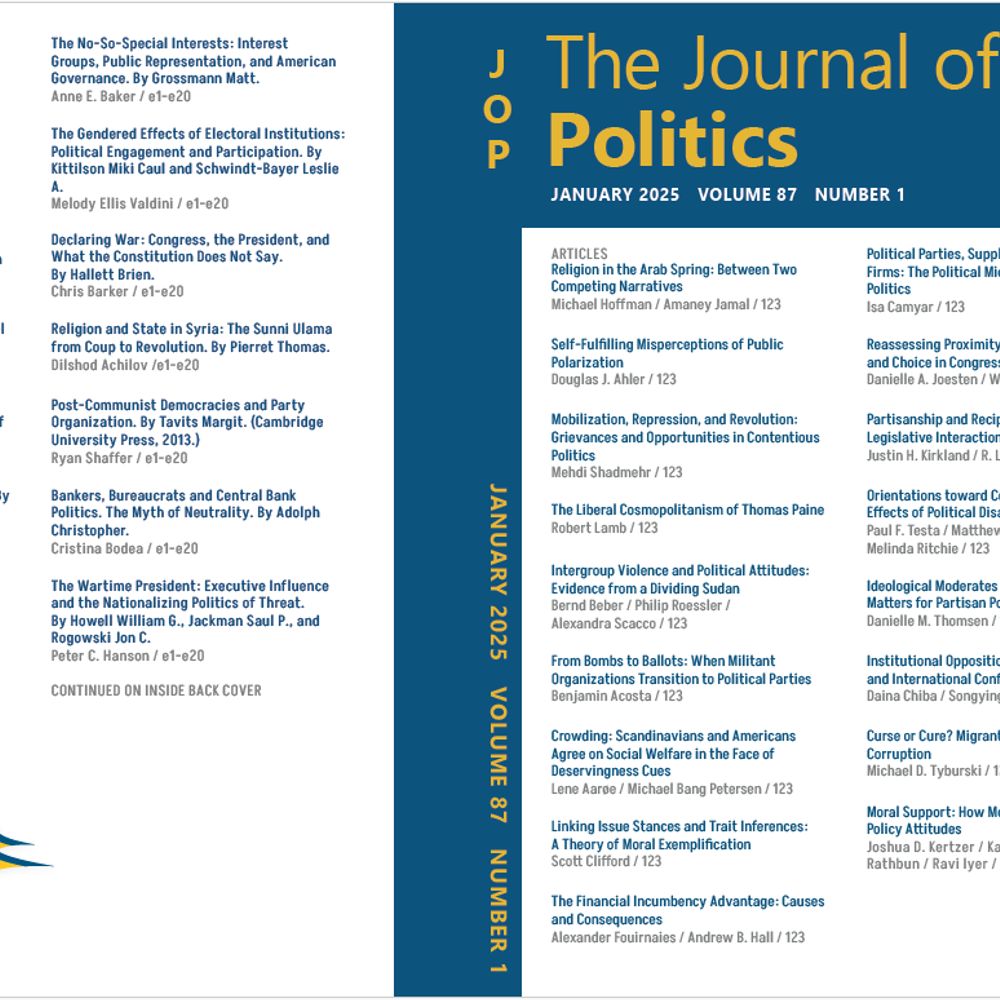
"Why Civil and Military Conscription Deserve a Second Look" by Sven Altenburger. (@svenaltenburger.bsky.social)
ubwp.buffalo.edu/jopblog/2025...
ubwp.buffalo.edu/jopblog/2025...
Why Civil and Military Conscription Deserve a Second Look – The Journal of Politics Blog
ubwp.buffalo.edu
June 8, 2025 at 10:22 PM
"Why Civil and Military Conscription Deserve a Second Look" by Sven Altenburger. (@svenaltenburger.bsky.social)
ubwp.buffalo.edu/jopblog/2025...
ubwp.buffalo.edu/jopblog/2025...
Reposted by Maik Hamjediers

💫Very happy to share that my first single-authored paper has been published in @sfjournal.bsky.social. I suggest to combine Life Course Feature Selection with Ñopo decomposition to disentangle which life-course events drive gender inequalities such as Gender Pension Gaps doi.org/10.1093/sf/s...
🧵👇
🧵👇

Full-time employment is all that matters? Quantifying the role of relevant and gender-exclusive life-course experiences for gender pension gaps
Abstract. Gender pension gaps (GPGs) represent crucial indicators of gender inequalities over the life course. Despite reaching higher levels, they have re
doi.org
September 8, 2025 at 10:07 AM
💫Very happy to share that my first single-authored paper has been published in @sfjournal.bsky.social. I suggest to combine Life Course Feature Selection with Ñopo decomposition to disentangle which life-course events drive gender inequalities such as Gender Pension Gaps doi.org/10.1093/sf/s...
🧵👇
🧵👇
Reposted by Maik Hamjediers
Did military service in Europe affect men's occupational choices? @mhamjediers.bsky.social presenting at #ECSR2025, very focused and passionate about research, as usual.
We investigate selection into armed forces, licensed and male-dominated occupations across multiple countries.
We investigate selection into armed forces, licensed and male-dominated occupations across multiple countries.

September 5, 2025 at 3:56 PM
Did military service in Europe affect men's occupational choices? @mhamjediers.bsky.social presenting at #ECSR2025, very focused and passionate about research, as usual.
We investigate selection into armed forces, licensed and male-dominated occupations across multiple countries.
We investigate selection into armed forces, licensed and male-dominated occupations across multiple countries.
Reposted by Maik Hamjediers

CLIC in Cologne! 🧳🚋
#ECSR2025 kicks off in Cologne tomorrow and we are excited to see many CLICers & friends on the program 🔥
Come join us in these great sessions 👇
#ECSR2025 kicks off in Cologne tomorrow and we are excited to see many CLICers & friends on the program 🔥
Come join us in these great sessions 👇


September 2, 2025 at 11:29 AM
CLIC in Cologne! 🧳🚋
#ECSR2025 kicks off in Cologne tomorrow and we are excited to see many CLICers & friends on the program 🔥
Come join us in these great sessions 👇
#ECSR2025 kicks off in Cologne tomorrow and we are excited to see many CLICers & friends on the program 🔥
Come join us in these great sessions 👇
In the context of debates on military capacities, this small research note uses the exact date of Russia’s invasion of Ukraine as an unexpected event during a survey to corroborate that willingness to fight rises with proximity to conflict (cf. doi.org/10.1017/eis.2025.12)
Any feedback is welcome!
Any feedback is welcome!

August 29, 2025 at 12:24 PM
In the context of debates on military capacities, this small research note uses the exact date of Russia’s invasion of Ukraine as an unexpected event during a survey to corroborate that willingness to fight rises with proximity to conflict (cf. doi.org/10.1017/eis.2025.12)
Any feedback is welcome!
Any feedback is welcome!
Reposted by Maik Hamjediers

This is the most interesting opinion piece I have read on the topic of polygenic embryo screening!
The "having" and "doing" of motherhood, the concrete practicalities of IVF, the blur between traits and diseases, etc.
Highly recommended reading.
The "having" and "doing" of motherhood, the concrete practicalities of IVF, the blur between traits and diseases, etc.
Highly recommended reading.
August 12, 2025 at 3:35 PM
This is the most interesting opinion piece I have read on the topic of polygenic embryo screening!
The "having" and "doing" of motherhood, the concrete practicalities of IVF, the blur between traits and diseases, etc.
Highly recommended reading.
The "having" and "doing" of motherhood, the concrete practicalities of IVF, the blur between traits and diseases, etc.
Highly recommended reading.