



Lucy Stafford
@lucysta02475610.bsky.social
PhD researcher. Interoception (mostly gastrointestinal), body image/representation, eating disorders, computational approaches (she/her). https://sites.google.com/york.ac.uk/lucy-stafford/about-me
Reposted by Lucy Stafford

How the brain listens to the body matters.
Our new preprint investigates interoceptive processing in schizophrenia spectrum disorders across phenomenology, behavior, and heartbeat-evoked brain responses. 🧠🫀DOI: doi.org/10.64898/202...
Our new preprint investigates interoceptive processing in schizophrenia spectrum disorders across phenomenology, behavior, and heartbeat-evoked brain responses. 🧠🫀DOI: doi.org/10.64898/202...

From Body to Brain and Back: Multimodal Evidence for Interoceptive Alterations in Schizophrenia Spectrum Disorders
When the brain and body misalign, emotional experience and sense of reality can be disrupted. Although such atypical experiences are central to schizophrenia spectrum disorders (SSD), interoception, p...
doi.org
January 20, 2026 at 9:40 AM
How the brain listens to the body matters.
Our new preprint investigates interoceptive processing in schizophrenia spectrum disorders across phenomenology, behavior, and heartbeat-evoked brain responses. 🧠🫀DOI: doi.org/10.64898/202...
Our new preprint investigates interoceptive processing in schizophrenia spectrum disorders across phenomenology, behavior, and heartbeat-evoked brain responses. 🧠🫀DOI: doi.org/10.64898/202...
Reposted by Lucy Stafford

Delighted to share my first paper of 2026 "Interoception and allostatic load after stroke: A scoping review". Available now, open access: doi.org/10.1016/j.ne...
Redirecting
doi.org
January 20, 2026 at 2:25 AM
Delighted to share my first paper of 2026 "Interoception and allostatic load after stroke: A scoping review". Available now, open access: doi.org/10.1016/j.ne...
Reposted by Lucy Stafford

It took several late night/early morning meetings, but I’m very happy to see this perspective piece on #Autistic #interoception published. journals.sagepub.com/doi/10.1177/...

Interoception in Autism, Pitfalls, and Promise: A Participatory Research Perspective - Eleanor R. Palser, Wenn B. Lawson, Emma Goodall, Elizabeth Pellicano, 2026
Bodily autonomy is essential to Autistic well-being. Interoception supports bodily autonomy through guiding behavior in support of homeostasis. Promoting adapti...
journals.sagepub.com
January 15, 2026 at 5:06 PM
It took several late night/early morning meetings, but I’m very happy to see this perspective piece on #Autistic #interoception published. journals.sagepub.com/doi/10.1177/...
Reposted by Lucy Stafford

Our paper on interoceptive rhythms and perception now is published in NeuroImage 🚀📄
@alexgalvezpol.bsky.social already shared a fantastic breakdown of our main findings in the thread below👇🏽
🔗Full OA article: doi.org/10.1016/j.ne...
#Interoception #Perception #Neuroscience #ActiveSensing
@alexgalvezpol.bsky.social already shared a fantastic breakdown of our main findings in the thread below👇🏽
🔗Full OA article: doi.org/10.1016/j.ne...
#Interoception #Perception #Neuroscience #ActiveSensing
January 6, 2026 at 11:34 AM
Our paper on interoceptive rhythms and perception now is published in NeuroImage 🚀📄
@alexgalvezpol.bsky.social already shared a fantastic breakdown of our main findings in the thread below👇🏽
🔗Full OA article: doi.org/10.1016/j.ne...
#Interoception #Perception #Neuroscience #ActiveSensing
@alexgalvezpol.bsky.social already shared a fantastic breakdown of our main findings in the thread below👇🏽
🔗Full OA article: doi.org/10.1016/j.ne...
#Interoception #Perception #Neuroscience #ActiveSensing
Reposted by Lucy Stafford

New job alert 💫 We’re hiring a 3-year postdoc for the NEPTUNE project to study the causal mechanisms of paranoia and social learning.
Work with us on experimental psychopharmacology (THC), social cognition, and psychosis 🧑🔬
Apply here: lnkd.in/gQqnNvjR](my.corehr.com/pls/kclrecru...)
Please RT :)
Work with us on experimental psychopharmacology (THC), social cognition, and psychosis 🧑🔬
Apply here: lnkd.in/gQqnNvjR](my.corehr.com/pls/kclrecru...)
Please RT :)

December 18, 2025 at 8:27 AM
New job alert 💫 We’re hiring a 3-year postdoc for the NEPTUNE project to study the causal mechanisms of paranoia and social learning.
Work with us on experimental psychopharmacology (THC), social cognition, and psychosis 🧑🔬
Apply here: lnkd.in/gQqnNvjR](my.corehr.com/pls/kclrecru...)
Please RT :)
Work with us on experimental psychopharmacology (THC), social cognition, and psychosis 🧑🔬
Apply here: lnkd.in/gQqnNvjR](my.corehr.com/pls/kclrecru...)
Please RT :)
Reposted by Lucy Stafford

Last preprint 🎶(of the year).
If vagus nerve stimulation alters motivation by amplifying internal signals, then bodily states should matter. Using milkshake vs. water loads, we show that tVNS-induced changes in Pavlovian bias are dependent on hunger. #neuroskyence 🩺
www.biorxiv.org/content/10.6...
If vagus nerve stimulation alters motivation by amplifying internal signals, then bodily states should matter. Using milkshake vs. water loads, we show that tVNS-induced changes in Pavlovian bias are dependent on hunger. #neuroskyence 🩺
www.biorxiv.org/content/10.6...

December 17, 2025 at 7:24 AM
Last preprint 🎶(of the year).
If vagus nerve stimulation alters motivation by amplifying internal signals, then bodily states should matter. Using milkshake vs. water loads, we show that tVNS-induced changes in Pavlovian bias are dependent on hunger. #neuroskyence 🩺
www.biorxiv.org/content/10.6...
If vagus nerve stimulation alters motivation by amplifying internal signals, then bodily states should matter. Using milkshake vs. water loads, we show that tVNS-induced changes in Pavlovian bias are dependent on hunger. #neuroskyence 🩺
www.biorxiv.org/content/10.6...
Reposted by Lucy Stafford

It is hugely fun & we are very lucky to do science for the sake of science. But it is amazing to see work we and many others I admire have done turn into public awareness thanks to excellent science writing.
(see also www.nytimes.com/2025/11/25/s...)
(see also www.nytimes.com/2025/11/25/s...)
December 17, 2025 at 9:25 AM
It is hugely fun & we are very lucky to do science for the sake of science. But it is amazing to see work we and many others I admire have done turn into public awareness thanks to excellent science writing.
(see also www.nytimes.com/2025/11/25/s...)
(see also www.nytimes.com/2025/11/25/s...)
Reposted by Lucy Stafford

New writeup on interoception in Scientific American focusing on its role in mental health:
www.scientificamerican.com/article/inte...
www.scientificamerican.com/article/inte...

Disruptions in This Sixth Sense May Drive Mental Illness
Disruptions in interoception may underlie anxiety, eating disorders, and other mental health ailments
www.scientificamerican.com
December 16, 2025 at 8:59 PM
New writeup on interoception in Scientific American focusing on its role in mental health:
www.scientificamerican.com/article/inte...
www.scientificamerican.com/article/inte...
Reposted by Lucy Stafford
Out now in @ebiomedicine.bsky.social 🚨.
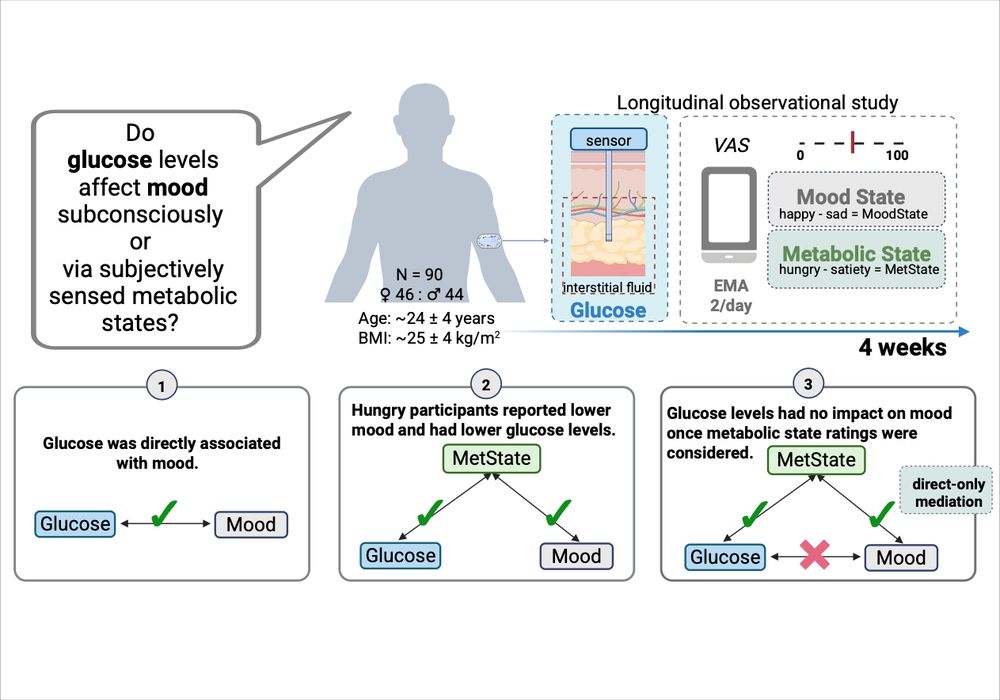
Hunger often affects our mood, but is this a conscious or a subconscious process? Using continuous glucose monitoring, we show that differences in mood are driven by hunger ratings, not just glucose. #neuroskyence 🩺
www.thelancet.com/journals/EBI...
Hunger often affects our mood, but is this a conscious or a subconscious process? Using continuous glucose monitoring, we show that differences in mood are driven by hunger ratings, not just glucose. #neuroskyence 🩺
www.thelancet.com/journals/EBI...
December 8, 2025 at 1:33 PM
Out now in @ebiomedicine.bsky.social 🚨.
Hunger often affects our mood, but is this a conscious or a subconscious process? Using continuous glucose monitoring, we show that differences in mood are driven by hunger ratings, not just glucose. #neuroskyence 🩺
www.thelancet.com/journals/EBI...
Hunger often affects our mood, but is this a conscious or a subconscious process? Using continuous glucose monitoring, we show that differences in mood are driven by hunger ratings, not just glucose. #neuroskyence 🩺
www.thelancet.com/journals/EBI...
Reposted by Lucy Stafford

Out now in Translational Psychiatry! www.nature.com/articles/s41...
November 28, 2025 at 2:53 PM
Out now in Translational Psychiatry! www.nature.com/articles/s41...
Reposted by Lucy Stafford

Very excited to introduce InteroMap, a new bodily mapping tool designed to measure how we subjectively experience our bodily sensations, what we call interoceptive phenomenology 🧵👇


November 18, 2025 at 10:07 PM
Very excited to introduce InteroMap, a new bodily mapping tool designed to measure how we subjectively experience our bodily sensations, what we call interoceptive phenomenology 🧵👇
Reposted by Lucy Stafford

What is the most profitable industry in the world, this side of the law? Not oil, not IT, not pharma.
It's *scientific publishing*.
We call this the Drain of Scientific Publishing.
Paper: arxiv.org/abs/2511.04820
Background: doi.org/10.1162/qss_...
Thread @markhanson.fediscience.org.ap.brid.gy 👇
It's *scientific publishing*.
We call this the Drain of Scientific Publishing.
Paper: arxiv.org/abs/2511.04820
Background: doi.org/10.1162/qss_...
Thread @markhanson.fediscience.org.ap.brid.gy 👇

November 12, 2025 at 10:31 AM
What is the most profitable industry in the world, this side of the law? Not oil, not IT, not pharma.
It's *scientific publishing*.
We call this the Drain of Scientific Publishing.
Paper: arxiv.org/abs/2511.04820
Background: doi.org/10.1162/qss_...
Thread @markhanson.fediscience.org.ap.brid.gy 👇
It's *scientific publishing*.
We call this the Drain of Scientific Publishing.
Paper: arxiv.org/abs/2511.04820
Background: doi.org/10.1162/qss_...
Thread @markhanson.fediscience.org.ap.brid.gy 👇
Reposted by Lucy Stafford

It's that time of year when many start thinking about applying for PhDs. If you're applying for a UK PhD position, here is a blog post I wrote a while back that might be helpful
#cognition #psychscisky #neuroskyence #psychjobs
#cognition #psychscisky #neuroskyence #psychjobs
How to get PhD funding in the UK
It is that time of year again. The leaves are turning golden, red, and orange (or just brown), the nights are drawing in, and there is a chi...
aidanhorner.blogspot.com
October 6, 2025 at 6:03 PM
It's that time of year when many start thinking about applying for PhDs. If you're applying for a UK PhD position, here is a blog post I wrote a while back that might be helpful
#cognition #psychscisky #neuroskyence #psychjobs
#cognition #psychscisky #neuroskyence #psychjobs
Reposted by Lucy Stafford

Thank you to @psypost.bsky.social for featuring our @natmentalhealth.nature.com research on stomach–brain communication and worse mental health symptoms
www.psypost.org/scientists-d...
Was also shared on X but with weirdly more hair colour comments 🌈 than the science itself 😅:
x.com/OwenGregoria...
www.psypost.org/scientists-d...
Was also shared on X but with weirdly more hair colour comments 🌈 than the science itself 😅:
x.com/OwenGregoria...

Scientists discover surprising link between gut-brain interactions and mental health
Every emotion has a physical side, but one organ has been curiously overlooked in brain-body research. Now, scientists are turning their attention to the stomach—and discovering signals that may chang...
www.psypost.org
October 1, 2025 at 8:02 AM
Thank you to @psypost.bsky.social for featuring our @natmentalhealth.nature.com research on stomach–brain communication and worse mental health symptoms
www.psypost.org/scientists-d...
Was also shared on X but with weirdly more hair colour comments 🌈 than the science itself 😅:
x.com/OwenGregoria...
www.psypost.org/scientists-d...
Was also shared on X but with weirdly more hair colour comments 🌈 than the science itself 😅:
x.com/OwenGregoria...
Reposted by Lucy Stafford
Even after recovery, relapse is heartbreakingly common in anorexia nervosa. Could the answer lie in the gut’s hidden signals? 🧵

September 22, 2025 at 8:14 PM
Even after recovery, relapse is heartbreakingly common in anorexia nervosa. Could the answer lie in the gut’s hidden signals? 🧵
Reposted by Lucy Stafford
Reilly, Brown & Frank link altered taste, touch, vision, and gut sensing to anorexia and bulimia nervosa, highlight knowledge gaps, and proposing neurobiologically-informed strategies for clinical translation. pubmed.ncbi.nlm.nih.gov/38730196/

Perceptual Dysfunction in Eating Disorders - PubMed
Eating disorders (EDs) are characterized by abnormal responses to food and weight-related stimuli and are associated with significant distress, impairment, and poor outcomes. Because many of the cardi...
pubmed.ncbi.nlm.nih.gov
September 17, 2025 at 6:32 AM
Reilly, Brown & Frank link altered taste, touch, vision, and gut sensing to anorexia and bulimia nervosa, highlight knowledge gaps, and proposing neurobiologically-informed strategies for clinical translation. pubmed.ncbi.nlm.nih.gov/38730196/
Reposted by Lucy Stafford

🚨Do you want to join our online seminars?
Next month we have this amazing seminar with Anna and Noa!
Register to join, it’s free 🤓
#somatosensation
#interoception
#sensory
#body
#science
#neuroscience
docs.google.com/forms/d/e/1F...
Next month we have this amazing seminar with Anna and Noa!
Register to join, it’s free 🤓
#somatosensation
#interoception
#sensory
#body
#science
#neuroscience
docs.google.com/forms/d/e/1F...

September 16, 2025 at 10:27 AM
🚨Do you want to join our online seminars?
Next month we have this amazing seminar with Anna and Noa!
Register to join, it’s free 🤓
#somatosensation
#interoception
#sensory
#body
#science
#neuroscience
docs.google.com/forms/d/e/1F...
Next month we have this amazing seminar with Anna and Noa!
Register to join, it’s free 🤓
#somatosensation
#interoception
#sensory
#body
#science
#neuroscience
docs.google.com/forms/d/e/1F...
Reposted by Lucy Stafford

New qualitative paper! A foray into gastric interception. @lucysta02475610.bsky.social ran a LOT of focus groups, across groups with eating disorders, gastric disorders and neither, to understand how people experience the sensations from their GI system. www.sciencedirect.com/science/arti...

"I feel full with shame": A qualitative perspective on gastric interoceptive sensibility
“Am I hungry? Did I overeat at lunch?” Gastric interoception - the sensing, interpretation, and regulation of signals from the gastrointestinal system…
www.sciencedirect.com
September 13, 2025 at 7:03 AM
New qualitative paper! A foray into gastric interception. @lucysta02475610.bsky.social ran a LOT of focus groups, across groups with eating disorders, gastric disorders and neither, to understand how people experience the sensations from their GI system. www.sciencedirect.com/science/arti...
Reposted by Lucy Stafford

In this @cp-trendsneuro.bsky.social Spotlight, I describe how a recent paper by @leahbanellis.bsky.social, @brainandstomach.bsky.social, et al. opens new avenues in interoception research, including those focussed on the subjective interpretation of internal signals: www.cell.com/trends/neuro...

Stomach–brain synchronisation is associated with poorer mental health
In common parlance, ‘being in touch with your body’ is often used positively. However,
in a recent study, Banellis, Rebollo, and colleagues show that better stomach–brain
synchronisation is actually a...
www.cell.com
September 9, 2025 at 11:32 AM
In this @cp-trendsneuro.bsky.social Spotlight, I describe how a recent paper by @leahbanellis.bsky.social, @brainandstomach.bsky.social, et al. opens new avenues in interoception research, including those focussed on the subjective interpretation of internal signals: www.cell.com/trends/neuro...
Reposted by Lucy Stafford

🧠 New publication out!
👁️🗨️ 🫀 In this perspective, we draw parallels with anosognosia
for hemiplegia, commonly seen in acute stroke patients, in the attempt to explain anosognosia for the illness in anorexia nervosa, based on recent
computational accounts
www.frontiersin.org/journals/neu...
👁️🗨️ 🫀 In this perspective, we draw parallels with anosognosia
for hemiplegia, commonly seen in acute stroke patients, in the attempt to explain anosognosia for the illness in anorexia nervosa, based on recent
computational accounts
www.frontiersin.org/journals/neu...
Frontiers | The adamant adherence to a prior belief: the case of anosognosia in anorexia nervosa
Anorexia Nervosa (AN) is a complex psychiatric disorder marked by restrictive eating and distorted body image. Often, individuals with AN show a persistent d...
www.frontiersin.org
September 5, 2025 at 3:35 PM
🧠 New publication out!
👁️🗨️ 🫀 In this perspective, we draw parallels with anosognosia
for hemiplegia, commonly seen in acute stroke patients, in the attempt to explain anosognosia for the illness in anorexia nervosa, based on recent
computational accounts
www.frontiersin.org/journals/neu...
👁️🗨️ 🫀 In this perspective, we draw parallels with anosognosia
for hemiplegia, commonly seen in acute stroke patients, in the attempt to explain anosognosia for the illness in anorexia nervosa, based on recent
computational accounts
www.frontiersin.org/journals/neu...
Reposted by Lucy Stafford

On Prolific, "we estimate that about 34% of online study participants use LLMs to answer open-ended questions atleast some of the time..."
Seems like a very timely paper for behavioural scientists using online samples: osf.io/preprints/so... ;
We really need more papers on this issue
Seems like a very timely paper for behavioural scientists using online samples: osf.io/preprints/so... ;
We really need more papers on this issue

August 29, 2025 at 9:46 AM
On Prolific, "we estimate that about 34% of online study participants use LLMs to answer open-ended questions atleast some of the time..."
Seems like a very timely paper for behavioural scientists using online samples: osf.io/preprints/so... ;
We really need more papers on this issue
Seems like a very timely paper for behavioural scientists using online samples: osf.io/preprints/so... ;
We really need more papers on this issue
A roller coaster of a thread for any interoceptive researchers ⬇️
August 28, 2025 at 9:41 AM
A roller coaster of a thread for any interoceptive researchers ⬇️
Reposted by Lucy Stafford
Wow, this is the kind of evidence we need to move ahead in the field. I'll go out on a limb here: I guess it is more about the gut than cardiac and respiratory domains. Huge effort by @leahbanellis.bsky.social @micahgallen.com and the entire team 👏

Interoceptive Ability is Unrelated to Mental Health Symptoms: Evidence From a Large Scale Multi-Domain Psychophysical Investigation https://www.medrxiv.org/content/10.1101/2025.08.25.25334366v1
August 27, 2025 at 3:36 PM
Wow, this is the kind of evidence we need to move ahead in the field. I'll go out on a limb here: I guess it is more about the gut than cardiac and respiratory domains. Huge effort by @leahbanellis.bsky.social @micahgallen.com and the entire team 👏
Reposted by Lucy Stafford

the tldr of my thread is that, interoceptive sensing at rest has no relationship to mental health symptoms, and we think this is likely because we need to measure interoception during and after arousal, close in time to symptoms, with ecological measures.
Are interoception and mental health linked? Many assume so, with interoception even described as a psychiatric “p-factor.” But in our latest preprint, we were surprised to find little evidence for such a connection. www.medrxiv.org/content/10.1... 🧵 Thread with our reflections on the matter 👇

Interoceptive Ability is Unrelated to Mental Health Symptoms: Evidence From a Large Scale Multi-Domain Psychophysical Investigation
Interoception-the sensing and perception of the internal viscera-is widely cast as a transdiagnostic mechanism linking brain-body interaction to mental illness. Prevailing models propose that altered ...
www.medrxiv.org
August 28, 2025 at 7:01 AM
the tldr of my thread is that, interoceptive sensing at rest has no relationship to mental health symptoms, and we think this is likely because we need to measure interoception during and after arousal, close in time to symptoms, with ecological measures.
Reposted by Lucy Stafford

The latest from our lab @the-ecg.bsky.social: interoceptive sensing at rest is *not* related to mental health symptoms 🤔 Read our study here 👇
Are interoception and mental health linked? Many assume so, with interoception even described as a psychiatric “p-factor.” But in our latest preprint, we were surprised to find little evidence for such a connection. www.medrxiv.org/content/10.1... 🧵 Thread with our reflections on the matter 👇
Interoceptive Ability is Unrelated to Mental Health Symptoms: Evidence From a Large Scale Multi-Domain Psychophysical Investigation
Interoception-the sensing and perception of the internal viscera-is widely cast as a transdiagnostic mechanism linking brain-body interaction to mental illness. Prevailing models propose that altered ...
www.medrxiv.org
August 28, 2025 at 8:37 AM
The latest from our lab @the-ecg.bsky.social: interoceptive sensing at rest is *not* related to mental health symptoms 🤔 Read our study here 👇