




Ladislas Nalborczyk
@lnalborczyk.bsky.social
Computational cognitive neuroscientist @cnrs.fr 🧠💻
Inner speech, mental/motor imagery, cognitive/statistical modelling, EMG, M/EEG, open and slow science. https://lnalborczyk.github.io
Inner speech, mental/motor imagery, cognitive/statistical modelling, EMG, M/EEG, open and slow science. https://lnalborczyk.github.io
Pinned

Modelling time-resolved electrophysiological data with Bayesian generalised additive multilevel models
Providing utility functions for fitting Bayesian generalised additive multilevel models (BGAMMs) to time-resolved data (e.g., M/EEG, pupillometry, mouse-tracking, etc) and identifying clusters.
lnalborczyk.github.io
If you analyse time-resolved data (M/EEG, iEEG, pupillometry, force recordings…) and feel limited by cluster-based permutation tests (CBPTs); especially when trying to determine when an effect starts or ends; you may want to try our new R package: lnalborczyk.github.io/neurogam/
#rstats #brms #EEG
#rstats #brms #EEG
Reposted by Ladislas Nalborczyk


Reposted by Ladislas Nalborczyk

📆 updated for 2026!
list of summer schools & short courses in the realm of (computational) neuroscience or data analysis of EEG / MEG / LFP: 🔗 docs.google.com/spreadsheets...
list of summer schools & short courses in the realm of (computational) neuroscience or data analysis of EEG / MEG / LFP: 🔗 docs.google.com/spreadsheets...

various computational neuroscience / MEEG / LFP short courses and summer schools
docs.google.com
December 19, 2025 at 4:37 PM
📆 updated for 2026!
list of summer schools & short courses in the realm of (computational) neuroscience or data analysis of EEG / MEG / LFP: 🔗 docs.google.com/spreadsheets...
list of summer schools & short courses in the realm of (computational) neuroscience or data analysis of EEG / MEG / LFP: 🔗 docs.google.com/spreadsheets...
Reposted by Ladislas Nalborczyk

Bichan Wu (@bichanw.bsky.social) & I wrote a tutorial paper on Reduced Rank Regression (RRR) — the statistical method underlying "communication subspaces" from Semedo et al 2019 — aimed at neuroscientists.
arxiv.org/abs/2512.12467
arxiv.org/abs/2512.12467

Reduced rank regression for neural communication: a tutorial for neuroscientists
Reduced rank regression (RRR) is a statistical method for finding a low-dimensional linear mapping between a set of high-dimensional inputs and outputs. In recent years, RRR has found numerous applica...
arxiv.org
December 17, 2025 at 2:06 AM
Bichan Wu (@bichanw.bsky.social) & I wrote a tutorial paper on Reduced Rank Regression (RRR) — the statistical method underlying "communication subspaces" from Semedo et al 2019 — aimed at neuroscientists.
arxiv.org/abs/2512.12467
arxiv.org/abs/2512.12467
Reposted by Ladislas Nalborczyk

Modeling Speed–Accuracy Trade-Offs in the Stopping Rule for Confidence Judgments! Now out in #PsychologicalReview (aka we can finally say we do comp models)! Led by @stefherregods.bsky.social @lucvermeylen.bsky.social @pierreledenmat.bsky.social
Paper: desenderlab.com/wp-content/u... Thread ↓↓↓
Paper: desenderlab.com/wp-content/u... Thread ↓↓↓
desenderlab.com
December 16, 2025 at 3:52 PM
Modeling Speed–Accuracy Trade-Offs in the Stopping Rule for Confidence Judgments! Now out in #PsychologicalReview (aka we can finally say we do comp models)! Led by @stefherregods.bsky.social @lucvermeylen.bsky.social @pierreledenmat.bsky.social
Paper: desenderlab.com/wp-content/u... Thread ↓↓↓
Paper: desenderlab.com/wp-content/u... Thread ↓↓↓
Reposted by Ladislas Nalborczyk

New preprint!
www.biorxiv.org/content/10.6...
As you are silently reading this, you may experience a little voice in your head. How is it represented in the brain, and what purpose does it serve? Our new study answers the questions.
Together with @adriendoerig.bsky.social and Radek Cichy.(1/8)
www.biorxiv.org/content/10.6...
As you are silently reading this, you may experience a little voice in your head. How is it represented in the brain, and what purpose does it serve? Our new study answers the questions.
Together with @adriendoerig.bsky.social and Radek Cichy.(1/8)

Auditory representations of words during silent visual reading
Silent visual reading is accompanied by the phenomenological experience of an inner voice. However, the temporal dynamics and functional role of the underlying neural representations remain unclear. H...
www.biorxiv.org
December 15, 2025 at 3:10 PM
New preprint!
www.biorxiv.org/content/10.6...
As you are silently reading this, you may experience a little voice in your head. How is it represented in the brain, and what purpose does it serve? Our new study answers the questions.
Together with @adriendoerig.bsky.social and Radek Cichy.(1/8)
www.biorxiv.org/content/10.6...
As you are silently reading this, you may experience a little voice in your head. How is it represented in the brain, and what purpose does it serve? Our new study answers the questions.
Together with @adriendoerig.bsky.social and Radek Cichy.(1/8)
Reposted by Ladislas Nalborczyk
Our group has been looking at beta bursts for the last 5 years, but we do it a little differently than most - we group into types them based on their waveforms. In this open access article we lay out why and what we think this might mean
journals.sagepub.com/doi/10.1177/...
#neuroskyence
journals.sagepub.com/doi/10.1177/...
#neuroskyence

December 12, 2025 at 10:00 AM
Our group has been looking at beta bursts for the last 5 years, but we do it a little differently than most - we group into types them based on their waveforms. In this open access article we lay out why and what we think this might mean
journals.sagepub.com/doi/10.1177/...
#neuroskyence
journals.sagepub.com/doi/10.1177/...
#neuroskyence
If you analyse time-resolved data (M/EEG, iEEG, pupillometry, force recordings…) and feel limited by cluster-based permutation tests (CBPTs); especially when trying to determine when an effect starts or ends; you may want to try our new R package: lnalborczyk.github.io/neurogam/
#rstats #brms #EEG
#rstats #brms #EEG
Modelling time-resolved electrophysiological data with Bayesian generalised additive multilevel models
Providing utility functions for fitting Bayesian generalised additive multilevel models (BGAMMs) to time-resolved data (e.g., M/EEG, pupillometry, mouse-tracking, etc) and identifying clusters.
lnalborczyk.github.io
December 11, 2025 at 11:38 AM
If you analyse time-resolved data (M/EEG, iEEG, pupillometry, force recordings…) and feel limited by cluster-based permutation tests (CBPTs); especially when trying to determine when an effect starts or ends; you may want to try our new R package: lnalborczyk.github.io/neurogam/
#rstats #brms #EEG
#rstats #brms #EEG
Reposted by Ladislas Nalborczyk

I'm teaching Statistical Rethinking again starting Jan 2026. This time with live lectures, divided into Beginner and Experienced sections. Will be a lot more work for me, but I hope much better for students.
I will record lectures & all will be found at this link: github.com/rmcelreath/s...
I will record lectures & all will be found at this link: github.com/rmcelreath/s...

December 9, 2025 at 1:58 PM
I'm teaching Statistical Rethinking again starting Jan 2026. This time with live lectures, divided into Beginner and Experienced sections. Will be a lot more work for me, but I hope much better for students.
I will record lectures & all will be found at this link: github.com/rmcelreath/s...
I will record lectures & all will be found at this link: github.com/rmcelreath/s...
Reposted by Ladislas Nalborczyk

🎉 APPLICATIONS ARE OPEN 🎉
Join the MESEC Winter School 2026 in Ephesus, Turkey, March 22–28. 🗓️☀️
A week of methods, ideas, and deep dives into consciousness with an international community.
Apply now and share the call. 🧠
🔗 mesec.co/event/winter...
Join the MESEC Winter School 2026 in Ephesus, Turkey, March 22–28. 🗓️☀️
A week of methods, ideas, and deep dives into consciousness with an international community.
Apply now and share the call. 🧠
🔗 mesec.co/event/winter...
MESEC | MESEC Winter School 2026
mesec.co
December 9, 2025 at 8:31 PM
🎉 APPLICATIONS ARE OPEN 🎉
Join the MESEC Winter School 2026 in Ephesus, Turkey, March 22–28. 🗓️☀️
A week of methods, ideas, and deep dives into consciousness with an international community.
Apply now and share the call. 🧠
🔗 mesec.co/event/winter...
Join the MESEC Winter School 2026 in Ephesus, Turkey, March 22–28. 🗓️☀️
A week of methods, ideas, and deep dives into consciousness with an international community.
Apply now and share the call. 🧠
🔗 mesec.co/event/winter...
Reposted by Ladislas Nalborczyk

📚 The international DIM C-BRAINS PhD program is back!
Up for grabs: 7 fully funded, 3-year doctoral contracts in the Île-de-France region, 3 of which will be hosted by Paris Brain Institute.
📆 Application deadline: February 1, 2026.
👉 Find out more: parisbraininstitute.org/dim-c-brains...
Up for grabs: 7 fully funded, 3-year doctoral contracts in the Île-de-France region, 3 of which will be hosted by Paris Brain Institute.
📆 Application deadline: February 1, 2026.
👉 Find out more: parisbraininstitute.org/dim-c-brains...

The DIM C-BRAINS international PhD program opens its 2026 call for applications. | Paris Brain Institute
The international DIM C-BRAINS PhD program is back. Up for grabs: 7 fully funded, 3-year doctoral contracts in the Île-de-France region, 3 of which will be hosted by the Institut du Cerveau. Applicati...
parisbraininstitute.org
December 5, 2025 at 5:04 PM
📚 The international DIM C-BRAINS PhD program is back!
Up for grabs: 7 fully funded, 3-year doctoral contracts in the Île-de-France region, 3 of which will be hosted by Paris Brain Institute.
📆 Application deadline: February 1, 2026.
👉 Find out more: parisbraininstitute.org/dim-c-brains...
Up for grabs: 7 fully funded, 3-year doctoral contracts in the Île-de-France region, 3 of which will be hosted by Paris Brain Institute.
📆 Application deadline: February 1, 2026.
👉 Find out more: parisbraininstitute.org/dim-c-brains...
Reposted by Ladislas Nalborczyk

The Groningen Spring school on Cognitive Modeling is back! Join us from March 30th-April 2nd, 2026! www.ai.rug.nl/springschool/
Groningen Spring School in Cognitive Modeling
www.ai.rug.nl
December 4, 2025 at 7:50 PM
The Groningen Spring school on Cognitive Modeling is back! Join us from March 30th-April 2nd, 2026! www.ai.rug.nl/springschool/
Reposted by Ladislas Nalborczyk

🚀 Job alert for ML researchers who love "impossible" problems:
Detect inner speech from EEG signals. No labels. Lots of noise.
Standard methods failed. We will invent something new.
Deadline: Jan 4, 2026
hr-jobs.lancs.ac.uk/Vacancy.aspx...
#DeepLearning #Neuroscience #AIResearch
Detect inner speech from EEG signals. No labels. Lots of noise.
Standard methods failed. We will invent something new.
Deadline: Jan 4, 2026
hr-jobs.lancs.ac.uk/Vacancy.aspx...
#DeepLearning #Neuroscience #AIResearch

Job Opportunity at Lancaster University: Senior Research Associate in Machine Learning for Spontaneous Inner Speech Detection
The Department of Psychology at Lancaster University is seeking to appoint a Senior Research Associate in Machine Learning (ML), at 0.8 FTE (4 days per week) to develop novel computational methods for...
hr-jobs.lancs.ac.uk
December 1, 2025 at 12:46 PM
🚀 Job alert for ML researchers who love "impossible" problems:
Detect inner speech from EEG signals. No labels. Lots of noise.
Standard methods failed. We will invent something new.
Deadline: Jan 4, 2026
hr-jobs.lancs.ac.uk/Vacancy.aspx...
#DeepLearning #Neuroscience #AIResearch
Detect inner speech from EEG signals. No labels. Lots of noise.
Standard methods failed. We will invent something new.
Deadline: Jan 4, 2026
hr-jobs.lancs.ac.uk/Vacancy.aspx...
#DeepLearning #Neuroscience #AIResearch
Reposted by Ladislas Nalborczyk

New article published in @frontiersin.bsky.social #Psychology! We introduce fastACI, an #openaccess toolbox that enables researchers to design auditory reverse-correlation experiments and analyze the resulting data. www.frontiersin.org/journals/psy... @cognitionens.bsky.social @lsp-ens.bsky.social

Frontiers | FastACI: a toolbox for investigating auditory perception using reverse correlation
The fastACI toolbox provides a compilation of tools for collecting and analyzing data from auditory reverse-correlation experiments. These experiments involv...
www.frontiersin.org
November 28, 2025 at 1:48 PM
New article published in @frontiersin.bsky.social #Psychology! We introduce fastACI, an #openaccess toolbox that enables researchers to design auditory reverse-correlation experiments and analyze the resulting data. www.frontiersin.org/journals/psy... @cognitionens.bsky.social @lsp-ens.bsky.social
Reposted by Ladislas Nalborczyk

Testing 191 proposed linguistic universals with methods that account for genealogical descent & geographical proximity: “despite vast design space of possible grammars, languages don't evolve entirely at random. Shared cognitive/communicative pressures repeatedly push towards similar solutions.“👇🧪

Enduring constraints on grammar revealed by Bayesian spatiophylogenetic analyses - Nature Human Behaviour
Despite their great diversity, human languages are shaped by recurring grammatical universals. Verkerk et al. show that about one-third of the proposed universals hold cross-linguistically through ana...
www.nature.com
November 24, 2025 at 5:40 PM
Testing 191 proposed linguistic universals with methods that account for genealogical descent & geographical proximity: “despite vast design space of possible grammars, languages don't evolve entirely at random. Shared cognitive/communicative pressures repeatedly push towards similar solutions.“👇🧪
Reposted by Ladislas Nalborczyk
Origins of language, one of humanity’s most distinctive traits, may be best explained as a unique convergence of multiple capacities each with its own evolutionary history, involving intertwined roles of biology & culture. This framing can expand research horizons. A 🧵 on our @science.org paper.🧪1/n

What enables human language? A biocultural framework
Explaining the origins of language is a key challenge in understanding ourselves as a species. We present an empirical framework that draws on synergies across fields to facilitate robust studies of l...
www.science.org
November 23, 2025 at 11:54 AM
Origins of language, one of humanity’s most distinctive traits, may be best explained as a unique convergence of multiple capacities each with its own evolutionary history, involving intertwined roles of biology & culture. This framing can expand research horizons. A 🧵 on our @science.org paper.🧪1/n
Reposted by Ladislas Nalborczyk

What enables human language? A biocultural framework. New paper by Inbal Arnon & al. with @limorraviv.bsky.social , @profsimonfisher.bsky.social
doi.org/10.1126/science.adq8303
doi.org/10.1126/science.adq8303

What enables human language? A biocultural framework
Explaining the origins of language is a key challenge in understanding ourselves as a species. We present an empirical framework that draws on synergies across fields to facilitate robust studies of l...
doi.org
November 21, 2025 at 8:35 AM
What enables human language? A biocultural framework. New paper by Inbal Arnon & al. with @limorraviv.bsky.social , @profsimonfisher.bsky.social
doi.org/10.1126/science.adq8303
doi.org/10.1126/science.adq8303
Reposted by Ladislas Nalborczyk

Is the “standard workflow” holding back fMRI analysis?
Mass-univariate analysis is still the bread-and-butter: intuitive, fast… and chronically overfitted. Add harsh multiple-comparison penalties, and we patch the workflow with statistical band-aids. No wonder the stringency debates never die.
Mass-univariate analysis is still the bread-and-butter: intuitive, fast… and chronically overfitted. Add harsh multiple-comparison penalties, and we patch the workflow with statistical band-aids. No wonder the stringency debates never die.
November 18, 2025 at 10:13 PM
Is the “standard workflow” holding back fMRI analysis?
Mass-univariate analysis is still the bread-and-butter: intuitive, fast… and chronically overfitted. Add harsh multiple-comparison penalties, and we patch the workflow with statistical band-aids. No wonder the stringency debates never die.
Mass-univariate analysis is still the bread-and-butter: intuitive, fast… and chronically overfitted. Add harsh multiple-comparison penalties, and we patch the workflow with statistical band-aids. No wonder the stringency debates never die.
Reposted by Ladislas Nalborczyk
Advances in genomics are giving exciting new perspectives on biology of speech, language & reading. My latest peer-reviewed paper is a tutorial, guiding readers from different backgrounds through the history of the field, current state-of-the-art, & where we’re heading. A taster in this thread.🧪
1/n
1/n

Genomic Investigations of Spoken and Written Language Abilities: A Guide to Advances in Approaches, Technologies, and Discovery
Purpose: The aim of this tutorial is to show how the rise of molecular technologies
and analytical methods in human genetics yields exciting new ...
pubs.asha.org
November 17, 2025 at 5:54 PM
Advances in genomics are giving exciting new perspectives on biology of speech, language & reading. My latest peer-reviewed paper is a tutorial, guiding readers from different backgrounds through the history of the field, current state-of-the-art, & where we’re heading. A taster in this thread.🧪
1/n
1/n
Reposted by Ladislas Nalborczyk

We released a pretty cool dataset/preprint today looking at video game play, cognition, time-use and a ton of self-reported psych measures at osf.io/preprints/ps... with @nballou.bsky.social @matti.vuorre.com @thomashakman.bsky.social @rpsychologist.com and @shuhbillskee.bsky.social RRs coming soon


November 14, 2025 at 4:35 PM
We released a pretty cool dataset/preprint today looking at video game play, cognition, time-use and a ton of self-reported psych measures at osf.io/preprints/ps... with @nballou.bsky.social @matti.vuorre.com @thomashakman.bsky.social @rpsychologist.com and @shuhbillskee.bsky.social RRs coming soon
Reposted by Ladislas Nalborczyk

🎉 Finally out in Journal of Phonetics, tutorial with @paulbuerkner.com
📖 "Bayesian beta regressions with brms in R: A tutorial for phoneticians"
Accepted manuscript here: doi.org/10.31219/osf...
Repo: github.com/stefanocoret...
Publisher link: www.sciencedirect.com/science/arti...
📖 "Bayesian beta regressions with brms in R: A tutorial for phoneticians"
Accepted manuscript here: doi.org/10.31219/osf...
Repo: github.com/stefanocoret...
Publisher link: www.sciencedirect.com/science/arti...
a close up of a rat looking at the camera with the word drunken written in the corner
ALT: a close up of a rat looking at the camera with the word drunken written in the corner
media.tenor.com
November 15, 2025 at 3:21 PM
🎉 Finally out in Journal of Phonetics, tutorial with @paulbuerkner.com
📖 "Bayesian beta regressions with brms in R: A tutorial for phoneticians"
Accepted manuscript here: doi.org/10.31219/osf...
Repo: github.com/stefanocoret...
Publisher link: www.sciencedirect.com/science/arti...
📖 "Bayesian beta regressions with brms in R: A tutorial for phoneticians"
Accepted manuscript here: doi.org/10.31219/osf...
Repo: github.com/stefanocoret...
Publisher link: www.sciencedirect.com/science/arti...
Reposted by Ladislas Nalborczyk
With sequencing of Hitler's DNA making headlines, time for a reminder: analysing a polygenic score from a dead historically-significant figure won't give new insights into that person's behaviour. In a brief paper last year, we used Beethoven's genome to directly illustrate the fallacies involved.🧪👇
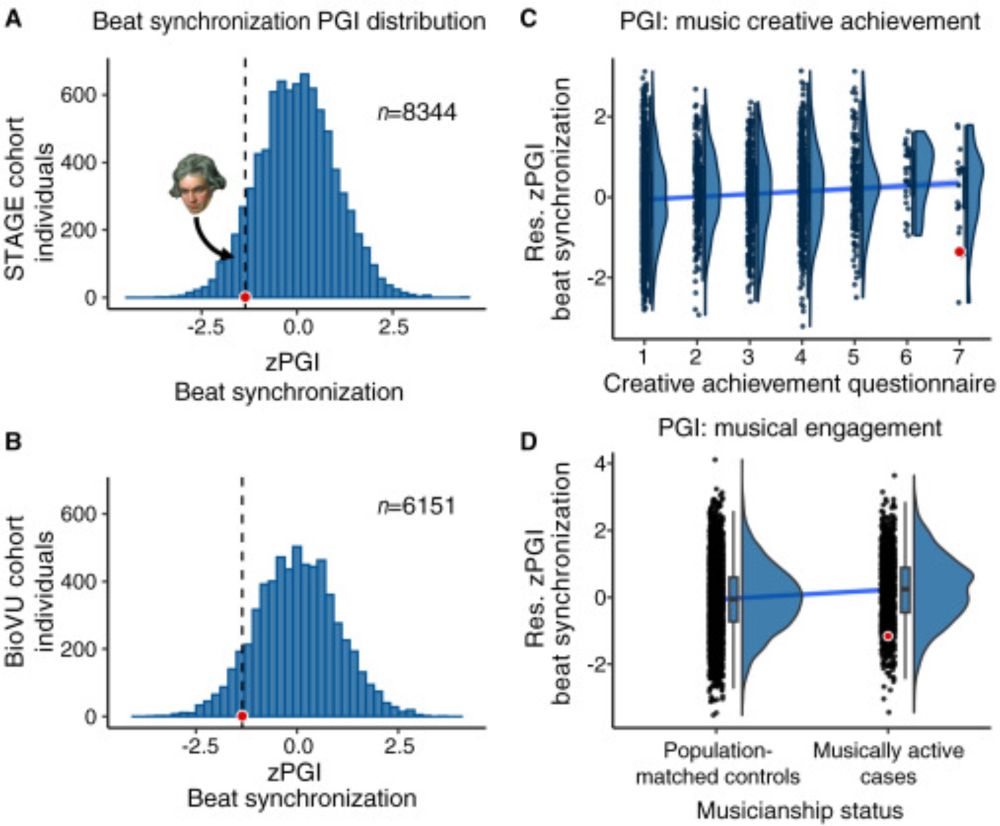
Notes from Beethoven’s genome
Wesseldijk et al. compare the genomic information collected from Ludwig van Beethoven
with population-based datasets used to quantify musical achievement.
www.cell.com
November 13, 2025 at 11:26 AM
With sequencing of Hitler's DNA making headlines, time for a reminder: analysing a polygenic score from a dead historically-significant figure won't give new insights into that person's behaviour. In a brief paper last year, we used Beethoven's genome to directly illustrate the fallacies involved.🧪👇
Reposted by Ladislas Nalborczyk

Time, space, memory and brain–body rhythms — a Perspective by György Buzsáki
#neuroscience #neuroskyence
www.nature.com/articles/s41...
#neuroscience #neuroskyence
www.nature.com/articles/s41...

Time, space, memory and brain–body rhythms - Nature Reviews Neuroscience
Understanding how the brain represents experienced time and how representations of space and time are integrated to form episodic memories has been a goal of much neuroscientific research. In this Per...
www.nature.com
November 13, 2025 at 11:43 AM
Time, space, memory and brain–body rhythms — a Perspective by György Buzsáki
#neuroscience #neuroskyence
www.nature.com/articles/s41...
#neuroscience #neuroskyence
www.nature.com/articles/s41...
Reposted by Ladislas Nalborczyk

A Nature survey shows how widely researchers disagree on what quantum mechanics says about reality.
Read the results - and find out what interpretation suits you - at this @nature.com article by @lizziegibney.bsky.social
A run-down of major findings: 🧵
www.nature.com/articles/d41...
Read the results - and find out what interpretation suits you - at this @nature.com article by @lizziegibney.bsky.social
A run-down of major findings: 🧵
www.nature.com/articles/d41...

Physicists disagree wildly on what quantum mechanics says about reality, Nature survey shows
First major attempt to chart researchers’ views finds interpretations in conflict.
www.nature.com
July 30, 2025 at 10:25 AM
A Nature survey shows how widely researchers disagree on what quantum mechanics says about reality.
Read the results - and find out what interpretation suits you - at this @nature.com article by @lizziegibney.bsky.social
A run-down of major findings: 🧵
www.nature.com/articles/d41...
Read the results - and find out what interpretation suits you - at this @nature.com article by @lizziegibney.bsky.social
A run-down of major findings: 🧵
www.nature.com/articles/d41...
Reposted by Ladislas Nalborczyk

1/n We have discovered that bees can keep track of time duration!
Bees can discriminate long 🟡🟡 vs short🟡 flashes, a bit like the "dash" and "dot" of the Morse code.
Check our new paper royalsocietypublishing.org/doi/10.1098/... and videoclip youtu.be/hsGxU65OMQk?... @preparedmindslab.bsky.social
Bees can discriminate long 🟡🟡 vs short🟡 flashes, a bit like the "dash" and "dot" of the Morse code.
Check our new paper royalsocietypublishing.org/doi/10.1098/... and videoclip youtu.be/hsGxU65OMQk?... @preparedmindslab.bsky.social

November 12, 2025 at 8:58 AM
1/n We have discovered that bees can keep track of time duration!
Bees can discriminate long 🟡🟡 vs short🟡 flashes, a bit like the "dash" and "dot" of the Morse code.
Check our new paper royalsocietypublishing.org/doi/10.1098/... and videoclip youtu.be/hsGxU65OMQk?... @preparedmindslab.bsky.social
Bees can discriminate long 🟡🟡 vs short🟡 flashes, a bit like the "dash" and "dot" of the Morse code.
Check our new paper royalsocietypublishing.org/doi/10.1098/... and videoclip youtu.be/hsGxU65OMQk?... @preparedmindslab.bsky.social
Reposted by Ladislas Nalborczyk

New work from the lab published in @cp-neuron.bsky.social by @jonasterlau.bsky.social and Jan Martini. We describe that trial-by-trial variability indexes recurrent connectivity across the cortical hierarchy, which supports reliable and flexible coding www.cell.com/neuron/abstr... (1/4)

Structure in noise: Recurrent connectivity shapes neural variability to balance perceptual and cognitive demands in the human brain
Does neural variability reflect random noise or a feature that benefits adaptive behavior?
Using intracranial recordings in humans, Terlau et al. demonstrate that neural variability
results from the r...
www.cell.com
November 10, 2025 at 5:06 PM
New work from the lab published in @cp-neuron.bsky.social by @jonasterlau.bsky.social and Jan Martini. We describe that trial-by-trial variability indexes recurrent connectivity across the cortical hierarchy, which supports reliable and flexible coding www.cell.com/neuron/abstr... (1/4)