



Julien Devilliers
@juliendevilliers.bsky.social
Postdoc Virginia Tech / sensory system 🦟 / molecular biology / entomology / phylogenomics / colour pattern / mimicry / vision / polarised light 🦋🇨🇵🇬🇧🇺🇲
https://juliendevi.github.io/
https://juliendevi.github.io/
Pinned
Check out this new preprint from the lab: www.biorxiv.org/content/10.6...
Lan Lou, @juliendevilliers.bsky.social, @karthikeyanc.bsky.social, @lahonderelab.bsky.social, the Tu Lab, and @joshuabenoit.bsky.social show that mosquito olfactory rhythms are synced with daily rhythms in how we smell.
Lan Lou, @juliendevilliers.bsky.social, @karthikeyanc.bsky.social, @lahonderelab.bsky.social, the Tu Lab, and @joshuabenoit.bsky.social show that mosquito olfactory rhythms are synced with daily rhythms in how we smell.
Temporal synchrony between human odor rhythms and mosquito olfactory preference shapes host attraction
For anthropophilic mosquitoes such as Aedes aegypti, aligning host-seeking with human availability enhances foraging efficiency and reproductive success. Although time of day modulates mosquito activity and olfactory sensitivity, it remains unknown whether human hosts display rhythmic changes in odor cues and whether mosquitoes adjust their sensory responses accordingly. Here, we combine chemical, behavioral, genetic, and transcriptomic approaches to reveal that both mosquitoes and their human hosts in this interaction are temporally synchronized. Gas chromatography-mass spectrometry showed systematic daily shifts in human body odor composition between morning and evening. Correspondingly, mosquitoes prefer host odors that match their own active phase, a time-specific preference abolished in timeless mutants and under constant darkness. Silencing the timeless gene further induced an aversion for the host scent under light-dark conditions. Transcriptomic analysis of mosquito heads and antennae uncovered rhythmic expression of sensory and neuromodulatory genes, driven by both circadian and light-dark cycles and which peaks during mosquitoes' active periods, with rhythmic co-expression networks collapsing in timeless knockouts. Together, these results show that mosquito attraction to humans is temporally tuned by the interplay of host odor rhythms and mosquito sensory rhythms, revealing a previously unrecognized form of interspecific temporal synchronization in vector-host interactions. ### Competing Interest Statement The authors have declared no competing interest. National Institutes of Health, R01AI155785, R21AI166633, R01AI148551 National Institute of Food and Agriculture, VA-160212
www.biorxiv.org
Check it out! Daily fluctuations of human smell, with behavioural and molecular synchronisation of mosquitoes smell and attraction! And icing on the cake a new timeless mutant line...
Reposted by Julien Devilliers

Our new study is out in @pnas.org ! 🐜🌍
We show that the environment shapes how ant societies are distributed across the world. Accessible here:
www.pnas.org/doi/10.1073/...
We show that the environment shapes how ant societies are distributed across the world. Accessible here:
www.pnas.org/doi/10.1073/...

Environmental conditions shape the global distribution of ant societies | PNAS
Sociality has evolved several times and is a key strategy for overcoming environmental
challenges and promoting ecological success. Yet, it remains...
www.pnas.org
February 6, 2026 at 8:54 AM
Our new study is out in @pnas.org ! 🐜🌍
We show that the environment shapes how ant societies are distributed across the world. Accessible here:
www.pnas.org/doi/10.1073/...
We show that the environment shapes how ant societies are distributed across the world. Accessible here:
www.pnas.org/doi/10.1073/...
Reposted by Julien Devilliers

Calling all OrthoFinder users!
We’ve just released GLADE, a tool to infer gene gains, losses, duplications, and ancestral genomes across a phylogeny.
GLADE runs directly on OrthoFinder results.
www.biorxiv.org/content/10.6...
github.com/lauriebelch/...
(1/10)
We’ve just released GLADE, a tool to infer gene gains, losses, duplications, and ancestral genomes across a phylogeny.
GLADE runs directly on OrthoFinder results.
www.biorxiv.org/content/10.6...
github.com/lauriebelch/...
(1/10)
www.biorxiv.org
January 29, 2026 at 12:07 PM
Calling all OrthoFinder users!
We’ve just released GLADE, a tool to infer gene gains, losses, duplications, and ancestral genomes across a phylogeny.
GLADE runs directly on OrthoFinder results.
www.biorxiv.org/content/10.6...
github.com/lauriebelch/...
(1/10)
We’ve just released GLADE, a tool to infer gene gains, losses, duplications, and ancestral genomes across a phylogeny.
GLADE runs directly on OrthoFinder results.
www.biorxiv.org/content/10.6...
github.com/lauriebelch/...
(1/10)
A bit of a different collaboration on neurodegenerative diseases between at the time PhD students
journals.sagepub.com/doi/10.1177/...
journals.sagepub.com/doi/10.1177/...

Glucocorticoid Treatment Dampens Kynurenine Pathway Activation and Cytokine Release in Immune Stimulated Human Microglia - Martina Esposito Soccoio, Robert P. Mason, Julien Devilliers, Roberto Feuda, ...
As a first line of defence for the central nervous system (CNS), microglia play a critical role in maintaining homeostasis within the brain. Upon detection of d...
journals.sagepub.com
January 24, 2026 at 2:15 PM
A bit of a different collaboration on neurodegenerative diseases between at the time PhD students
journals.sagepub.com/doi/10.1177/...
journals.sagepub.com/doi/10.1177/...
Check it out! Daily fluctuations of human smell, with behavioural and molecular synchronisation of mosquitoes smell and attraction! And icing on the cake a new timeless mutant line...
Check out this new preprint from the lab: www.biorxiv.org/content/10.6...
Lan Lou, @juliendevilliers.bsky.social, @karthikeyanc.bsky.social, @lahonderelab.bsky.social, the Tu Lab, and @joshuabenoit.bsky.social show that mosquito olfactory rhythms are synced with daily rhythms in how we smell.
Lan Lou, @juliendevilliers.bsky.social, @karthikeyanc.bsky.social, @lahonderelab.bsky.social, the Tu Lab, and @joshuabenoit.bsky.social show that mosquito olfactory rhythms are synced with daily rhythms in how we smell.
Temporal synchrony between human odor rhythms and mosquito olfactory preference shapes host attraction
For anthropophilic mosquitoes such as Aedes aegypti, aligning host-seeking with human availability enhances foraging efficiency and reproductive success. Although time of day modulates mosquito activity and olfactory sensitivity, it remains unknown whether human hosts display rhythmic changes in odor cues and whether mosquitoes adjust their sensory responses accordingly. Here, we combine chemical, behavioral, genetic, and transcriptomic approaches to reveal that both mosquitoes and their human hosts in this interaction are temporally synchronized. Gas chromatography-mass spectrometry showed systematic daily shifts in human body odor composition between morning and evening. Correspondingly, mosquitoes prefer host odors that match their own active phase, a time-specific preference abolished in timeless mutants and under constant darkness. Silencing the timeless gene further induced an aversion for the host scent under light-dark conditions. Transcriptomic analysis of mosquito heads and antennae uncovered rhythmic expression of sensory and neuromodulatory genes, driven by both circadian and light-dark cycles and which peaks during mosquitoes' active periods, with rhythmic co-expression networks collapsing in timeless knockouts. Together, these results show that mosquito attraction to humans is temporally tuned by the interplay of host odor rhythms and mosquito sensory rhythms, revealing a previously unrecognized form of interspecific temporal synchronization in vector-host interactions. ### Competing Interest Statement The authors have declared no competing interest. National Institutes of Health, R01AI155785, R21AI166633, R01AI148551 National Institute of Food and Agriculture, VA-160212
www.biorxiv.org
January 22, 2026 at 1:09 PM
Check it out! Daily fluctuations of human smell, with behavioural and molecular synchronisation of mosquitoes smell and attraction! And icing on the cake a new timeless mutant line...
Reposted by Julien Devilliers

Check out this new preprint from the lab: www.biorxiv.org/content/10.6...
Lan Lou, @juliendevilliers.bsky.social, @karthikeyanc.bsky.social, @lahonderelab.bsky.social, the Tu Lab, and @joshuabenoit.bsky.social show that mosquito olfactory rhythms are synced with daily rhythms in how we smell.
Lan Lou, @juliendevilliers.bsky.social, @karthikeyanc.bsky.social, @lahonderelab.bsky.social, the Tu Lab, and @joshuabenoit.bsky.social show that mosquito olfactory rhythms are synced with daily rhythms in how we smell.
Temporal synchrony between human odor rhythms and mosquito olfactory preference shapes host attraction
For anthropophilic mosquitoes such as Aedes aegypti, aligning host-seeking with human availability enhances foraging efficiency and reproductive success. Although time of day modulates mosquito activity and olfactory sensitivity, it remains unknown whether human hosts display rhythmic changes in odor cues and whether mosquitoes adjust their sensory responses accordingly. Here, we combine chemical, behavioral, genetic, and transcriptomic approaches to reveal that both mosquitoes and their human hosts in this interaction are temporally synchronized. Gas chromatography-mass spectrometry showed systematic daily shifts in human body odor composition between morning and evening. Correspondingly, mosquitoes prefer host odors that match their own active phase, a time-specific preference abolished in timeless mutants and under constant darkness. Silencing the timeless gene further induced an aversion for the host scent under light-dark conditions. Transcriptomic analysis of mosquito heads and antennae uncovered rhythmic expression of sensory and neuromodulatory genes, driven by both circadian and light-dark cycles and which peaks during mosquitoes' active periods, with rhythmic co-expression networks collapsing in timeless knockouts. Together, these results show that mosquito attraction to humans is temporally tuned by the interplay of host odor rhythms and mosquito sensory rhythms, revealing a previously unrecognized form of interspecific temporal synchronization in vector-host interactions. ### Competing Interest Statement The authors have declared no competing interest. National Institutes of Health, R01AI155785, R21AI166633, R01AI148551 National Institute of Food and Agriculture, VA-160212
www.biorxiv.org
January 22, 2026 at 12:21 PM
Check out this new preprint from the lab: www.biorxiv.org/content/10.6...
Lan Lou, @juliendevilliers.bsky.social, @karthikeyanc.bsky.social, @lahonderelab.bsky.social, the Tu Lab, and @joshuabenoit.bsky.social show that mosquito olfactory rhythms are synced with daily rhythms in how we smell.
Lan Lou, @juliendevilliers.bsky.social, @karthikeyanc.bsky.social, @lahonderelab.bsky.social, the Tu Lab, and @joshuabenoit.bsky.social show that mosquito olfactory rhythms are synced with daily rhythms in how we smell.
Reposted by Julien Devilliers

Ever wanted to know how the visual system of a long distance migratory moth looks like? Then you'll find your answers in our new paper. Finally out, after about a decade of collecting data by a group af amazing co-authors. Find it here, open access: link.springer.com/article/10.1...

December 18, 2025 at 2:16 PM
Ever wanted to know how the visual system of a long distance migratory moth looks like? Then you'll find your answers in our new paper. Finally out, after about a decade of collecting data by a group af amazing co-authors. Find it here, open access: link.springer.com/article/10.1...
Reposted by Julien Devilliers

Multiple anthropogenic stressors can negatively impact species but can a single stressor also have multiple, concurrent impacts? Here we show that light pollution creates several simultaneous impacts to the nocturnal movement ecology of a moth and a spider: tinyurl.com/5eku5bff (1/5)

December 17, 2025 at 8:15 PM
Multiple anthropogenic stressors can negatively impact species but can a single stressor also have multiple, concurrent impacts? Here we show that light pollution creates several simultaneous impacts to the nocturnal movement ecology of a moth and a spider: tinyurl.com/5eku5bff (1/5)
Reposted by Julien Devilliers
Learn about using the VectorByte Databases, VecTraits and VecDyn, to answer cool questions! Save the date for the VectorByte training workshop at Virginia Tech, together with EEID, May 30-June 1, 2026!!

December 5, 2025 at 3:09 PM
Learn about using the VectorByte Databases, VecTraits and VecDyn, to answer cool questions! Save the date for the VectorByte training workshop at Virginia Tech, together with EEID, May 30-June 1, 2026!!
Reposted by Julien Devilliers

🚨RA/PhD position available in evolutionary neurobiology 🚨
Working on a deep dive into circuit changes during mushroom body expansion in Heliconius butterflies @camzoology.bsky.social
- employment benefits
- 4 years funding
- 1000% fun
Deadline: 14/1/2026
Details:
www.cam.ac.uk/jobs/researc...
Working on a deep dive into circuit changes during mushroom body expansion in Heliconius butterflies @camzoology.bsky.social
- employment benefits
- 4 years funding
- 1000% fun
Deadline: 14/1/2026
Details:
www.cam.ac.uk/jobs/researc...

November 21, 2025 at 2:31 PM
🚨RA/PhD position available in evolutionary neurobiology 🚨
Working on a deep dive into circuit changes during mushroom body expansion in Heliconius butterflies @camzoology.bsky.social
- employment benefits
- 4 years funding
- 1000% fun
Deadline: 14/1/2026
Details:
www.cam.ac.uk/jobs/researc...
Working on a deep dive into circuit changes during mushroom body expansion in Heliconius butterflies @camzoology.bsky.social
- employment benefits
- 4 years funding
- 1000% fun
Deadline: 14/1/2026
Details:
www.cam.ac.uk/jobs/researc...
Reposted by Julien Devilliers

Spiders that experience vibrations, visual stimuli, both or none during development do not differ strongly in the size of their brain areas. This is a surprising finding. Even more surprising is that siblings react alike. See our new publication in the J. comp. Neurology.
doi.org/10.1002/cne....
🧪🕷
doi.org/10.1002/cne....
🧪🕷

November 22, 2025 at 9:01 PM
Spiders that experience vibrations, visual stimuli, both or none during development do not differ strongly in the size of their brain areas. This is a surprising finding. Even more surprising is that siblings react alike. See our new publication in the J. comp. Neurology.
doi.org/10.1002/cne....
🧪🕷
doi.org/10.1002/cne....
🧪🕷
Reposted by Julien Devilliers

The earliest mature debate about animal consciousness occurred around 1900 and centred on the insects. We cover this rich history in this new article, as well as some more recent developments on the topic: royalsocietypublishing.org/.../10.../rs...

November 14, 2025 at 12:54 PM
The earliest mature debate about animal consciousness occurred around 1900 and centred on the insects. We cover this rich history in this new article, as well as some more recent developments on the topic: royalsocietypublishing.org/.../10.../rs...
Reposted by Julien Devilliers

I am so excited to share new work on a TE insertion that regulates iridescence in swordtails, led by fantastic grad student @nadiahaghani.bsky.social and with help from many coauthors! In a time that has been so difficult to navigate, this & other projects have kept my spirits up: shorturl.at/NE65A

Insertion of an invading retrovirus regulates a novel color trait in swordtail fish
For over a century, evolutionary biologists have been motivated to understand the mechanisms through which organisms adapt to their environments. Coloration and pigmentation are remarkably variable wi...
shorturl.at
November 12, 2025 at 8:34 PM
I am so excited to share new work on a TE insertion that regulates iridescence in swordtails, led by fantastic grad student @nadiahaghani.bsky.social and with help from many coauthors! In a time that has been so difficult to navigate, this & other projects have kept my spirits up: shorturl.at/NE65A
Reposted by Julien Devilliers
Please drop me a line is you are interested to work in my lab and are eligible for the CSC funding!
We are looking for candidates interested in (and eligible for) CSC-funded PhD positions, for the project " AI-powered system to monitor biodiversity and study behaviour of key wild pollinators"
www.findaphd.com/phds/project...
Please contact Lena by email for informal enquiries.
www.findaphd.com/phds/project...
Please contact Lena by email for informal enquiries.
November 11, 2025 at 9:03 PM
Please drop me a line is you are interested to work in my lab and are eligible for the CSC funding!
Reposted by Julien Devilliers

Do you work (/want to work) with caterpillars? Or sensory systems? Or BOTH?! Well good golly do we have the paper for you! We explain the senses that caterpillars have, what they use them for, and how anthropogenic sensory pollution might be messing it all up 🐛 doi.org/10.1007/s003...

The sensory ecology of caterpillars - Journal of Comparative Physiology A
Caterpillars (larval Lepidoptera) are one of the most ecologically and evolutionarily significant taxa on Earth. As both feeders and food, they shape the dynamics of enumerate ecosystems on land. Key ...
doi.org
November 10, 2025 at 3:24 PM
Do you work (/want to work) with caterpillars? Or sensory systems? Or BOTH?! Well good golly do we have the paper for you! We explain the senses that caterpillars have, what they use them for, and how anthropogenic sensory pollution might be messing it all up 🐛 doi.org/10.1007/s003...
Reposted by Julien Devilliers
Check out our newest paper on mosquito sugar feeding! 🦟🌸
This study was led M. VanderGiessen, F. Upshur & M. Cartadena-Guzman. A great collaboration with L. Escobar & @thevinaugerlab.bsky.social!
@globalchangebio.bsky.social @vtbiochemistry.bsky.social
academic.oup.com/jme/article-...
This study was led M. VanderGiessen, F. Upshur & M. Cartadena-Guzman. A great collaboration with L. Escobar & @thevinaugerlab.bsky.social!
@globalchangebio.bsky.social @vtbiochemistry.bsky.social
academic.oup.com/jme/article-...

Effect of landscape heterogeneity on mosquito abundance and sugar feeding behavior
Abstract. Mosquito-borne diseases pose a dire threat to humanity, claiming over 700,000 lives annually. At the local scale, the interplay between several e
academic.oup.com
November 6, 2025 at 9:38 PM
Check out our newest paper on mosquito sugar feeding! 🦟🌸
This study was led M. VanderGiessen, F. Upshur & M. Cartadena-Guzman. A great collaboration with L. Escobar & @thevinaugerlab.bsky.social!
@globalchangebio.bsky.social @vtbiochemistry.bsky.social
academic.oup.com/jme/article-...
This study was led M. VanderGiessen, F. Upshur & M. Cartadena-Guzman. A great collaboration with L. Escobar & @thevinaugerlab.bsky.social!
@globalchangebio.bsky.social @vtbiochemistry.bsky.social
academic.oup.com/jme/article-...
Reposted by Julien Devilliers

Excited to announce the final version of the Mosquito Cell Atlas is out now in @cellpress.bsky.social!! 🦟🩸
There is SO much left to find & investigate in this dataset (& the rich biology of the Aedes aegypti mosquito)! We hope this helps scientists in many fields!
www.cell.com/cell/fulltex...
There is SO much left to find & investigate in this dataset (& the rich biology of the Aedes aegypti mosquito)! We hope this helps scientists in many fields!
www.cell.com/cell/fulltex...

A single-nucleus transcriptomic atlas of the adult Aedes aegypti mosquito
A comprehensive single-nucleus RNA-seq atlas of >367,000 nuclei from male and female
Aedes aegypti mosquitoes reveals sexual dimorphism in sensory systems and brain cell
types and widespread co-expres...
www.cell.com
October 30, 2025 at 4:05 PM
Excited to announce the final version of the Mosquito Cell Atlas is out now in @cellpress.bsky.social!! 🦟🩸
There is SO much left to find & investigate in this dataset (& the rich biology of the Aedes aegypti mosquito)! We hope this helps scientists in many fields!
www.cell.com/cell/fulltex...
There is SO much left to find & investigate in this dataset (& the rich biology of the Aedes aegypti mosquito)! We hope this helps scientists in many fields!
www.cell.com/cell/fulltex...
Reposted by Julien Devilliers

🌷New Research highlight showcases Arrowsmith et al. (2025), which shows that temperature alone can shift pollinators’ floral choices in diverse plant–pollinator communities. Such thermally-driven species interaction rewiring may have important consequences. ➡️ buff.ly/i5QrFjd
@blancaac.bsky.social
@blancaac.bsky.social

October 28, 2025 at 1:05 PM
🌷New Research highlight showcases Arrowsmith et al. (2025), which shows that temperature alone can shift pollinators’ floral choices in diverse plant–pollinator communities. Such thermally-driven species interaction rewiring may have important consequences. ➡️ buff.ly/i5QrFjd
@blancaac.bsky.social
@blancaac.bsky.social
Reposted by Julien Devilliers
Does #SexualSelection fuel #Speciation?
Our new #meta-analysis of comparative studies finds support for a positive relationship, but the rather moderate global effect suggests it’s not necessarily a dominant force.
doi.org/10.1093/evle...
Our new #meta-analysis of comparative studies finds support for a positive relationship, but the rather moderate global effect suggests it’s not necessarily a dominant force.
doi.org/10.1093/evle...

Sexual selection and speciation: a meta-analysis of comparative studies
Abstract. Understanding the drivers of biodiversity is a central goal in evolutionary biology. In particular, sexual selection has long been proposed as a
doi.org
October 22, 2025 at 11:24 AM
Does #SexualSelection fuel #Speciation?
Our new #meta-analysis of comparative studies finds support for a positive relationship, but the rather moderate global effect suggests it’s not necessarily a dominant force.
doi.org/10.1093/evle...
Our new #meta-analysis of comparative studies finds support for a positive relationship, but the rather moderate global effect suggests it’s not necessarily a dominant force.
doi.org/10.1093/evle...
Reposted by Julien Devilliers

🚨 New paper out in #JCP-A @springernature.com "Divergent sensory transcriptomic profiles in positive and negative learning in Bicyclus Anynana butterflies" by Yi Teng Ter & Erica Westerman #Neurogenomics #VisualLearning #Lepidoptera 🧪🧠🦋
↘️ link.springer.com/article/10.1... ↙️
↘️ link.springer.com/article/10.1... ↙️

Divergent sensory transcriptomic profiles in positive and negative learning in Bicyclus Anynana butterflies - Journal of Comparative Physiology A
Journal of Comparative Physiology A - Mate preference learning, where individuals learn to prefer or avoid specific phenotypes during mate selection, is pervasive across animal taxa and influences...
link.springer.com
October 23, 2025 at 12:06 AM
🚨 New paper out in #JCP-A @springernature.com "Divergent sensory transcriptomic profiles in positive and negative learning in Bicyclus Anynana butterflies" by Yi Teng Ter & Erica Westerman #Neurogenomics #VisualLearning #Lepidoptera 🧪🧠🦋
↘️ link.springer.com/article/10.1... ↙️
↘️ link.springer.com/article/10.1... ↙️
Reposted by Julien Devilliers

Latest work out today in @currentbiology.bsky.social
We find the fly development gene bicoid is much older than previously thought (~20 million yrs older!) 🪰🧬
To pinpoint its origins we tackled the Diptera phylogeny, providing some resolution (many open questions remain).
🔗 tinyurl.com/2vyuevpy
We find the fly development gene bicoid is much older than previously thought (~20 million yrs older!) 🪰🧬
To pinpoint its origins we tackled the Diptera phylogeny, providing some resolution (many open questions remain).
🔗 tinyurl.com/2vyuevpy
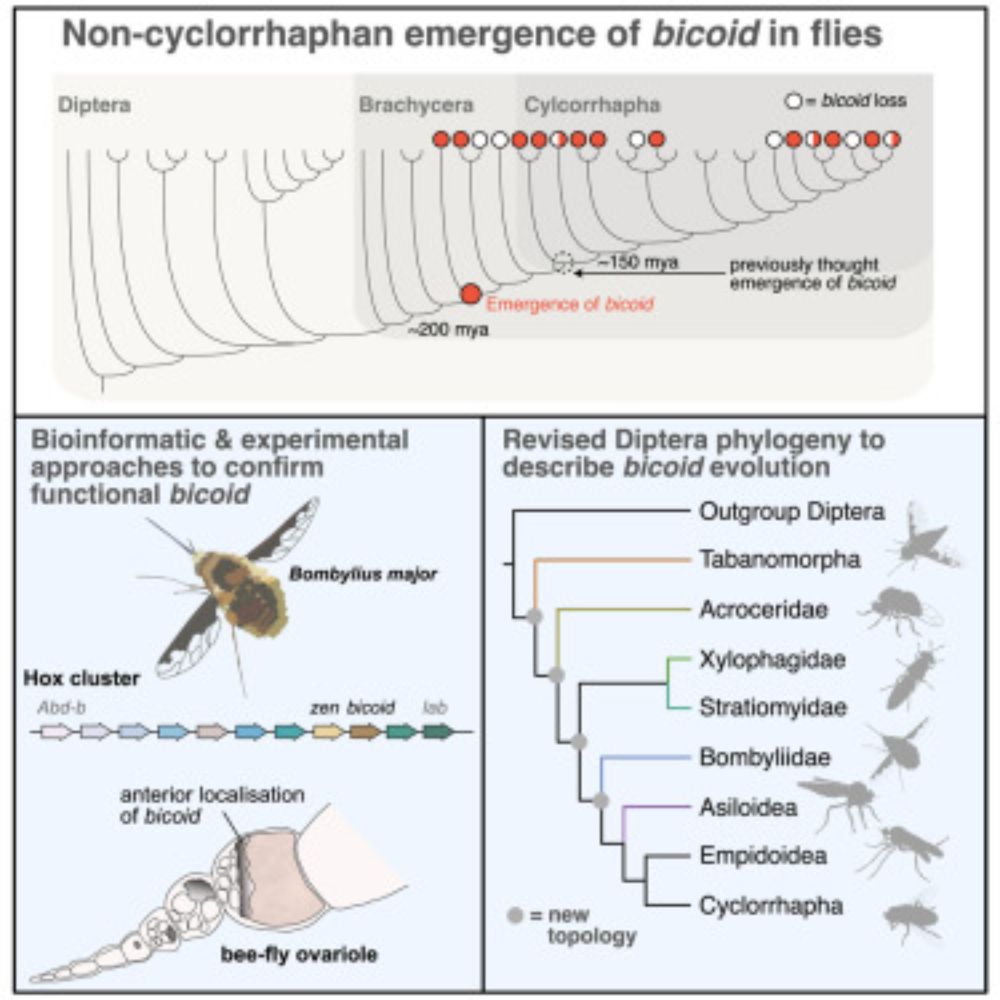
Revised evolutionary relationships within Brachycera and the early origin of bicoid in flies
Mulhair et al. uncover a functional bicoid in non-cyclorrhaphan flies, pushing the
gene's origin back by ∼20 million years. Reassessing the Diptera phylogeny using the
largest dataset to date permits ...
www.cell.com
October 17, 2025 at 3:14 PM
Latest work out today in @currentbiology.bsky.social
We find the fly development gene bicoid is much older than previously thought (~20 million yrs older!) 🪰🧬
To pinpoint its origins we tackled the Diptera phylogeny, providing some resolution (many open questions remain).
🔗 tinyurl.com/2vyuevpy
We find the fly development gene bicoid is much older than previously thought (~20 million yrs older!) 🪰🧬
To pinpoint its origins we tackled the Diptera phylogeny, providing some resolution (many open questions remain).
🔗 tinyurl.com/2vyuevpy
🚨 PhD position available!
Study the implications of vision on sleep using drosophila as a model.
Apply by end of November
Study the implications of vision on sleep using drosophila as a model.
Apply by end of November

Hello #neuroscience mastodon,
we have a BBSRC funded #phd position open!
A cool project utilise #drosophila transcriptome and connectome to map out the novel #sleep controlling visual pathway!
see details here:
https://www.kofanchenlab.net/come-join-us
please boost and spread the words!
we have a BBSRC funded #phd position open!
A cool project utilise #drosophila transcriptome and connectome to map out the novel #sleep controlling visual pathway!
see details here:
https://www.kofanchenlab.net/come-join-us
please boost and spread the words!

Come Join US
Fully funded PhD position available:
www.kofanchenlab.net
October 15, 2025 at 1:26 PM
🚨 PhD position available!
Study the implications of vision on sleep using drosophila as a model.
Apply by end of November
Study the implications of vision on sleep using drosophila as a model.
Apply by end of November
Reposted by Julien Devilliers

Interested in joining my lab to study the evolution and development of monoaminergic neurons?
You can now apply for the Giuseppe Levi Post-Doc Fellowship (2 years, Neurobiology, EU citizens).
Deadline: 10 Nov 2025 – 18:00
For more info selezionionline.lincei.it and email me!
You can now apply for the Giuseppe Levi Post-Doc Fellowship (2 years, Neurobiology, EU citizens).
Deadline: 10 Nov 2025 – 18:00
For more info selezionionline.lincei.it and email me!
Online Applications – Accademia Nazionale dei Lincei
- Home
Online Applications – Accademia Nazionale dei Lincei
selezionionline.lincei.it
October 14, 2025 at 10:43 AM
Interested in joining my lab to study the evolution and development of monoaminergic neurons?
You can now apply for the Giuseppe Levi Post-Doc Fellowship (2 years, Neurobiology, EU citizens).
Deadline: 10 Nov 2025 – 18:00
For more info selezionionline.lincei.it and email me!
You can now apply for the Giuseppe Levi Post-Doc Fellowship (2 years, Neurobiology, EU citizens).
Deadline: 10 Nov 2025 – 18:00
For more info selezionionline.lincei.it and email me!
Reposted by Julien Devilliers

📢 New publication 'From Trees to Traits: A Review of Advances in PhyloG2P Methods and Future Directions' by Arlie Macdonald, Maddie James, Jonathan Mitchell and Barbara Holland in Genome Biology and Evolution 🧪
doi.org/10.1093/gbe/...
#Phylogenomics
doi.org/10.1093/gbe/...
#Phylogenomics

From Trees to Traits: A Review of Advances in PhyloG2P Methods and Future Directions
Abstract. Mapping genotypes to phenotypes is a fundamental goal in biology. Phylogenetic Genotype to Phenotype mapping methods are a relatively new set of
doi.org
October 6, 2025 at 11:42 PM
📢 New publication 'From Trees to Traits: A Review of Advances in PhyloG2P Methods and Future Directions' by Arlie Macdonald, Maddie James, Jonathan Mitchell and Barbara Holland in Genome Biology and Evolution 🧪
doi.org/10.1093/gbe/...
#Phylogenomics
doi.org/10.1093/gbe/...
#Phylogenomics
Reposted by Julien Devilliers

Protocol for multiplex whole-mount RNA fluorescence in situ hybridization combined with immunohistochemistry in the mosquito brain #protocol #starprotocols #cellpress

Protocol for multiplex whole-mount RNA fluorescence in situ hybridization combined with immunohistochemistry in the mosquito brain
Advances in sequencing technologies have enabled transcriptional profiling of previously understudied yet critical species, such as mosquitoes. Here, we present a protocol for multiplex whole-mount RNA fluorescence in situ hybridization combined with immunohistochemistry in the Anopheles gambiae brain. We describe steps for dissection, fixation, probe hybridization, hybridization chain reaction (HCR) probe detection, and primary antibody application. We then detail procedures for tissue preparat...
dlvr.it
September 27, 2025 at 3:08 PM
Protocol for multiplex whole-mount RNA fluorescence in situ hybridization combined with immunohistochemistry in the mosquito brain #protocol #starprotocols #cellpress
Reposted by Julien Devilliers

📢🦋 Our paper ‘Global selection on insect antipredator coloration’ is out and featured on the cover of @science.org
We ran a huge experiment to find out how ecological context favours camouflage and warning colouration as antipredator strategies. 1/6
www.science.org/doi/10.1126/...
We ran a huge experiment to find out how ecological context favours camouflage and warning colouration as antipredator strategies. 1/6
www.science.org/doi/10.1126/...

September 25, 2025 at 6:26 PM
📢🦋 Our paper ‘Global selection on insect antipredator coloration’ is out and featured on the cover of @science.org
We ran a huge experiment to find out how ecological context favours camouflage and warning colouration as antipredator strategies. 1/6
www.science.org/doi/10.1126/...
We ran a huge experiment to find out how ecological context favours camouflage and warning colouration as antipredator strategies. 1/6
www.science.org/doi/10.1126/...