




Misha Teplitskiy | Science of science | on LinkedIn mostly
@innovation.bsky.social
Mostly on LinkedIn:
https://www.linkedin.com/in/misha-teplitskiy
https://www.linkedin.com/in/misha-teplitskiy
A nice reminder that it's hard to know how often simultaneous discoveries happen in science. Any measures based on scholarly literature will be severe undercounts due to secrecy or simply unpublished work

January 18, 2026 at 4:06 AM
A nice reminder that it's hard to know how often simultaneous discoveries happen in science. Any measures based on scholarly literature will be severe undercounts due to secrecy or simply unpublished work
Reposted by Misha Teplitskiy | Science of science | on LinkedIn mostly
New piece w/ James Evans in Science explores what we call 'science after science', an era where our ability to control nature may exceed our ability to understand it; a new struggle to sustain curiosity & understanding under AI's predictive dominance. #ai #science
www.science.org/doi/10.1126/...
www.science.org/doi/10.1126/...

After science
Twenty-five years ago, Ted Chiang wrote a prescient science fiction short that began: “It has been 25 years since a report of original research was last submitted to our editors for publication, makin...
www.science.org
November 14, 2025 at 6:23 PM
New piece w/ James Evans in Science explores what we call 'science after science', an era where our ability to control nature may exceed our ability to understand it; a new struggle to sustain curiosity & understanding under AI's predictive dominance. #ai #science
www.science.org/doi/10.1126/...
www.science.org/doi/10.1126/...
Reposted by Misha Teplitskiy | Science of science | on LinkedIn mostly

Now published at PNAS ‼️ w/ @innovation.bsky.social
How does peer reviewer diversity affect fairness in peer review and the direction of published science? We find a "geographical representation bias" in 60 STEM journals published by @ioppublishing.bsky.social.
www.pnas.org/doi/10.1073/...
How does peer reviewer diversity affect fairness in peer review and the direction of published science? We find a "geographical representation bias" in 60 STEM journals published by @ioppublishing.bsky.social.
www.pnas.org/doi/10.1073/...

August 14, 2025 at 5:55 PM
Now published at PNAS ‼️ w/ @innovation.bsky.social
How does peer reviewer diversity affect fairness in peer review and the direction of published science? We find a "geographical representation bias" in 60 STEM journals published by @ioppublishing.bsky.social.
www.pnas.org/doi/10.1073/...
How does peer reviewer diversity affect fairness in peer review and the direction of published science? We find a "geographical representation bias" in 60 STEM journals published by @ioppublishing.bsky.social.
www.pnas.org/doi/10.1073/...
Reposted by Misha Teplitskiy | Science of science | on LinkedIn mostly

This paper explores academic peer review as a source of knowledge transfer and learning for the reviewers themselves.
spkl.io/63328A1crC
@innovation.bsky.social @jamesmzd.bsky.social
spkl.io/63328A1crC
@innovation.bsky.social @jamesmzd.bsky.social
July 23, 2025 at 3:00 PM
This paper explores academic peer review as a source of knowledge transfer and learning for the reviewers themselves.
spkl.io/63328A1crC
@innovation.bsky.social @jamesmzd.bsky.social
spkl.io/63328A1crC
@innovation.bsky.social @jamesmzd.bsky.social
Reposted by Misha Teplitskiy | Science of science | on LinkedIn mostly

Bad news for economists...

In families with several children of the same sex, the odds of having another baby of that sex are higher than of having one of the opposite sex
go.nature.com/45caBj4
go.nature.com/45caBj4
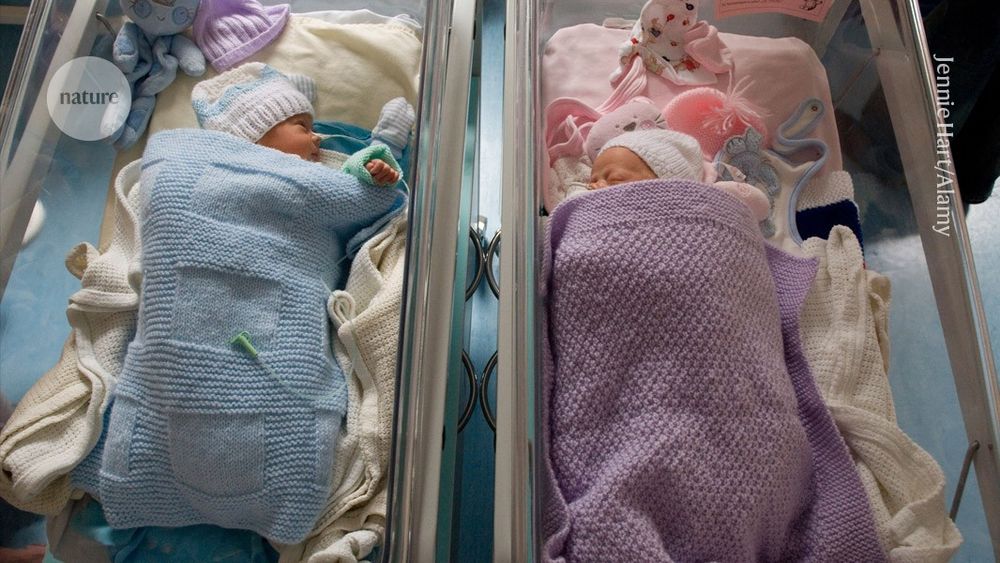
Sex at birth is not always random — mum’s age and genetics can play a part
Families with three or more boys, for example, are more likely to have another boy than a girl as the next child.
go.nature.com
July 21, 2025 at 9:15 AM
Bad news for economists...
Reposted by Misha Teplitskiy | Science of science | on LinkedIn mostly

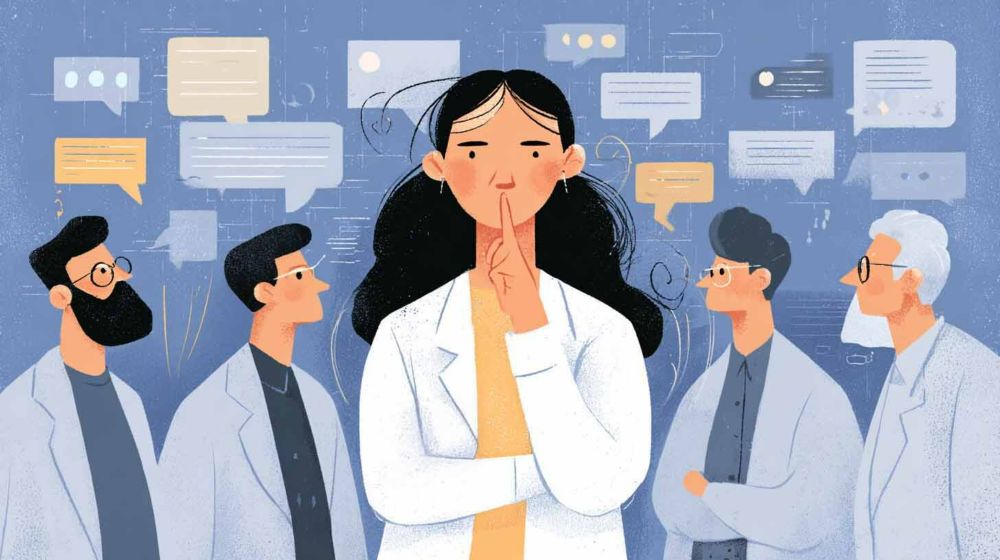
Wow - an important read for #academicsky #scisky #medsky, about a study on professional social media activity by female scientists vs male, performed using @altmetric.com data from 2013-2018 (so, pre-Bluesky)
Summary: news.umich.edu/fewer-women-...
Paper: www.nature.com/articles/s41...
Summary: news.umich.edu/fewer-women-...
Paper: www.nature.com/articles/s41...
Fewer women amplify their scientific voices online
A new University of Michigan study finds that women are about 28% less likely than men to promote their scientific papers on X (formerly Twitter)—a seemingly minor digital decision that could have big...
news.umich.edu
July 7, 2025 at 5:48 PM
Wow - an important read for #academicsky #scisky #medsky, about a study on professional social media activity by female scientists vs male, performed using @altmetric.com data from 2013-2018 (so, pre-Bluesky)
Summary: news.umich.edu/fewer-women-...
Paper: www.nature.com/articles/s41...
Summary: news.umich.edu/fewer-women-...
Paper: www.nature.com/articles/s41...
Reposted by Misha Teplitskiy | Science of science | on LinkedIn mostly

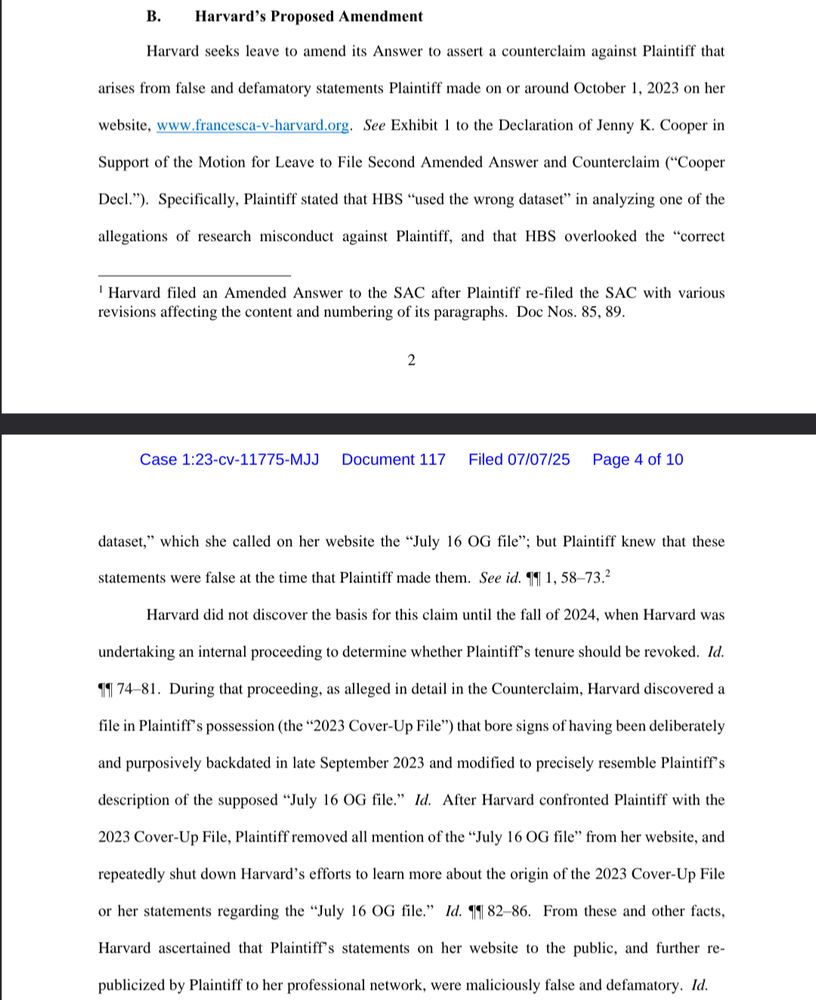
Do you remember Francesca Gino's claim on her website that HBS analyzed the "wrong data file" in their investigation, and that a "real file" proved her innocence?
HBS is now claiming that the "real file" was fabricated by Gino... and thus that Gino's claim was defamatory.
HBS is now claiming that the "real file" was fabricated by Gino... and thus that Gino's claim was defamatory.
July 8, 2025 at 1:06 PM
Do you remember Francesca Gino's claim on her website that HBS analyzed the "wrong data file" in their investigation, and that a "real file" proved her innocence?
HBS is now claiming that the "real file" was fabricated by Gino... and thus that Gino's claim was defamatory.
HBS is now claiming that the "real file" was fabricated by Gino... and thus that Gino's claim was defamatory.
In 1981 NYT published a piece on the then-new citation index, and how it was being used "unintentionally" for performance evaluations

July 7, 2025 at 3:55 PM
In 1981 NYT published a piece on the then-new citation index, and how it was being used "unintentionally" for performance evaluations
Reposted by Misha Teplitskiy | Science of science | on LinkedIn mostly
🏮NEW WORKING PAPER ALERT🏮
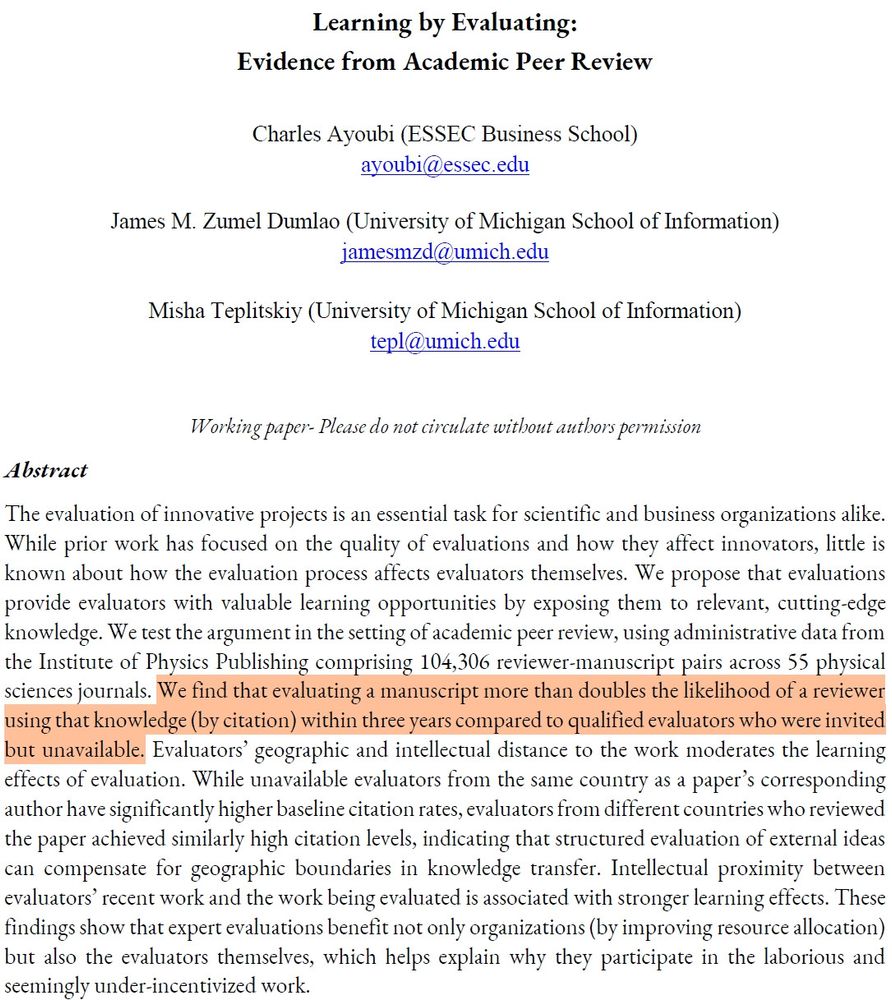
Scientists collectively spend tens of millions of hours peer reviewing each year, mostly for no $$. Why??
In new work w/ Charles Ayoubi and @innovation.bsky.social, we observe a private benefit for participating in evaluation: 💡💡Learning💡💡
Scientists collectively spend tens of millions of hours peer reviewing each year, mostly for no $$. Why??
In new work w/ Charles Ayoubi and @innovation.bsky.social, we observe a private benefit for participating in evaluation: 💡💡Learning💡💡
July 6, 2025 at 4:25 PM
🏮NEW WORKING PAPER ALERT🏮
Scientists collectively spend tens of millions of hours peer reviewing each year, mostly for no $$. Why??
In new work w/ Charles Ayoubi and @innovation.bsky.social, we observe a private benefit for participating in evaluation: 💡💡Learning💡💡
Scientists collectively spend tens of millions of hours peer reviewing each year, mostly for no $$. Why??
In new work w/ Charles Ayoubi and @innovation.bsky.social, we observe a private benefit for participating in evaluation: 💡💡Learning💡💡
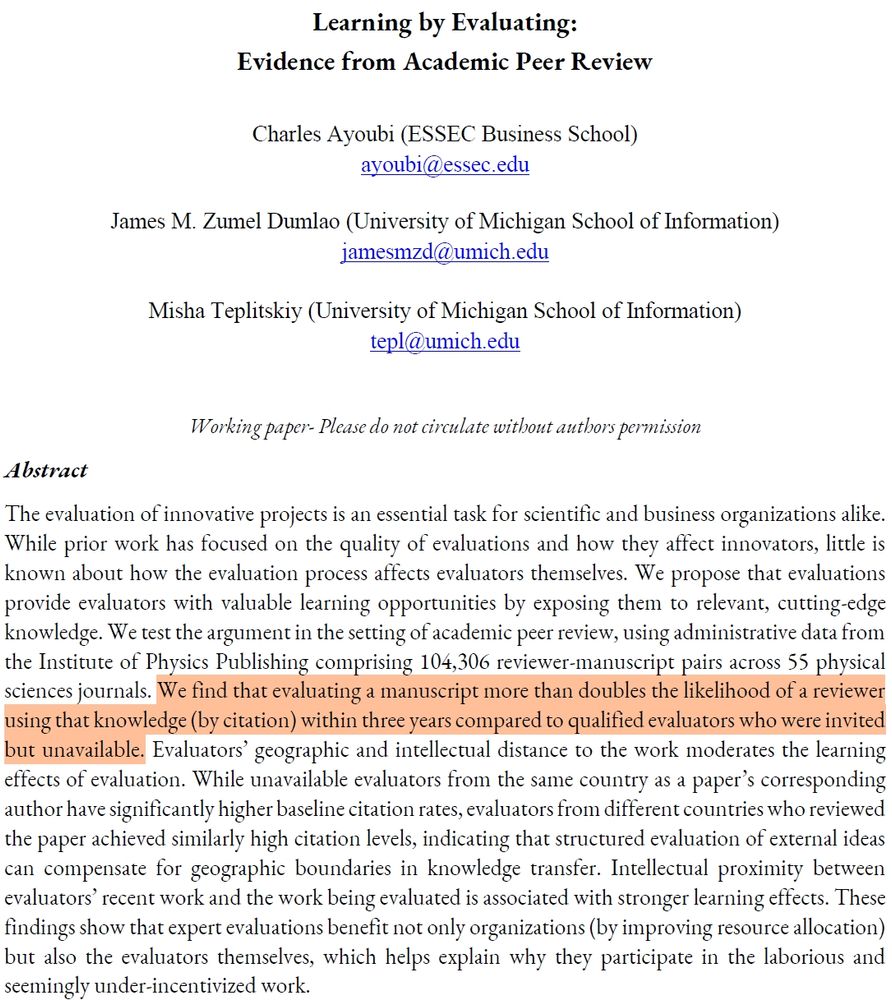
Why do we peer review?
In a new paper, we establish a self-interested reason: learning.
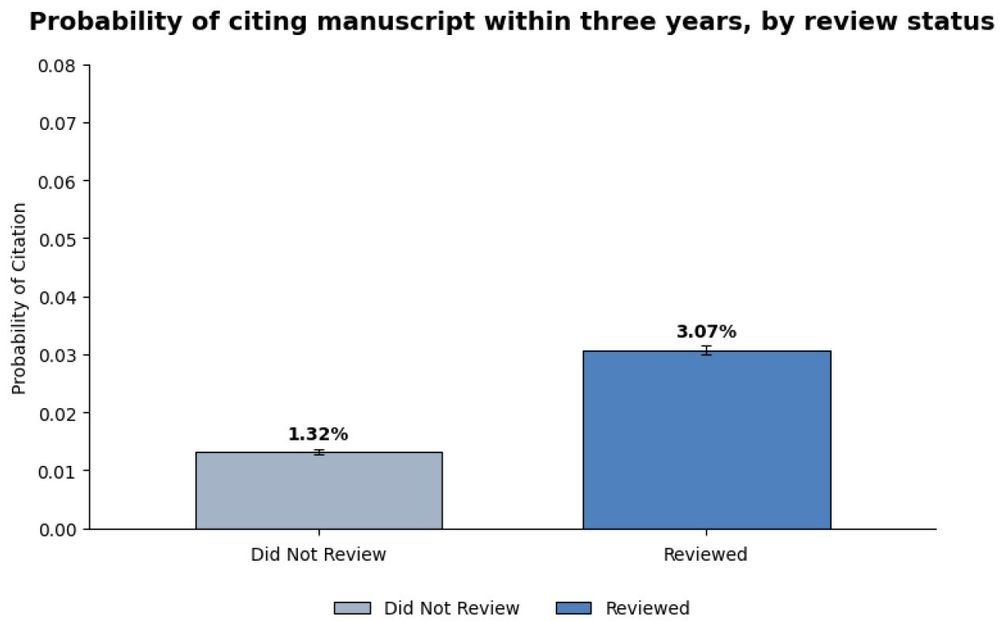
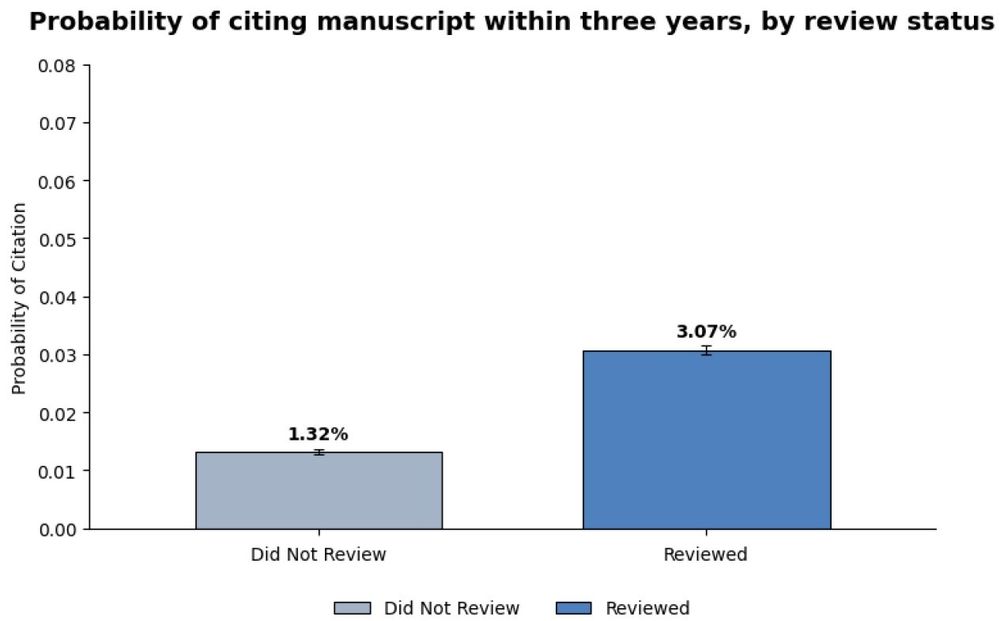
With a quasi-experimental design applied to admin data from 55 journals, we show reviewing a paper doubles chances of citing it in future work!
In a new paper, we establish a self-interested reason: learning.
With a quasi-experimental design applied to admin data from 55 journals, we show reviewing a paper doubles chances of citing it in future work!
July 5, 2025 at 12:24 AM
Why do we peer review?
In a new paper, we establish a self-interested reason: learning.
With a quasi-experimental design applied to admin data from 55 journals, we show reviewing a paper doubles chances of citing it in future work!
In a new paper, we establish a self-interested reason: learning.
With a quasi-experimental design applied to admin data from 55 journals, we show reviewing a paper doubles chances of citing it in future work!
Men are much more likely to self-promote their papers on Twitter/X than women

July 1, 2025 at 3:45 PM
Men are much more likely to self-promote their papers on Twitter/X than women
Seems relevant: politicians are more likely to vote for war when they don't have sons who would do the fighting
www.journals.uchicago.edu/doi/abs/10.1...
www.journals.uchicago.edu/doi/abs/10.1...

No Kin in the Game: Moral Hazard and War in the US Congress | Journal of Political Economy: Vol 131, No 9
We study agency frictions in the US Congress. We examine the long-standing hypothesis that political elites engage in conflict because they fail to internalize the associated costs. We compare the vot...
www.journals.uchicago.edu
June 22, 2025 at 3:31 AM
Seems relevant: politicians are more likely to vote for war when they don't have sons who would do the fighting
www.journals.uchicago.edu/doi/abs/10.1...
www.journals.uchicago.edu/doi/abs/10.1...

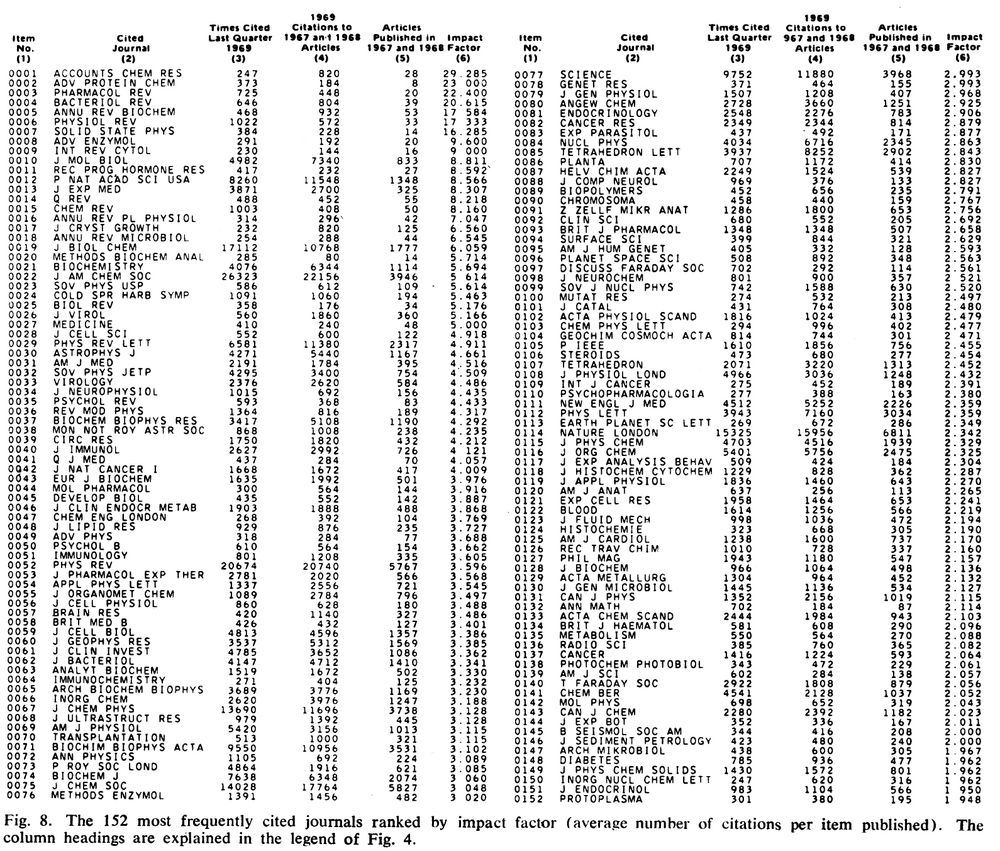
First-ever ranking of journals by impact factor, published by Garfield in Science in 1972.
Science is ranked #77, impact factor 2.99
Nature is #114, impact factor 2.34
Science is ranked #77, impact factor 2.99
Nature is #114, impact factor 2.34
June 19, 2025 at 4:34 AM
First-ever ranking of journals by impact factor, published by Garfield in Science in 1972.
Science is ranked #77, impact factor 2.99
Nature is #114, impact factor 2.34
Science is ranked #77, impact factor 2.99
Nature is #114, impact factor 2.34
Reposted by Misha Teplitskiy | Science of science | on LinkedIn mostly

Going to the hospital because I broke my wrist smashing the endorse button:
www.understandingai.org/p/i-got-fool...
www.understandingai.org/p/i-got-fool...
I got fooled by AI-for-science hype—here's what it taught me
I used AI in my plasma physics research and it didn’t go the way I expected.
www.understandingai.org
May 19, 2025 at 6:04 PM
Going to the hospital because I broke my wrist smashing the endorse button:
www.understandingai.org/p/i-got-fool...
www.understandingai.org/p/i-got-fool...
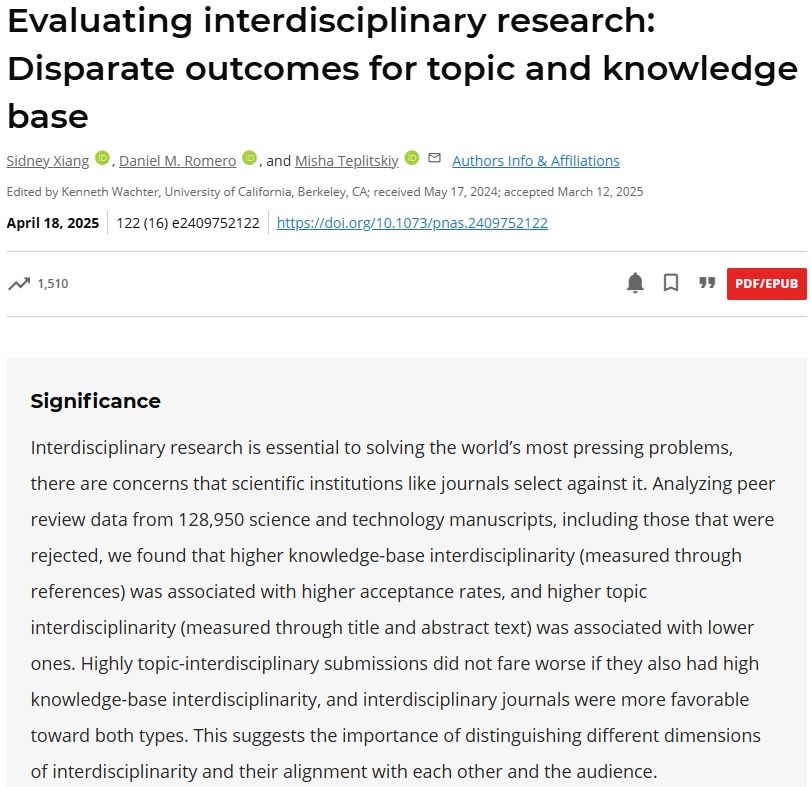
Conventional wisdom says interdisciplinary research is valuable but harder to get through peer review (need to please diverse reviewers, etc).
@sdxiang.bsky.social Daniel and I partnered with @ioppublishing.bsky.social to test this wisdom and add nuance
@sdxiang.bsky.social Daniel and I partnered with @ioppublishing.bsky.social to test this wisdom and add nuance
May 15, 2025 at 1:03 AM
Conventional wisdom says interdisciplinary research is valuable but harder to get through peer review (need to please diverse reviewers, etc).
@sdxiang.bsky.social Daniel and I partnered with @ioppublishing.bsky.social to test this wisdom and add nuance
@sdxiang.bsky.social Daniel and I partnered with @ioppublishing.bsky.social to test this wisdom and add nuance
Reposted by Misha Teplitskiy | Science of science | on LinkedIn mostly

Schism 2: electric boogaloo
May 3, 2025 at 3:53 AM
Schism 2: electric boogaloo
Periodic reminder that economists would sacrifice half a thumb for an AER pub

May 2, 2025 at 3:23 AM
Periodic reminder that economists would sacrifice half a thumb for an AER pub
Does professor quality matter for training the next generation of researchers? Or will good PhD students do good research either way?
Quality matters
Quality matters

April 25, 2025 at 4:01 PM
Does professor quality matter for training the next generation of researchers? Or will good PhD students do good research either way?
Quality matters
Quality matters
There used to be very little turnover in NIH sections, now there's a lot more

April 25, 2025 at 1:56 PM
There used to be very little turnover in NIH sections, now there's a lot more
Hmmm, maybe enforcing antitrust is a good idea 🤔

April 25, 2025 at 12:03 AM
Hmmm, maybe enforcing antitrust is a good idea 🤔
Reposted by Misha Teplitskiy | Science of science | on LinkedIn mostly
When you ask for the data

April 22, 2025 at 7:07 PM
When you ask for the data
Reposted by Misha Teplitskiy | Science of science | on LinkedIn mostly

The academic job market has changed just a bit
(from an interview with Robert Barro)
(from an interview with Robert Barro)

April 22, 2025 at 2:07 PM
The academic job market has changed just a bit
(from an interview with Robert Barro)
(from an interview with Robert Barro)
Can we stop diffusion of particular AI technologies to countries we don't "like"?
ChatGPT is useful case. OpenAI *still* prohibits access in major countries. But do these prohibitions actually work?
New paper by @honglin-bao.bsky.social and @sunmengyi.bsky.social suggests they don't!
1/3
ChatGPT is useful case. OpenAI *still* prohibits access in major countries. But do these prohibitions actually work?
New paper by @honglin-bao.bsky.social and @sunmengyi.bsky.social suggests they don't!
1/3


April 17, 2025 at 4:46 PM
Can we stop diffusion of particular AI technologies to countries we don't "like"?
ChatGPT is useful case. OpenAI *still* prohibits access in major countries. But do these prohibitions actually work?
New paper by @honglin-bao.bsky.social and @sunmengyi.bsky.social suggests they don't!
1/3
ChatGPT is useful case. OpenAI *still* prohibits access in major countries. But do these prohibitions actually work?
New paper by @honglin-bao.bsky.social and @sunmengyi.bsky.social suggests they don't!
1/3
Reposted by Misha Teplitskiy | Science of science | on LinkedIn mostly

Marc Andreessen really, really hates universities, which seems to be a pretty common sensibility from billionaires who have spent too much time online. www.nytimes.com/2025/03/18/o...

April 11, 2025 at 1:24 PM
Marc Andreessen really, really hates universities, which seems to be a pretty common sensibility from billionaires who have spent too much time online. www.nytimes.com/2025/03/18/o...