



Hans Henrik Bruun
@hhbruun.bsky.social
Scientist, naturalist, earthling
Professor of #community.ecology, University of Copenhagen
| biodiversity | conservation | restoration | rewilding | vegetation | trait-based | seed dispersal | phytophagous insects | resurveys | legacy data | eDNA | iNatter
Professor of #community.ecology, University of Copenhagen
| biodiversity | conservation | restoration | rewilding | vegetation | trait-based | seed dispersal | phytophagous insects | resurveys | legacy data | eDNA | iNatter
Reposted by Hans Henrik Bruun

Fast-growing trees are set to dominate the #forests of the #future — but at a cost🌳
Our Nature Plants (@natplants.nature.com) study shows a global shift toward "sprinter" tree species, while slow-growing, functionally critical #trees face elevated #extinction risk. www.nature.com/articles/s41...
Our Nature Plants (@natplants.nature.com) study shows a global shift toward "sprinter" tree species, while slow-growing, functionally critical #trees face elevated #extinction risk. www.nature.com/articles/s41...

Global functional shifts in trees driven by alien naturalization and native extinction - Nature Plants
This study finds that native tree extinctions and alien naturalizations are pushing forests towards fast-growing, resource-demanding species. This global shift could affect carbon storage and ecosyste...
www.nature.com
January 29, 2026 at 6:11 AM
Fast-growing trees are set to dominate the #forests of the #future — but at a cost🌳
Our Nature Plants (@natplants.nature.com) study shows a global shift toward "sprinter" tree species, while slow-growing, functionally critical #trees face elevated #extinction risk. www.nature.com/articles/s41...
Our Nature Plants (@natplants.nature.com) study shows a global shift toward "sprinter" tree species, while slow-growing, functionally critical #trees face elevated #extinction risk. www.nature.com/articles/s41...
Were it not for the all too frequent school shootings, one could easily get the impression there are no schools in the US

January 24, 2026 at 1:30 PM
Were it not for the all too frequent school shootings, one could easily get the impression there are no schools in the US
Kudos to Yuan-zhen Liu and Philip F. Thomsen, who led the work. Thanks to all collaborators, Jesper Bechsgaard, Lynn Dicks, Toke Thomas Høye, Trine Bilde and Sean Birk Bek Craig
December 30, 2025 at 4:55 PM
Kudos to Yuan-zhen Liu and Philip F. Thomsen, who led the work. Thanks to all collaborators, Jesper Bechsgaard, Lynn Dicks, Toke Thomas Høye, Trine Bilde and Sean Birk Bek Craig
The rarest species, Andrena marginata, showed severe decline in the most recent 50-100 y
The other rare species, Bombus veteranus, had gone through steep decline more than 1000 y ago and a more stable trend since then
One of the common spp, B. pascuorum, showed pop size changes on a 50 ky time scale
The other rare species, Bombus veteranus, had gone through steep decline more than 1000 y ago and a more stable trend since then
One of the common spp, B. pascuorum, showed pop size changes on a 50 ky time scale
December 30, 2025 at 4:55 PM
The rarest species, Andrena marginata, showed severe decline in the most recent 50-100 y
The other rare species, Bombus veteranus, had gone through steep decline more than 1000 y ago and a more stable trend since then
One of the common spp, B. pascuorum, showed pop size changes on a 50 ky time scale
The other rare species, Bombus veteranus, had gone through steep decline more than 1000 y ago and a more stable trend since then
One of the common spp, B. pascuorum, showed pop size changes on a 50 ky time scale
🐝 We used pooled whole-genome sequencing data to reconstruct demographic history for two rare and two common wild bee species
📉 The two rare species showed lower historical population sizes than the two common species
📊 The approach was validated using simulated data
doi.org/10.1111/mec....
📉 The two rare species showed lower historical population sizes than the two common species
📊 The approach was validated using simulated data
doi.org/10.1111/mec....
doi.org
December 30, 2025 at 4:55 PM
🐝 We used pooled whole-genome sequencing data to reconstruct demographic history for two rare and two common wild bee species
📉 The two rare species showed lower historical population sizes than the two common species
📊 The approach was validated using simulated data
doi.org/10.1111/mec....
📉 The two rare species showed lower historical population sizes than the two common species
📊 The approach was validated using simulated data
doi.org/10.1111/mec....
Could it be because some human activities mimicked lost megafauna impacts from the evolutionary (Pleistocene) landscapes in which species arose and developed? The Holocene has in many ways presented aberrant ecosystem properties

December 16, 2025 at 9:38 PM
Could it be because some human activities mimicked lost megafauna impacts from the evolutionary (Pleistocene) landscapes in which species arose and developed? The Holocene has in many ways presented aberrant ecosystem properties
A great ecologist and scientist. His southern hemisphere perspective on “European” ecology was very stimulating and thought-provoking.
December 15, 2025 at 6:29 PM
A great ecologist and scientist. His southern hemisphere perspective on “European” ecology was very stimulating and thought-provoking.
Huge thanks to Ditte, @srosbakh.bsky.social & all collaborators
December 11, 2025 at 8:20 AM
Huge thanks to Ditte, @srosbakh.bsky.social & all collaborators
Next step: Comparison with recent data to identify winners, lossers and drivers of change 🌳🍂🥀
December 11, 2025 at 8:20 AM
Next step: Comparison with recent data to identify winners, lossers and drivers of change 🌳🍂🥀
@dittemch.bsky.social has led the digitization of the historical dot maps of plant species distribution in Denmark. After a lot of harmonization and validations, the data (10 x 10 km grid) are now out with a preprint describing the procudure.
#biodiversity_change #legacy_data
#biodiversity_change #legacy_data

December 11, 2025 at 8:20 AM
@dittemch.bsky.social has led the digitization of the historical dot maps of plant species distribution in Denmark. After a lot of harmonization and validations, the data (10 x 10 km grid) are now out with a preprint describing the procudure.
#biodiversity_change #legacy_data
#biodiversity_change #legacy_data
@skjoldsoendergaard.bsky.social something for you?
December 4, 2025 at 6:31 PM
@skjoldsoendergaard.bsky.social something for you?
Reposted by Hans Henrik Bruun

Så er udkast til habitatkonsekvensvurderingen af Tangeværket ude!
Tak til @Altingetdk
Jeg håber du læser med, @jeppebruus.bsky.social
#vildgudenå
legacy.altinget.dk/misc/udkast-...
Tak til @Altingetdk
Jeg håber du læser med, @jeppebruus.bsky.social
#vildgudenå
legacy.altinget.dk/misc/udkast-...
legacy.altinget.dk
November 13, 2025 at 10:55 AM
Så er udkast til habitatkonsekvensvurderingen af Tangeværket ude!
Tak til @Altingetdk
Jeg håber du læser med, @jeppebruus.bsky.social
#vildgudenå
legacy.altinget.dk/misc/udkast-...
Tak til @Altingetdk
Jeg håber du læser med, @jeppebruus.bsky.social
#vildgudenå
legacy.altinget.dk/misc/udkast-...
link to Nature paper
www.nature.com/articles/d41...
www.nature.com/articles/d41...

Is academic research becoming too competitive? Nature examines the data
Applications for European research grants increased in 2025. Scientists say they’re feeling the competition.
www.nature.com
October 27, 2025 at 7:45 AM
link to Nature paper
www.nature.com/articles/d41...
www.nature.com/articles/d41...
"The decline in success rates is absolutely not satisfactory, because it sometimes borders on a lottery”
Nature 17 October 2025
Well, an honest lottery would IMHO be far better. For the reasons outlined here:
blogs.lse.ac.uk/impactofsoci...
Nature 17 October 2025
Well, an honest lottery would IMHO be far better. For the reasons outlined here:
blogs.lse.ac.uk/impactofsoci...

Funding competition sabotages science - Impact of Social Sciences
Research funding competitions seem fair but are often flawed. Gerald Schweiger, Adrian G. Barnett and Stijn Conix argue lotteries may support better science.
blogs.lse.ac.uk
October 27, 2025 at 7:45 AM
"The decline in success rates is absolutely not satisfactory, because it sometimes borders on a lottery”
Nature 17 October 2025
Well, an honest lottery would IMHO be far better. For the reasons outlined here:
blogs.lse.ac.uk/impactofsoci...
Nature 17 October 2025
Well, an honest lottery would IMHO be far better. For the reasons outlined here:
blogs.lse.ac.uk/impactofsoci...
Hommage to Sofia Corradi, who conceived the idea of academic degrees without borders - the Erasmus Program


October 20, 2025 at 6:33 AM
Hommage to Sofia Corradi, who conceived the idea of academic degrees without borders - the Erasmus Program
Pretty mindblowing!

There are forces in #nature that are at work that we don't experience or aren't aware of, but that are essential parts of the lives and spectacular numbers of creatures. For example, this from Ranjiangshang Ran and colleagues @pnas.org
www.pnas.org/doi/10.1073/...
www.pnas.org/doi/10.1073/...

Electrostatics facilitate midair host attachment in parasitic jumping nematodes | PNAS
Jumping can be hazardous for entomopathogenic nematodes (EPNs) as those that fail
to attach to an insect host face death by predation or starvation...
www.pnas.org
October 18, 2025 at 5:39 PM
Pretty mindblowing!
Indeed the asexual generation of the gall wasp Neuroterus quercusbaccarum on common oak. If you pop some galls off, you may find larvae of the inquiline gall midge Parallelodiplosis galliperda bladmineerders.nl/parasites/an...
Parallelodiplosis galliperda – Plant Parasites of Europe
bladmineerders.nl
October 18, 2025 at 7:52 AM
Indeed the asexual generation of the gall wasp Neuroterus quercusbaccarum on common oak. If you pop some galls off, you may find larvae of the inquiline gall midge Parallelodiplosis galliperda bladmineerders.nl/parasites/an...
Reposted by Hans Henrik Bruun
Bumble #bee #pollination of #linden already 24.6 milllion years ago - cool new empirical illustration of the deep roots of the ecologies of modern-day species www.sci.news/paleontology...
(photo 1: commons.wikimedia.org/wiki/File:Bombus_hypnorum_-_Tilia_cordata_-_Keila.jpg)
(photo 1: commons.wikimedia.org/wiki/File:Bombus_hypnorum_-_Tilia_cordata_-_Keila.jpg)


October 17, 2025 at 5:12 AM
Bumble #bee #pollination of #linden already 24.6 milllion years ago - cool new empirical illustration of the deep roots of the ecologies of modern-day species www.sci.news/paleontology...
(photo 1: commons.wikimedia.org/wiki/File:Bombus_hypnorum_-_Tilia_cordata_-_Keila.jpg)
(photo 1: commons.wikimedia.org/wiki/File:Bombus_hypnorum_-_Tilia_cordata_-_Keila.jpg)
Thanks in particular to Michele Di Musciano, Riccardo Testolin and Ale Chiarucci for stearing the boat safely ashore
October 13, 2025 at 7:41 AM
Thanks in particular to Michele Di Musciano, Riccardo Testolin and Ale Chiarucci for stearing the boat safely ashore
The results only tell us that site selection was (a lot) better than random, not if the management of N2000 sites secured long-term persistence of biodiversity. Alas, lots of evidence suggest the opposite.
#N2K #spatialconservationplanning
#N2K #spatialconservationplanning
October 13, 2025 at 7:41 AM
The results only tell us that site selection was (a lot) better than random, not if the management of N2000 sites secured long-term persistence of biodiversity. Alas, lots of evidence suggest the opposite.
#N2K #spatialconservationplanning
#N2K #spatialconservationplanning
New paper alert! The EU Natura 2000 network encompasses populations of most vascular plant species in the region, but with a lot of spatial variation in representativity. The results provide guidance for for better coverage after the planned network expansion.
doi.org/10.1111/cobi...
doi.org/10.1111/cobi...

Representativeness of the Natura 2000 network for preserving plant biodiversity in the European Union
The Natura 2000 (N2K) network of protected areas is one of the main tools for area-based conservation in the European Union (EU), yet its role in preserving plant biodiversity requires better underst...
doi.org
October 13, 2025 at 7:41 AM
New paper alert! The EU Natura 2000 network encompasses populations of most vascular plant species in the region, but with a lot of spatial variation in representativity. The results provide guidance for for better coverage after the planned network expansion.
doi.org/10.1111/cobi...
doi.org/10.1111/cobi...
Reposted by Hans Henrik Bruun

The new European Butterfly Red List is published today, with worrying findings. Over 1/4 (28%) of Europe’s 442 species are threatened with extinction or are close to being so. The situation is far worse for our 148 endemic species, 40% are now threatened or nearly so www.bc-europe.eu/webpage.php?...

October 11, 2025 at 9:17 AM
The new European Butterfly Red List is published today, with worrying findings. Over 1/4 (28%) of Europe’s 442 species are threatened with extinction or are close to being so. The situation is far worse for our 148 endemic species, 40% are now threatened or nearly so www.bc-europe.eu/webpage.php?...
Random street corner in Leuven BE
#stopgenocide
#stopgenocide

October 11, 2025 at 5:16 PM
Random street corner in Leuven BE
#stopgenocide
#stopgenocide
Reposted by Hans Henrik Bruun

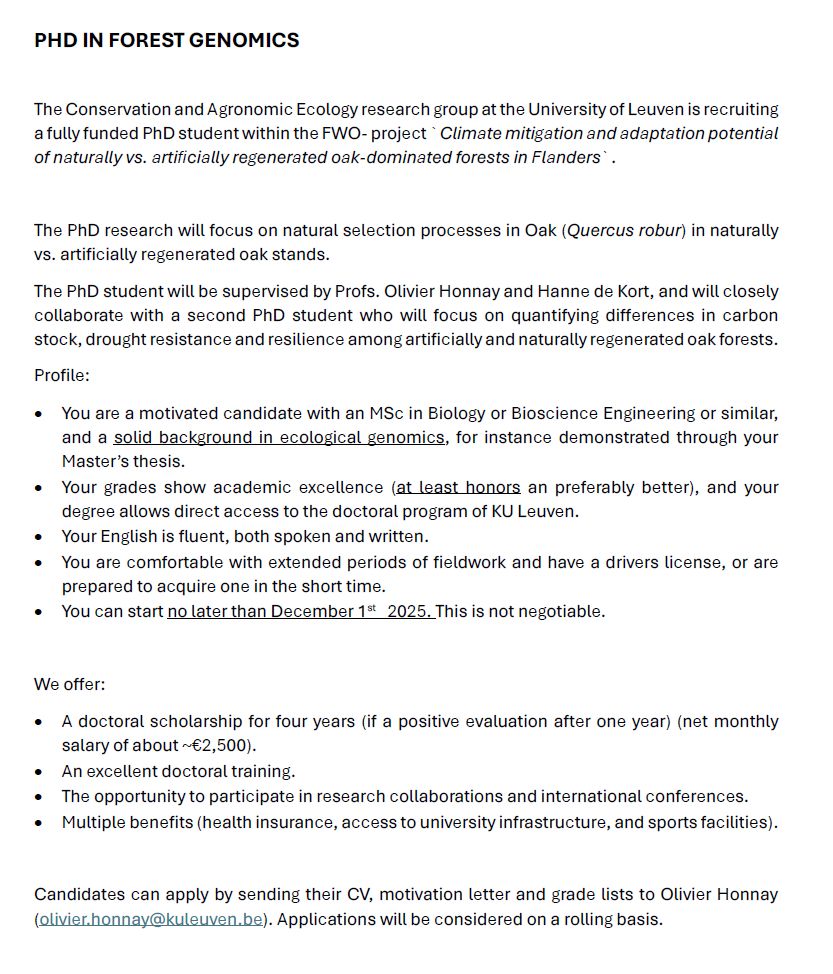
📢 Vacancy: I am urgently recruiting a PhD candidate to join a project on selection processes in pedunculate oak.
📅 Start date: no later than December 1st.
📅 Start date: no later than December 1st.
October 3, 2025 at 8:09 AM
📢 Vacancy: I am urgently recruiting a PhD candidate to join a project on selection processes in pedunculate oak.
📅 Start date: no later than December 1st.
📅 Start date: no later than December 1st.