




Griffin Lab
@griffinlabpaleo.bsky.social
Origin of major clades, ontogeny & evolution of form, evo+devo+paleo — Dept of Geosciences at Princeton University
Pinned
www.science.org
Very excited to share that our latest paper is out in Science! We show that the type specimen of Nanotyrannus—an isolated skull—is fully grown, showing that it is not a juvenile Tyrannosaurus rex but a distinct species (1/12)
www.science.org/doi/10.1126/...
www.science.org/doi/10.1126/...
Reposted by Griffin Lab
🚨 Hot off the press: Our look into of the palaeontological database landscape and its sustainability into the future.
Palaeo databases are invaluable and continue to transform our research field - but they are vulnerable... (1/6) 🧪 ⛏️
www.nature.com/articles/s41...
Palaeo databases are invaluable and continue to transform our research field - but they are vulnerable... (1/6) 🧪 ⛏️
www.nature.com/articles/s41...

The billion-dollar case for sustaining palaeontology’s digital databases - Nature Ecology & Evolution
The authors survey community palaeontological databases, documenting their contributions to science as well as their vulnerabilities, and provide recommendations for the future of open science databas...
www.nature.com
February 11, 2026 at 2:10 PM
🚨 Hot off the press: Our look into of the palaeontological database landscape and its sustainability into the future.
Palaeo databases are invaluable and continue to transform our research field - but they are vulnerable... (1/6) 🧪 ⛏️
www.nature.com/articles/s41...
Palaeo databases are invaluable and continue to transform our research field - but they are vulnerable... (1/6) 🧪 ⛏️
www.nature.com/articles/s41...
In bird embryology you occasionally get an unfertilized “dud” egg. @lnwilson.bsky.social, not wanting her emu eggs to go to waste, used a dud egg to make a beautiful cake for the lab!

February 5, 2026 at 9:04 PM
In bird embryology you occasionally get an unfertilized “dud” egg. @lnwilson.bsky.social, not wanting her emu eggs to go to waste, used a dud egg to make a beautiful cake for the lab!
Reposted by Griffin Lab

For your delight and amusement, here are some dinosaur gastroliths, underneath the ribs of an Early Jurassic sauropodomorph from Zimbabwe 🦖🇿🇼


January 26, 2026 at 7:07 AM
For your delight and amusement, here are some dinosaur gastroliths, underneath the ribs of an Early Jurassic sauropodomorph from Zimbabwe 🦖🇿🇼
Reposted by Griffin Lab
Not a big baby! My commentary in @science.org about the latest Nanotyrannus research. www.science.org/doi/10.1126/...

Not a big baby
Multipronged approaches resolve the debate about the Nanotyrannus fossil species
www.science.org
January 15, 2026 at 7:10 PM
Not a big baby! My commentary in @science.org about the latest Nanotyrannus research. www.science.org/doi/10.1126/...
Reposted by Griffin Lab

Why does life explore so few of the forms it could possibly take? Using fractal descriptors, this #scienceadvances paper shows that Earth’s biosphere clusters around simple shapes, reflecting deep evolutionary constraints. @artemyte.bsky.social @manlius.bsky.social www.science.org/doi/pdf/10.1...

January 11, 2026 at 1:23 PM
Why does life explore so few of the forms it could possibly take? Using fractal descriptors, this #scienceadvances paper shows that Earth’s biosphere clusters around simple shapes, reflecting deep evolutionary constraints. @artemyte.bsky.social @manlius.bsky.social www.science.org/doi/pdf/10.1...
Reposted by Griffin Lab

Our lab is growing: we will have openings for student and staff positions throughout the year. Please visit edwards-lab.org for the most up to date job positions. I am excited to work with the department and looking forward to the months ahead!

a man wearing a beanie and a black jacket is smiling and holding a piece of food .
ALT: a man wearing a beanie and a black jacket is smiling and holding a piece of food .
media.tenor.com
January 7, 2026 at 3:28 PM
Our lab is growing: we will have openings for student and staff positions throughout the year. Please visit edwards-lab.org for the most up to date job positions. I am excited to work with the department and looking forward to the months ahead!
Reposted by Griffin Lab

A few new papers out recently that I'm excited to share with you!
First: How well could stem reptiles hear?
www.nature.com/articles/s41...
First: How well could stem reptiles hear?
www.nature.com/articles/s41...

Evidence for high-frequency hearing in a Permian stem reptile - Nature Communications
Hearing evolved in most amniotes by the late Permian, but its origins in reptiles remain poorly understood. Here, using biomechanical and morphometric analyses, the authors show that high frequency hearing likely had evolved in reptiles by the late Permian.
www.nature.com
December 22, 2025 at 2:08 PM
A few new papers out recently that I'm excited to share with you!
First: How well could stem reptiles hear?
www.nature.com/articles/s41...
First: How well could stem reptiles hear?
www.nature.com/articles/s41...
Reposted by Griffin Lab
Another cool paper, glad to see it finally out:
www.nature.com/articles/s41...
Figuring out the range of error that exists, & factors influencing offsets, between growth marks and ontogenetic age remains a challenge for estimating growth curves from bone histo data.
More work like this is needed.
www.nature.com/articles/s41...
Figuring out the range of error that exists, & factors influencing offsets, between growth marks and ontogenetic age remains a challenge for estimating growth curves from bone histo data.
More work like this is needed.
Stochastic growth marks in Crocodylus niloticus - Scientific Reports
Skeletochronology combined with growth curve reconstruction is routinely used to assess the age and growth dynamics of extinct and extant vertebrates. Here we performed in vivo labelling studies of th...
www.nature.com
December 20, 2025 at 3:17 PM
Another cool paper, glad to see it finally out:
www.nature.com/articles/s41...
Figuring out the range of error that exists, & factors influencing offsets, between growth marks and ontogenetic age remains a challenge for estimating growth curves from bone histo data.
More work like this is needed.
www.nature.com/articles/s41...
Figuring out the range of error that exists, & factors influencing offsets, between growth marks and ontogenetic age remains a challenge for estimating growth curves from bone histo data.
More work like this is needed.
This was done with an Original Prusa XL, highly recommended
December 12, 2025 at 5:07 PM
This was done with an Original Prusa XL, highly recommended
The Vertebrate Paleontology students did a great job 3D printing and painting skulls—look at that homology!


December 12, 2025 at 3:08 PM
The Vertebrate Paleontology students did a great job 3D printing and painting skulls—look at that homology!
Reposted by Griffin Lab

The discovery that Nanotyrannus is a distinct species from the T-rex indicates complex food web and interspecies interactions in the Dinosaur world. This research was funded by NSF post-doc grants, which were just archived, i.e., they're no longer available.
news.yale.edu/2025/12/04/t...
news.yale.edu/2025/12/04/t...
‘Teen’ rex no more: New study agrees Nanotyrannus is a separate species
A new study, based in part on samples from the Yale Peabody Museum, shows that a small dinosaur thought to be a juvenile Tyrannosaurus rex was actually a distinct species.
news.yale.edu
December 8, 2025 at 4:08 PM
The discovery that Nanotyrannus is a distinct species from the T-rex indicates complex food web and interspecies interactions in the Dinosaur world. This research was funded by NSF post-doc grants, which were just archived, i.e., they're no longer available.
news.yale.edu/2025/12/04/t...
news.yale.edu/2025/12/04/t...
Reposted by Griffin Lab

Congratulations to UMMP Associate Research Scientist Miriam Zelditch on the release of the third edition of the indispensable "Geometric Morphometrics for Biologists" (a.k.a. the green book)! #FossilFriday

December 6, 2025 at 1:12 AM
Congratulations to UMMP Associate Research Scientist Miriam Zelditch on the release of the third edition of the indispensable "Geometric Morphometrics for Biologists" (a.k.a. the green book)! #FossilFriday
Reposted by Griffin Lab
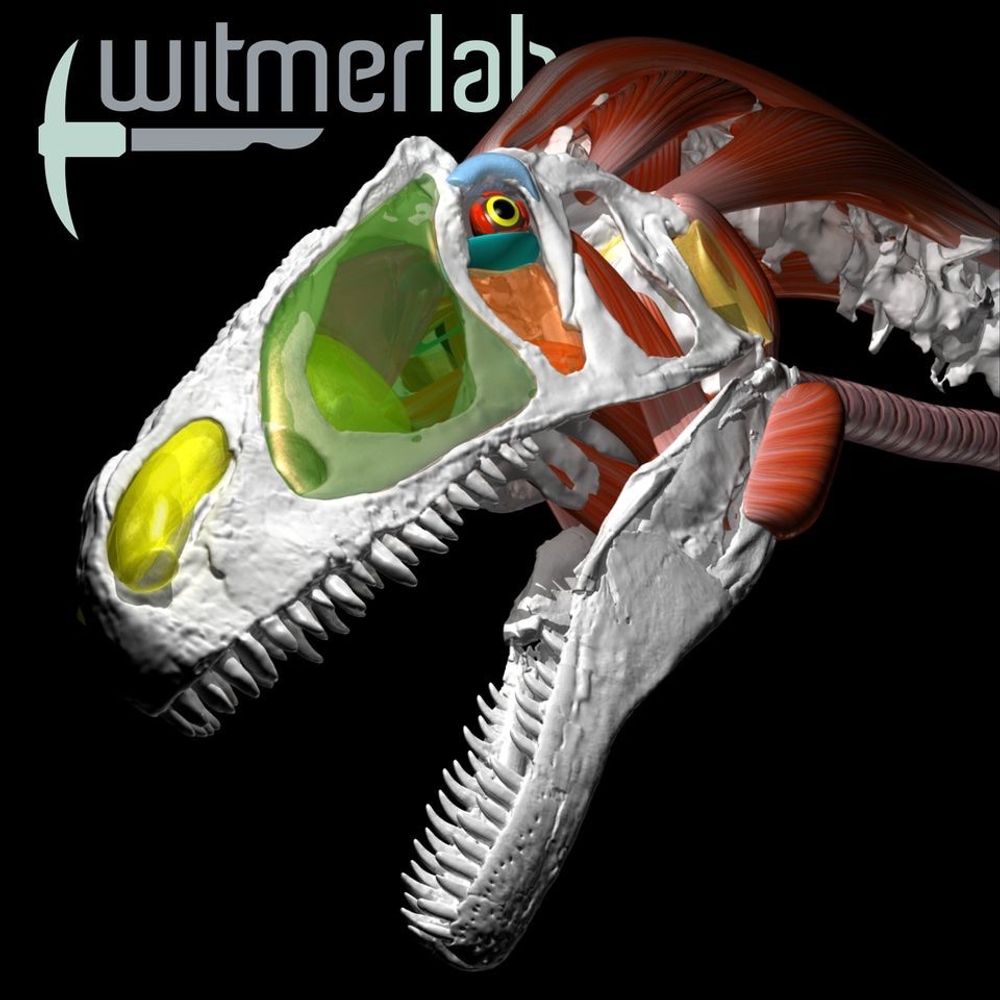
#FossilFriday The awesome new article in Science by
@griffinlabpaleo.bsky.social et al. adds more evidence for the validity of Nanotyrannus by showing that the hyoid bone in the holotype has adult bone histology. Here are some more images showing the ceratobranchial bone in place in the skull. 🦖
@griffinlabpaleo.bsky.social et al. adds more evidence for the validity of Nanotyrannus by showing that the hyoid bone in the holotype has adult bone histology. Here are some more images showing the ceratobranchial bone in place in the skull. 🦖


December 5, 2025 at 10:28 PM
#FossilFriday The awesome new article in Science by
@griffinlabpaleo.bsky.social et al. adds more evidence for the validity of Nanotyrannus by showing that the hyoid bone in the holotype has adult bone histology. Here are some more images showing the ceratobranchial bone in place in the skull. 🦖
@griffinlabpaleo.bsky.social et al. adds more evidence for the validity of Nanotyrannus by showing that the hyoid bone in the holotype has adult bone histology. Here are some more images showing the ceratobranchial bone in place in the skull. 🦖
Reposted by Griffin Lab
Development of the zebrafish retina captured on a light sheet microscope. Credit to @ichajaroslav.bsky.social. #ZebrafishZunday 🧪

November 23, 2025 at 8:37 AM
Development of the zebrafish retina captured on a light sheet microscope. Credit to @ichajaroslav.bsky.social. #ZebrafishZunday 🧪
Just emailed it to you!
December 4, 2025 at 9:32 PM
Just emailed it to you!
I forgot image credit, I apologize! This is by Andrey Atuchin, courtesy the Cleveland Museum
December 4, 2025 at 7:16 PM
I forgot image credit, I apologize! This is by Andrey Atuchin, courtesy the Cleveland Museum
Thanks to all our collaborators, the taggable ones are @ashpoust.bsky.social , @mfabbri.bsky.social , @rileysombathy.bsky.social ! Extra thanks to the Cleveland Museum, the Yale Peabody Museum, and the LA Natural History Museum for allowing crucial sampling of their specimens (12/12)
December 4, 2025 at 7:02 PM
Thanks to all our collaborators, the taggable ones are @ashpoust.bsky.social , @mfabbri.bsky.social , @rileysombathy.bsky.social ! Extra thanks to the Cleveland Museum, the Yale Peabody Museum, and the LA Natural History Museum for allowing crucial sampling of their specimens (12/12)
Really nice work by @jgn-paleo.bsky.social & Zanno reached this same conclusion from independent lines of evidence/specimens just a few weeks ago. Our papers converge on the same conclusion, mutually bolstering each other (11/12)
www.nature.com/articles/s41...
www.nature.com/articles/s41...

Nanotyrannus and Tyrannosaurus coexisted at the close of the Cretaceous - Nature
A well-preserved skeleton of a nearly mature tyrannosaur from the Hell Creek Formation in Montana, USA supports the existence of a second Nanotyrannus species, Nanotyrannus lethaeus sp. nov., and vali...
www.nature.com
December 4, 2025 at 7:02 PM
Really nice work by @jgn-paleo.bsky.social & Zanno reached this same conclusion from independent lines of evidence/specimens just a few weeks ago. Our papers converge on the same conclusion, mutually bolstering each other (11/12)
www.nature.com/articles/s41...
www.nature.com/articles/s41...
We have uploaded all high-resolution, whole-slide images in all light regimes onto Dryad, available for anyone to download, study, and compare (10/12)
doi.org/10.5061/drya...
doi.org/10.5061/drya...
Dryad | Data: Data for: A diminutive Tyrannosaur lived alongside <em>Tyrannosaurus rex</em>
doi.org
December 4, 2025 at 7:02 PM
We have uploaded all high-resolution, whole-slide images in all light regimes onto Dryad, available for anyone to download, study, and compare (10/12)
doi.org/10.5061/drya...
doi.org/10.5061/drya...
So the Nanotyrannus type specimen is full-size, or nearly so. We discuss more in the paper why we don’t find it likely that this is simple intraspecific variation in T. rex, sexual dimorphism, or a congenital dwarfism. The best explanation is that Nanotyrannus is distinct from Tyrannosaurus (9/12)

December 4, 2025 at 7:02 PM
So the Nanotyrannus type specimen is full-size, or nearly so. We discuss more in the paper why we don’t find it likely that this is simple intraspecific variation in T. rex, sexual dimorphism, or a congenital dwarfism. The best explanation is that Nanotyrannus is distinct from Tyrannosaurus (9/12)
This is especially apparent when we compare to a juvenile T. rex hyoid from the LACM. Despite being smaller in size, the Nano hyoid shows a close package of external growth marks that is the classic indicator of skeletal maturity (8/12)


December 4, 2025 at 7:02 PM
This is especially apparent when we compare to a juvenile T. rex hyoid from the LACM. Despite being smaller in size, the Nano hyoid shows a close package of external growth marks that is the classic indicator of skeletal maturity (8/12)
All that was left was to test the Nanotyrannus type specimen, the skull that formally defines the species Nanotyrannus lancensis. At the time, it was the general consensus that Nano was a juvenile T. rex, so we were surprised to find every indication of maturity in the hyoid (7/12)

December 4, 2025 at 7:02 PM
All that was left was to test the Nanotyrannus type specimen, the skull that formally defines the species Nanotyrannus lancensis. At the time, it was the general consensus that Nano was a juvenile T. rex, so we were surprised to find every indication of maturity in the hyoid (7/12)
Then, we had to establish that it worked in extinct dinosaurs, especially large theropods. Running the size gamut from Coelophysis to Allosaurus to two definitive Tyrannosaurus individuals, we showed that hyoid microstructure works well! Not quite as precise as limbs, but it gets the job done (6/12)

December 4, 2025 at 7:02 PM
Then, we had to establish that it worked in extinct dinosaurs, especially large theropods. Running the size gamut from Coelophysis to Allosaurus to two definitive Tyrannosaurus individuals, we showed that hyoid microstructure works well! Not quite as precise as limbs, but it gets the job done (6/12)
First, we had to establish that hyoid histology worked to gauge maturity in living relatives of dinosaurs of known growth stages. We showed that it did, in a growth series of Ostrich, Alligator, and even a Dwarf Caiman. Step one, done! (5/12)

December 4, 2025 at 7:02 PM
First, we had to establish that hyoid histology worked to gauge maturity in living relatives of dinosaurs of known growth stages. We showed that it did, in a growth series of Ostrich, Alligator, and even a Dwarf Caiman. Step one, done! (5/12)
The Nano skull does have ‘hyoids’, tubular throat bones. During a visit to the Cleveland Museum of Natural History, curator Caitlin Colleary and I wondered if these might also contain a record of growth, and allow us to directly test maturity in the name-bearing specimen (4/12)


December 4, 2025 at 7:02 PM
The Nano skull does have ‘hyoids’, tubular throat bones. During a visit to the Cleveland Museum of Natural History, curator Caitlin Colleary and I wondered if these might also contain a record of growth, and allow us to directly test maturity in the name-bearing specimen (4/12)