


The Fromm Lab
@frommlab.bsky.social
lab at @UiTNorgesarktis studying microRNAs, paleotranscriptomics, biosystematics with a fable for flatworms.
MirGeneDB, MirMachine, MirMiner (soon!)
MirGeneDB, MirMachine, MirMiner (soon!)
Pinned
The Fromm Lab
@frommlab.bsky.social
· Dec 8

Two days of teaching everything about microRNAs in Oslo (#OsloBioinformaticsWeek) ahead.
Reposted by The Fromm Lab

new paper from the Lai lab! Renfu Shang performs careful mechanistic dissection of miRNA cluster assistance and reveals many insights and surprises to this enigmatic regulatory strategy that gives suboptimal miRNAs a boost. if you love Northerns, you'll ♥️ this! 🧬
genesdev.cshlp.org/content/earl...
genesdev.cshlp.org/content/earl...
Separable roles for Microprocessor and its cofactors, ERH and SAFB1/2, during microRNA cluster assistance
A biweekly scientific journal publishing high-quality research in molecular biology and genetics, cancer biology, biochemistry, and related fields
genesdev.cshlp.org
January 23, 2026 at 8:21 PM
new paper from the Lai lab! Renfu Shang performs careful mechanistic dissection of miRNA cluster assistance and reveals many insights and surprises to this enigmatic regulatory strategy that gives suboptimal miRNAs a boost. if you love Northerns, you'll ♥️ this! 🧬
genesdev.cshlp.org/content/earl...
genesdev.cshlp.org/content/earl...
Reposted by The Fromm Lab

Happy to see our study out! We define the sequence determinants for miRNA-target interactions in flies and provide a foundation for improving computational prediction of miRNA-mediated regulation in Drosophila.
www.nature.com/articles/s41...
#miRNA, @natcomms.nature.com, @rti-umasschan.bsky.social
www.nature.com/articles/s41...
#miRNA, @natcomms.nature.com, @rti-umasschan.bsky.social
Biochemical principles of miRNA targeting in flies - Nature Communications
MicroRNAs guide Argonaute proteins to repress gene expression. Here, the authors define the binding rules for five Drosophila miRNAs, showing a narrow preference for canonical seed sites and identifyi...
www.nature.com
February 6, 2026 at 8:39 AM
Happy to see our study out! We define the sequence determinants for miRNA-target interactions in flies and provide a foundation for improving computational prediction of miRNA-mediated regulation in Drosophila.
www.nature.com/articles/s41...
#miRNA, @natcomms.nature.com, @rti-umasschan.bsky.social
www.nature.com/articles/s41...
#miRNA, @natcomms.nature.com, @rti-umasschan.bsky.social
Reposted by The Fromm Lab

A #parasitic wasp suppresses host pupation by #microRNA-mediated transcriptional silencing of OfE93
onlinelibrary.wiley.com/doi/10.1111/...
onlinelibrary.wiley.com/doi/10.1111/...

A parasitic wasp suppresses host pupation by microRNA‐mediated transcriptional silencing of OfE93
Parasitism by Macrocentrus cingulum induces miR-281a-5p upregulation in the host Ostrinia furnacalis larvae, which suppresses OfE93 expression and arrests pupation. This finding reveals a miRNA-media...
onlinelibrary.wiley.com
January 27, 2026 at 1:14 PM
A #parasitic wasp suppresses host pupation by #microRNA-mediated transcriptional silencing of OfE93
onlinelibrary.wiley.com/doi/10.1111/...
onlinelibrary.wiley.com/doi/10.1111/...
Symbiotic (and genomic) entrenchment!
www.cell.com/cell/abstrac...
www.cell.com/cell/abstrac...

Symbiotic entrenchment through ecological Catch-22
A symbiotic rove beetle develops a stealth phenotype by silencing production of its
hydrocarbon pheromones, enabling it to infiltrate ant colonies, steal ant pheromones,
and achieve social acceptance ...
www.cell.com
February 7, 2026 at 9:46 AM
Symbiotic (and genomic) entrenchment!
www.cell.com/cell/abstrac...
www.cell.com/cell/abstrac...
Reposted by The Fromm Lab

‘Science journals retract 500 papers a month. This is why it matters.
A small team of volunteers is tracking thousands of falsified studies, including cases of bribery, fraud and plagiarism’
Ivan Oransky @retractionwatch.com, @alicedreger.bsky.social @thetimes.com
www.thetimes.com/uk/science/a...
A small team of volunteers is tracking thousands of falsified studies, including cases of bribery, fraud and plagiarism’
Ivan Oransky @retractionwatch.com, @alicedreger.bsky.social @thetimes.com
www.thetimes.com/uk/science/a...

Science journals retract 500 papers a month. This is why it matters
A small team of volunteers is tracking thousands of falsified studies, including cases of bribery, fraud and plagiarism
www.thetimes.com
January 19, 2026 at 5:35 PM
‘Science journals retract 500 papers a month. This is why it matters.
A small team of volunteers is tracking thousands of falsified studies, including cases of bribery, fraud and plagiarism’
Ivan Oransky @retractionwatch.com, @alicedreger.bsky.social @thetimes.com
www.thetimes.com/uk/science/a...
A small team of volunteers is tracking thousands of falsified studies, including cases of bribery, fraud and plagiarism’
Ivan Oransky @retractionwatch.com, @alicedreger.bsky.social @thetimes.com
www.thetimes.com/uk/science/a...
Reposted by The Fromm Lab
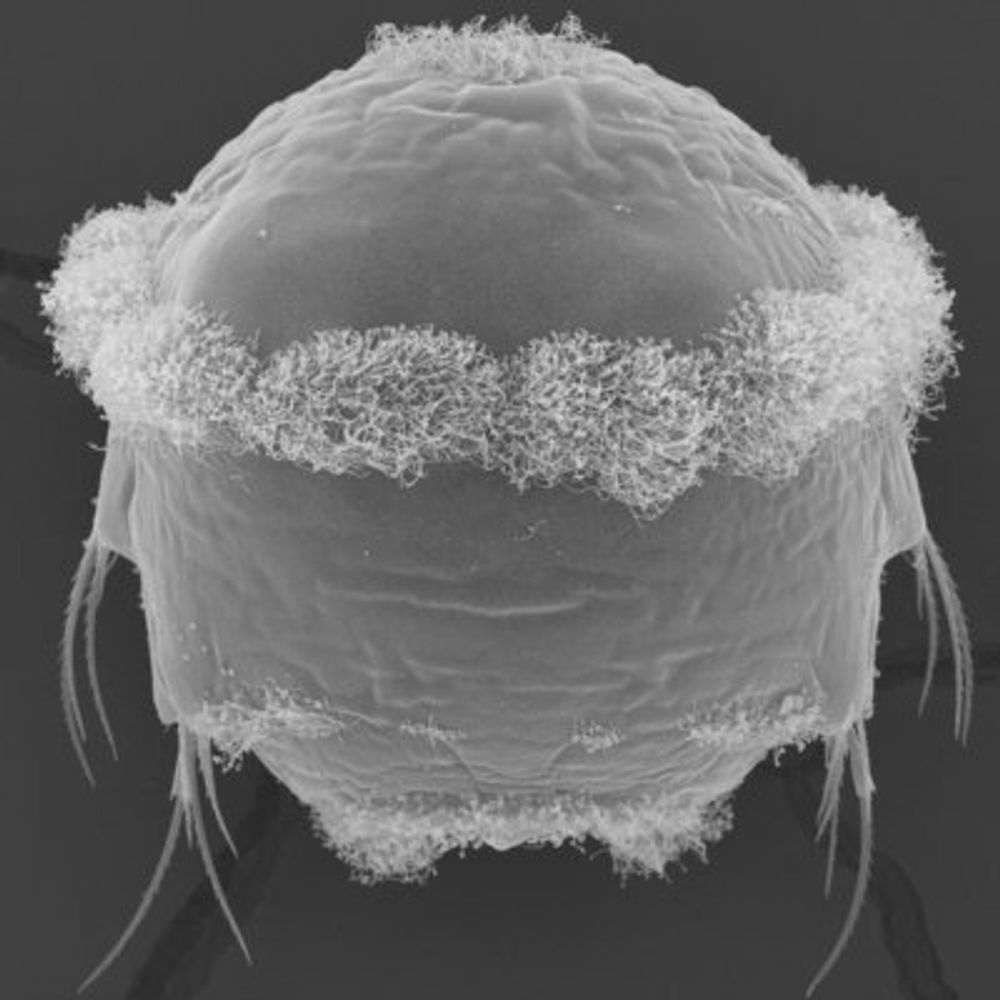
If you are interested in electron microscopy, registration is still open for the
"Electron Microscopy Hands-On Course: sample preparation and imaging of marine environmental samples"
at Stazione Zoologica in Naples.
WIth great teachers from Naples […]
[Original post on biologists.social]
"Electron Microscopy Hands-On Course: sample preparation and imaging of marine environmental samples"
at Stazione Zoologica in Naples.
WIth great teachers from Naples […]
[Original post on biologists.social]

January 13, 2026 at 7:08 AM
If you are interested in electron microscopy, registration is still open for the
"Electron Microscopy Hands-On Course: sample preparation and imaging of marine environmental samples"
at Stazione Zoologica in Naples.
WIth great teachers from Naples […]
[Original post on biologists.social]
"Electron Microscopy Hands-On Course: sample preparation and imaging of marine environmental samples"
at Stazione Zoologica in Naples.
WIth great teachers from Naples […]
[Original post on biologists.social]
Reposted by The Fromm Lab
Wow! 167.2 Gb HiFi yield from a PacBio SMRT cell🎉 Are we getting close the record? This run was for the “Genome of Sweden” project, where we're building a national reference dataset from 10 year old biobanked DNA samples🧬🧪

January 12, 2026 at 9:54 AM
Wow! 167.2 Gb HiFi yield from a PacBio SMRT cell🎉 Are we getting close the record? This run was for the “Genome of Sweden” project, where we're building a national reference dataset from 10 year old biobanked DNA samples🧬🧪
Reposted by The Fromm Lab

Dreaming of a de novo assembly of your pesky short ancient sequences? 🧬 A new tool, CarpeDeam, may just help your dreams come true. 🧬🖥️
link.springer.com/article/10.1...
#MetagenomicsMonday #ancientDNA #aDNA #paleogenomics #bioinformatics
link.springer.com/article/10.1...
#MetagenomicsMonday #ancientDNA #aDNA #paleogenomics #bioinformatics

CarpeDeam: a de novo metagenome assembler for heavily damaged ancient datasets - Genome Biology
De novo assembly of ancient metagenomic datasets is a challenging task. Ultra-short fragment size and characteristic postmortem damage patterns of sequenced ancient DNA molecules leave current tools…
link.springer.com
January 12, 2026 at 8:01 AM
Dreaming of a de novo assembly of your pesky short ancient sequences? 🧬 A new tool, CarpeDeam, may just help your dreams come true. 🧬🖥️
link.springer.com/article/10.1...
#MetagenomicsMonday #ancientDNA #aDNA #paleogenomics #bioinformatics
link.springer.com/article/10.1...
#MetagenomicsMonday #ancientDNA #aDNA #paleogenomics #bioinformatics
!!!
We wrote the Strain on scientific publishing to highlight the problems of time & trust. With a fantastic group of co-authors, we present The Drain of Scientific Publishing:
a 🧵 1/n
Drain: arxiv.org/abs/2511.04820
Strain: direct.mit.edu/qss/article/...
Oligopoly: direct.mit.edu/qss/article/...
a 🧵 1/n
Drain: arxiv.org/abs/2511.04820
Strain: direct.mit.edu/qss/article/...
Oligopoly: direct.mit.edu/qss/article/...


December 22, 2025 at 10:49 AM
!!!
Reposted by The Fromm Lab

I can only second this. BUT, what people often are not aware of: Frontiers in Zoology does NOT belong to the rest of the Frontiers in journals. It is the official journal of the German Zoological Society, a BMC journal and founded BEFORE the other Front in. We suffer a lot from this hijacking.
December 21, 2025 at 1:50 PM
I can only second this. BUT, what people often are not aware of: Frontiers in Zoology does NOT belong to the rest of the Frontiers in journals. It is the official journal of the German Zoological Society, a BMC journal and founded BEFORE the other Front in. We suffer a lot from this hijacking.
Latest RNAcentral update out!
academic.oup.com/nar/advance-...
academic.oup.com/nar/advance-...
Validate User
academic.oup.com
December 21, 2025 at 1:05 PM
Latest RNAcentral update out!
academic.oup.com/nar/advance-...
academic.oup.com/nar/advance-...
Reposted by The Fromm Lab
Permanent Research Group Leader Position, Crete, Greece: Interested to assume long-term responsibilities for the Biodiversity Computing Group www.biocomp.gr I have set up in Crete? Apply now via apella.minedu.gov.gr/en/node/5998 (PDF also in English) - for questions email to stamatak@ics.forth.gr

December 15, 2025 at 7:23 AM
Permanent Research Group Leader Position, Crete, Greece: Interested to assume long-term responsibilities for the Biodiversity Computing Group www.biocomp.gr I have set up in Crete? Apply now via apella.minedu.gov.gr/en/node/5998 (PDF also in English) - for questions email to stamatak@ics.forth.gr
Awesome two day course on microRNA annotation and differential expression analysis done in Oslo last week (#OsloBioinformaticsweek2025) done.
Participants (and tutors!) were so committed that this turned out a microRNA hackathon and we are drafting a paper!!!!
Thanks for the invite!!
Participants (and tutors!) were so committed that this turned out a microRNA hackathon and we are drafting a paper!!!!
Thanks for the invite!!


December 14, 2025 at 11:46 AM
Awesome two day course on microRNA annotation and differential expression analysis done in Oslo last week (#OsloBioinformaticsweek2025) done.
Participants (and tutors!) were so committed that this turned out a microRNA hackathon and we are drafting a paper!!!!
Thanks for the invite!!
Participants (and tutors!) were so committed that this turned out a microRNA hackathon and we are drafting a paper!!!!
Thanks for the invite!!
Reposted by The Fromm Lab
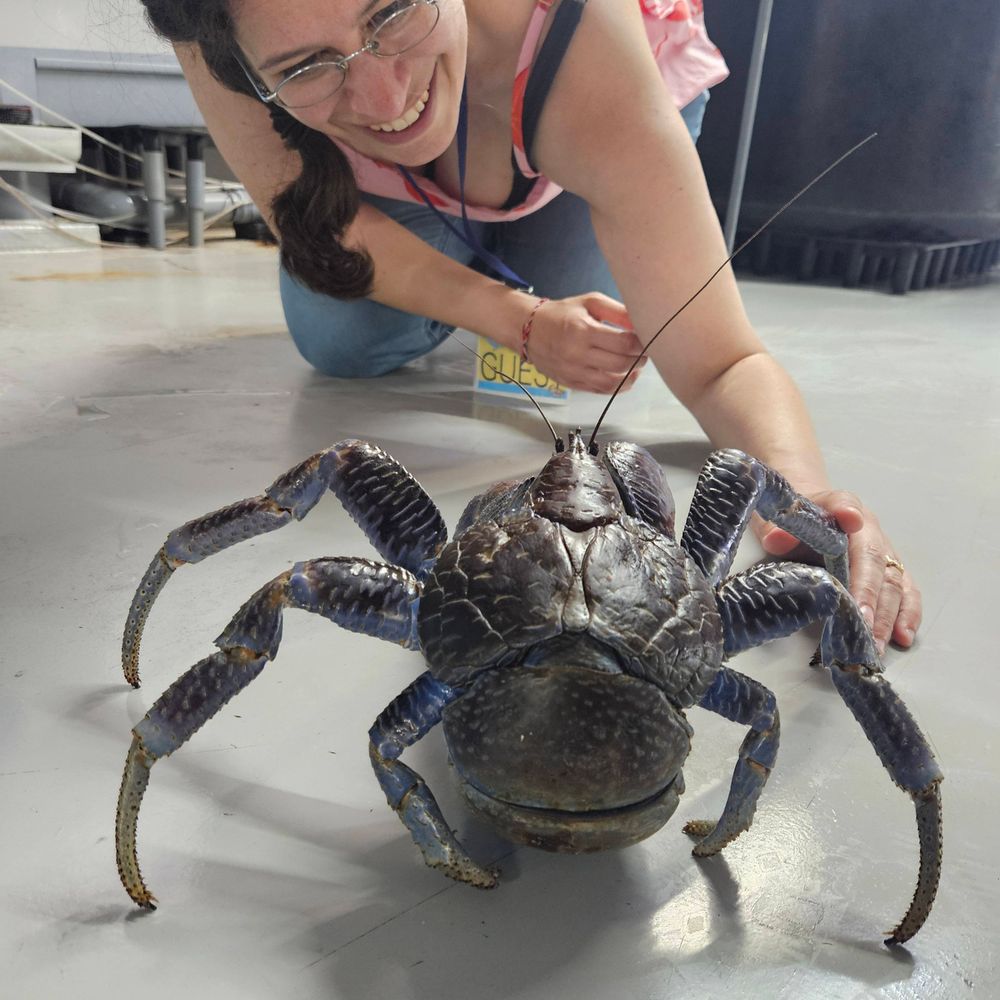
Peracarid crustaceans contain multitudes - at least 26000 species. In the open ocean, some have transparent eyes up to half the body size (they see more contrast but less precision). In caves, they lose eyes and enhance their smell processing.
Papers next #Crustmas 🧪🦑
Papers next #Crustmas 🧪🦑


![Overview of [two of] the three blind peracarids studied.
A, B: Spelaeogriphus lepidops, (Spelaeogriphacea) exhibits an eyeless rudimentary eyestalk (A), a slender antenna 1 and a prominent antenna 2 (dark hue of specimen in A due to artificial staining). B: Courtesy by G. Giribet.
C: Mictocaris halope (Mictocarididae) exhibits an eyeless rudimentary eyestalk, and a prominent antenna 1 and 2.](https://cdn.bsky.app/img/feed_thumbnail/plain/did:plc:m7m7xfifbtfoc3fgj757r5sq/bafkreicfwsetbd5uoqrn53ttkr4sosyhqz7lxmr6pajz56aztg3f3hmzha@jpeg)

December 10, 2024 at 4:37 PM
Peracarid crustaceans contain multitudes - at least 26000 species. In the open ocean, some have transparent eyes up to half the body size (they see more contrast but less precision). In caves, they lose eyes and enhance their smell processing.
Papers next #Crustmas 🧪🦑
Papers next #Crustmas 🧪🦑
Two days of teaching everything about microRNAs in Oslo (#OsloBioinformaticsWeek) ahead.
December 8, 2025 at 10:04 AM
Two days of teaching everything about microRNAs in Oslo (#OsloBioinformaticsWeek) ahead.
Reposted by The Fromm Lab

WOW❗🤯
The amount and quality of the abstracts we've received have completely blown us away! More than 300 abstracts from researchers at all levels and from 33 countries.
We will communicate the selected talks and open registration soon 👉 icp2026.palaeogenomics.org
#ICP2026 will be UNMISSABLE 😍💪
The amount and quality of the abstracts we've received have completely blown us away! More than 300 abstracts from researchers at all levels and from 33 countries.
We will communicate the selected talks and open registration soon 👉 icp2026.palaeogenomics.org
#ICP2026 will be UNMISSABLE 😍💪
December 2, 2025 at 9:52 AM
WOW❗🤯
The amount and quality of the abstracts we've received have completely blown us away! More than 300 abstracts from researchers at all levels and from 33 countries.
We will communicate the selected talks and open registration soon 👉 icp2026.palaeogenomics.org
#ICP2026 will be UNMISSABLE 😍💪
The amount and quality of the abstracts we've received have completely blown us away! More than 300 abstracts from researchers at all levels and from 33 countries.
We will communicate the selected talks and open registration soon 👉 icp2026.palaeogenomics.org
#ICP2026 will be UNMISSABLE 😍💪
@projectpsyche.bsky.social is there a way to get samples of Morpho from you?
November 26, 2025 at 10:31 AM
@projectpsyche.bsky.social is there a way to get samples of Morpho from you?
#FREECOURSE-announcement
Want to learn about microRNA annotation and differential expression analyses? Within the Oslo Bioinformatics week 2025, we will be teaching a two-day course on the 9th and 10th of December at the University of Oslo. 1/2
Want to learn about microRNA annotation and differential expression analyses? Within the Oslo Bioinformatics week 2025, we will be teaching a two-day course on the 9th and 10th of December at the University of Oslo. 1/2
November 25, 2025 at 10:37 AM
#FREECOURSE-announcement
Want to learn about microRNA annotation and differential expression analyses? Within the Oslo Bioinformatics week 2025, we will be teaching a two-day course on the 9th and 10th of December at the University of Oslo. 1/2
Want to learn about microRNA annotation and differential expression analyses? Within the Oslo Bioinformatics week 2025, we will be teaching a two-day course on the 9th and 10th of December at the University of Oslo. 1/2
Reposted by The Fromm Lab

Latest work out today in @currentbiology.bsky.social
We find the fly development gene bicoid is much older than previously thought (~20 million yrs older!) 🪰🧬
To pinpoint its origins we tackled the Diptera phylogeny, providing some resolution (many open questions remain).
🔗 tinyurl.com/2vyuevpy
We find the fly development gene bicoid is much older than previously thought (~20 million yrs older!) 🪰🧬
To pinpoint its origins we tackled the Diptera phylogeny, providing some resolution (many open questions remain).
🔗 tinyurl.com/2vyuevpy
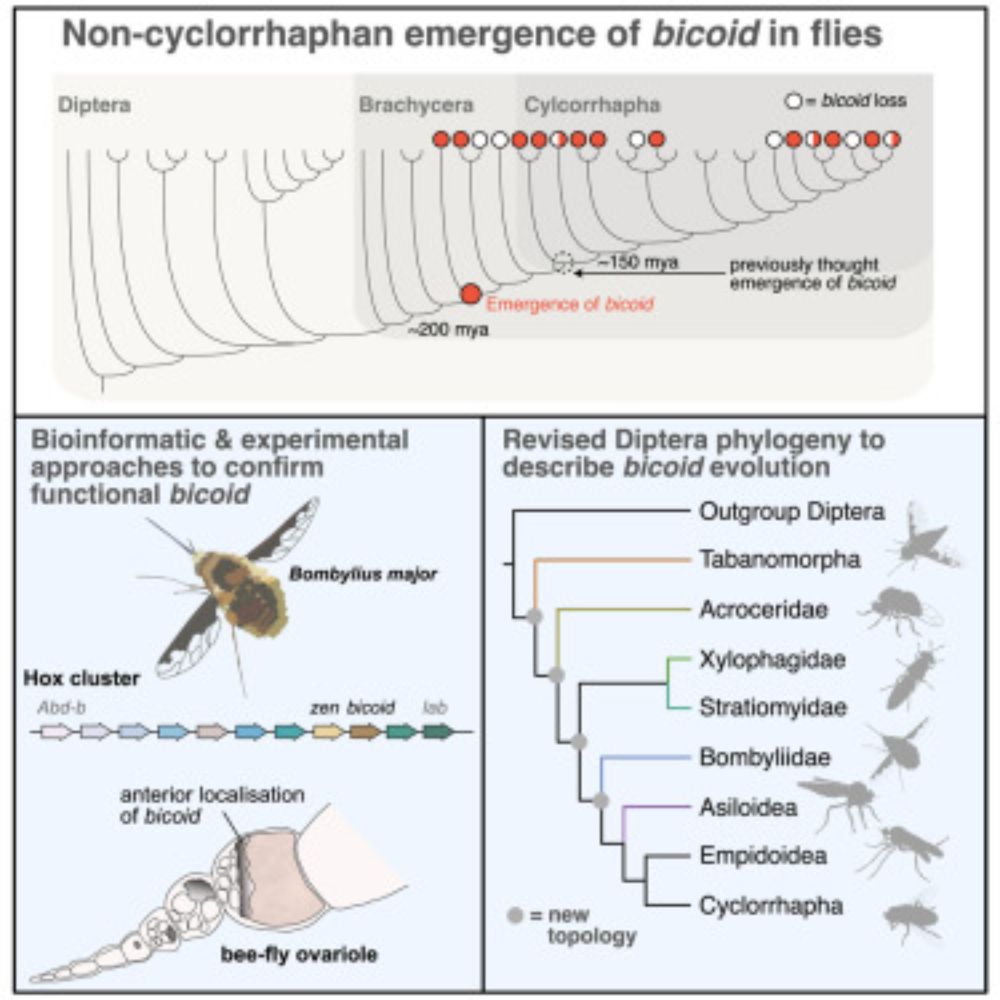
Revised evolutionary relationships within Brachycera and the early origin of bicoid in flies
Mulhair et al. uncover a functional bicoid in non-cyclorrhaphan flies, pushing the
gene's origin back by ∼20 million years. Reassessing the Diptera phylogeny using the
largest dataset to date permits ...
www.cell.com
October 17, 2025 at 3:14 PM
Latest work out today in @currentbiology.bsky.social
We find the fly development gene bicoid is much older than previously thought (~20 million yrs older!) 🪰🧬
To pinpoint its origins we tackled the Diptera phylogeny, providing some resolution (many open questions remain).
🔗 tinyurl.com/2vyuevpy
We find the fly development gene bicoid is much older than previously thought (~20 million yrs older!) 🪰🧬
To pinpoint its origins we tackled the Diptera phylogeny, providing some resolution (many open questions remain).
🔗 tinyurl.com/2vyuevpy
Reposted by The Fromm Lab

Out today, our take on 6-methyladenine #6mA evolution in Eukaryotes @natgenet.nature.com. We asked a simple question, is really DNA 6mA common across the eukaryotes? The answer is "yes" if you're a unicellular eukaryote 🦠, not so if you're multicellular 🐝🌱🍄. www.nature.com/articles/s41... 1/9

Adenine DNA methylation associated with transcriptionally permissive chromatin is widespread across eukaryotes - Nature Genetics
Long-read sequencing in 18 unicellular eukaryotes reveals that 6mA is widespread across eukaryotes and is enriched at transcriptionally permissive regions, which are also marked by H3K4me3.
www.nature.com
November 18, 2025 at 12:00 PM
Out today, our take on 6-methyladenine #6mA evolution in Eukaryotes @natgenet.nature.com. We asked a simple question, is really DNA 6mA common across the eukaryotes? The answer is "yes" if you're a unicellular eukaryote 🦠, not so if you're multicellular 🐝🌱🍄. www.nature.com/articles/s41... 1/9
Reposted by The Fromm Lab

Forty-thousand-year-old mammoth mummies yield oldest RNA yet found
Forty-thousand-year-old mammoth mummies yield oldest RNA yet found
Ancient RNA promises to shed light on how genes functioned in extinct animals
www.science.org
November 14, 2025 at 5:55 PM
Forty-thousand-year-old mammoth mummies yield oldest RNA yet found
Reposted by The Fromm Lab

The world’s oldest #RNA extracted from #WoollyMammoth: “gives us a completely different picture” ↓ 🧪⚒️
Woolly mammoth preserved in the Siberian permafrost for nearly 40,000 years sequenced. 🖥️ 🧬
www.youtube.com/watch?v=tHQv...
Weekend reading:
www.scilifelab.se/news/worlds-...
Woolly mammoth preserved in the Siberian permafrost for nearly 40,000 years sequenced. 🖥️ 🧬
www.youtube.com/watch?v=tHQv...
Weekend reading:
www.scilifelab.se/news/worlds-...

The world’s oldest #RNA extracted from #WoollyMammoth: “gives us a completely different picture”
YouTube video by SciLifeLab
www.youtube.com
November 14, 2025 at 4:11 PM
The world’s oldest #RNA extracted from #WoollyMammoth: “gives us a completely different picture” ↓ 🧪⚒️
Woolly mammoth preserved in the Siberian permafrost for nearly 40,000 years sequenced. 🖥️ 🧬
www.youtube.com/watch?v=tHQv...
Weekend reading:
www.scilifelab.se/news/worlds-...
Woolly mammoth preserved in the Siberian permafrost for nearly 40,000 years sequenced. 🖥️ 🧬
www.youtube.com/watch?v=tHQv...
Weekend reading:
www.scilifelab.se/news/worlds-...
Reposted by The Fromm Lab

RNA recovered from Siberian mammoth that died 39,000 years ago - https://www.channelnewsasia.com/business/rna-recovered-siberian-mammoth-died-39000-years-ago-5468461

RNA recovered from Siberian mammoth that died 39,000 years ago
WASHINGTON :Scientists have recovered the oldest-known RNA, a molecule necessary for most biological functions, from a woolly mammoth that inhabited Siberia about 39,000 years ago, showing it can last longer than previously known and promising a new path for studying organisms that lived long ago.The RNA, suc
www.channelnewsasia.com
November 14, 2025 at 4:10 PM
RNA recovered from Siberian mammoth that died 39,000 years ago - https://www.channelnewsasia.com/business/rna-recovered-siberian-mammoth-died-39000-years-ago-5468461
Reposted by The Fromm Lab
Woolly Mammoth Reveals the World’s Oldest RNA www.scientificamerican.com/article/wool...

A Frozen Woolly Mammoth Reveals the World’s Oldest RNA
RNA has been extracted from an ancient woolly mammoth, providing insight into its last moments on Earth
www.scientificamerican.com
November 14, 2025 at 5:58 PM
Woolly Mammoth Reveals the World’s Oldest RNA www.scientificamerican.com/article/wool...