



Dimitris Volteras
@dvolteras.bsky.social
Computational biology at the Briscoe lab @crick.ac.uk.
Previously PhD @imperialcollegeldn.bsky.social.
Modelling gene regulation in heterogeneous cell populations.
Previously PhD @imperialcollegeldn.bsky.social.
Modelling gene regulation in heterogeneous cell populations.
Reposted by Dimitris Volteras

A new paper with Bogdan Georgiev, Javier Gomez-Serrano, and Adam Zsolt Wagner: "Mathematical exploration and discovery at scale" arxiv.org/abs/2511.02864. Further discussion is at terrytao.wordpress.com/2025/11/05/m...

Mathematical exploration and discovery at scale
AlphaEvolve is a generic evolutionary coding agent that combines the generative capabilities of LLMs with automated evaluation in an iterative evolutionary framework that proposes, tests, and refines ...
arxiv.org
November 6, 2025 at 3:42 AM
A new paper with Bogdan Georgiev, Javier Gomez-Serrano, and Adam Zsolt Wagner: "Mathematical exploration and discovery at scale" arxiv.org/abs/2511.02864. Further discussion is at terrytao.wordpress.com/2025/11/05/m...
Reposted by Dimitris Volteras

Fresh from the press💥 We asked what happens when you evolve gene regulatory networks computationally at scale. Do general principles of GRN evolution jump out? Is the process predictable? Read on to find out @prxlife.bsky.social @crick.ac.uk @ucl-ipls.bsky.social 👉 journals.aps.org/prxlife/abst...

Gene Network Organization, Mutation, and Selection Collectively Drive Developmental Pattern Evolvability and Predictability
The historical order in which mutations appear during evolution determine the evolutionary trajectory of gene regulatory networks and influence how developmental patterns change and diversify over tim...
journals.aps.org
September 16, 2025 at 7:46 PM
Fresh from the press💥 We asked what happens when you evolve gene regulatory networks computationally at scale. Do general principles of GRN evolution jump out? Is the process predictable? Read on to find out @prxlife.bsky.social @crick.ac.uk @ucl-ipls.bsky.social 👉 journals.aps.org/prxlife/abst...
Proud to have contributed to this work! We built a stochastic agent-based model, revealing that axonal injury promotes retention in white matter leading to dense wild-type tumours, while absence of axonal injury leads to disseminated tumours and delayed glioblastoma progression.

Nature research paper: Axonal injury is a targetable driver of glioblastoma progression
go.nature.com/4lFmpiN
go.nature.com/4lFmpiN

Axonal injury is a targetable driver of glioblastoma progression - Nature
Axonal injury, induced in the white matter by expansion of early tumour cells, is a key driver of glioblastoma progression.
go.nature.com
September 4, 2025 at 3:21 PM
Proud to have contributed to this work! We built a stochastic agent-based model, revealing that axonal injury promotes retention in white matter leading to dense wild-type tumours, while absence of axonal injury leads to disseminated tumours and delayed glioblastoma progression.
Reposted by Dimitris Volteras

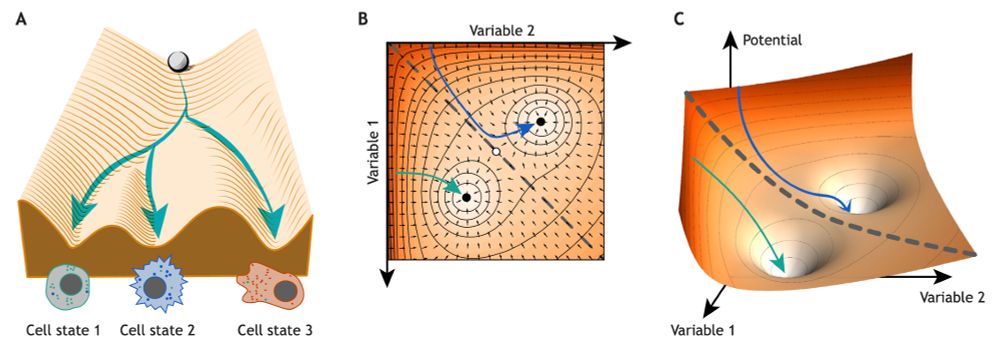
We wrote this introductory review on how concepts from dynamical systems can help us understand developmental biology, hope it’s useful to somebody! It was a lot of fun to put together, and great to collaborate with brilliant colleagues across theory and experiments
Introducing five concepts from dynamical systems to decode developmental regulatory mechanisms, have a read! @perez-carrasco.bsky.social @roederlab.bsky.social @mpipz.bsky.social This effort started in a morphogenesis meeting @kitp-ucsb.bsky.social in 2023. journals.biologists.com/dev/article/...
August 4, 2025 at 2:46 PM
We wrote this introductory review on how concepts from dynamical systems can help us understand developmental biology, hope it’s useful to somebody! It was a lot of fun to put together, and great to collaborate with brilliant colleagues across theory and experiments
Reposted by Dimitris Volteras

Help me build a virtual version of my apartment by training a hugeee (like so huge) neural network on temperature data from my stove.
Call to action from the community to achive this ambitious goal!
Call to action from the community to achive this ambitious goal!
June 26, 2025 at 7:14 PM
Help me build a virtual version of my apartment by training a hugeee (like so huge) neural network on temperature data from my stove.
Call to action from the community to achive this ambitious goal!
Call to action from the community to achive this ambitious goal!
Reposted by Dimitris Volteras

Two years ago, I've completely reoriented my research to try to make AI safe by design. In this TIME op-ed, I present my team's new direction called "Scientist AI"; a practical, effective and more secure alternative to the current uncontrolled agency-driven trajectory.
time.com/7283507/safe...
time.com/7283507/safe...

A Potential Path to Safer AI Development
Yoshua Bengio warns that the current approach to developing AI models carries potentially catastrophic risks.
time.com
May 9, 2025 at 10:57 AM
Two years ago, I've completely reoriented my research to try to make AI safe by design. In this TIME op-ed, I present my team's new direction called "Scientist AI"; a practical, effective and more secure alternative to the current uncontrolled agency-driven trajectory.
time.com/7283507/safe...
time.com/7283507/safe...
Reposted by Dimitris Volteras

genomebiology.biomedcentral.com/articles/10....
Quite an indictment of some of the current single cell "virtual cell" foundation models. Even for the relatively mundane applications, cell labeling, batch correction etc, they are poor compared to much simpler & cheaper methods.
Quite an indictment of some of the current single cell "virtual cell" foundation models. Even for the relatively mundane applications, cell labeling, batch correction etc, they are poor compared to much simpler & cheaper methods.
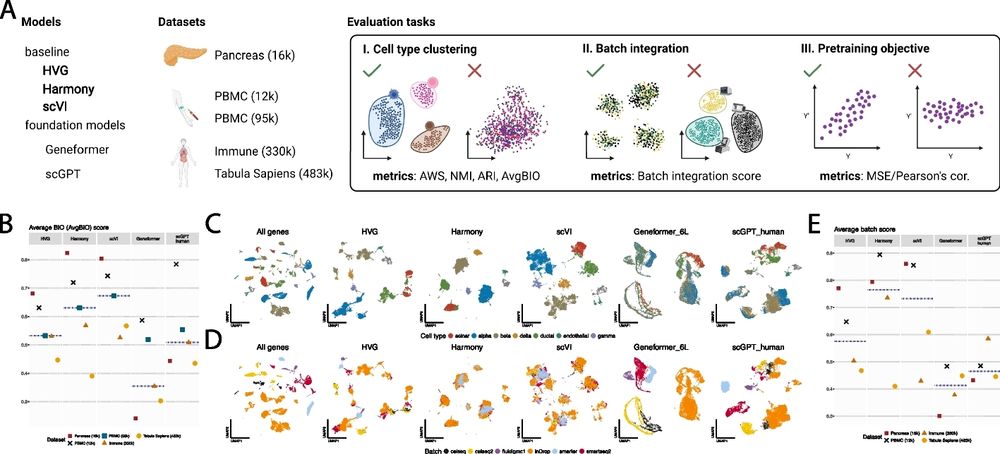
Zero-shot evaluation reveals limitations of single-cell foundation models - Genome Biology
Foundation models such as scGPT and Geneformer have not been rigorously evaluated in a setting where they are used without any further training (i.e., zero-shot). Understanding the performance of mode...
genomebiology.biomedcentral.com
April 20, 2025 at 4:14 PM
genomebiology.biomedcentral.com/articles/10....
Quite an indictment of some of the current single cell "virtual cell" foundation models. Even for the relatively mundane applications, cell labeling, batch correction etc, they are poor compared to much simpler & cheaper methods.
Quite an indictment of some of the current single cell "virtual cell" foundation models. Even for the relatively mundane applications, cell labeling, batch correction etc, they are poor compared to much simpler & cheaper methods.
Reposted by Dimitris Volteras

EFL-3/E2F7 modulates Wnt signalling by repressing the Nemo-like kinase LIT-1 during asymmetric epidermal cell division in C. elegans
Read this @reviewcommons.org transfer Research Article by @mar-ferrando-marco.bsky.social & Michalis Barkoulas @imperialcollegeldn.bsky.social
doi.org/10.1242/dev....
Read this @reviewcommons.org transfer Research Article by @mar-ferrando-marco.bsky.social & Michalis Barkoulas @imperialcollegeldn.bsky.social
doi.org/10.1242/dev....
![figure 3 (C) Representative images of LIT-1::GFP following the L2 asymmetric division in controls (WT), tissue-specific efl-3 mutants [efl-3(−)] and animals containing the lit-1(icb164) CRISPR deletion. Seam cell nuclei are circled in white. Hypodermal nuclei are labelled with blue arrowheads. a, anterior daughter cell; p, posterior daughter cell.](https://cdn.bsky.app/img/feed_thumbnail/plain/did:plc:btitwyhiegkb6f62oguxt6m6/bafkreih2xjdz4bhvm7z7h5d7i3gx4qw2xrfhix3iphhvaddvhaogimnz4y@jpeg)
March 7, 2025 at 8:58 AM
EFL-3/E2F7 modulates Wnt signalling by repressing the Nemo-like kinase LIT-1 during asymmetric epidermal cell division in C. elegans
Read this @reviewcommons.org transfer Research Article by @mar-ferrando-marco.bsky.social & Michalis Barkoulas @imperialcollegeldn.bsky.social
doi.org/10.1242/dev....
Read this @reviewcommons.org transfer Research Article by @mar-ferrando-marco.bsky.social & Michalis Barkoulas @imperialcollegeldn.bsky.social
doi.org/10.1242/dev....
Reposted by Dimitris Volteras
Proteins degrade at different rates. These rates can span 2-3 orders of magnitude. When cells are not growing, this allows proteins that degrade slower than others to preferentially accumulate. This accumulation imparts influence on protein concentrations.
www.biorxiv.org/content/10.1...
www.biorxiv.org/content/10.1...

Protein degradation and growth dependent dilution substantially shape mammalian proteomes
Cellular protein concentrations are maintained through a balance of synthesis and clearance. Clearance occurs through both protein degradation and growth-dependent dilution. At slow growth, clearance ...
www.biorxiv.org
February 12, 2025 at 5:43 PM
Proteins degrade at different rates. These rates can span 2-3 orders of magnitude. When cells are not growing, this allows proteins that degrade slower than others to preferentially accumulate. This accumulation imparts influence on protein concentrations.
www.biorxiv.org/content/10.1...
www.biorxiv.org/content/10.1...