




Ran Duan
@drduanran.bsky.social
PhD candidate at Marine and Environmental Biology @USC
cyanobacteria/omics/evolution/climate change/trace metal
cyanobacteria/omics/evolution/climate change/trace metal
Reposted by Ran Duan

Coupling of excitation energy to photochemistry in natural marine phytoplankton communities under iron stress www.pnas.org/doi/abs/10.1... #jcampubs 🌊

Coupling of excitation energy to photochemistry in natural marine phytoplankton communities under iron stress | PNAS
Oxygenic photosynthesis requires excitation energy transfer from light-harvesting
complexes (LHCs) to reaction centers (RCs) to drive photochemical...
www.pnas.org
July 30, 2025 at 2:09 PM
Coupling of excitation energy to photochemistry in natural marine phytoplankton communities under iron stress www.pnas.org/doi/abs/10.1... #jcampubs 🌊
Reposted by Ran Duan
Phosphorus limitation heightens vulnerability of Crocosphaera watsonii to ocean warming compared with iron limitation www.frontiersin.org/journals/mic... #jcampubs 🌊
January 6, 2026 at 2:31 PM
Phosphorus limitation heightens vulnerability of Crocosphaera watsonii to ocean warming compared with iron limitation www.frontiersin.org/journals/mic... #jcampubs 🌊
Reposted by Ran Duan
Biogenically driven marine organic aerosol production over the West Pacific Ocean bg.copernicus.org/articles/23/... #jcampubs 🌊

Biogenically driven marine organic aerosol production over the West Pacific Ocean
Abstract. Marine organic aerosols play crucial roles in cloud formation and climate regulation within the marine boundary layer. However, the abundance of marine primary organic carbon (MPOC) generate...
bg.copernicus.org
January 5, 2026 at 2:16 PM
Biogenically driven marine organic aerosol production over the West Pacific Ocean bg.copernicus.org/articles/23/... #jcampubs 🌊
iron metalloproteome of Pseudomonas aeruginosa under oxic and anoxic conditions url: academic.oup.com/metallomics/...

The iron metalloproteome of Pseudomonas aeruginosa under oxic and anoxic conditions
Abstract. Pseudomonas aeruginosa is a major contributor to human infections and is widely distributed in the environment. Its ability for growth under aero
academic.oup.com
January 1, 2026 at 11:39 PM
iron metalloproteome of Pseudomonas aeruginosa under oxic and anoxic conditions url: academic.oup.com/metallomics/...
Reposted by Ran Duan

A paper published in Nature in September suggests a quarter of heatwave events from 2000-23 would have been near impossible without anthropogenic climate change. The paper also indicates that major carbon emitters are responsible for around 50% of the increase in intensity of these events. ⚒️ 🧪

Systematic attribution of heatwaves to the emissions of carbon majors - Nature
Climate change made 213 historical heatwaves reported over 2000–2023 more likely and more intense, to which each of the 180 carbon majors (fossil fuel and cement producers) substantially contributed.
go.nature.com
December 28, 2025 at 11:28 PM
A paper published in Nature in September suggests a quarter of heatwave events from 2000-23 would have been near impossible without anthropogenic climate change. The paper also indicates that major carbon emitters are responsible for around 50% of the increase in intensity of these events. ⚒️ 🧪
Reposted by Ran Duan
The changing roles of Escherichia coli www.nature.com/articles/s41... #jcampubs

The changing roles of Escherichia coli - Nature Microbiology
Richard Lenski traces the legacy of Escherichia coli and how science is evolving to use this model organism in new ways.
www.nature.com
December 24, 2025 at 9:23 PM
The changing roles of Escherichia coli www.nature.com/articles/s41... #jcampubs
Reposted by Ran Duan
Diverse community of rhizobia-diatom symbioses fixes nitrogen in the South Pacific gyre academic.oup.com/ismecommun/a... #jcampubs 🌊

Diverse community of rhizobia-diatom symbioses fixes nitrogen in the South Pacific gyre
Abstract. Nitrogen fixation is crucial for sustaining productivity in most of the open ocean. Cyanobacteria are the most prominent N2-fixers, but based on
academic.oup.com
December 9, 2025 at 2:32 PM
Diverse community of rhizobia-diatom symbioses fixes nitrogen in the South Pacific gyre academic.oup.com/ismecommun/a... #jcampubs 🌊
Reposted by Ran Duan

Grateful to share our paper on gene-specific selective sweeps in human gut microbiomes, now out in Nature! It has been a joy to work with @rwolff.bsky.social, whose insights and hard work made this possible.
www.nature.com/articles/s41...
www.nature.com/articles/s41...

Gene-specific selective sweeps are pervasive across human gut microbiomes - Nature
Development and application of the integrated linkage disequilibrium score (iLDS) reveals both selective pressures impacting the human gut microbiome and the mechanisms by which gut bacteria adapt to ...
www.nature.com
December 17, 2025 at 6:53 PM
Grateful to share our paper on gene-specific selective sweeps in human gut microbiomes, now out in Nature! It has been a joy to work with @rwolff.bsky.social, whose insights and hard work made this possible.
www.nature.com/articles/s41...
www.nature.com/articles/s41...
Reposted by Ran Duan

Is the Zinc Hypothesis true? (Zn control of marine primary production). Apparently yes: by multiple independent lines of evidence, including zinc stress protein biomarkers, in the low pCO2 waters of a coastal Antarctica bloom. Thesis work by Riss Kell and many wonderful collabs. In Open review BG. 🌊

Zinc stimulation of phytoplankton in a low carbon dioxide, coastal Antarctic environment: evidence for the Zn hypothesis
Abstract. The ocean acts as a carbon sink, absorbing carbon from the atmosphere and resulting in substantial uptake of anthropogenic CO2 emissions. As biological processes in the oceans such as net pr...
egusphere.copernicus.org
April 15, 2025 at 3:25 AM
Is the Zinc Hypothesis true? (Zn control of marine primary production). Apparently yes: by multiple independent lines of evidence, including zinc stress protein biomarkers, in the low pCO2 waters of a coastal Antarctica bloom. Thesis work by Riss Kell and many wonderful collabs. In Open review BG. 🌊
Reposted by Ran Duan
Nitrogen-fixing microbes gain genes in diverse types of living environments www.pnas.org/doi/abs/10.1... #jcampubs

Nitrogen-fixing microbes gain genes in diverse types of living environments | PNAS
Biological nitrogen fixation (BNF), which is catalyzed by a large nitrogenase enzyme
complex, has evolved in both bacteria and archaea. Indeed, nit...
www.pnas.org
December 1, 2025 at 2:29 PM
Nitrogen-fixing microbes gain genes in diverse types of living environments www.pnas.org/doi/abs/10.1... #jcampubs
Reposted by Ran Duan
Localized nutrient colimitation of phytoplankton growth rates across the subtropical South Pacific Ocean www.pnas.org/doi/abs/10.1... #jcampubs 🌊

Localized nutrient colimitation of phytoplankton growth rates across the subtropical South Pacific Ocean | PNAS
The simultaneous depletion of multiple nutrients in seawater potentially leads to
colimitation of phytoplankton growth across large oceanic extents...
www.pnas.org
December 12, 2025 at 6:21 AM
Localized nutrient colimitation of phytoplankton growth rates across the subtropical South Pacific Ocean www.pnas.org/doi/abs/10.1... #jcampubs 🌊
Reposted by Ran Duan

Transcriptomics in the era of long-read sequencing
Free to read here: rdcu.be/efBjP
Free to read here: rdcu.be/efBjP
December 10, 2025 at 3:43 PM
Transcriptomics in the era of long-read sequencing
Free to read here: rdcu.be/efBjP
Free to read here: rdcu.be/efBjP
Reposted by Ran Duan

Nitrogen fixation by nitrogenase requires a metallocofactor built by dedicated multiprotein machinery. Structural snapshots of a precursor entering a key maturase reveal the dynamic process of FeMo-cofactor assembly
www.nature.com/articles/s41...
www.nature.com/articles/s41...

Dynamics driving the precursor in NifEN scaffold during nitrogenase FeMo-cofactor assembly - Nature Chemical Biology
Nitrogen fixation by nitrogenase requires a metallocofactor built by a dedicated multiprotein machinery. Here, the authors captured structural snapshots of a precursor entering a key maturase, reveali...
www.nature.com
November 19, 2025 at 8:21 PM
Nitrogen fixation by nitrogenase requires a metallocofactor built by dedicated multiprotein machinery. Structural snapshots of a precursor entering a key maturase reveal the dynamic process of FeMo-cofactor assembly
www.nature.com/articles/s41...
www.nature.com/articles/s41...
Reposted by Ran Duan

1/ Our review on sequencing-based #microbiome analysis is in the Dec 24 issue of Nature Reviews Genetics. We explore DNA/RNA-sequencing approaches for studying microbiome structure and function, highlighting the biological insights sequencing-based microbiome research offers.
go.nature.com/3XFqonu
go.nature.com/3XFqonu

Sequencing-based analysis of microbiomes - Nature Reviews Genetics
In this Review, Pinto and Bhatt provide an overview of DNA-sequencing and RNA-sequencing approaches that can be used to study the composition, structure, and function of microbiomes and discuss the bi...
go.nature.com
November 19, 2024 at 3:25 AM
1/ Our review on sequencing-based #microbiome analysis is in the Dec 24 issue of Nature Reviews Genetics. We explore DNA/RNA-sequencing approaches for studying microbiome structure and function, highlighting the biological insights sequencing-based microbiome research offers.
go.nature.com/3XFqonu
go.nature.com/3XFqonu
Reposted by Ran Duan

Metal ions are universally required for life, and many of the foundational principles of metal homeostasis have emerged from studies of microbial systems. In this review, I provide a introductory overview targeted to those new to the field.
#MicroSky #Metals
rdcu.be/eycU2
#MicroSky #Metals
rdcu.be/eycU2
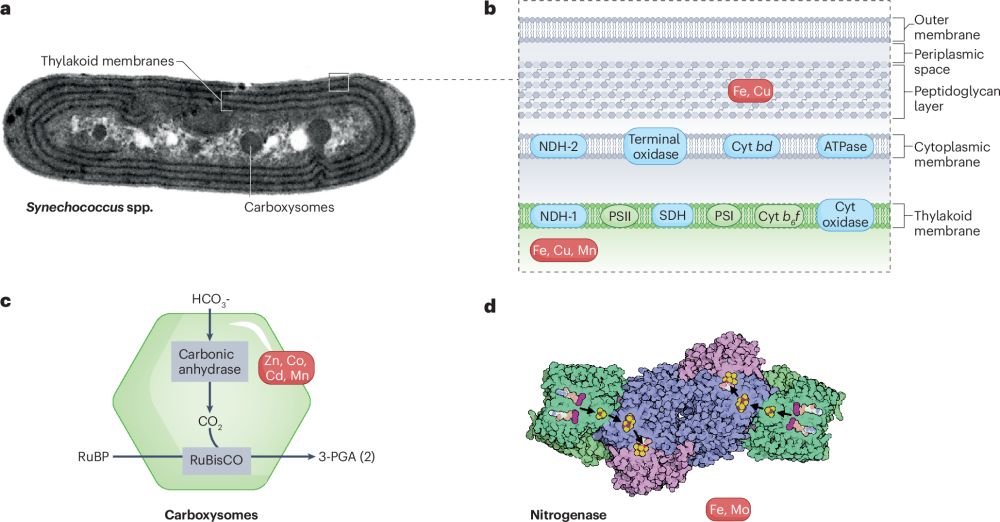
Microbial metal physiology: ions to ecosystems
Nature Reviews Microbiology - Metal ions are required for all cells, and their homeostasis relies on ancient mechanisms that facilitate their import, distribution and storage. In this Review,...
rdcu.be
July 28, 2025 at 5:08 PM
Metal ions are universally required for life, and many of the foundational principles of metal homeostasis have emerged from studies of microbial systems. In this review, I provide a introductory overview targeted to those new to the field.
#MicroSky #Metals
rdcu.be/eycU2
#MicroSky #Metals
rdcu.be/eycU2
Reposted by Ran Duan
Ocean-M: an integrated global-scale multi-omics database for marine microbial diversity, function and ecological interactions academic.oup.com/nar/advance-... #jcampubs 🌊

Ocean-M: an integrated global-scale multi-omics database for marine microbial diversity, function and ecological interactions
Abstract. Multi-omics analyses have significantly advanced the understanding of complex marine microbial communities and their interactions. Despite notabl
academic.oup.com
November 1, 2025 at 7:35 AM
Ocean-M: an integrated global-scale multi-omics database for marine microbial diversity, function and ecological interactions academic.oup.com/nar/advance-... #jcampubs 🌊
Reposted by Ran Duan

Please Re-Post. Our global GRUMP microbial ocean database is out in Scientific Data! Unfractionated, single universal PCR, with Archaea, Bacteria, and Eukaryotes all on the same scale with the same denominator. Pole to pole, depths to 6000m. Lots of metadata. www.nature.com/articles/s41...
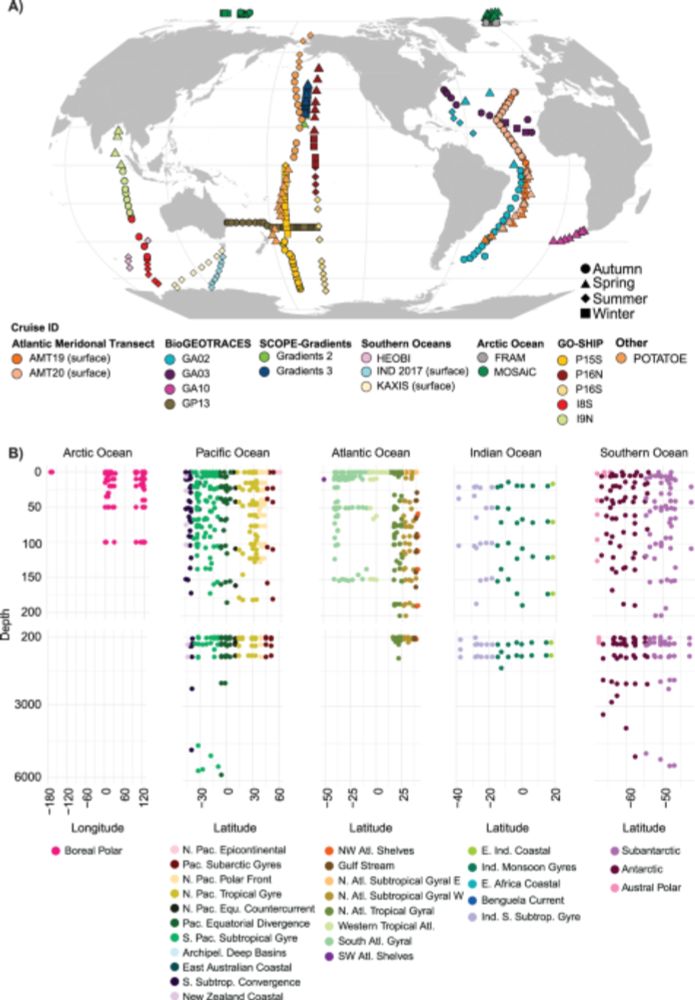
Characterizing organisms from three domains of life with universal primers from throughout the global ocean - Scientific Data
Scientific Data - Characterizing organisms from three domains of life with universal primers from throughout the global ocean
www.nature.com
July 2, 2025 at 4:19 PM
Please Re-Post. Our global GRUMP microbial ocean database is out in Scientific Data! Unfractionated, single universal PCR, with Archaea, Bacteria, and Eukaryotes all on the same scale with the same denominator. Pole to pole, depths to 6000m. Lots of metadata. www.nature.com/articles/s41...
Reposted by Ran Duan
Contrasting Responses of Oceanic and Coastal Synechococcus to Iron Limitation and Warming Interactions #USC_MEB #ResearchAtUSC #jcampubs 🌊 enviromicro-journals.onlinelibrary.wiley.com/doi/10.1111/...
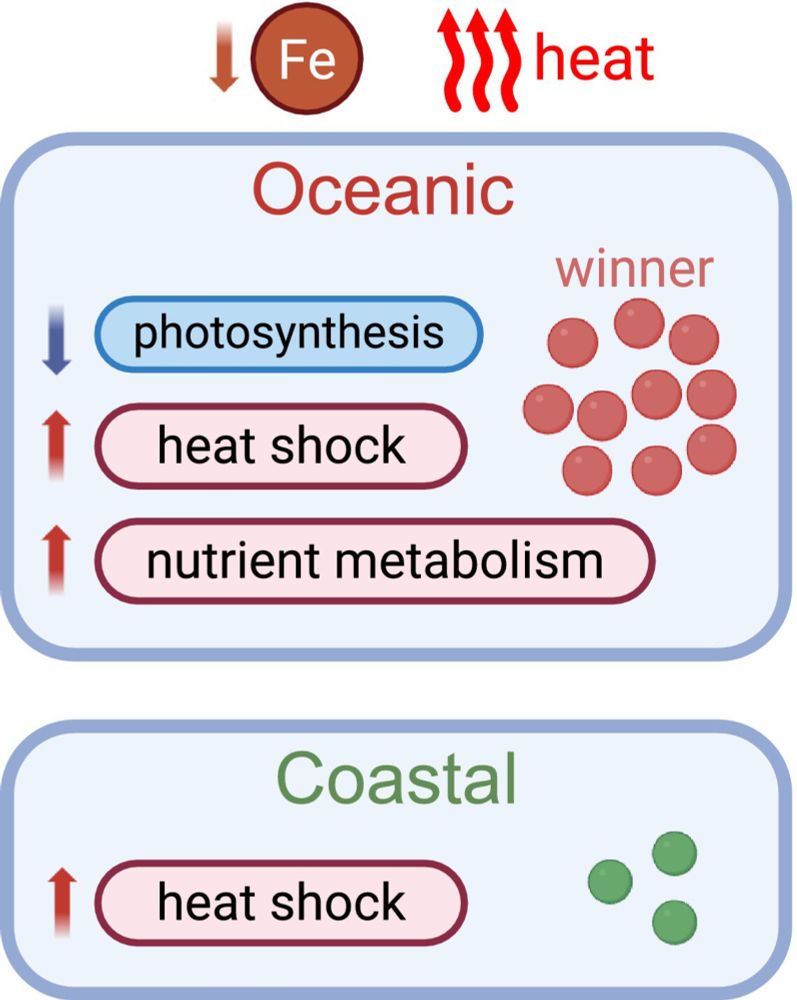
Contrasting Responses of Oceanic and Coastal Synechococcus to Iron Limitation and Warming Interactions
Oceanic Synechococcus respond to the interactive effects of iron (Fe) limitation and ocean warming by regulating photosynthesis, nutrient metabolism, and heat shock gene expression, while a coastal s...
enviromicro-journals.onlinelibrary.wiley.com
July 21, 2025 at 4:33 PM
Contrasting Responses of Oceanic and Coastal Synechococcus to Iron Limitation and Warming Interactions #USC_MEB #ResearchAtUSC #jcampubs 🌊 enviromicro-journals.onlinelibrary.wiley.com/doi/10.1111/...
Last week at GRS/GRC AEM, I presented Chapters 2 & 3, where I use proteomics/experimental evolution to probe how marine diazotrophic cyanobacteria cope with warming + nutrient limitation. Incredible opportunities to get feedback and connect!
July 19, 2025 at 1:06 PM
Last week at GRS/GRC AEM, I presented Chapters 2 & 3, where I use proteomics/experimental evolution to probe how marine diazotrophic cyanobacteria cope with warming + nutrient limitation. Incredible opportunities to get feedback and connect!
Happy to share that the 1st chapter of my PhD on how coastal & oceanic Synechococcus deal with iron × warming interactions is now published in Environmental Microbiology Reports!
enviromicro-journals.onlinelibrary.wiley.com/doi/10.1111/...
enviromicro-journals.onlinelibrary.wiley.com/doi/10.1111/...
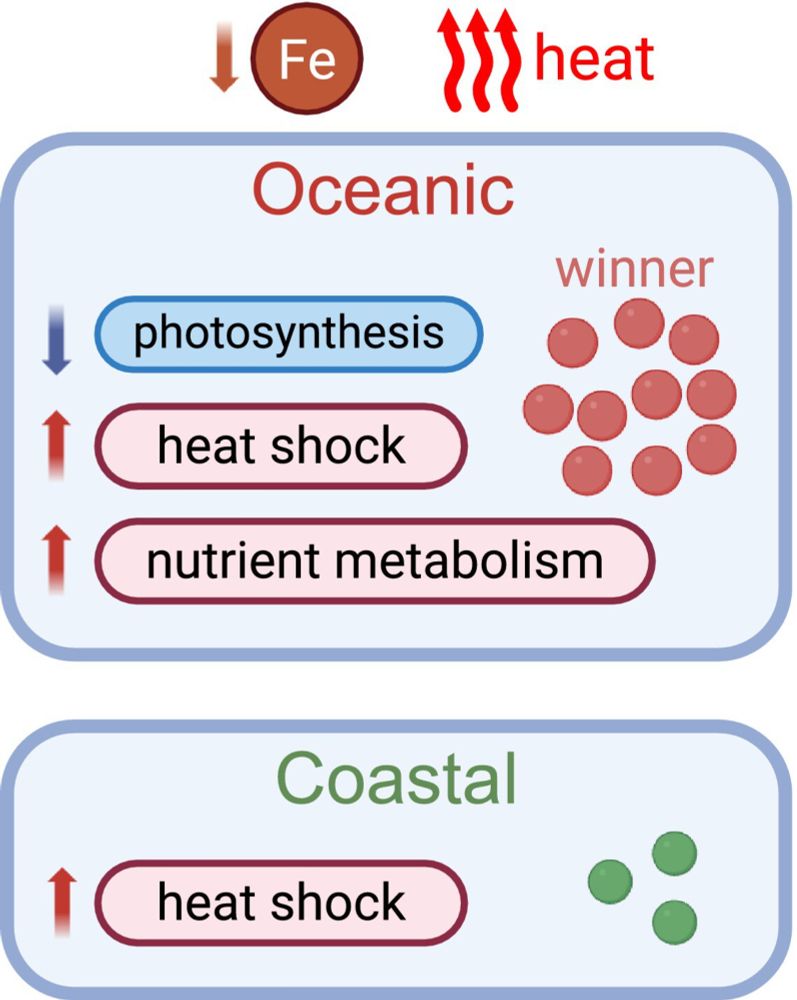
Contrasting Responses of Oceanic and Coastal Synechococcus to Iron Limitation and Warming Interactions
Oceanic Synechococcus respond to the interactive effects of iron (Fe) limitation and ocean warming by regulating photosynthesis, nutrient metabolism, and heat shock gene expression, while a coastal s...
enviromicro-journals.onlinelibrary.wiley.com
July 19, 2025 at 1:04 PM
Happy to share that the 1st chapter of my PhD on how coastal & oceanic Synechococcus deal with iron × warming interactions is now published in Environmental Microbiology Reports!
enviromicro-journals.onlinelibrary.wiley.com/doi/10.1111/...
enviromicro-journals.onlinelibrary.wiley.com/doi/10.1111/...