




Steve Diggle
@digglelab.bsky.social
Professor of Microbiology at Georgia Tech. Interested in bacterial interactions, quorum sensing, biofilms, antimicrobial resistance and R-pyocins. www.thedigglelab.com.
Pinned
From infestation to infection: a systematic review of arthropod-mediated microbial transmission in hospitals | Antimicrobial Stewardship & Healthcare Epidemiology | Cambridge Core
From infestation to infection: a systematic review of arthropod-mediated microbial transmission in hospitals - Volume 6 Issue 1
www.cambridge.org
Our new review highlights that ants, cockroaches, and flies carry antimicrobial-resistant bacteria and fungi in hospitals. Better pest management is key to infection prevention. #ASHEJournal #microsky www.cambridge.org/core/journal...
Reposted by Steve Diggle

It’s the final week to apply for the Microbiology Editor role. We're looking for passionate experts to help shape the future of research. Submit your CV and cover letter by February 16: https://microb.io/4qKdgJ6

<i>Microbiology</i> Editors: Call for expressions of interest
microb.io
February 9, 2026 at 9:00 AM
It’s the final week to apply for the Microbiology Editor role. We're looking for passionate experts to help shape the future of research. Submit your CV and cover letter by February 16: https://microb.io/4qKdgJ6
Reposted by Steve Diggle

Remember the medieval remedy we reconstructed years ago? We've now dissected the various ways it attacks and kills bacteria! Preprinted & submitted, led by @tosinorababa.bsky.social & Jess Furner-Pardoe w/ many collaborators #MicroSky #Ancientbiotics www.biorxiv.org/content/10.6...

February 3, 2026 at 9:58 AM
Remember the medieval remedy we reconstructed years ago? We've now dissected the various ways it attacks and kills bacteria! Preprinted & submitted, led by @tosinorababa.bsky.social & Jess Furner-Pardoe w/ many collaborators #MicroSky #Ancientbiotics www.biorxiv.org/content/10.6...
Reposted by Steve Diggle
Only 2 weeks left to apply for the Microbiology journal's Editorial Board. Contribute to high-quality research and engage with the scientific community. Find out more and apply by February 16: https://microb.io/4qKdgJ6
<i>Microbiology</i> Editors: Call for expressions of interest
microb.io
February 2, 2026 at 2:00 PM
Only 2 weeks left to apply for the Microbiology journal's Editorial Board. Contribute to high-quality research and engage with the scientific community. Find out more and apply by February 16: https://microb.io/4qKdgJ6
Reposted by Steve Diggle
New primer alert! Microbial primer discussing 'ancientbiotics': the search for 'new' antimicrobials from ancient remedies. @microbiologysociety.org @friendlymicrobe.bsky.social www.microbiologyresearch.org/content/jour...

Microbial Primer: Ancientbiotics – making modern antimicrobials from historical infection remedies
The modern antibiotic era began in the early twentieth century, but humans have long used materials from the natural world to attempt to treat the symptoms of infection. In this primer, we will discus...
www.microbiologyresearch.org
February 2, 2026 at 5:24 PM
New primer alert! Microbial primer discussing 'ancientbiotics': the search for 'new' antimicrobials from ancient remedies. @microbiologysociety.org @friendlymicrobe.bsky.social www.microbiologyresearch.org/content/jour...
Come and join our editorial team
Microbiology is seeking Editors to help ensure the publication of high-quality research and to foster engagement across the microbiology community.
Expertise in biotechnology, regulation, sensing, signalling or AMR is especially welcome.
🗓️ Apply by 16 February: https://microb.io/4qKdgJ6
Expertise in biotechnology, regulation, sensing, signalling or AMR is especially welcome.
🗓️ Apply by 16 February: https://microb.io/4qKdgJ6
<i>Microbiology</i> Editors: Call for expressions of interest
microb.io
January 29, 2026 at 12:56 PM
Come and join our editorial team
Reposted by Steve Diggle
Why should microbiologists be interested in historical infection remedies, and how can we best investigate them for antimicrobial discovery? Thoroughly enjoyed co-writing this Microbiology Primer with @tosinorababa.bsky.social www.microbiologyresearch.org/content/jour... #MicroSky #Ancientbiotics

Microbial Primer: Ancientbiotics – making modern antimicrobials from historical infection remedies
The modern antibiotic era began in the early twentieth century, but humans have long used materials from the natural world to attempt to treat the symptoms of infection. In this primer, we will discus...
www.microbiologyresearch.org
January 29, 2026 at 10:44 AM
Why should microbiologists be interested in historical infection remedies, and how can we best investigate them for antimicrobial discovery? Thoroughly enjoyed co-writing this Microbiology Primer with @tosinorababa.bsky.social www.microbiologyresearch.org/content/jour... #MicroSky #Ancientbiotics
Do you want to be a journal editor and help shape the future of the @microbiologysociety.org? If so, check out this link Come and help shape the future of the journal Microbiology microbiologysociety.org/news/society...

<i>Microbiology</i> Editors: Call for expressions of interest
microbiologysociety.org
January 23, 2026 at 12:03 PM
Do you want to be a journal editor and help shape the future of the @microbiologysociety.org? If so, check out this link Come and help shape the future of the journal Microbiology microbiologysociety.org/news/society...
Reposted by Steve Diggle
New paper alert! An improved Tn7 lux reporter construct with basal lux expression eliminated. @microbiologysociety.org www.microbiologyresearch.org/content/jour...

Improving a Tn7-based luciferase reporter system for promoter activity studies
Single-copy chromosomal integration systems are essential tools for stable gene expression in bacteria, minimizing variability associated with plasmid-based systems. The Tn7 transposon-based system is...
www.microbiologyresearch.org
January 22, 2026 at 8:49 AM
New paper alert! An improved Tn7 lux reporter construct with basal lux expression eliminated. @microbiologysociety.org www.microbiologyresearch.org/content/jour...
Reposted by Steve Diggle

Studies of clinical isolates show that P. aeruginosa and S. aureus interact in strain-specific ways. Surprisingly, competition doesn't always rely on usual chemical signals (AQs), highlighting the complexity of infections.
pubmed.ncbi.nlm.nih.gov/41533460/
#Microbiology #Biofilms #HealthScience
pubmed.ncbi.nlm.nih.gov/41533460/
#Microbiology #Biofilms #HealthScience

Clinical isolates from chronic wounds reveal strain-specific, alkyl-quinolone-independent competition in Pseudomonas aeruginosa- Staphylococcus aureus biofilms - PubMed
<span><b>Introduction.</b> Chronic wounds are notoriously difficult to treat and are associated with decreased limb function, reduced quality of life and significant morbidity. Their recurrent nature, despite aggressive antibiotic therapy, is due in part to the presence of polymicrobial biofilms. <i>Pseud</i></span> …
pubmed.ncbi.nlm.nih.gov
January 21, 2026 at 8:41 PM
Studies of clinical isolates show that P. aeruginosa and S. aureus interact in strain-specific ways. Surprisingly, competition doesn't always rely on usual chemical signals (AQs), highlighting the complexity of infections.
pubmed.ncbi.nlm.nih.gov/41533460/
#Microbiology #Biofilms #HealthScience
pubmed.ncbi.nlm.nih.gov/41533460/
#Microbiology #Biofilms #HealthScience
Reposted by Steve Diggle
Insects in hospitals are potential disease vectors! 🪳🪰
A new systematic review shows that cockroaches, flies, and ants often carry drug-resistant bacteria and can transmit pathogens to patients. 🏥
pubmed.ncbi.nlm.nih.gov/41562025/
#InfectionPrevention #PublicHealth #Microbiology
A new systematic review shows that cockroaches, flies, and ants often carry drug-resistant bacteria and can transmit pathogens to patients. 🏥
pubmed.ncbi.nlm.nih.gov/41562025/
#InfectionPrevention #PublicHealth #Microbiology
From infestation to infection: a systematic review of arthropod-mediated microbial transmission in hospitals - PubMed
Arthropods in healthcare environments commonly harbor clinically relevant and antimicrobial-resistant microbes, and limited but compelling evidence supports their potential role in patient transmission. Strengthened pest management and environmental hygiene are essential components of infection prev …
pubmed.ncbi.nlm.nih.gov
January 21, 2026 at 8:43 PM
Insects in hospitals are potential disease vectors! 🪳🪰
A new systematic review shows that cockroaches, flies, and ants often carry drug-resistant bacteria and can transmit pathogens to patients. 🏥
pubmed.ncbi.nlm.nih.gov/41562025/
#InfectionPrevention #PublicHealth #Microbiology
A new systematic review shows that cockroaches, flies, and ants often carry drug-resistant bacteria and can transmit pathogens to patients. 🏥
pubmed.ncbi.nlm.nih.gov/41562025/
#InfectionPrevention #PublicHealth #Microbiology
Reposted by Steve Diggle

My lab has published our first paper! We previously showed that Rothia are associated with healthy nasal microbiomes and inhibit the pathobiont Moraxella catarrhalis. We now describe the novel species Rothia similimucilaginosa. Check it out here: www.microbiologyresearch.org/content/jour...

Rothia similimucilaginosa sp. nov., isolated from the human nasal cavity
Four strains of a Gram-stain-positive, coccoid, catalase-positive, non-motile bacterium were recovered from nasal lavage samples collected from children in Wisconsin during the Spring of 2008. These s...
www.microbiologyresearch.org
January 19, 2026 at 5:45 PM
My lab has published our first paper! We previously showed that Rothia are associated with healthy nasal microbiomes and inhibit the pathobiont Moraxella catarrhalis. We now describe the novel species Rothia similimucilaginosa. Check it out here: www.microbiologyresearch.org/content/jour...
P. aeruginosa can outcompete S. aureus in chronic wounds through strain-specific, alkyl-quinoline-independent mechanisms. This highlights why clinical isolates are key to understanding these infections. 🧬🧫 #Microbiology #Biofilms #Microsky www.microbiologyresearch.org/content/jour...

Clinical isolates from chronic wounds reveal strain-specific, alkyl-quinolone-independent competition in Pseudomonas aeruginosa–Staphylococcus aureus biofilms
Introduction. Chronic wounds are notoriously difficult to treat and are associated with decreased limb function, reduced quality of life and significant morbidity. Their recurrent nature, despite aggr...
www.microbiologyresearch.org
January 15, 2026 at 4:22 PM
P. aeruginosa can outcompete S. aureus in chronic wounds through strain-specific, alkyl-quinoline-independent mechanisms. This highlights why clinical isolates are key to understanding these infections. 🧬🧫 #Microbiology #Biofilms #Microsky www.microbiologyresearch.org/content/jour...
Reposted by Steve Diggle
📢 We’re looking for Senior Editors to guide MGen's 'Pathogens and Epidemiology' section and promote high-quality research while representing the Microbiology Society. Apply by Monday 19 January 2026: microb.io/Vacancies
#MGen
#MGen

Jobs
View the current job vacancies at the Microbiology Society.
microb.io
January 13, 2026 at 9:15 AM
📢 We’re looking for Senior Editors to guide MGen's 'Pathogens and Epidemiology' section and promote high-quality research while representing the Microbiology Society. Apply by Monday 19 January 2026: microb.io/Vacancies
#MGen
#MGen
Our new review highlights that ants, cockroaches, and flies carry antimicrobial-resistant bacteria and fungi in hospitals. Better pest management is key to infection prevention. #ASHEJournal #microsky www.cambridge.org/core/journal...
From infestation to infection: a systematic review of arthropod-mediated microbial transmission in hospitals | Antimicrobial Stewardship & Healthcare Epidemiology | Cambridge Core
From infestation to infection: a systematic review of arthropod-mediated microbial transmission in hospitals - Volume 6 Issue 1
www.cambridge.org
January 13, 2026 at 1:13 AM
Our new review highlights that ants, cockroaches, and flies carry antimicrobial-resistant bacteria and fungi in hospitals. Better pest management is key to infection prevention. #ASHEJournal #microsky www.cambridge.org/core/journal...
Reposted by Steve Diggle
Manchester Institute of Biotechnology is looking for a new Professor. There are a few priority areas including microbial engineering (broadly defined, from pathways to cells to microbiomes). Closing 12 Jan.
Join us in the best city in the UK 😜
www.jobs.manchester.ac.uk/Job/JobDetai...
Join us in the best city in the UK 😜
www.jobs.manchester.ac.uk/Job/JobDetai...
Professorial Appointment within the Manchester Institute of Biotechnology:Manchester Institute of Biotechnology
Applications are invited for a professorial appointment to be based in the Manchester Institute of Biotechnology (MIB) at the University of Manchester (UoM). The successful candidate will join a dynamic research environment at an exciting time and will help shape the institute research priorities and national/international profile. We are open to high quality applications from across the broad engineering biology and biotechnology landscape. Specific areas of interest include but are not limited to chemical biology of disease related proteins, natural product biosynthesis and enzyme discovery; structural biology and mechanistic enzymology; and microbial engineering.
www.jobs.manchester.ac.uk
December 20, 2025 at 12:21 PM
Manchester Institute of Biotechnology is looking for a new Professor. There are a few priority areas including microbial engineering (broadly defined, from pathways to cells to microbiomes). Closing 12 Jan.
Join us in the best city in the UK 😜
www.jobs.manchester.ac.uk/Job/JobDetai...
Join us in the best city in the UK 😜
www.jobs.manchester.ac.uk/Job/JobDetai...
Reposted by Steve Diggle
Society Event Grant – Annual Conference 2026 Awards of up to £350 (UK) and £650 (International) are available for eligible members wishing to attend the Annual Conference in Belfast. Application deadline is midnight GMT 02/01/26.
🔗Link here: microb.io/AC26Grant
#Microbio26 #Microbiology #MiM26
🔗Link here: microb.io/AC26Grant
#Microbio26 #Microbiology #MiM26
December 20, 2025 at 1:01 PM
Society Event Grant – Annual Conference 2026 Awards of up to £350 (UK) and £650 (International) are available for eligible members wishing to attend the Annual Conference in Belfast. Application deadline is midnight GMT 02/01/26.
🔗Link here: microb.io/AC26Grant
#Microbio26 #Microbiology #MiM26
🔗Link here: microb.io/AC26Grant
#Microbio26 #Microbiology #MiM26
Reposted by Steve Diggle
New paper alert! Insight into the type 7 secretion system of Staph aureus, including locus type similarities and role in virulence. @microbiologysociety.org @proftracypalmer.bsky.social www.microbiologyresearch.org/content/jour...

The Staphylococcus aureus LXG-domain toxins EsxX and SAR0287 do not promote virulence in a zebrafish larval infection model
The Staphylococcus aureus type VIIb secretion system (T7SSb) is a multiprotein secretion system that secretes toxins with antibacterial activity, but which is also required for full virulence in anima...
www.microbiologyresearch.org
December 19, 2025 at 12:19 PM
New paper alert! Insight into the type 7 secretion system of Staph aureus, including locus type similarities and role in virulence. @microbiologysociety.org @proftracypalmer.bsky.social www.microbiologyresearch.org/content/jour...
Reposted by Steve Diggle
New paper alert! Establishing the infection properties of a type B Francisella tularensis strain. @microbiologysociety.org www.microbiologyresearch.org/content/jour...

Animal modelling with the Francisella tularensis subspecies holarctica strain OR96-0246
Tularemia is a zoonotic disease caused by Francisella tularensis. Most human cases are caused by F. tularensis ssp. tularensis (type A) or F. tularensis ssp. holarctica (type B), with the former consi...
www.microbiologyresearch.org
December 19, 2025 at 12:22 PM
New paper alert! Establishing the infection properties of a type B Francisella tularensis strain. @microbiologysociety.org www.microbiologyresearch.org/content/jour...
Reposted by Steve Diggle
New paper alert! Acr/Tol efflux has strain-specific roles in physiology in Klebsiella pneumoniae. @microbiologysociety.org @ilyasalav.bsky.social www.microbiologyresearch.org/content/jour...

Strain-dependent contribution of the AcrAB-TolC efflux pump to Klebsiella pneumoniae physiology
Klebsiella pneumoniae is a prominent opportunistic pathogen increasingly associated with multidrug resistance and virulence. One of the main mechanisms of antimicrobial resistance in K. pneumoniae is ...
www.microbiologyresearch.org
December 19, 2025 at 12:28 PM
New paper alert! Acr/Tol efflux has strain-specific roles in physiology in Klebsiella pneumoniae. @microbiologysociety.org @ilyasalav.bsky.social www.microbiologyresearch.org/content/jour...
Reposted by Steve Diggle
📢 We’re looking for Editors to join Microbial Genomics! We’re seeking Editors with some previous editorial experience to support our to help ensure the publication of high-quality, impactful research. Find out more and apply by 19 January 2026: microb.io/Vacancies

Jobs
View the current job vacancies at the Microbiology Society.
microb.io
December 19, 2025 at 12:29 PM
📢 We’re looking for Editors to join Microbial Genomics! We’re seeking Editors with some previous editorial experience to support our to help ensure the publication of high-quality, impactful research. Find out more and apply by 19 January 2026: microb.io/Vacancies
Check out the Microbial Primers page. Short articles written to help people new to a field to get quickly up to speed. @microbiologysociety.org
www.microbiologyresearch.org/content/micr...
www.microbiologyresearch.org/content/micr...
Microbial Primers | Microbiology Society
In the constantly evolving world of microbiology, new research and discoveries can often be overwhelming. ‘Microbial Primers’ is a series of short articles designed to simplify and illuminate intricat...
www.microbiologyresearch.org
December 17, 2025 at 8:27 PM
Check out the Microbial Primers page. Short articles written to help people new to a field to get quickly up to speed. @microbiologysociety.org
www.microbiologyresearch.org/content/micr...
www.microbiologyresearch.org/content/micr...
Reposted by Steve Diggle

Recent work from the lab showing how presence of O-antigen deficient Pseudomonas variants change aggregate assembly and microbiogeography of infection
journals.asm.org/doi/10.1128/...
journals.asm.org/doi/10.1128/...

Whole-tissue imaging reveals intrastrain diversity shapes the spatial organization of Pseudomonas aeruginosa in a murine infection model | mSphere
Intrastrain genetic and phenotypic diversity within Pseudomonas aeruginosa populations is common in chronic pulmonary infections. While this intrastrain heterogeneity is a hallmark of chronic infection, its consequences for the spatial organization of P. aeruginosa within the airways remain unclear. Here, we demonstrate that the loss of O-specific antigen in a subpopulation of P. aeruginosa significantly alters the spatial architecture of P. aeruginosa, without changing the total population size or composition. Using a combination of tissue clearing and hybridization chain reaction RNA-FISH in a murine lung infection model, we mapped the localization of genetically distinct P. aeruginosa variants in mixed populations in vivo. These findings reveal that genetic diversification within a strain can reshape the infection landscape at the micron scale, highlighting the overlooked role of intrastrain dynamics in shaping the microbiogeography of infections and influencing host-pathogen interactions.
journals.asm.org
December 16, 2025 at 2:18 PM
Recent work from the lab showing how presence of O-antigen deficient Pseudomonas variants change aggregate assembly and microbiogeography of infection
journals.asm.org/doi/10.1128/...
journals.asm.org/doi/10.1128/...
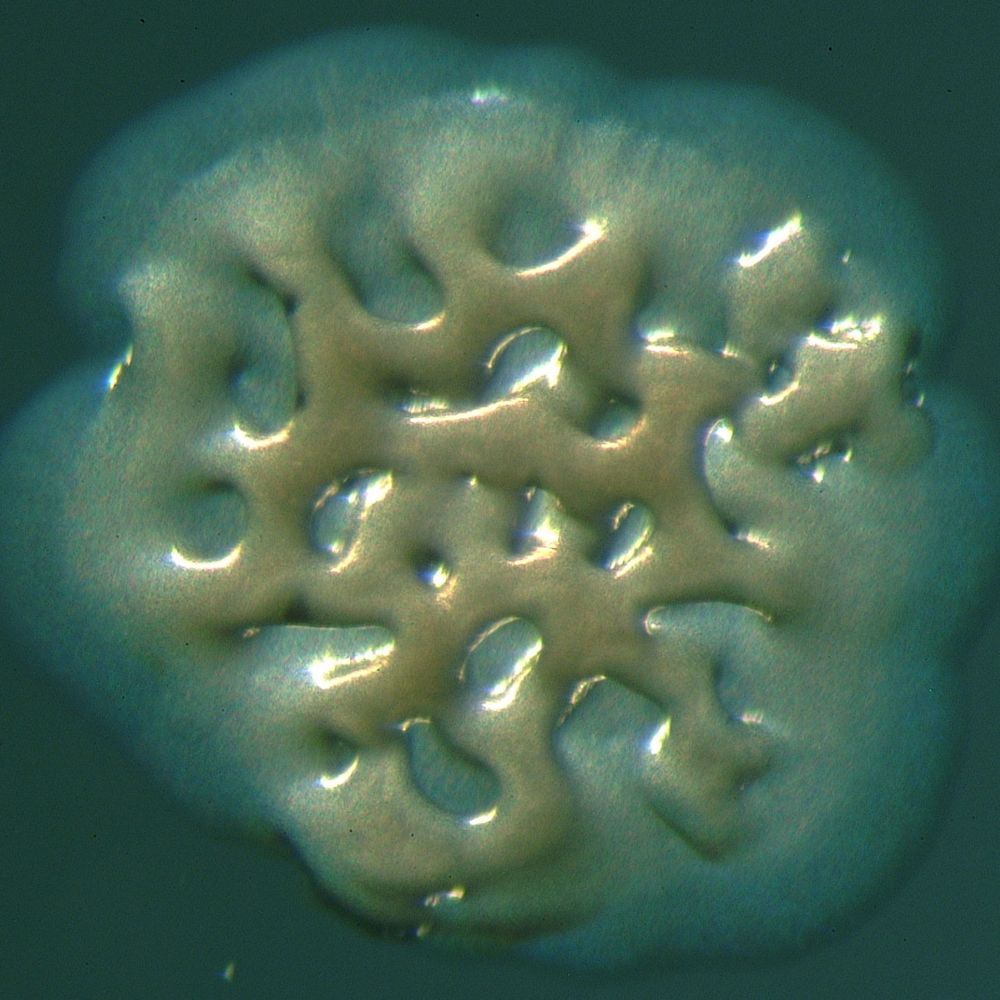
Pseudomonas aeruginosa isolates sourced from infection are often not blue/green pigment producers. Textbooks might tell you something different.

December 16, 2025 at 6:51 PM
Pseudomonas aeruginosa isolates sourced from infection are often not blue/green pigment producers. Textbooks might tell you something different.
Reposted by Steve Diggle
A bacterial predator, Halobacteriovorax, acts as a living "probiotic" that halts Vibrio-induced disease progression in endangered Caribbean corals. This shows microbial predators are promising new tools for coral disease therapy! #CoralReefs #MicrobialEcology #ISMEJ academic.oup.com/ismej/advanc...

Halobacteriovorax halts disease progression in endangered Caribbean corals
Abstract. Predation is a top-down regulator of ecosystem integrity and a key driver of community structure and evolution in plants and animals. Despite our
academic.oup.com
December 16, 2025 at 4:42 PM
A bacterial predator, Halobacteriovorax, acts as a living "probiotic" that halts Vibrio-induced disease progression in endangered Caribbean corals. This shows microbial predators are promising new tools for coral disease therapy! #CoralReefs #MicrobialEcology #ISMEJ academic.oup.com/ismej/advanc...
Reposted by Steve Diggle
R-pyocins, phage tail-like complexes, act as highly specific weapons against susceptible strains. Their non-replicative and potent nature makes them a prime candidate for next-generation antimicrobials against drug-resistant infections! #Microbiology www.microbiologyresearch.org/content/jour...

Microbial Primer: The R-pyocins of Pseudomonas aeruginosa
R-pyocins are phage tail-like protein complexes produced by Pseudomonas aeruginosa that deliver a single, lethal hit by depolarizing the target cell membrane. Unlike phages, R-pyocins lack capsids and...
www.microbiologyresearch.org
December 16, 2025 at 4:45 PM
R-pyocins, phage tail-like complexes, act as highly specific weapons against susceptible strains. Their non-replicative and potent nature makes them a prime candidate for next-generation antimicrobials against drug-resistant infections! #Microbiology www.microbiologyresearch.org/content/jour...