



Bouwe Reijenga
@breijenga.bsky.social
(Macro)evolutionary biologist • postdoc @OxUniEarthSci
from fossils, phylogenies and theory to community assembly and diversification trends
from fossils, phylogenies and theory to community assembly and diversification trends
Pinned
Bouwe Reijenga
@breijenga.bsky.social
· Mar 26
PNAS
Proceedings of the National Academy of Sciences (PNAS), a peer reviewed journal of the National Academy of Sciences (NAS) - an authoritative source of high-impact, original research that broadly spans...
doi.org
Out now in @pnas.org , we study the recovery dynamics of biodiversity across the Cretaceous–Paleogene mass extinction. We quantify how species-area relationships – how diversity scales with geographic area – have changed for dinosaurs, mammals and others: doi.org/10.1073/pnas...
Reposted by Bouwe Reijenga

Our new paper presents a framework for analysing the processes that generate novel ecosystems, discussing different conceptual and practical approaches across ecological disciplines. You can read it, open access, in @methodsinecoevol.bsky.social
besjournals.onlinelibrary.wiley.com/doi/10.1111/...
besjournals.onlinelibrary.wiley.com/doi/10.1111/...

The making of novel ecosystems: A process‐based framework for measurement, analysis and application
Ecological novelty is emerging rapidly due to global change drivers such as climate shifts, species introductions, defaunation, and land-use transformation. These changes challenge how we assess, ...
besjournals.onlinelibrary.wiley.com
February 12, 2026 at 9:49 AM
Our new paper presents a framework for analysing the processes that generate novel ecosystems, discussing different conceptual and practical approaches across ecological disciplines. You can read it, open access, in @methodsinecoevol.bsky.social
besjournals.onlinelibrary.wiley.com/doi/10.1111/...
besjournals.onlinelibrary.wiley.com/doi/10.1111/...
Reposted by Bouwe Reijenga

In #GENETICS, @hildeschneemann.bsky.social and John Welch introduce a simple fitness landscape model to predict hybrid fitness with arbitrary ploidy and an arbitrary number of hybridizing lineages using data from #maize and rye. buff.ly/E24fZsM

February 2, 2026 at 2:02 PM
In #GENETICS, @hildeschneemann.bsky.social and John Welch introduce a simple fitness landscape model to predict hybrid fitness with arbitrary ploidy and an arbitrary number of hybridizing lineages using data from #maize and rye. buff.ly/E24fZsM
Reposted by Bouwe Reijenga

On March 3rd @ 5pm CET, we are re-starting the Integration of speciation seminar series! The first 3 sessions feature talks by *Early-Career Researchers*, and include a Q&A with an established PI about their career path.
Sign up to get the link: speciation-network.pages.ist.ac.at/seminar-seri...
Sign up to get the link: speciation-network.pages.ist.ac.at/seminar-seri...

February 9, 2026 at 3:40 PM
On March 3rd @ 5pm CET, we are re-starting the Integration of speciation seminar series! The first 3 sessions feature talks by *Early-Career Researchers*, and include a Q&A with an established PI about their career path.
Sign up to get the link: speciation-network.pages.ist.ac.at/seminar-seri...
Sign up to get the link: speciation-network.pages.ist.ac.at/seminar-seri...
Reposted by Bouwe Reijenga

I am looking for a PhD student to join my new Socio-Eco-Evo group, hosted in Katie Peichel's Evolutionary Ecology Division @ University of Bern. We're offering a fully funded 4-year position, studying social plasticity and behavioral adaptation among stickleback in Greenland. Please share around!

February 2, 2026 at 12:01 PM
I am looking for a PhD student to join my new Socio-Eco-Evo group, hosted in Katie Peichel's Evolutionary Ecology Division @ University of Bern. We're offering a fully funded 4-year position, studying social plasticity and behavioral adaptation among stickleback in Greenland. Please share around!
Reposted by Bouwe Reijenga
New paper out with a combo of empirical patterns and theoretical models to propose a new ecological mechanism undelying body size evolution rdcu.be/e06Vt

Diverging selection on body size in specialist terrestrial mammals
Nature Ecology & Evolution - A comparative analysis of trait data combined with a mathematical model suggests that dietary specialization drives selection towards the smallest and largest body...
rdcu.be
January 28, 2026 at 9:01 PM
New paper out with a combo of empirical patterns and theoretical models to propose a new ecological mechanism undelying body size evolution rdcu.be/e06Vt
Reposted by Bouwe Reijenga

If you’re interested in extinction risk, please check out our new paper in @science.org led by my former PhD student Cooper: www.science.org/doi/full/10....

January 16, 2026 at 9:39 AM
If you’re interested in extinction risk, please check out our new paper in @science.org led by my former PhD student Cooper: www.science.org/doi/full/10....
Reposted by Bouwe Reijenga

New paper out: “allopatric” Drosophila species aren’t so allopatric after all. We show that most currently allopatric species pairs probably overlapped in the past and exchanged genes at levels similar to sympatric pairs. @evolletters.bsky.social
doi.org/10.1093/evle... [1/6]
doi.org/10.1093/evle... [1/6]

Genomic analyses in Drosophila do not support the classic allopatric model of speciation
Abstract. The allopatric model of speciation has dominated our understanding of speciation biology and biogeography since the Modern Synthesis. It is uncon
doi.org
January 15, 2026 at 11:58 AM
New paper out: “allopatric” Drosophila species aren’t so allopatric after all. We show that most currently allopatric species pairs probably overlapped in the past and exchanged genes at levels similar to sympatric pairs. @evolletters.bsky.social
doi.org/10.1093/evle... [1/6]
doi.org/10.1093/evle... [1/6]
Reposted by Bouwe Reijenga

🚨 New paper out in @ecography.bsky.social ! 📝
Led by Dr. Søren Faurby, we built upon the estimated unrecorded bird extinctions by @r-cooke.bsky.social et al. 2023 and try to estimate the corresponding unrecorded loss of phylogenetic diversity. 🦤🧬
Check the full paper here:
doi.org/10.1002/ecog...
Led by Dr. Søren Faurby, we built upon the estimated unrecorded bird extinctions by @r-cooke.bsky.social et al. 2023 and try to estimate the corresponding unrecorded loss of phylogenetic diversity. 🦤🧬
Check the full paper here:
doi.org/10.1002/ecog...

Quantifying the unrecorded loss of avian phylogenetic diversity
Humans have drastically reduced avian diversity, with the majority of extinctions occurring on islands. Previous studies have quantified various aspects of this decline, including both taxonomic and ...
doi.org
January 13, 2026 at 10:53 AM
🚨 New paper out in @ecography.bsky.social ! 📝
Led by Dr. Søren Faurby, we built upon the estimated unrecorded bird extinctions by @r-cooke.bsky.social et al. 2023 and try to estimate the corresponding unrecorded loss of phylogenetic diversity. 🦤🧬
Check the full paper here:
doi.org/10.1002/ecog...
Led by Dr. Søren Faurby, we built upon the estimated unrecorded bird extinctions by @r-cooke.bsky.social et al. 2023 and try to estimate the corresponding unrecorded loss of phylogenetic diversity. 🦤🧬
Check the full paper here:
doi.org/10.1002/ecog...
Reposted by Bouwe Reijenga

Excited about our new preprint showing bidirectional adaptive introgression between invasive and native crop pests over ecological timescales www.biorxiv.org/content/10.6...

The collision of two genomes threatens global food security
Human activity alters selection pressures and species' ranges, creating opportunities for hybridisation through secondary contact. Ancient hybridization has enabled adaptive radiation, but its role in...
www.biorxiv.org
December 26, 2025 at 11:21 AM
Excited about our new preprint showing bidirectional adaptive introgression between invasive and native crop pests over ecological timescales www.biorxiv.org/content/10.6...
Reposted by Bouwe Reijenga

Our paper in the PNAS Special Feature on 🐕 is out!
We demonstrated the accuracy of imputing ancient canid genomes, looked at inbreeding levels over the past 10,000 years and found genomic regions resistant to ROH which were enriched for immunity and chemosensory genes.
www.pnas.org/doi/10.1073/...
We demonstrated the accuracy of imputing ancient canid genomes, looked at inbreeding levels over the past 10,000 years and found genomic regions resistant to ROH which were enriched for immunity and chemosensory genes.
www.pnas.org/doi/10.1073/...

Imputation of ancient canid genomes reveals inbreeding history over the past 10,000 years | PNAS
The multi-millennia-long history between dogs and humans has placed them at the forefront
of archaeological and genomic research. Despite ongoing e...
www.pnas.org
December 1, 2025 at 11:00 AM
Our paper in the PNAS Special Feature on 🐕 is out!
We demonstrated the accuracy of imputing ancient canid genomes, looked at inbreeding levels over the past 10,000 years and found genomic regions resistant to ROH which were enriched for immunity and chemosensory genes.
www.pnas.org/doi/10.1073/...
We demonstrated the accuracy of imputing ancient canid genomes, looked at inbreeding levels over the past 10,000 years and found genomic regions resistant to ROH which were enriched for immunity and chemosensory genes.
www.pnas.org/doi/10.1073/...
Reposted by Bouwe Reijenga

Cool paper on rate-time scaling: it’s not just an artifact! We need to re-think underlying evolutionary processes generating (fossil) phenotypic changes! By @vildebruhn.bsky.social @kjetillsj.bsky.social


November 13, 2025 at 11:38 AM
Cool paper on rate-time scaling: it’s not just an artifact! We need to re-think underlying evolutionary processes generating (fossil) phenotypic changes! By @vildebruhn.bsky.social @kjetillsj.bsky.social
Reposted by Bouwe Reijenga

How time, climate, and storage shape DNA survival in herbarium specimens - and why plants from the tropics face tougher odds 🌿🧬
#AncientDNA
www.biorxiv.org/content/10.1...
#AncientDNA
www.biorxiv.org/content/10.1...

November 4, 2025 at 8:32 PM
How time, climate, and storage shape DNA survival in herbarium specimens - and why plants from the tropics face tougher odds 🌿🧬
#AncientDNA
www.biorxiv.org/content/10.1...
#AncientDNA
www.biorxiv.org/content/10.1...
Reposted by Bouwe Reijenga

How does life evolve to adapt to modern cities?
Out now in Science, my PhD work with @lindymcbr.bsky.social uncovers the ancient origin of the “London Underground mosquito” – one of the most iconic examples of urban adaptation.
🧵(1/n)
@science.org
www.science.org/doi/10.1126/science.ady4515
Out now in Science, my PhD work with @lindymcbr.bsky.social uncovers the ancient origin of the “London Underground mosquito” – one of the most iconic examples of urban adaptation.
🧵(1/n)
@science.org
www.science.org/doi/10.1126/science.ady4515

Ancient origin of an urban underground mosquito
Understanding how life is adapting to urban environments represents an important challenge in evolutionary biology. In this work, we investigate a widely cited example of urban adaptation, Culex pipie...
www.science.org
October 25, 2025 at 4:46 AM
How does life evolve to adapt to modern cities?
Out now in Science, my PhD work with @lindymcbr.bsky.social uncovers the ancient origin of the “London Underground mosquito” – one of the most iconic examples of urban adaptation.
🧵(1/n)
@science.org
www.science.org/doi/10.1126/science.ady4515
Out now in Science, my PhD work with @lindymcbr.bsky.social uncovers the ancient origin of the “London Underground mosquito” – one of the most iconic examples of urban adaptation.
🧵(1/n)
@science.org
www.science.org/doi/10.1126/science.ady4515
Reposted by Bouwe Reijenga

Reposted by Bouwe Reijenga

Excited to share our new paper where we find that the rise, decline and fall of clades is not explained by the usual suspects (diversity-dependence, ecological opportunities) but rather by species' insidious loss of macroevolutionary fitness: www.nature.com/articles/s41... 1/3

Loss of macroevolutionary species fitness explains the rise and fall of clades - Nature Ecology & Evolution
The interplay between speciation and extinction rates shapes clade diversity dynamics. Using a novel phylogenetic model that includes living and fossil lineages, the authors estimate speciation and ex...
www.nature.com
October 17, 2025 at 9:12 AM
Excited to share our new paper where we find that the rise, decline and fall of clades is not explained by the usual suspects (diversity-dependence, ecological opportunities) but rather by species' insidious loss of macroevolutionary fitness: www.nature.com/articles/s41... 1/3
Reposted by Bouwe Reijenga

Human impacts on large mammals went well beyond triggering late Quaternary mass extinctions. A new paper by Brook et al. showing that biogeographic patterns were erased by the spread of domesticated species:
royalsocietypublishing.org/doi/10.1098/...
A related paper is in press. Stay tuned.
royalsocietypublishing.org/doi/10.1098/...
A related paper is in press. Stay tuned.
August 13, 2025 at 3:28 AM
Human impacts on large mammals went well beyond triggering late Quaternary mass extinctions. A new paper by Brook et al. showing that biogeographic patterns were erased by the spread of domesticated species:
royalsocietypublishing.org/doi/10.1098/...
A related paper is in press. Stay tuned.
royalsocietypublishing.org/doi/10.1098/...
A related paper is in press. Stay tuned.
"The genomics of discrete polymorphisms maintained by disruptive selection"
www.cell.com/trends/ecolo...
www.cell.com/trends/ecolo...

The genomics of discrete polymorphisms maintained by disruptive selection
Disruptive selection can lead to the evolution of discrete morphs. We show that particular
genetic architectures, in terms of dominance, epistasis, and linkage, are likely to
evolve to produce discret...
www.cell.com
September 15, 2025 at 10:39 PM
"The genomics of discrete polymorphisms maintained by disruptive selection"
www.cell.com/trends/ecolo...
www.cell.com/trends/ecolo...
Reposted by Bouwe Reijenga

Hybridization and introgression are major evolutionary processes. Since the 1940s, the prevailing view has been that they shape plants far more than animals. In our new study (www.science.org/doi/10.1126/...
), we find the opposite: animals exchange genes more, and for longer, than plants
), we find the opposite: animals exchange genes more, and for longer, than plants

September 12, 2025 at 7:55 AM
Hybridization and introgression are major evolutionary processes. Since the 1940s, the prevailing view has been that they shape plants far more than animals. In our new study (www.science.org/doi/10.1126/...
), we find the opposite: animals exchange genes more, and for longer, than plants
), we find the opposite: animals exchange genes more, and for longer, than plants
Reposted by Bouwe Reijenga

Extreme climate events can catalyze rapid evolutionary change! in our new Current Biology (@currentbiology.bsky.social) piece, Colin and I argue it’s time to study their evolutionary consequences systematically — beyond opportunistic observations. www.cell.com/current-biol...

Evolutionary consequences of extreme climate events
Simon Baeckens and Colin Donihue review case studies of rapid evolutionary change
in response to extreme climate events and sketch a framework for future studies in
the rapidly changing climate of the...
www.cell.com
September 8, 2025 at 7:17 PM
Extreme climate events can catalyze rapid evolutionary change! in our new Current Biology (@currentbiology.bsky.social) piece, Colin and I argue it’s time to study their evolutionary consequences systematically — beyond opportunistic observations. www.cell.com/current-biol...
Reposted by Bouwe Reijenga

Check out our perceptive on the Emerging uses of artificial intelligence in deep time biodiversity research www.nature.com/articles/s44...
#AI #paleontology
#AI #paleontology

Emerging uses of artificial intelligence in deep time biodiversity research - Nature Reviews Biodiversity
This Perspective explores the existing and potential applications of artificial intelligence in deep time biodiversity research as well as offer guidelines on equitable and ethical use of artificial i...
www.nature.com
August 11, 2025 at 7:51 AM
Check out our perceptive on the Emerging uses of artificial intelligence in deep time biodiversity research www.nature.com/articles/s44...
#AI #paleontology
#AI #paleontology
Reposted by Bouwe Reijenga

Our paper, led by Eva van der Heijden, shows the work of an international team combining phylogenomics, hybridisation tests, population and comparative genomics and pheromone analyses to resolve the taxonomy and evolution of two rapid radiations of glasswing butterflies. www.pnas.org/doi/10.1073/...
PNAS
Proceedings of the National Academy of Sciences (PNAS), a peer reviewed journal of the National Academy of Sciences (NAS) - an authoritative source of high-impact, original research that broadly spans...
www.pnas.org
July 30, 2025 at 7:28 PM
Our paper, led by Eva van der Heijden, shows the work of an international team combining phylogenomics, hybridisation tests, population and comparative genomics and pheromone analyses to resolve the taxonomy and evolution of two rapid radiations of glasswing butterflies. www.pnas.org/doi/10.1073/...
Reposted by Bouwe Reijenga

🚨 The New Age of global bird phylogenies continues!
Hot on the heels of the fantastic updated tree created by @eliotmiller.bsky.social and others, we use a different approach to generate a near-comprehensive timetree of >9000 bird species. 1/3
www.cell.com/current-biol...
🧪🌐🪶
Hot on the heels of the fantastic updated tree created by @eliotmiller.bsky.social and others, we use a different approach to generate a near-comprehensive timetree of >9000 bird species. 1/3
www.cell.com/current-biol...
🧪🌐🪶
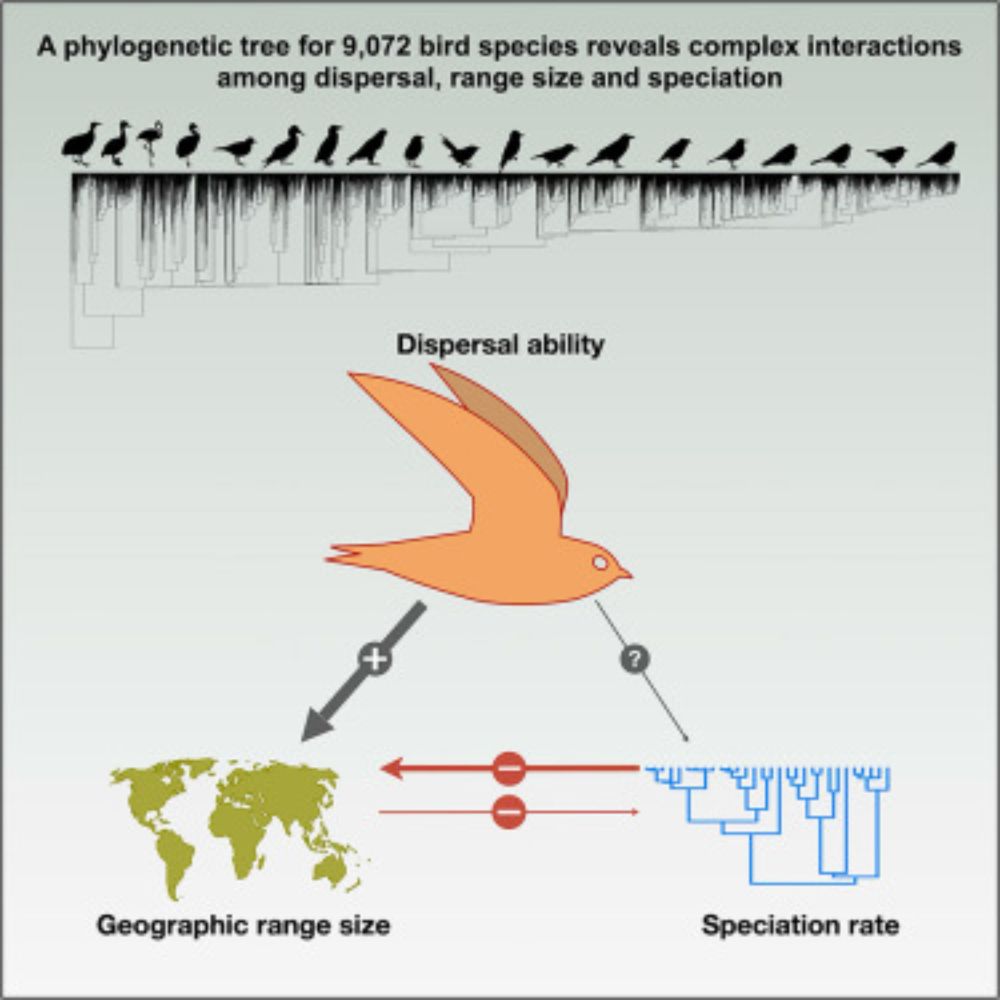
A new time tree of birds reveals the interplay between dispersal, geographic range size, and diversification
Flight may affect the dispersal and evolution of birds. Using a new evolutionary tree,
Claramunt et al. find that efficient fliers have broader geographic ranges, and speciation
reduces range size, bu...
www.cell.com
July 30, 2025 at 3:43 PM
🚨 The New Age of global bird phylogenies continues!
Hot on the heels of the fantastic updated tree created by @eliotmiller.bsky.social and others, we use a different approach to generate a near-comprehensive timetree of >9000 bird species. 1/3
www.cell.com/current-biol...
🧪🌐🪶
Hot on the heels of the fantastic updated tree created by @eliotmiller.bsky.social and others, we use a different approach to generate a near-comprehensive timetree of >9000 bird species. 1/3
www.cell.com/current-biol...
🧪🌐🪶
Reposted by Bouwe Reijenga

New paper out today in @pnas.org presenting near-complete phylogeny of the Grevilleoideae subfamily of Proteaceae plants, representing years of work and huge collaboration from an amazing team - ft. @marcelcardillo.bsky.social @hsauquet.bsky.social @austinmast.bsky.social and many others not on bsky

July 15, 2025 at 11:59 PM
New paper out today in @pnas.org presenting near-complete phylogeny of the Grevilleoideae subfamily of Proteaceae plants, representing years of work and huge collaboration from an amazing team - ft. @marcelcardillo.bsky.social @hsauquet.bsky.social @austinmast.bsky.social and many others not on bsky
Reposted by Bouwe Reijenga

the current rate of extinction, as estimated by ourselves and others, whom we cited, and across diverse major taxa, we may well be headed in the direction of a new mass extinction event
www.cell.com/trends/ecolo... 🌐🧪
www.cell.com/trends/ecolo... 🌐🧪

Denying that we may be experiencing the start of the Sixth Mass Extinction paves the way for it to happen
Arguing that we are not currently experiencing a Sixth Mass Extinction, or at least
playing down its possibility, gives support to those who would happily allow it to
happen. Wiens and Saban [1], in a...
www.cell.com
July 16, 2025 at 7:02 AM
the current rate of extinction, as estimated by ourselves and others, whom we cited, and across diverse major taxa, we may well be headed in the direction of a new mass extinction event
www.cell.com/trends/ecolo... 🌐🧪
www.cell.com/trends/ecolo... 🌐🧪