



Bouwe Reijenga
@breijenga.bsky.social
(Macro)evolutionary biologist • postdoc @OxUniEarthSci
from fossils, phylogenies and theory to community assembly and diversification trends
from fossils, phylogenies and theory to community assembly and diversification trends
Meta-analysis reveals that phenotypic plasticity and divergent selection promote reproductive isolation during incipient speciation
www.nature.com/articles/s41...
#evobio #speciation 🧪
www.nature.com/articles/s41...
#evobio #speciation 🧪

May 7, 2025 at 4:20 PM
Meta-analysis reveals that phenotypic plasticity and divergent selection promote reproductive isolation during incipient speciation
www.nature.com/articles/s41...
#evobio #speciation 🧪
www.nature.com/articles/s41...
#evobio #speciation 🧪
Cool paper by @cocomacro.bsky.social et al. showing the diverse diversification history of hymenoptera in the fossil record!
doi.org/10.1016/j.cu...
#macroevolution #evolution #paleobiology @morethanadodo.bsky.social
doi.org/10.1016/j.cu...
#macroevolution #evolution #paleobiology @morethanadodo.bsky.social

March 28, 2025 at 11:15 AM
Cool paper by @cocomacro.bsky.social et al. showing the diverse diversification history of hymenoptera in the fossil record!
doi.org/10.1016/j.cu...
#macroevolution #evolution #paleobiology @morethanadodo.bsky.social
doi.org/10.1016/j.cu...
#macroevolution #evolution #paleobiology @morethanadodo.bsky.social
Only millions of years later in the Selandian and Thanetian, the intercept and local diversity increase and remain stable throughout and in the Ypressian.

March 26, 2025 at 3:09 PM
Only millions of years later in the Selandian and Thanetian, the intercept and local diversity increase and remain stable throughout and in the Ypressian.
Immediately Post-K/Pg in the Danian, and perhaps contrasting ideas of broadly ranging disaster taxa, the SAR slope and therefore turnover and regionalisation of biota appears to increase dramatically.

March 26, 2025 at 3:09 PM
Immediately Post-K/Pg in the Danian, and perhaps contrasting ideas of broadly ranging disaster taxa, the SAR slope and therefore turnover and regionalisation of biota appears to increase dramatically.
Pre-K/Pg in the Maastrichtian, we find that terrestrial tetrapods in general show a decline in regional diversity and turnover across space. The decrease in regional diversity is driven by a decrease in intercept for nonavian dinosaurs, but all groups such as mammals show a decrease in slope.

March 26, 2025 at 3:09 PM
Pre-K/Pg in the Maastrichtian, we find that terrestrial tetrapods in general show a decline in regional diversity and turnover across space. The decrease in regional diversity is driven by a decrease in intercept for nonavian dinosaurs, but all groups such as mammals show a decrease in slope.
We quantify how SARs have changed across six geological stages level for terrestrial tetrapods. Results are validated with spatially explicit neutral models to access our ability to infer SARs correctly. However, we repeat our analysis for NALMAs and find qualitatively identical results.

March 26, 2025 at 3:09 PM
We quantify how SARs have changed across six geological stages level for terrestrial tetrapods. Results are validated with spatially explicit neutral models to access our ability to infer SARs correctly. However, we repeat our analysis for NALMAs and find qualitatively identical results.
Species-area relationships (SARs) are a ubiquitous phenomenon in ecology but have rarely been studied in the fossil record. The form of SARs contains rich information about the link between local and regional-scale richness.

March 26, 2025 at 3:09 PM
Species-area relationships (SARs) are a ubiquitous phenomenon in ecology but have rarely been studied in the fossil record. The form of SARs contains rich information about the link between local and regional-scale richness.
Perhaps unique among mass extinctions, the K/Pg event catalysed a rapid net increase in diversity, increasing the equilibrial diversity of terrestrial tetrapods on land. However, whether this is caused by changes in richness locally, or by changes to the spatial scaling of diversity is unclear.

March 26, 2025 at 3:09 PM
Perhaps unique among mass extinctions, the K/Pg event catalysed a rapid net increase in diversity, increasing the equilibrial diversity of terrestrial tetrapods on land. However, whether this is caused by changes in richness locally, or by changes to the spatial scaling of diversity is unclear.
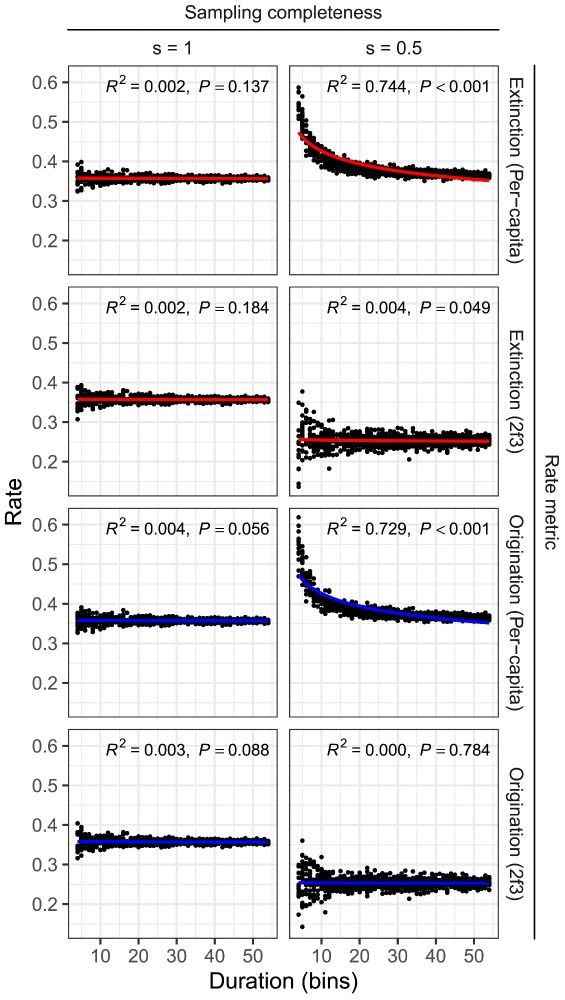
We perform simulations to back up our empirical analysis and show that even minor sample incompleteness can cause rate scaling when not corrected for. This is likely due to error in the estimation of rates in especially short duration clades.
January 24, 2025 at 3:16 PM
We perform simulations to back up our empirical analysis and show that even minor sample incompleteness can cause rate scaling when not corrected for. This is likely due to error in the estimation of rates in especially short duration clades.
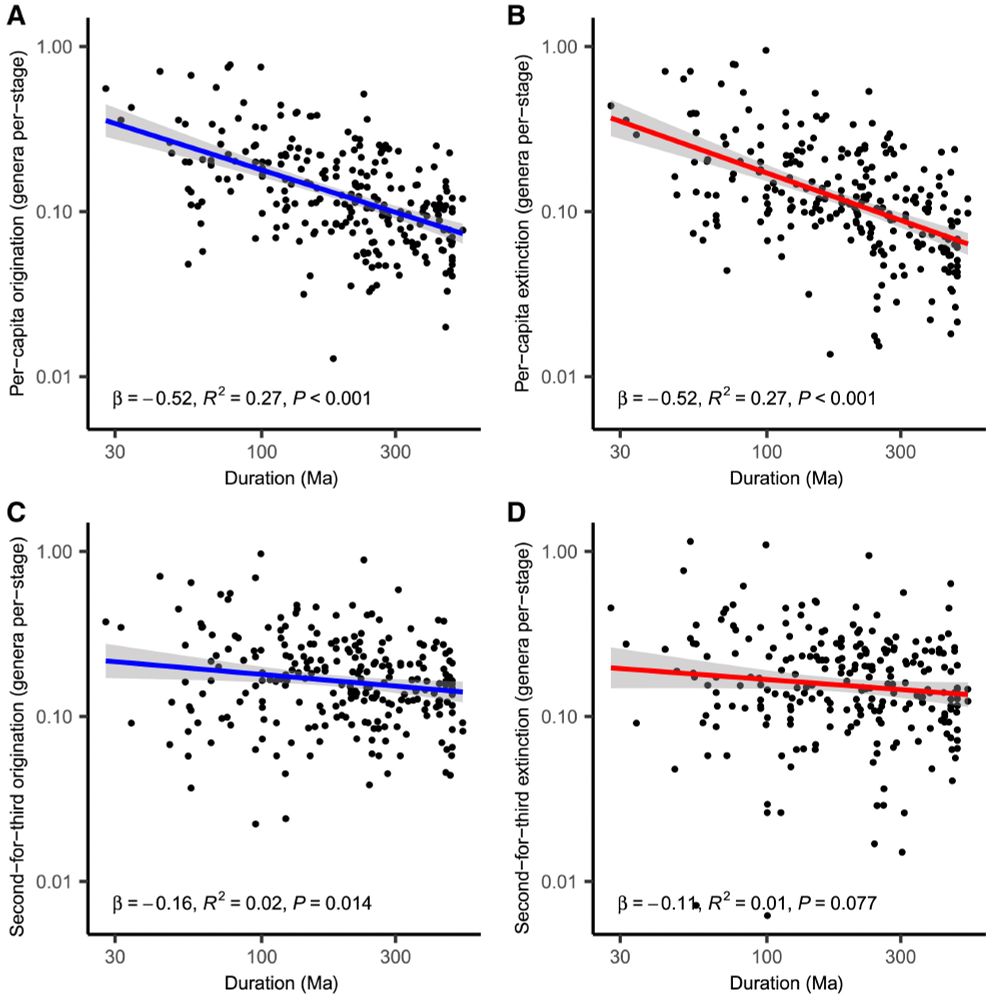
We compiled a @paleodb.bsky.social dataset of 408 marine orders across the Phanerozoic (~538.8 Ma - now) and show that rate scaling arises under age range-based metrics (A,B), but are absent or severly reduced when using metrics controlling for the incompleteness of the fossil record (C,D)
January 24, 2025 at 3:16 PM
We compiled a @paleodb.bsky.social dataset of 408 marine orders across the Phanerozoic (~538.8 Ma - now) and show that rate scaling arises under age range-based metrics (A,B), but are absent or severly reduced when using metrics controlling for the incompleteness of the fossil record (C,D)
We back up our empirical analysis with simple simulations that show that even with uniform, moderate but incomplete sampling, rate scaling is introduced

September 16, 2024 at 4:47 PM
We back up our empirical analysis with simple simulations that show that even with uniform, moderate but incomplete sampling, rate scaling is introduced
The fossil record is far from complete, and ignoring this could lead to several sampling artefacts. We show that if uneven sampling is corrected for, rate-scaling largely disappears in the Phanerozoic marine fossil record (bottom row)

September 16, 2024 at 4:47 PM
The fossil record is far from complete, and ignoring this could lead to several sampling artefacts. We show that if uneven sampling is corrected for, rate-scaling largely disappears in the Phanerozoic marine fossil record (bottom row)
New pre-print on the presence of negative scaling between diversification rates and the duration of clades. Various explanations, such as incongruence between micro- and macroevolution, have been put forward based on molecular phylogenies, but the fossil record has been ignored

September 16, 2024 at 4:46 PM
New pre-print on the presence of negative scaling between diversification rates and the duration of clades. Various explanations, such as incongruence between micro- and macroevolution, have been put forward based on molecular phylogenies, but the fossil record has been ignored