



Andrea Botteon
@andreabotteon.bsky.social
Astrophysicist at INAF-IRA. Previously at UniBologna and UniLeiden. Mainly dealing with colliding galaxy clusters, merger shocks and their radio outcome.
Pinned
Andrea Botteon
@andreabotteon.bsky.social
· Sep 19

New paper alert! We studied a galaxy cluster pair with @SKA_Africa MeerKAT UHF and @NCRA_Outreach uGMRT band 3 data and found diffuse emission between the two clusters! 1/7
arxiv.org/abs/2509.14348
arxiv.org/abs/2509.14348
A radio relic mimicking a radio halo? by @paola-dominguez.bsky.social+ (w/ @jzuhone.bsky.social @emstar.bsky.social myself+)
This could be the case of MACSJ0018.5+1626, where numerical simulations show that the radio emission could be due to a relic seen face-on
arxiv.org/abs/2602.05050
This could be the case of MACSJ0018.5+1626, where numerical simulations show that the radio emission could be due to a relic seen face-on
arxiv.org/abs/2602.05050

February 6, 2026 at 9:34 AM
A radio relic mimicking a radio halo? by @paola-dominguez.bsky.social+ (w/ @jzuhone.bsky.social @emstar.bsky.social myself+)
This could be the case of MACSJ0018.5+1626, where numerical simulations show that the radio emission could be due to a relic seen face-on
arxiv.org/abs/2602.05050
This could be the case of MACSJ0018.5+1626, where numerical simulations show that the radio emission could be due to a relic seen face-on
arxiv.org/abs/2602.05050
Radio observations A1775 and A1795, by vanWeeren+ (w/ @cjriseley.bsky.social, @rtimmerman.bsky.social, myself+)
MeerKAT @SKA_Africa recovers the known diffuse emission in both systems. Interestingly, the large-scale halo in A1795 is compatible with a hardonic origin...
arxiv.org/abs/2601.16288
MeerKAT @SKA_Africa recovers the known diffuse emission in both systems. Interestingly, the large-scale halo in A1795 is compatible with a hardonic origin...
arxiv.org/abs/2601.16288


January 26, 2026 at 7:21 AM
Radio observations A1775 and A1795, by vanWeeren+ (w/ @cjriseley.bsky.social, @rtimmerman.bsky.social, myself+)
MeerKAT @SKA_Africa recovers the known diffuse emission in both systems. Interestingly, the large-scale halo in A1795 is compatible with a hardonic origin...
arxiv.org/abs/2601.16288
MeerKAT @SKA_Africa recovers the known diffuse emission in both systems. Interestingly, the large-scale halo in A1795 is compatible with a hardonic origin...
arxiv.org/abs/2601.16288
New study of two merging galaxy clusters, by Srikanth+ (w/ myself, @roxycas++)
@LOFAR, GMRT, and @ESA_XMM observations are combined to investigate the nature of the diffuse emission in A773 and A1351.
Congrats to Koushika on her first paper!
arxiv.org/abs/2601.13316
@LOFAR, GMRT, and @ESA_XMM observations are combined to investigate the nature of the diffuse emission in A773 and A1351.
Congrats to Koushika on her first paper!
arxiv.org/abs/2601.13316

January 21, 2026 at 7:40 AM
New study of two merging galaxy clusters, by Srikanth+ (w/ myself, @roxycas++)
@LOFAR, GMRT, and @ESA_XMM observations are combined to investigate the nature of the diffuse emission in A773 and A1351.
Congrats to Koushika on her first paper!
arxiv.org/abs/2601.13316
@LOFAR, GMRT, and @ESA_XMM observations are combined to investigate the nature of the diffuse emission in A773 and A1351.
Congrats to Koushika on her first paper!
arxiv.org/abs/2601.13316
Pick your favorite "dot"

January 16, 2026 at 7:25 AM
Pick your favorite "dot"
What comes after paper I? Paper II! Still led by @e_derubeis
In the new paper, a more detailed investigation about the origin of the filaments is done by combining LOFAR @astronnl.bsky.social data with new uGMRT and VLA observations at higher frequency
arxiv.org/abs/2512.19471
In the new paper, a more detailed investigation about the origin of the filaments is done by combining LOFAR @astronnl.bsky.social data with new uGMRT and VLA observations at higher frequency
arxiv.org/abs/2512.19471


December 23, 2025 at 8:09 AM
What comes after paper I? Paper II! Still led by @e_derubeis
In the new paper, a more detailed investigation about the origin of the filaments is done by combining LOFAR @astronnl.bsky.social data with new uGMRT and VLA observations at higher frequency
arxiv.org/abs/2512.19471
In the new paper, a more detailed investigation about the origin of the filaments is done by combining LOFAR @astronnl.bsky.social data with new uGMRT and VLA observations at higher frequency
arxiv.org/abs/2512.19471
Paper accepted for publication in @aanda-journal.bsky.social! You can find the accepted version in today's replacements on arXiv (arxiv.org/abs/2509.14348). The only notable update is that we left the merger scenario open, as we are not sure if the clusters are observed pre or post collision
New paper alert! We studied a galaxy cluster pair with @SKA_Africa MeerKAT UHF and @NCRA_Outreach uGMRT band 3 data and found diffuse emission between the two clusters! 1/7
arxiv.org/abs/2509.14348
arxiv.org/abs/2509.14348
December 10, 2025 at 7:23 AM
Paper accepted for publication in @aanda-journal.bsky.social! You can find the accepted version in today's replacements on arXiv (arxiv.org/abs/2509.14348). The only notable update is that we left the merger scenario open, as we are not sure if the clusters are observed pre or post collision
A fresh look at Abell 2163, by Santra+ (including myself)
This is one of the hottest, most massive, and brightest cluster in the sky. New uGMRT band 3 and band 4 data are used to study the giant (among the largest!) radio halo hosted in this merging system
arxiv.org/abs/2511.22124
This is one of the hottest, most massive, and brightest cluster in the sky. New uGMRT band 3 and band 4 data are used to study the giant (among the largest!) radio halo hosted in this merging system
arxiv.org/abs/2511.22124


December 1, 2025 at 12:59 PM
A fresh look at Abell 2163, by Santra+ (including myself)
This is one of the hottest, most massive, and brightest cluster in the sky. New uGMRT band 3 and band 4 data are used to study the giant (among the largest!) radio halo hosted in this merging system
arxiv.org/abs/2511.22124
This is one of the hottest, most massive, and brightest cluster in the sky. New uGMRT band 3 and band 4 data are used to study the giant (among the largest!) radio halo hosted in this merging system
arxiv.org/abs/2511.22124
Check for the wonderful science that @axisprobe.bsky.social would enable in the white book uploaded today in arXiv: arxiv.org/abs/2511.00253
I've participated with a chapter on "X-ray and radio surface brightness edges in the ICM", you can find it in the Galaxies GO Science section (page 69)
I've participated with a chapter on "X-ray and radio surface brightness edges in the ICM", you can find it in the Galaxies GO Science section (page 69)

November 4, 2025 at 8:47 AM
Check for the wonderful science that @axisprobe.bsky.social would enable in the white book uploaded today in arXiv: arxiv.org/abs/2511.00253
I've participated with a chapter on "X-ray and radio surface brightness edges in the ICM", you can find it in the Galaxies GO Science section (page 69)
I've participated with a chapter on "X-ray and radio surface brightness edges in the ICM", you can find it in the Galaxies GO Science section (page 69)
News on Abell 754 from @XRISM_jp, by Okabe+ and Omiya+
Combining the gas kinematic from XRISM and WL from Subauru, a new merger scenario is proposed. The "3rd dimension" has been unlocked thanks to XRISM 😀
arxiv.org/abs/2510.16291
arxiv.org/abs/2510.16553
Combining the gas kinematic from XRISM and WL from Subauru, a new merger scenario is proposed. The "3rd dimension" has been unlocked thanks to XRISM 😀
arxiv.org/abs/2510.16291
arxiv.org/abs/2510.16553


October 21, 2025 at 7:54 AM
News on Abell 754 from @XRISM_jp, by Okabe+ and Omiya+
Combining the gas kinematic from XRISM and WL from Subauru, a new merger scenario is proposed. The "3rd dimension" has been unlocked thanks to XRISM 😀
arxiv.org/abs/2510.16291
arxiv.org/abs/2510.16553
Combining the gas kinematic from XRISM and WL from Subauru, a new merger scenario is proposed. The "3rd dimension" has been unlocked thanks to XRISM 😀
arxiv.org/abs/2510.16291
arxiv.org/abs/2510.16553
Reposted by Andrea Botteon

October 16, 2025 at 9:19 AM
Reposted by Andrea Botteon

I also had two papers come out this month! I worked on the first XRISM results from the Perseus cluster and got time on XRISM to observe A1914, which we discovered was undergoing a line-of-sight merger! 🔭


September 25, 2025 at 11:31 PM
I also had two papers come out this month! I worked on the first XRISM results from the Perseus cluster and got time on XRISM to observe A1914, which we discovered was undergoing a line-of-sight merger! 🔭
New paper alert! We studied a galaxy cluster pair with @SKA_Africa MeerKAT UHF and @NCRA_Outreach uGMRT band 3 data and found diffuse emission between the two clusters! 1/7
arxiv.org/abs/2509.14348
arxiv.org/abs/2509.14348
September 19, 2025 at 3:56 AM
New paper alert! We studied a galaxy cluster pair with @SKA_Africa MeerKAT UHF and @NCRA_Outreach uGMRT band 3 data and found diffuse emission between the two clusters! 1/7
arxiv.org/abs/2509.14348
arxiv.org/abs/2509.14348
Aaand the paper has been accepted! The accepted version of the paper was posted on arXiv on Aug 19: arxiv.org/abs/2505.05415
September 3, 2025 at 1:49 PM
Aaand the paper has been accepted! The accepted version of the paper was posted on arXiv on Aug 19: arxiv.org/abs/2505.05415
Low frequency observations of the Ophiuchus cluster, by Giacintucci+
The giant fossil lobe is studied in detail. The new data show steep spectrum filamentary structures embedded in the lobe. The lobe extends up to 820 kpc from the cluster center
arxiv.org/abs/2508.20190
The giant fossil lobe is studied in detail. The new data show steep spectrum filamentary structures embedded in the lobe. The lobe extends up to 820 kpc from the cluster center
arxiv.org/abs/2508.20190

August 29, 2025 at 7:19 AM
Low frequency observations of the Ophiuchus cluster, by Giacintucci+
The giant fossil lobe is studied in detail. The new data show steep spectrum filamentary structures embedded in the lobe. The lobe extends up to 820 kpc from the cluster center
arxiv.org/abs/2508.20190
The giant fossil lobe is studied in detail. The new data show steep spectrum filamentary structures embedded in the lobe. The lobe extends up to 820 kpc from the cluster center
arxiv.org/abs/2508.20190
.@XRISM_jp obs of the Ophiuchus cluster, by Fujita+
A low velocity dispersion is measured in the inner and outer regions (115 km/s at <25kpc, 186 km/s at 25-50 kpc). The same goes for the bulk velocity (8 km/s vs 104 km/s): is the sloshing at its minimum?
arxiv.org/abs/2507.00126
A low velocity dispersion is measured in the inner and outer regions (115 km/s at <25kpc, 186 km/s at 25-50 kpc). The same goes for the bulk velocity (8 km/s vs 104 km/s): is the sloshing at its minimum?
arxiv.org/abs/2507.00126

July 2, 2025 at 6:45 AM
.@XRISM_jp obs of the Ophiuchus cluster, by Fujita+
A low velocity dispersion is measured in the inner and outer regions (115 km/s at <25kpc, 186 km/s at 25-50 kpc). The same goes for the bulk velocity (8 km/s vs 104 km/s): is the sloshing at its minimum?
arxiv.org/abs/2507.00126
A low velocity dispersion is measured in the inner and outer regions (115 km/s at <25kpc, 186 km/s at 25-50 kpc). The same goes for the bulk velocity (8 km/s vs 104 km/s): is the sloshing at its minimum?
arxiv.org/abs/2507.00126
The magnetic field in A2142, by Pagliotta+
A rotation measure and polarization study is performed with MeerKAT. The magnetic field profile of the ICM is drawn, indicating a central field strength of 9.5 muG at the cluster center.
arxiv.org/abs/2507.00114
A rotation measure and polarization study is performed with MeerKAT. The magnetic field profile of the ICM is drawn, indicating a central field strength of 9.5 muG at the cluster center.
arxiv.org/abs/2507.00114

July 2, 2025 at 6:36 AM
The magnetic field in A2142, by Pagliotta+
A rotation measure and polarization study is performed with MeerKAT. The magnetic field profile of the ICM is drawn, indicating a central field strength of 9.5 muG at the cluster center.
arxiv.org/abs/2507.00114
A rotation measure and polarization study is performed with MeerKAT. The magnetic field profile of the ICM is drawn, indicating a central field strength of 9.5 muG at the cluster center.
arxiv.org/abs/2507.00114
MeerKAT observations of CHEX-MATE clusters, by Balboni+ (w/ @annalisa-astro.bsky.social, myself++)
A sample of 21 massive clusters is studied. Diffuse radio emission is detected in all systems (new halos and relics!)
arxiv.org/abs/2507.00133
A sample of 21 massive clusters is studied. Diffuse radio emission is detected in all systems (new halos and relics!)
arxiv.org/abs/2507.00133

July 2, 2025 at 6:33 AM
MeerKAT observations of CHEX-MATE clusters, by Balboni+ (w/ @annalisa-astro.bsky.social, myself++)
A sample of 21 massive clusters is studied. Diffuse radio emission is detected in all systems (new halos and relics!)
arxiv.org/abs/2507.00133
A sample of 21 massive clusters is studied. Diffuse radio emission is detected in all systems (new halos and relics!)
arxiv.org/abs/2507.00133
Reposted by Andrea Botteon

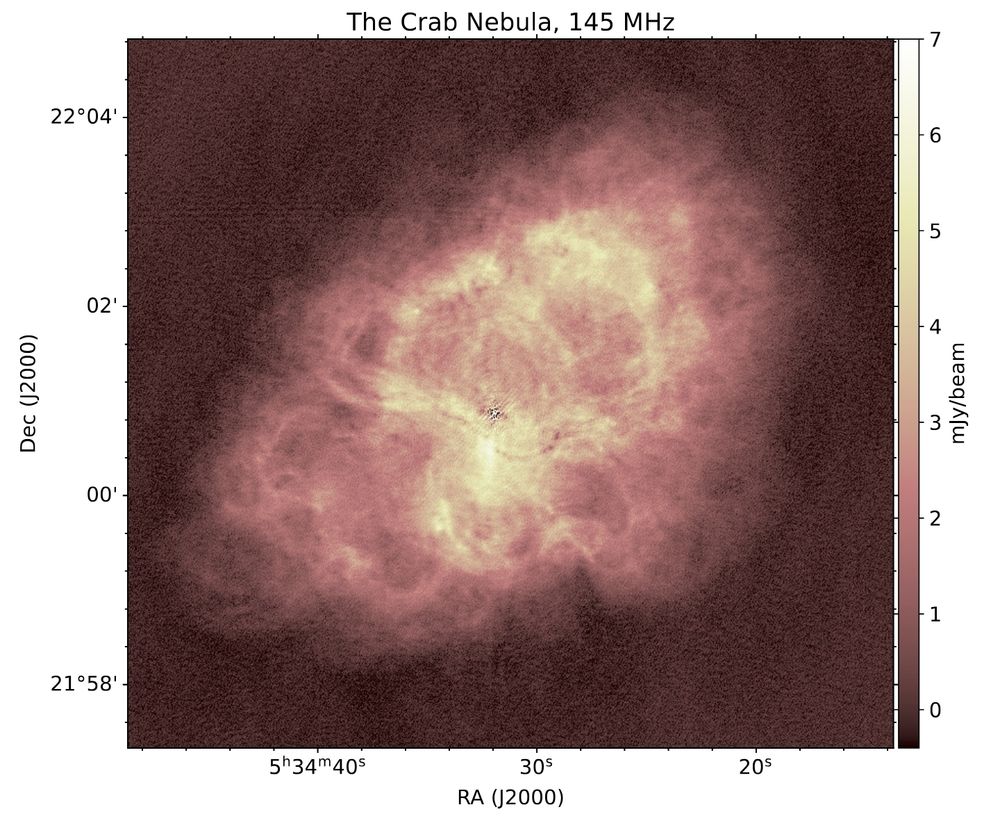
Happy to have been a coauthor on this paper led by Maria Arias and @rtimmerman.bsky.social looking at the crab nebula with the full International #LOFAR Telescope that was put on arxiv yesterday! Lots of nice sub-arcsecond detail is revealed. Go check out the paper on arxiv arxiv.org/abs/2506.19460
June 26, 2025 at 10:08 AM
Happy to have been a coauthor on this paper led by Maria Arias and @rtimmerman.bsky.social looking at the crab nebula with the full International #LOFAR Telescope that was put on arxiv yesterday! Lots of nice sub-arcsecond detail is revealed. Go check out the paper on arxiv arxiv.org/abs/2506.19460
Reposted by Andrea Botteon

📢Paper and press releases day! We report the first-ever unambiguous detection of WHIM/missing baryons in a single cosmic filament using @ESA_XMM
and @JAXA_en
Suzaku data! It's the first time observations agree with LCDM simulations for the nature of WHIM www.aanda.org/articles/aa/...
and @JAXA_en
Suzaku data! It's the first time observations agree with LCDM simulations for the nature of WHIM www.aanda.org/articles/aa/...
Detection of pure warm-hot intergalactic medium emission from a 7.2 Mpc long filament in the Shapley supercluster using X-ray spectroscopy | Astronomy & Astrophysics (A&A)Mendeley
Astronomy & Astrophysics (A&A) is an international journal which publishes papers on all aspects of astronomy and astrophysics
www.aanda.org
June 19, 2025 at 8:33 AM
📢Paper and press releases day! We report the first-ever unambiguous detection of WHIM/missing baryons in a single cosmic filament using @ESA_XMM
and @JAXA_en
Suzaku data! It's the first time observations agree with LCDM simulations for the nature of WHIM www.aanda.org/articles/aa/...
and @JAXA_en
Suzaku data! It's the first time observations agree with LCDM simulations for the nature of WHIM www.aanda.org/articles/aa/...
Reposted by Andrea Botteon

Vanno ad Andrea Botteon e a Massimiliano Parente i due premi da duemila euro ciascuno della Società astronomica italiana consegnati oggi a Firenze. Congratulazioni!

Premi Sait 2025, ecco i vincitori
Polveri interstellari e ammassi di galassie sono al centro delle ricerche premiate quest’anno dalla Società astronomica italiana. Durante la cerimonia tenutasi oggi a Firenze, sono stati assegnati il ...
www.media.inaf.it
June 6, 2025 at 1:16 PM
Vanno ad Andrea Botteon e a Massimiliano Parente i due premi da duemila euro ciascuno della Società astronomica italiana consegnati oggi a Firenze. Congratulazioni!
The central region of A3667 in hard X-rays, by @MSMirakhor+@astroswalker
A @NASANuSTAR observation of the cluster is presented. The spectrum is better described by a 2T thermal model. An updated limit of B > 0.2 muG is provided from the lack of IC emission
arxiv.org/abs/2505.20453
A @NASANuSTAR observation of the cluster is presented. The spectrum is better described by a 2T thermal model. An updated limit of B > 0.2 muG is provided from the lack of IC emission
arxiv.org/abs/2505.20453


May 28, 2025 at 6:12 AM
The central region of A3667 in hard X-rays, by @MSMirakhor+@astroswalker
A @NASANuSTAR observation of the cluster is presented. The spectrum is better described by a 2T thermal model. An updated limit of B > 0.2 muG is provided from the lack of IC emission
arxiv.org/abs/2505.20453
A @NASANuSTAR observation of the cluster is presented. The spectrum is better described by a 2T thermal model. An updated limit of B > 0.2 muG is provided from the lack of IC emission
arxiv.org/abs/2505.20453
Thin filaments in the tails of A2255, by DeRubeis+ (w/ myself, @jurjen93.bsky.social+)
A2255 is known to be a "mess" (arxiv.org/abs/2006.04808). The new @LOFAR-VLBI images add further complexity in the system, this time revealing small-scale structures in its radio galaxies
arxiv.org/abs/2505.13595
A2255 is known to be a "mess" (arxiv.org/abs/2006.04808). The new @LOFAR-VLBI images add further complexity in the system, this time revealing small-scale structures in its radio galaxies
arxiv.org/abs/2505.13595


May 21, 2025 at 6:17 AM
Thin filaments in the tails of A2255, by DeRubeis+ (w/ myself, @jurjen93.bsky.social+)
A2255 is known to be a "mess" (arxiv.org/abs/2006.04808). The new @LOFAR-VLBI images add further complexity in the system, this time revealing small-scale structures in its radio galaxies
arxiv.org/abs/2505.13595
A2255 is known to be a "mess" (arxiv.org/abs/2006.04808). The new @LOFAR-VLBI images add further complexity in the system, this time revealing small-scale structures in its radio galaxies
arxiv.org/abs/2505.13595
Reposted by Andrea Botteon
A day late posting but after a lot of hard work I give you the survey overview papers for the EMU & POSSUM ASKAP surveys #EMU survey arxiv.org/abs/2505.08271 and the #POSSUM survey arxiv.org/abs/2505.08272 🔭

The Evolutionary Map of the Universe: A new radio atlas for the southern hemisphere sky
We present the Evolutionary Map of the Universe (EMU) survey conducted with the Australian Square Kilometre Array Pathfinder (ASKAP). EMU aims to deliver the touchstone radio atlas of the southern hem...
arxiv.org
May 15, 2025 at 12:30 PM
A day late posting but after a lot of hard work I give you the survey overview papers for the EMU & POSSUM ASKAP surveys #EMU survey arxiv.org/abs/2505.08271 and the #POSSUM survey arxiv.org/abs/2505.08272 🔭
Reposted by Andrea Botteon

The cascade of kinetic and magnetic energy from large to small scales in galactic-style turbulence behaves significantly different to the theoretical models that we regularly assume work.
www.nature.com/articles/s41...
Published in @natastron.nature.com
www.nature.com/articles/s41...
Published in @natastron.nature.com

May 13, 2025 at 3:11 PM
The cascade of kinetic and magnetic energy from large to small scales in galactic-style turbulence behaves significantly different to the theoretical models that we regularly assume work.
www.nature.com/articles/s41...
Published in @natastron.nature.com
www.nature.com/articles/s41...
Published in @natastron.nature.com
Radial properties of radio halos, by Rajpurohit+ (w/ myself+)
New radio halos with LLS>2 Mpc are reported, even at high-frequency. We measured the surface brightness and spectral properties of the emission, obtaining important results (more below)
arxiv.org/abs/2505.05415
1/4
New radio halos with LLS>2 Mpc are reported, even at high-frequency. We measured the surface brightness and spectral properties of the emission, obtaining important results (more below)
arxiv.org/abs/2505.05415
1/4


May 9, 2025 at 6:54 AM
Radial properties of radio halos, by Rajpurohit+ (w/ myself+)
New radio halos with LLS>2 Mpc are reported, even at high-frequency. We measured the surface brightness and spectral properties of the emission, obtaining important results (more below)
arxiv.org/abs/2505.05415
1/4
New radio halos with LLS>2 Mpc are reported, even at high-frequency. We measured the surface brightness and spectral properties of the emission, obtaining important results (more below)
arxiv.org/abs/2505.05415
1/4