



Research on atmospheric aerosols w/satellites & models.
Sharing and commenting on papers and sat images of (my) interest
Documenting on #highlatitudedust & #volcanotracks events.
Atmos-ocean exchange processes, Atmos. polarization radiative transfer ..
more
Research on atmospheric aerosols w/satellites & models.
Sharing and commenting on papers and sat images of (my) interest
Documenting on #highlatitudedust & #volcanotracks events.
Atmos-ocean exchange processes, Atmos. polarization radiative transfer
Hello all, there are a lot of new people here so I thought of re-introducing myself. I am a Earth Observation (EO) aerosol scientist contracted to work for the only agency that has put people on the moon.
1/8
Below is an old self-introduction and description of what I have fun with (professionally speaking) .
The times are quite different than when I posted this, but well, we are still here, chugging along and hoping for the best.


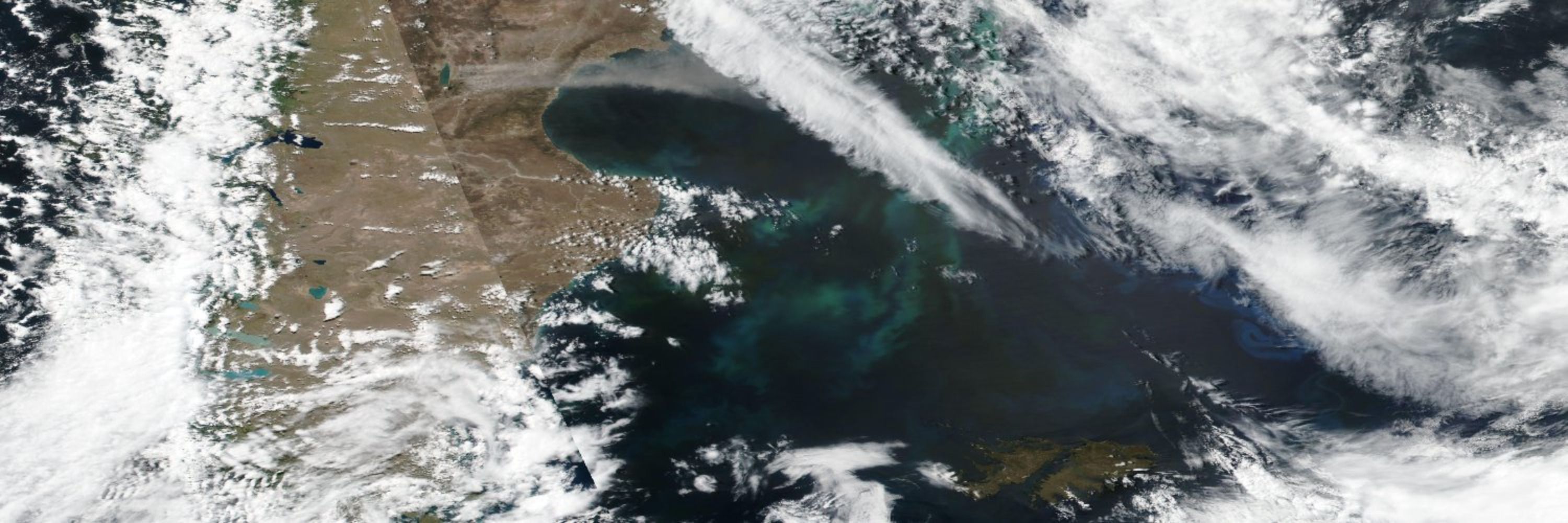
#highlatitudedust activity yesterday in the southern S. America. Dry lakes emit dust in concert, making an important contribution to the area given that it is so pristine that even small amounts make a different.
Strong winds bring dust even to Antarctica and well into the Southern Ocean.
Reposted by Santiago Gassó
Reposted by Santiago Gassó



Volcanic activity in Saunders and Zadovoski Is in the S. Atlantic.
This is minor activity & plumes do not have enough buoyancy to get through the cloud deck. The activity is only apparent in the change in reflective properties in clouds, only visible in the near-IR channels.
#volcanotrack
Reposted by Peter Jacobs

A study that looks into airborne sources of nutrients in an ocean bloom.
It finds that deposition occurred 1 month prior to the bloom. This fact is probably one of the reasons why finding causality deposition-bloom is so difficult to demonstrate.
agupubs.onlinelibrary.wiley.com/doi/full/10....
Reposted by Santiago Gassó

Image taken by Sentinel-2 on Jan. 26, 2026.


I wish I had read this a week ago....
Reposted by Santiago Gassó

Reposted by Santiago Gassó
Reposted by Santiago Gassó



Intense fires in Patagonia continued all day generating a lot #smoke, onshore winds prevent the eastward discharge and thus enabling smoke buildup over the mainland.

Very thick #smoke this morning in northern Patagonia, highlights that fires have been raging through the night.


While we freeze here in this side of the continent, the other side has been experiencing constant fire (yellow) and #highlatitudedust (red) activity .
I second this request. I do not use FB.
alternatively maybe you can post here the direct link to FB? (assuming it is open to public)
Reposted by Santiago Gassó

Image taken by Sentinel-2 on Jan. 22, 2026.
Reposted by Santiago Gassó


SOLAS endorses PYROMAR, an ESA-funded project studying how wildfire aerosols affect marine biogeochemistry and ocean CO₂ sinks 🌊🔥
Focus regions: Arctic Ocean, Californian upwelling & South Atlantic.
🔗 bit.ly/49wI7Q4
🌐 pyromar-project.com
Reposted by Peter Jacobs

A nice application combining 🛰️(TROPOMI) and global modeling to learn more about #isoprene, very important organic gas released by plants and used as a tracer to better understand biological atmospheric-land interactions .
#atmoschem
pubs.acs.org/doi/10.1021/...


A common feature seen in the lee of cyclones, here in the north Pacific, it looks like there is a thick haze.
Most likely it is not. It is just high reflective foam (because the high winds).
It difficult to differentiate whether foam or aerosol just by using visible images like this one.


Survey of marine #aerosols as seen by lidar and photometer
Interesting comments and finding on what we regularly call "prestine marine conditions" , the vertical structure of background aerosols is a bit more complicated than normally assumed.
amt.copernicus.org/articles/19/...


Interesting, big picture of research productivity from the view research paper productivity, time lines and country and region comparisons.
Attaching abstract.

An international #aerosol training school, cover from lab to remote sensing aerosol detection.
atmosphere.ugr.es/about/presen...

